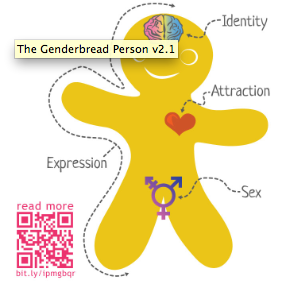
Sam Killermann’s Genderbread Person
On April 29, B.C.’s Maple Ridge-Mission MLA voted against allowing people to change their gender designation on their birth certificate if they haven’t had gender reassignment surgery.
Bill 17 was first introduced March 10. Maple Ridge-Mission MLA Marc Dalton voted against Section 115, saying, “My concern is it might lead to more self-acceptance issues with young people.” In the past, Dalton has called homosexuality a moral issue, like pornography, adultery, gambling and abortion as well as promoting a church that aims to cure homosexuality in the legislature.
Perhaps Dalton should read GLAAD’s tips for allies of transgender people: “It wouldn’t be appropriate to ask a non-transgender person about the appearance or status of their genitalia, so it isn’t appropriate to ask a transgender person that question either.”
Gender and sex can be independent from each other. As the World Health Organization explains, “sex” refers to a person’s biological and physiological characteristics, where “gender” is about socially constructed roles; what a society sees as masculine or feminine behaviours. Things like sexual orientation are not dependent on an individual’s gender; a transgender person, for instance, is not automatically gay.
Dalton doesn’t get it, and probably never will. Gender, like sexual orientation, is not a choice. As teacher and staff liaison for the gay-straight alliance at Thomas Haney Secondary, Kathryn Ferguson, says: “Thank you, Mr. Dalton, for reminding me why we do need gay-straight alliance groups in the public school system.”
]]>
Rosalind Russell and Cary Grant in 'His Girl Friday'. Newsrooms still have a long way to go toward achieving gender equity.
[Editor’s note: On a semi-regular basis, we survey a sample of recent back issues of This to analyze the topics we cover, how truly national our scope is, and the makeup of our contributor roster. See the last survey here.]
The new documentary Page One focuses on the state of journalism, its new technologies and decreasing revenues. And if you look closely, the trailer also reveals the struggling industry’s sweeping bias. The reporters and editors interviewed at the New York Times are mostly men (and they’re all white):
It’s old news that American print media is running a deficit on female contributors. Last year Elissa Strauss conducted a survey of major magazines in the U.S. The New Yorker had 27 percent female bylines. The Atlantic, 26 percent. Harper’s Magazine, 21 percent. And that’s just to name a few. You can view a more extensive list by VIDA here. And last February, CBC Radio followed up on the story, interviewing Canadian magazine editors about the same problem north of the border.
So when my editor asked me to survey a year’s worth of This magazines, I jumped at the chance to uncover our biases. Where did our stories take place? What topics did we write about? How many of our writers, and their sources, were female versus male? The results surprised me.
Methodology
My survey may not be 100 percent replicable at home. You can view the whole spreadsheet on Google Docs here, or download it as a CSV file. And you can check out the previous year’s stats (which tracked geography and topics, but didn’t track gender).
I kept track of every article that had a byline. I assigned each of these a location (e.g. Vancouver) and a general topic (e.g. environment). I also noted each contributor’s name and gender*. Then I took note of every person who was quoted. I chose to do this because a direct quote conveys the person’s voice to the reader. I also took note of each source’s gender. Quoted sources are very often referred to as “him” or “her” in an article. When they weren’t, I asked the writer or Googled names to find out.
As I surveyed the first magazine, an unexpected trend emerged. There seemed to be far more male sources than female sources. So I retraced my steps and added each source’s profession, title or expertise. I kept it up, hoping this would give me more insight if the trend continued.
Results
We haven’t changed much since last year in terms of geographic distribution. Ontario, particularly Toronto, appeared frequently (though we haven’t determined yet whether it’s disproportionate to Canada’s population). British Columbia, with particular emphasis on Vancouver, was a close second. This year it was the Yukon, Nunavut and PEI that went unmentioned (last year, it was New Brunswick that was non-existent between our purportedly national pages).
When it comes to our favourite topic, the environment is still number one. We also love technology and politics, as per the usual. Freelancers take note: we didn’t have nearly as many stories about racism or homophobia in this sample as we do about women’s rights. Transphobia was invisible between our pages.
This Magazine is a lefty indie not-for-profit with a male editor and female publisher, and our bylines are also pretty egalitarian: 53 percent of bylines over the year were female (76 out of 142). Compared to the male byline bias in the mainstream media, This Magazine constitutes a fair counterpoint.
However, when it comes to sources we’re not doing so well. Only 72 out of 256 sources quoted were female. That’s 28 percent. Suddenly we look a whole lot like those other magazines I mentioned. Are our writers biased, or are the numbers reflective of the status of women?
Both. Male writers were less likely to quote female sources (22 percent of sources quoted in their articles were female). By contrast, sources quoted by women were 33 percent female. This disparity suggests that credible, accessible, female sources exist—but men aren’t quoting them. Another factor could be that men tended to write more for our technology issue (13 out of 23 bylines), which acknowledged a lack of women experts in the field. Conversely the most female bylines (17 out of 23) could be found in “Voting Reform is a Feminist Issue.”
If our journalists are quoting people of the same gender as themselves and over half our bylines are female, shouldn’t we have a more even split of sources? Sadly it doesn’t appear that personal bias plays a strong enough role to account for the disparity. I have to conclude that the lack of females quoted reflects the status of women in society.
Think about it. Journalists quote people who hold positions of authority. As I read down the list of sources’ titles, I can say pretty confidently that our reporters interviewed the right people. Some of their sources are politicians, CEOs, judges, police officers, people of high military rank. In Canada, these positions are occupied by men and women—but women are decidedly the minority in those cases. In 2007, according to the Status of Women in Canada, 35 percent of those employed in managerial positions were women. According to a one-week old worldwide survey by the new UN agency for women, 44 percent of Canadian judges are female. Only 18 percent of law enforcement workers are female, says a 2006 StatsCan report. According to StatsCan the Department of National Defense, only 15 percent of Canadian Military personnel were female. It’s no wonder that our feature on Canada’s involvement in Afghanistan quoted no female military sources, and that our reporters interviewed few females involved in law when researching our “Legalize Everything” issue.
Solutions
The best thing journalists can do to eradicate bias is to be aware of it, which is why we do this kind of analysis in the first place. Without this first step, we can’t ever hope to challenge our points of view. Acknowledging bias includes direct and indirect bias. The first type includes journalistic and editorial perspectives. The second type includes structures that perpetuate the unequal status of women, such as advertising bias, media ownership, and hiring practices in the wider world. So although it’s a great start, seeking out female sources in law enforcement, engineering, politics and technology is not going to cure the gender gap. Those in positions of power must attempt to correct gender, race, sexual orientation and class biases when they hire and promote workers. Voting reform would help, too.
Don’t lose heart — there are also positive signs in the numbers. The equality of male-to-female bylines and the greater female tendency to write without using as many direct quotes (often considered a sign of reportorial confidence among journalists) challenges Strauss’ guess that women may be meek or passionless about politics and critical journalism. For a magazine with the slogan “everything is political,” this is simply not true. It could, however, still be correct for the magazines Strauss surveyed. After reading a year’s worth of This, I can safely say our writers (female and male) are unapologetically critical in their approach — and nowhere near shy.
We want to do better in terms of bias, and we welcome any and all suggestions on how to improve our coverage of underrepresented topics, locations and communities.
*I don’t believe gender is necessarily fixed, but it certainly has a binary status in our language. Whether the sources actually identified as one of two genders or not, our magazine certainly identified them as male or female; no articles used “s/he” or mentioned any other gender. Due to the superficiality and time constraints of this survey, it’s not possible to tackle the language problem right now. However, I would love to hear your thoughts on how this might be possible in the future. Email [email protected].

Compiled by Dylan C. Robertson & Victoria Salvas
This election means death. Not only have Ottawa scrums, filibusters, and drawn-out committees been killed, pieces of legislation making their way through parliament have all met a harsh end as politicians take to the campaign trail.
Before a bill becomes law, it is introduced in either the House of Commons or the Senate. Subsequently the bill goes through readings where it is introduced, given a number code and debated. It can be read again, amended then passed, from the House to the Senate but only becomes law if it is given Royal Assent by the Governor General.
But bills are stopped in their tracks when an election is called. We tracked down the people who pioneered five of the most important bills that died on the order paper when the writ dropped. We asked what they thought of the abrupt death of their projects and if they’ll attempt rebooting them.
While government bills (titled C- with a number under 201) can be reintroduced at an advanced phase with the consent of the House, private members’s bills and motions are entered in a lottery to determine their Order of Precedence, meaning the order in which they can be re-introduced. Only 30 members per session have their motions considered, although the list is replenished if all motions are dealt with.
Here’s a look at the five bills that may or may not rise again:
1. Cheaper HIV Drugs:
Bill C-393, An Act to amend the Patent Act (drugs for international humanitarian purposes), was introduced by then NDP MP Judy Wasylycia-Leis in May 2009. After she left to run for mayor of Winnipeg, the bill was adopted by another NDP MP, Paul Dewar.
The bill, which came to be known as “the AIDS drug bill” would’ve allowed generic drug makers to supply their products to developing countries, so they could fight diseases like tuberculosis and malaria, and help the world’s 15 million AIDS victims. Apotex Inc. had promised to make much-needed antiretrovirals for children, should the legislaiton pass. The bill, which was passed earlier this month by the House of Commons, was sabotaged by its review committee and then by the Conservatives’s attempt to effectively whip the senate, feeling it would hinder Big Pharma.
“It’s pretty outrageous,” said Richard Elliott, executive director of the Canadian HIV/AIDS Legal Network. “This bill had a lot of potential, and we pushed really hard to get it to pass. We had a lot of support from MPs in all parties.”
Dewar said he plans to reintroduce the bill. “We have to abolish the senate though, first,” he laughed. “That’s my plan. Well I’m just joking… but not really.” Dewar noted the bill was lucky to be successfully transferred after Wasylycia-Leis’s leave, as it is not an automatic process. “It was revived when actual co-operation broke out in the House of Commons,” he said. “Through unanimous consent, I was able to pick the bill up. “I’m ready, able, and willing to carry it forward after the election,” said Dewar, who hopes it ranks high in the order or precedence. “There’s so much public support for it. I don’t think they could get away with this again.”
2. Civilizing parliament:
Private Member’s Motion M-517 proposed a reform of Question Period. Conservative MP Michael Chong’s pet project aimed to civilize parliament’s most savage — and ironically unproductive — 45 minutes each sitting day.
The motion sought to strengthen how much discipline a speaker can give, lengthen the alloted time for each question and answer, and aimed at “examining the convention that the minister questioned need not respond.”
“Parliament needs to be reformed and I think the reform of parliament should begin with the reform of Question Period,” said Chong. If passed, the motion would have also stipulated who should be asked questions, most notably dedicating Wednesday exclusively for questions to the Prime Minister, and requiring ministers be present for two of the other four days. Chong noted that he was listed in the Order of Precedence for the first time in six years, and said he would re-table his motion in the rare chance he was listed for the next session. “I’m disappointed that the committee didn’t have a chance to deal with it before the election.”
Chong explained that while many members add motions and bills to the order paper solely to generate publicity for an issue, he fully intends to enact this reform. “I’ll continue to work on this issue through whatever mechanisms are available to me after the election,” said Chong. “Because this problem isn’t going away and I think Canadians want it to be addressed.”
3. Protecting trans rights:
Bill C-389, An Act to amend the Canadian Human Rights Act and the Criminal Code (gender identity and gender expression), was a private member’s bill sponsored by NDP MP Bill Siksay. Introduced in early 2009, the legislation would have make it illegal to discriminate based on gender identity, and aimed to protect transgender individuals by amending the Human Rights Act.
These amendments would have also been made to the Criminal Code, rendering these acts of discrimination hate crimes. The House passed the bill in February, against Stephen Harper’s wishes. However, the fact that it received “unanimous support from the Bloc, several Conservatives, and the Liberals bodes well for the next parliament” says Siksay. The MP is confident in the future of the bill; passing it again will demonstrate the governments’ “commitment to human rights.”
4. Improving First Nations’ water:
Bill S-11 Safe Drinking Water for First Nations Act, was introduced in May 2010 and would have developed federal regulations for governing water provision, disposal and quality standards in First Nations communities.
An issue that has received much attention recently is the issue of providing First Nations reserves with safe drinking water. An assessment from 2001-2001 found that three quarters of the drinking water systems in First Nations communities were at risk.
Despite the dire situation on many reserves, many First Nations leaders criticized the bill, feeling they were left out of the creating of the legislation and not offered funding to get it off the ground. The Assembly of First Nations felt that the bill presented lofty goals but sparse plans for financial investment and support, which in the long run, could leave reserves in worse condition.
5. Copyright reform:
Bill C-32, An Act to amend the Copyright Act, was the third attempt at copyright reform killed by an election call, dragging on a 14-year effort.
The bill sparked controversy for attempting to criminalize the use and promotion of software that circumvents digital locks, generating high-profile criticism, a minister’s comment that critics were “radical extremists,” and an indutry-led astroturfing campaign. But the bill also aimed at tackling online piracy, and making it legal to transfer music from CDs to iPods.
MP Tony Clement, who introduced the bill as Minister of Industry, told us he plans to reintroduce the bill if re-elected. “It’s just another example of important legislation that has now been discontinued because of the opposition parties passing a motion of non-confidence,” said Clement. “This is a very necessary piece of legislation to help regularize certain habits of consumers and also protect artists from wealth-destroying pirates. “I’m hoping that if we get a majority government, we can actually concentrate on the issues like C-32 and privacy protection and other aspects of the digital economy.”
]]> Best Canadian Essays 2010, the second annual collection of its kind from Tightrope Books, again includes a feature article that originally appeared in This Magazine. The collection includes Paul Gallant’s essay on the state of Canada’s gay rights movement in the wake of same-sex marriage legalization, “Over the rainbow“, from our September-October 2009 issue. Sounds like there are many other great pieces to read in the collection, judging by the rundown on co-editor Alex Boyd’s blog, including:
Katherine Ashenburg on cosmetic surgery, Ira Basen on citizen journalism, Will Braun on the tendency to customize Christ, Tyee Bridge on the power of fiction, Abou Farman on the Iranian Revolution, Paul Gallant on future of gay activism,Lisa Gregoire on life in Nunavut, Danielle Groen explores the brain when in love, Elizabeth Hay on the summer of her last poems, Jason McBride prepares for the end of the world, Carolyn Morris on people forced to live underground in Canada, Katharine Sandiford on the longest dogsled race in North America, Andrew Steinmetz on his family history and the Second World War, Timothy Taylor on a Spanish pilgrimage route, Chris Turner on the prodigal Alberta band, Nora Underwood on the future of farming and food.
Carolyn Morris’s excellent essay is reprinted from Toronto Life, but she also wrote about undocumented migrants needing health care in Canada in our March-April 2009 issue, if you’re looking for a bit of further reading. You also might be interested in reading Alison Lee’s “The New Face of Porn,” about feminism and pornography, from our November-December 2008 issue, which appeared in the 2009 Best Canadian Essays collection.
]]>
Scottish Flag and Rainbow Flag, together at last
I’m back in Scotland this month, for my first trip home since Christmas. Coming home is always incredible — a constant onslaught of the long-lost familiar — but being back also reminds me of some of the reasons I left in the first place.
I could give you a few of those, but lurking behind them all was a general sense of being at odds with my own country. Britain is not a place I’ve ever felt particularly safe as a queer, non gender-conforming person.
I don’t know how valid this discomfort is, or how much of it now is down to reverse culture shock, but it’s certainly true that I stick out here. People do a double-take when I walk into public washrooms. All of my gay friends have experienced street harassment of some kind, some of it vicious: an acquaintance was attacked last year by a man who followed her into a gay bar. Some of it merely irritating: for years I cut my own hair at home because I despaired of finding a hairdresser who would cut it short enough without hesitation and hand-wringing. In Toronto nobody looks twice at me, nobody yells at me in the street, and my hairdresser is queer.
Two years ago when I was a reviewer at the Edinburgh Fringe, I saw a stage adaptation of Stonewall, in which almost every straight person in the audience walked out, one by one. They’d obviously come looking for a bit of camp humour, but when it became obvious the transsexual character had lines and wasn’t just there to don fabulous outfits and sing, the uncomfortable fidgeting began. The same summer, I gave three stars to a Glaswegian comedian who afterwards accused me of being a lesbian with no sense of humour because I mentioned on my blog that his act was homophobic.
There is some less anecdotal evidence to support my sense that queers in Britain are worse off than those in Canada. In the news last weekend — buried behind five pages of Swine Flu — was a lesbian couple who have had to fight in the courts for access to National Health Service funding for in-vitro fertilization. Their fight has not been with the health service itself, but with their “regional primary care trust,” the body given the final say on matters of access to funding. Which GP you visit in Britain is determined by postal code, so simply switching doctors isn’t an option.
This story is interesting, because a few weeks ago while researching a story on transphobia in Britain I discovered that this same postcode lottery also means that transgendered people in some areas were being refused NHS funding for hormones and gender reassignment surgery.
This system is not all that different from the variation in treatments between Canadian provinces — gender reassignment is covered, for instance, in Ontario but not in Alberta — but I suspect the difference between ten provinces in Canada and 152 primary care trusts in Britain makes Britain’s a less visible problem. It’s entirely possible that you wouldn’t discover, say, that the Oxfordshire primary care trust routinely refuses to fund gender reassignment until you actually tried to access it.
Meanwhile, the Isle of Lewis just held its first civil partnership ceremony, six years after civil partnerships were introduced for same-sex couples in Britain. Reports in the press of a reluctant local registrar and the council’s tight-lipped promise to fulfill its “legal obligation” to carry out the service sounds like something from another era.
So as fantastic as it is to be home, I’m always a bit relieved to head back to Canada. Because increasingly I feel integrated there in a way that I never did in Scotland. And Toronto — for all that I am still bewildered by the traffic and I can only remember the names of five provinces at a time — feels safer and friendlier.
 Cate Simpson is a freelance journalist and reviews and web editor for Shameless magazine. She lives in Toronto.