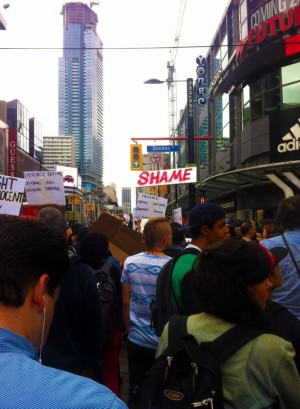
 Dundas Square, at 5:10 p.m., hundreds of protesters marched, outraged. Voices crying, “Shame!” Signs questioning, “Who will protect us from our protectors?” Bodies wearing office clothes, casual clothing, work out gear. Megaphones amplify chants, drums create unison, bagpipes mourn. Minds on Sammy Yatim, the 18-year-old boy fatally shot by police last Saturday.He never made it to meet his friend at their shared apartment, and never logged on for a Skype date with another. Instead he was pronounced dead at St. Michael’s Hospital.“In my mind it seemed like it couldn’t have been more than a couple minutes between the time when police arrived and the end of the situation,” witness Jeremy Ing tells Global News.
Amateur videos posted on YouTube and security tape footage show several officers surround the front door of a streetcar, stopped at a corner, near Victoria’s Spa and Rehabilitation Centre. Passerby Markus Grupp began filming just a few minutes past midnight. The shadowed figure of one officer in particular is especially chilling: his arms unwavering, gun raised and pointed at the doorway, where a person stands. They shout to drop the knife, the figure shouts back calling them pussies. “If you take one step in this direction with that foot …[inaudible] die,” shouts an officer. The figure moves slightly, met with three bullets, followed seconds after by at least six more. The body falls, and is seen to be Tasered.
Const. James Forcillo, who fatally shot Yatim, is a six-year veteran from 14 Division. He has been suspended with pay. The SIU is investigating, assigning six investigators and two forensic investigators. The unit has not yet interviewed Forcillo, whose lawyer says is “devastated.” As National Post columnist Christie Blatchford quotes activist Bromley Armstrong in her thoughts of the tragedy: “If I should beat my wife, you don’t ask my cousins to investigate.” Here, Blatchford is using these words to illustrate how police would investigate each other before the formation of the SIU. Post-SIU, however, the mistrust remains, this isn’t the first time someone who needed help was killed by police instead.
Hundreds participated in the protest Monday evening. It started at Dundas Square and led to the spot Yatim was killed, Dundas West and Bellwoods Avenue. A brief and heated stop was made outside a local police station. Yatim’s mother and sister were in attendance and requested the march move forward. Later, event coordinators wrote on the Facebook page Sammy’s Fight Back for Justice, “we are not here to terrorize the O.P.D that is not our mission. We are only here to fight for Sammy’s Justice and hopefully have stronger laws correlated to prevent this from happening to anyone else.”

Toronto police chief Bill Blair said at a Monday press conference that he understands the public’s concern, “The public also has a right to demand that the Toronto Police Service examine the conduct of its officers and to ensure that its training and procedures are both appropriate and followed. This will be done.” The same day, city councillor and TTC chair Karen Stintz wrote on her website, “Speaking as an elected official, and as a parent, I was disturbed.”
Witnesses reported seeing Yatim holding his penis and a knife, up to three inches long. “He did not seem mentally present,” says passenger Ing. The 505 driver evacuated the streetcar’s passengers, Yatim was left on alone and police were called. It was right they were called, but the officers did not do what they were trained to. According to The National Use-of-Force Framework for Police Officers in Canada, lethal force is to be used in response to “Grievous bodily harm or death.” The videos show Yatim standing, moving slightly, then being shot at least nine times. He was not Tasered first, but after. There was no attempt shown at negotiating. The Toronto Star collected instances where police have disarmed people with knives, without any fatalities, or even guns being raised in some. “He was cornered on an empty streetcar,” tweeted city councillor Janet Davis, who also questioned where the Mobile Crisis Intervention Team (MCIT) was. The Toronto Police website says, “As a second responder, the MCIT will answer calls, along with the primary response unit, that will ensure the client in crisis and those close to them are safe.”
Michael Eligon died on my street- he didn’t need to. Either did 18 yr old Sammy Yatim. He was cornered on an empty streetcar! #MCIT #topoli
— Janet Davis (@Janet_Davis) July 28, 2013
It isn’t known for sure whether or not Yatim was suffering mentally, there wasn’t a chance to find out. He wasn’t given the chance. The 18-year-old recently graduated from an all-boy Catholic school, Brebeuf College School on Steeles Avenue East. He planned on studying healthcare management at George Brown College in September. He and his sister, Sarah, moved to Toronto from Aleppo, Syria five years ago. They lived with their father after their parents’ divorce. His mother and extended family stayed in his home nation. Yatim’s uncle, Mejad “Jim” Yatim told The Star, “Sammy used to spend the summers with his mom in Syria until the situation became so dangerous.” Canada was supposed to be safer. The bereaved uncle adds, Yatim fit in with his friends by wearing hoodies and “pants lower than his father (Nabil) would stomach.” Nabil, who returned home early from a business trip after hearing the news, now says all he wants to do is bury his son.
After arguments of his pot use the teenager moved out of his father’s home in June. He and friend Nathan Schifitto moved to another friend’s place. Josh Ramoo and his seven-year-old son, Braden Scopie opened their doors to the teens. When Scopie talked to the Star, he told them he was sad, “He was my friend.”

Screen capture of The National Use-of-Force Framework for Police Officers in Canada
Yatim planned to move into his own place come September, but in the meantime renovated the room he shared with Schifitto, described by Ramoo as “a teenage dream room.” He searched for a job (his last was at a McDonald’s six months ago) and went with friends to help out on construction sites.
Joshua Videna was a friend of Yatim’s, “He seemed a little bit different, a little bit more stressed in life.” Videna says his friend would say, “I gotta get my life straight. I’m 18-years-old and pretty much not going anywhere.”
Sasha Maghami says she was Yatim’s best friend. When she left for a five-month trip to Australia on July 21, he asked her not to forget about him. Before she left, she says he seemed less talkative and playful.
He was a teenager.
A visitation for Yatim will be held today from 6 to 9 at Highland Funeral Home in Scarborough. His funeral will be tomorrow at 11. Facebook group Justice for Sammy invites people to attend the Toronto Police Services Board meeting Tuesday August 13 at 1:30.
]]>In Baker’s sort-of obituary it says, “In the wild sea lions live to about 10–in aquariums usually no more than 15.” So take that radicals demanding “the closure of all zoos and aquariums–denying children the opportunity to interact with amazing animals they would likely never see in the wild.”
“Let’s stop and think about [that he lived 29 years] for a moment. He lived twice the average lifespan. If a human did that he or she would have been a teenager when Canada became a nation, would have witnessed the first automobiles, been astonished at flight and journeys to the moon–not to mention the creation of the internet.”
This part of the statement reads a little weird. I think it may be addressing those that care about the animal abuse documented in a Toronto Star investigation that started a year ago. Those who care about the quality of the water the animals live in or an adequate staff amount, which was just fine in Baker’s case–he had “constant medical attention when he needed it.”
The OSPCA issued seven orders against the amusement park, but we can rest assured Baker’s death was not the park’s fault. Yes, a baby beluga named Skoot was killed by two older whales, a death that could have been protected had there been enough staff to help. Sure, maybe Kiska the killer whale’s tail has been bleeding on and off for months and the health of Smooshi the walrus is deteriorating (The animals’ former trainers are now being sued by the company for speaking out, so that takes care of that problem.) And there is reason to believe the park’s owner, John Holer, shot and killed the neighbour’s two Labrador retrievers. But this defensive statement is about Baker the sea lion; it has nothing to do about animal abuse allegations. Of course not.
]]>
Jessica McDiarmid.
Born and raised in British Columbia, Jessica McDiarmid knew from a young age that she wanted to write about tough subjects in difficult places. Around age 14, McDiarmid devoured Oakland Ross’s A Fire on the Mountains, a compilation of true-life stories about the extraordinary circumstances in which people live and thrive in 17 global hotspots, including El Salvador, Cuba, and Zambia. With the work of Canada’s most renowned foreign correspondents as inspiration, McDiarmid decided to take up a career in journalism.
Fast forward a decade, and McDiarmid is now competing directly with Ross for space in the world section of the Toronto Star, writing for the paper from Abidjan, Ivory Coast, about the ongoing standoff between former president Laurent Gbagbo and aspirant Alassane Outtara. She’s also covered Liberia’s lost generation of child soldiers and interviewed current presidential candidate Prince Johnson, a notorious warlord.
McDiarmid’s path to journalism was fairly direct. She took journalism at The University of King’s College in Halifax, graduating into the usual environment of unpaid internships, short-term contracts, and other piecemeal job opportunities. Unfazed, McDiarmid worked for a variety of news organizations, including the Hamilton Spectator, before landing a job at the Canadian Press, where, among other things, she went to New Orleans to write about the aftermath of Hurricane Katrina.
That yen to write from overseas proved too strong to ignore, however, and the summer of 2010 saw McDiarmid embarking on a six-month internship at Accra’s Daily Guide, co-ordinated by Toronto media development organization Journalists for Human Rights. With her internship over, she is now combining media development work with her own freelance journalism. And she’s not afraid of using her power as a writer to advocate for causes she believes in. “The best way to promote justice in the world is not just to take stories of Africa back to Canada, but to help empower journalists there to tell those stories to their own nations,” she says. Amen, sister.
 On Monday, the Toronto Star reported on two Ontario judges who opened an investigation after noticing slumping jury attendance rates — at times reaching as little as 50 percent.
The article goes in depth, examining jury absence rates and penalties by province. Only three of the provinces and territories track jury attendance, but those who do have relatively low penalties.
There are many reasons to avoid jury duty: it’s long, often unpleasant, and “sucks so bad.” The internet is abound with suggestions on how to get out of jury duty, with everything from feigning racism to being gay. Even if you do serve on a jury, you could cause a mistrial by being “dumb”.
In Canada, it is a civic duty to respond to a jury summons, either by showing up for the jury selection panel or providing a sufficient reason not to partake as a juror.
While some of the commentators on the Star article gladly participated in a lawyer hate-on, many spoke out about the very real barriers to participating as a juror.
Employers are legally obligated to grant employees leave for jury duty. Although jury duty remuneration vary by country and jurisdiction — in Phoenix you get free wi-fi, in L.A., free art gallery admission — it’s almost universal that employers have no requirement to pay salaries while you do your civic duty.
If approved at a jury panel, jurors in Ontario aren’t compensated until after 10 days of service (day 11 to 49: $40.00 per day, day 50 onwards: $100.00). This scheme is replicated across the country. In our (maybe post-)recession economy, many have less job security. With little to no stipend for lost work days, especially for the rising number of self-employed and those in precarious work, it’s no wonder many opt out.
There’s also the issue of transportation. When called to jury, citizens in most provinces have to get to the trial — or a jury panel, where they might be declined — on their own dime. A daily travel expense is issued to those approved for jury service living outside the city where the courthouse is.
As the Ontario government says, “parking facilities vary from courthouse to courthouse, and public transportation is strongly recommended if available. If you attend the courthouse as a member of the jury panel, you will be responsible for paying your own parking fees.” Nice.
While justice systems make allowances for certain hardships — medical conditions, school, vacations — being among the working poor isn’t one of them. In Ontario, there is no allowance issued for childcare expenses, so if you have to take time off from your minimum-wage hourly-paid job to attend jury duty, you’re left holding the bag for daycare or babysitting costs, without any income to offset it. The increasing number of people in that situation literally cannot afford to serve on a jury.
What results is a socially unrepresentative pool of potential jurors who are likely to be more economically privileged than the defendants they sit in judgment on. Much research has been published on jury biases based on economic background.
It’s reasonable to hypothesize that socio-economic status shapes verdicts. A jury’s perspective is shaped by the jurors themselves. If only those of a certain class or salary are able to afford the luxury of jury duty, they will deliberate on a very specific set of principles—especially in cases where poverty or race is involved.
Justice is costly. Fair trials require time, professionals, and lots of documentation. But just as underpaying prosecutors threatens the pursuit of justice, perpetuating barriers to jury duty compromises the integrity of a fair trial.
]]>
Shell Canada’s operations in Alberta’s oil sands are clean and green, and simply the victim of nasty rumours spread by environmentalists trying to tar the company’s reputation. That is, if you believe the “six-week Canwest special information feature on climate change, in partnership with Shell Canada.”
Canada’s largest media company teamed up with the oil giant to produce a series of features that showcase how Shell is tackling energy challenges and environmental responsibility. The full-page, feel-good features ran in six Canwest dailies—the National Post, Montreal Gazette, Ottawa Citizen, Calgary Herald, Edmonton Journal and Vancouver Sun—six Saturdays in a row in January and February 2010. The six-part series also appeared in the Toronto Star as a pullout section.
The series profiles friendly Shell employees who share what motivates them to work in Alberta’s oil sands—Canwest style is to avoid the use of “tar sands”—otherwise known as one of the world’s largest and most destructive industrial projects. There’s the climate change expert (a goateed grandpa clutching walking sticks), the chemist (a longhaired family man who dabbles in acting) and the environmental management systems coordinator (a young woman in a Cowichan sweater who spent countless hours as a child flipping through National Geographic). The features include “myth busters” to clear up so-called misconceptions like the idea that Shell’s oil sands production is too energy-intensive, pollutes the Athabasca River and results in “dirty oil,” among other allegedly tarnishing falsehoods. The only myth, however, is that these features are editorial content. The fact is, they’re paid advertisements for Shell.
While advertorials designed to look like newspaper stories are common, they are usually clearly identified as advertisements as urged by regulatory groups like Advertising Standards Canada. This is essential so readers don’t think the material is subject to the same standards and ethics of journalistic stories: accuracy, objectivity, impartiality, fairness and accountability.
Nowhere did the word “advertorial” or “advertising” appear on the Shell ads. Rather, “Canwest special information feature on climate change, in partnership with Shell Canada” was inked across the top of the page, suggesting an editorial partnership between Canwest and Shell, a major newsmaker. Seasoned journalist and outgoing chair of the Ryerson School of Journalism Paul Knox says the wording is euphemistic. “You’re either trying to disguise the advertorials as editorial content or you’re not,” says Knox. “And if you’re not trying to disguise them, what’s to be lost by being reasonably explicit about the terms?”
When asked this question, Canwest director of communications Phyllise Gelfand said: “We feel very strongly that the language was clear enough and that readers will appreciate it.” However, when asked to elaborate on what the language means, she said: “I’m not going to go into semantics with you.”
Gelfand pointed out the information features were presented in a different font, layout and style than the papers’ editorial content. However, the ads ran during the lead-up to the Olympics and during the Games, when many papers were using different layouts. Lifestyle spreads (fashion and homes, for example) also often take more colourful and creative layouts, not unlike the Shell ads. (In the Star, the pullout section was printed on a differently coloured paper.)
Advertorials are often distinguished from editorial copy by not placing a byline on the piece. But in this case, Alberta-based freelancers and Canwest contributors Brian Burton and Shannon Sutherland were credited. Both Burton and Sutherland have covered Shell and the oil industry for Canwest. Burton has 20 years of experience in corporate communications for leading energy corporations, according to his LinkedIn profile, which also states his goal: “to advocate successfully for my clients in the court of public opinion.” For Sutherland’s part, her bio on one magazine site says when she’s not “interrogating industrialists” she’s hanging out with her kids.

Click to enlarge
The advertorials also appeared on Canwest papers’ websites—on homepages as top stories and in the news section, with URLs that looked like those of any other news story. Just like regular news, readers could comment on the “stories.” Canwest refused to respond to allegations the campaign included seeded comments, meaning a slew of positive comments about Shell were posted and negative ones deleted in an effort to further sway public opinion. “I am not aware of this,” said Shell spokesperson Ed Greenberg. “I know you appreciate that anyone, whether or not they work for Shell, is entitled to read any newspaper or magazine they want and form their own opinions from what they read.”
When Sierra Club Executive Director John Bennett spotted the features in the Ottawa Citizen, the former newspaper reporter and ad sales rep was shocked by the one-sided nature of the information. “I could not tell they were ads,” Bennett says. “They looked and read like editorial content.” He only learned the features were ads when he contacted the publisher of the Citizen to complain about the unbalanced coverage. The nonprofit environmental advocacy organization promptly filed a complaint with Advertising Standards Canada. However, because Sierra Club went public by issuing a news release, ASC did not accept the complaint: it’s against the rules for special interest groups to generate publicity for their cause through the complaint process. Sierra Club also filed a complaint with the Ontario Press Council, which has not yet adjudicated the matter. The council’s advertising policy states ads that look like ordinary news stories should be clearly labelled as advertising.
Despite dismissing the complaint, ASC Vice-President of Standards Janet Feasby says advertising designed to look like news stories is of growing concern and ASC will be publishing an advisory on the subject to bring the issue to the attention of advertisers, media, and the public. Feasby points to a recent precedent decision, in which the ASC found a “special information supplement” in a newspaper that extolled the virtues of Neuragen, a homeopathic product, was presented in a manner that concealed the advertiser’s commercial intent. “It was clear to council that it was advertising, not information.” Like the Shell features, an ad for the company was included at the bottom of the page.
ASC can force advertisers and publications to remove ads, but often it’s too late: the ads have already run and the damage has been done. The only loser is the reader, who may have read and wrongly interpreted the ad as a news story. Papers that blur the line between advertorial and news content risk their credibility and their relationship with their audience. “The problem with these advertorial exercises is they muddy the waters and you’re placing obstacles in the way of a reader who’s trying to figure out, ‘What is my interest here, and what’s behind what I’m being told?’” says Knox, who teaches media ethics at Ryerson. “It has the potential to undermine the trust that your audience has in you and that’s fatal.”
The seriousness of this matter is magnified when the subject of the advertorial is a controversial one, such as climate change. “[These ads] play on public complacency, they play on the public’s hopes that the environment is being protected,” explained the Sierra Club’s Bennett. “One of the reasons we have so much difficulty advancing the environmental agenda in the face of overwhelming public support is because people can’t imagine there are governments or companies not trying to do the best they can. When you get misleading advertising like this, you play to that inborn need for people to believe that things are being looked after.” You also play into the inborn need people have to trust the media to provide them with honest coverage.
While Shell insists it produced the features to clear up “misconceptions” about climate change and its environmental commitment, the company has a track record for producing misleading, greenwashed advertising. In 2008, the Advertising Standards Authority in the U.K. denounced a Shell newspaper ad that described tar sands projects as sustainable, saying it breached rules on substantiation, truthfulness, and environmental claims. A year earlier, the ASA found another Shell ad guilty of greenwashing—this one featuring refinery chimneys emitting flowers. Still, Shell defends its ads.
“We were getting feedback from Canadians that all they were seeing and hearing was one-sided information [about climate change], so [the feature campaign] was done to try to balance the discussion,” said Greenberg. “Don’t you think that’s fair?” Readers?
]]>If you’re a journalist and still brave enough to announce that fact on social occasions, you can be more or less assured what the next question will be. “Don’t you worry,” someone will always begin with a sheen of sympathy, “that journalism is dying?”
There are a range of responses from which to choose: pull out some far more dire stats about the future of the car industry, offer a lukewarm endorsement of the Huffington Post-model, or remain in denial and pretend to be distracted by an incoming plate of hors d’oeuvres. But if journalists are smart – and as glamour and riches fade away, intelligence may be one of our only remaining virtues – we will stop bristling about defending our professional worth and personal sanity to perfect strangers, and instead feel honoured that people still care enough to ask the big question: “Is the mainstream media dying?”
Which is why it’s great that the relatively new Canadian Centre for Investigative Reporting is getting together a discussion panel to ask that question, as well as the follow-up: “Can investigative reporting save it?” And then, perhaps the biggest question of all: “Should it?”
Bilbo Poynter, the executive director of the centre, admits these questions are more about creating provocation than seeking resolution. And there is no doubt that the CCIR has assembled a distinguished panel of journalists — including the evening’s moderator Gillian Findlay of the premier investigative program The Fifth Estate, John Cruikshank of the Toronto Star, and several other important voices in Canadian journalism.
Still, on first glance, the idea that investigative journalism will save the mainstream media looks like a tough case to make indeed. As investigative reporting budgets are among the first things to go at most newspapers and magazines, muckracking looks more like a gangrenous limb on the sick old man that is mainstream journalism. Investigative journalism is great, most editors agree, but it is also slow, expensive and not always guaranteed to produce racy — or any – results. Hardly a winning combination in the fast-moving, commentary-heavy blogosphere.
Yet when journalist stop quipping long enough to let those awkward cocktail party conversations continue, it becomes clear that what people fear most about losing with the death of journalism looks very much like the work of investigative reporters: protecting the underdog, uncovering corporate malfeasance, and holding democracy to account. Will investigative reporting save journalism? I’ll let the panel convince you of that or not. But the really compelling question is a variation on the CCIR’s third question: Without investigative reporting, does journalism deserve to survive? It is a question without an easy answer. And as any investigative journalist will tell you, those are the best kind.
The panel takes place Wednesday, Aug. 5 at 6:30 p.m. at the NFB Mediatheque. 150 John St, at Richmond, in Toronto. Admission is a donation.
For more information call 905-525-4555 or e-mail [email protected]
]]>
It’s a week before election day, and the York Event Theatre in Toronto is filled with middle-aged New Democrats waxing nostalgic and rocking out to protest songs from the ’60s. The theatre is a sea of orange and green signs, carried by candidates and campaigners. There’s a contagious air of excitement as the crowd anxiously awaits the arrival of Jack Layton, the man who in a little more than a year has pulled the New Democratic Party from oblivion. A Toronto Star poll released the day before showed NDP public support at 20 percent nationally and 26 percent in Ontario—highs not seen since the party’s glory days in the late ’80s.
In a nod to the past, Ed Broadbent, 68, who led the NDP from 1975 to 1989, takes the stage to introduce Layton: “It is my pleasure to bring you the greatest political leader of our time: Jack Layton!” That’s quite the compliment coming from a man who claimed in an online spoof during the campaign that he was once more popular than Pierre Trudeau. Layton is the first Ontario-based NDP leader since Broadbent, and both share a love of academia: before sliding onto the political scene, Broadbent taught at York University, and Layton taught at three universities, including the University of Toronto. The crowd erupts into thunderous applause as Layton winds his way to the stage surrounded by camera crews and reporters, energized by the upbeat rhythm of the party’s theme song “Bring All the People Together,” a remix of the Parachute Club’s gay rights anthem “Rise Up.” Layton takes the stage with his wife and fellow federal candidate, Olivia Chow, on one side, Broadbent on the other, and dozens of the party’s Toronto-area candidates behind him, and declares: “We’re going to paint the town orange!”
An ambitious goal; some said too ambitious after the votes had been tallied just seven days later—the predicted “orange wave” across Toronto having dwindled to a lone orange island (Layton) in a sea of red. Layton had predicted 43 seats and an influential role in Parliament. In the weeks after the election, NDP officials claimed victory for doubling their popular vote, but to go from forecasting a role as the official opposition to winning just a few more seats than required for official party status has left many asking what happened. Layton’s charisma and mass appeal pulled the NDP out of oblivion, but ultimately Jack Fever, coupled with one of the slickest campaigns the party has ever delivered, just wasn’t enough to lure centrists, and even some scared lefties, away from the scandal-ridden Liberals and edge out the status quo.
Of course, it started out great. The NDP went into election mode soon after Layton, 54, was named leader in January 2003. Though he didn’t have a seat in the house, New Democrats knew they had a jewel in Layton; strategists now had to decide how to market him. “There’s no question that Jack Layton’s leadership was paramount to the momentum of the campaign,” says Brad Lavigne, the party’s director of communications. “We have more money because Jack is an exciting leader who people want to donate to. Everything flows from Jack.”
Thanks largely to donations generated from excitement about Layton, the NDP was able to spend twice as much on advertising in 2004 as it did in the 2000 federal election. The party was determined to increase its popular vote, which had slipped to 8.5 percent, and, more importantly, to increase its seat count, which, at the time, stood at 14. “Sitting in the corner being the conscience of Parliament was no longer an adequate goal,” Lavigne says. “We wanted a larger role and greater influence.”
In August 2003, the NDP hired Vancouver-based ad firm NOW Communications to handle the looming 2004 campaign. NOW is a progressive company that specializes in public-advocacy marketing. Paul Degenstein, the firm’s vice-president, managed the NDP file. Degenstein is no stranger to the party—he was a speechwriter for former NDP leader Audrey McLaughlin. (In 1992, a cartoon in Saturday Night magazine depicted him as the ventriloquist to McLaughlin’s dummy. He responded in the media by calling the cartoon “stupid and unethical.”) The firm has handled several provincial NDP campaigns, including recent runs in Nova Scotia and Manitoba. The Nova Scotia election saw the NDP gain five seats and retain its position as the official opposition. In Manitoba, NOW helped the party increase its majority and carry Premier Gary Doer to an easy re-election. Lavigne says the federal NDP watched the firm closely during the provincial campaigns: “They have a fantastic track record.”
Soon, NDP television spots began popping up where you least expected them: on prime time television. Once relegated to late, late night TV, NDP ads now played during the Academy Awards and Stanley Cup play-offs. The ads also infiltrated various community papers and radio stations, in multiple languages.
Despite the high-profile TV spots, marketing experts say the message was soft. Early ads touched briefly on issues like health care, cities, pensions and the environment, but didn’t focus on one point in particular. “If they’d given [voters] something to latch on to, they may have done better,” says Richard D. Johnson, chair of the department of marketing, business economics and law at the University of Alberta. Marketing specialist Martin Wales agrees. “They didn’t give me enough reason to vote for them—they didn’t present anything unique.”
However, the NDP was getting valuable screen time outside of the ads, as Layton began regularly making the evening news. “Layton has a skill for good soundbites—even without a seat he was in the national media for a year,” Wales observes.
The NDP hired a professional fundraiser and, in January, began mailing promotional packages to gear up for the expected spring election. The party targeted 100,000 NDP members and donors, and 200,000 addresses gleaned from progressive Canadian organizations. “The response was unprecedented for the NDP…. I would say we tripled our predictions,” marvels Diane Alexopoulos, the party’s fundraising coordinator. “We’ve surpassed our goals twice already—we have to keep drafting new plans.” She, too, attributes the sharp rise in support to excitement about Layton.
Coupling the NDP’s grassroots history with the growing power of the internet, the party borrowed a fundraising tactic from the American Democrats. Personal e-campaigns recruited NDP supporters—young, tech-savvy ones in particular—to run their own electronic fundraising campaigns on behalf of the party. Campaigners used their personal address books, and set fundraising goals for themselves. The average goal was $1,000. The initiative attracted 500 personal e-campaigners and raised almost $10,000. “The NDP did a good job of using the internet,” Wales remarks. He credits the party with innovative initiatives to lure people to their sites, pointing to Broadbent’s satirical online video in particular. “I think [the video] did do a number of good things, primarily introducing the internet to the election process,” he says.
In another attempt to attract younger voters, the NDP staged concerts like the Toronto event “Let’s Jack it Up,” hosted by Layton and Barenaked Ladies’ singer Steven Page. The event featured indie rock bands popular with the young folks like The Sadies and the Constantines. Lavigne says the artists themselves approached the NDP with the idea. “The artists come out and say, ‘We play for these people day in and day out and they’re hungry to hear a leader talk about how to make their country great,’” he says. “Let’s Jack it Up” played to a sellout crowd of over 2,000.
Jim Laxer, a York University political science professor and former NDP research director, attributes part of Layton’s youth appeal to his progressive platform. “It’s a very positive agenda that could actually speak to younger voters.” He notes that past NDP platforms have focused more on defending existing social programs, an appeal that targets older voters. “Let’s face it—Jack Layton is the first [NDP] leader to be able to speak at universities to a packed room in a long time,” Laxer says.
Perhaps the strangest example of the party’s cross-generational appeal came from a New Democrat with a cult celebrity status of his own. Ed Broadbent’s decision to join Layton’s team and return to politics after stepping down as leader in 1989 stirred up nostalgia among older NDP supporters. Strategists played up Broadbent’s return through traditional campaign tools like flyers and public appearances. Then, in late spring, the party received a gift of sorts. TV show This Hour Has 22 Minutes produced a mock music video featuring Broadbent rapping: “I’m the one you all should know/ Once more popular than Trudeau … Float like a butterfly, sting like a bee/ It’s time for voting NDP.” The show decided not to run it, and the NDP jumped on the chance to adopt the video as its own. “When we saw it, we realized its great potential to attract young people to the website,” Lavigne explains. “It was very successful—it went viral.” The video never ran as a television ad, but it received plenty of news coverage, drawing people to the NDP website where they could download and play the video. Its self-deprecating humour was a welcome step away from the perception that the party takes itself too seriously. “The NDP has a certain air of puritanism and self-righteousness,” Laxer notes. “Anything self-deprecating sounds good to me.”

It’s less than 60 hours before the polls open, and the waitresses at the Woolwich Arms pub in Guelph, Ontario, are saying it’s the busiest night they’ve witnessed. It’s just after midnight, and the pub is crammed beyond capacity with a crowd of 40- and 50-somethings who staked out a place at the Wooly in the early evening to ensure they’ll get to see Layton. Guelph is the final stop on today’s eight-city campaign trail. Layton’s NDP is near the height of its popularity. Today’s polls—the last before the election—place public support for the party at 17 percent, and even the most conservative pollsters are predicting 25 orange seats.
When the campaign bus arrives, two and a half hours late, more than 100 people are lining the grass outside. Layton exits the bus, again surrounded by camera crews and reporters, smiling and shaking hands. He makes his way through the cheering crowd into the pub’s small darts room. “The man, the legend,” one man remarks. “I shook his hand!” a flustered woman gasps, laughing like she’s just encountered a rock star.
Layton’s uncanny ability to draw people in, paired with tireless touring, helped give the NDP campaign a human face. Everywhere he went he spoke to packed rooms—that’s normal for larger parties, but for the NDP it was a surprising new development. The Toronto-Danforth all-candidates debate in a small community centre in Layton’s riding packed in several hundred residents, leaving at least 150 more outside in the rain, straining to catch the action on loudspeakers outside. (The all-candidates debate in Defence Minister Bill Graham’s neighboring Toronto-Centre riding drew just 40 people.) Layton’s relentless campaign schedule didn’t seem to bring him down—he always looked invigorated. “I’ve known Jack now for over 30 years, and he’s always had this tremendous energy,” says Laxer. “He’s an extra-human phenomenon.”
Even with Layton’s drive and appeal, the NDP just wasn’t equipped to fight in a new and unexpected battlefield. There are a few factors that can help explain—with the benefit of hindsight—the party’s reversal of fortune. The Liberal sponsorship scandal changed the dynamics of the campaign before it even officially started. After Christmas, the Liberals seemed untouchable. The NDP kicked off its TV campaign early in the year by taking aim at the Grits. After Adscam brought the Liberals down, and the united right suddenly became a huge player, the NDP shifted its focus to position itself as an alternative to the Conservatives. NDP TV spots began targeting both parties instead of focusing on just one, using catch phrases like “If you don’t trust the Liberals and you’re worried about the Conservatives’ hidden agenda, there is a positive choice.” Ken Wong, a marketing professor at Queen’s University, says this shift hurt the party. “I think that if they had stuck to their original message, which was anti-Liberal, instead of switching to anti-Conservative, they would have been more successful,” he says.
Laxer cites this “who to target” dilemma as a chronic thorn in the party’s side. “The biggest weakness of the campaign was the inability to figure out what to say to voters about the threat from the right,” Laxer says. He points to the NDP’s attempts to dismiss the Liberals as Conservatives in disguise as a huge mistake. In June, the party launched an Ontario-only TV ad that pegged Stephen Harper, Dalton McGuinty and Mike Harris together. “I would regard myself as someone on the left, but when they try to tell me that the Liberals and the Conservatives are the same, what’s left of my hair stands on end because I just don’t buy it.”
By June, Harper’s Conservatives had made enough public gaffes to effectively scare most moderate Canadians. As gay rights and abortion edged their way into the election spotlight, the Liberals pounced and positioned themselves as the social justice-loving, tree-hugging, progressive choice. On June 22, Paul Martin told British Columbia voters: “There are two parties that could form the next government. If you are thinking of voting NDP, I ask you to think about the implications of your vote. In a race as close as this, you may well help Stephen Harper become prime minister.” The Liberals were hijacking the NDP platform in a last-ditch attempt to save themselves. And it worked. Even when it didn’t make sense—in ridings where the Liberals stood no chance—many previous NDP supporters checked the Liberal box, ironically pushing the Conservatives ahead just enough to win in dozens of NDP/Conservative swing ridings across the country. Henry Jacek, a political science professor at McMaster University, points to Oshawa as a perfect example of counter-intuitive strategic voting. Just a few days before the election, the NDP candidate Sid Ryan was in the lead in this southern Ontario riding, followed by the Conservatives, with the Liberals a distant third. After Martin’s appeal to vote Liberal, voters pushed the Conservatives into the lead, with just enough progressives voting Liberal to put the NDP in second place. Lavigne attacks the logic behind strategic voting, claiming the randomness of the outcome takes all the strategy out of the act. “I call that voting for something bad to avoid something worse,” he says. “I don’t call that str
ategic at all. That’s the opposite of strategic.”
He says the party will keep grappling with how to address the problem of strategic voting, but he offers no insight into what exactly it will do. “Liberal scare tactics elected more Conservatives,” Lavigne contends. “We’ll continue to appeal to voters to not buy into the fear.”
The NDP also may have underestimated the Green Party threat—a party that came from obscurity to qualify for funding from Elections Canada. Jacek recommends that in the leadup to the next election the NDP attack the Greens. “I suspect Green Party voters are far to the left of the people running the Green Party. This is not a European-style Green Party,” he says. “The NDP largely ignored the Greens. In hindsight, perhaps that wasn’t wise. Even if they got half, or even one third of the Green Party votes, they’d have more seats.” Lavigne agrees. “We’d probably have another 10 to 20 seats had the Green Party vote not been at four percent nationally,” he says. “I think in the next election people will understand that the Green Party is not progressive—it’s a right-wing, regressive party…. I think with scrutiny and closer examination people will see the Green Party for what it really is.”
As the NDP prepares for the first sitting of the new government in October—just one seat away from giving the Liberals the balance of power—Layton’s role is still uncertain. But the next election may be sooner than anyone expects. And, for all Layton’s political experience, he’s still a rookie in Ottawa. Laxer notes that run-off elections, the type that occur soon after the election of a minority government, tend to treat third parties badly. But he’s optimistic that Layton will be able to buck this trend. He predicts the Parliament convening in October will be a progressive one, and if the NDP can take credit for its role in implementing popular new policies, the party just might be able to improve its showing next time around. “Jack has got to take credit for things,” Laxer says. “And—I’m saying this in the most complimentary way—Jack is pretty good at taking credit. As a political leader, you have to be.”
Lavigne says the party has no regrets. “I can’t think of any tool that we could have used that we didn’t,” he muses, noting that the NDP is already gearing up for the dropping of the writ. “The next election could be 12 to 24 months away. We’re going to take all the good things from this campaign and use them again. And, our guard is going to be up.”
Wong gives the NDP the nod for running the best marketing campaign, but he’s careful to point out that being a winner among losers is not much of a victory: “That doesn’t mean I think it’s done a good job. I think the other two parties have done a horrific job.” Johnson criticizes the Liberals and Conservatives for relying too heavily on attack ads, and credits the NDP for incorporating a positive message in its television appeal. “You don’t give people a fear message without a positive way to solve it,” Johnson says.
“When everyone looks like a loser, people tend to stick with the status quo, which looks like what happened here.”
]]>