We’ve got some exciting things happening at This, and we’d like your help. We’re currently on the hunt for Canadian stories from 2012 that the mainstream media might have missed, and we want to hear your ideas. Did something happen in your community that went largely undetected? Did someone you know do something really great and get no media coverage for it? Did something appalling go underreported? We want to know what you, the people who live and work all over this country, think deserves more coverage. We’re especially interested in stories from Manitoba, Saskatchewan, Nova Scotia, Prince Edward Island, and Newfoundland and Labrador.
We’re also looking for stories to watch in 2013: What do you think are the pressing issues that we need to keep on top of in the coming year? What can we not afford to ignore?
Please send all suggestions to [email protected]. While we can’t promise to include your idea, we can assure you that your opinion is valid and valued.
Thank-you for your contribution, and for continuing to read and support This!
]]>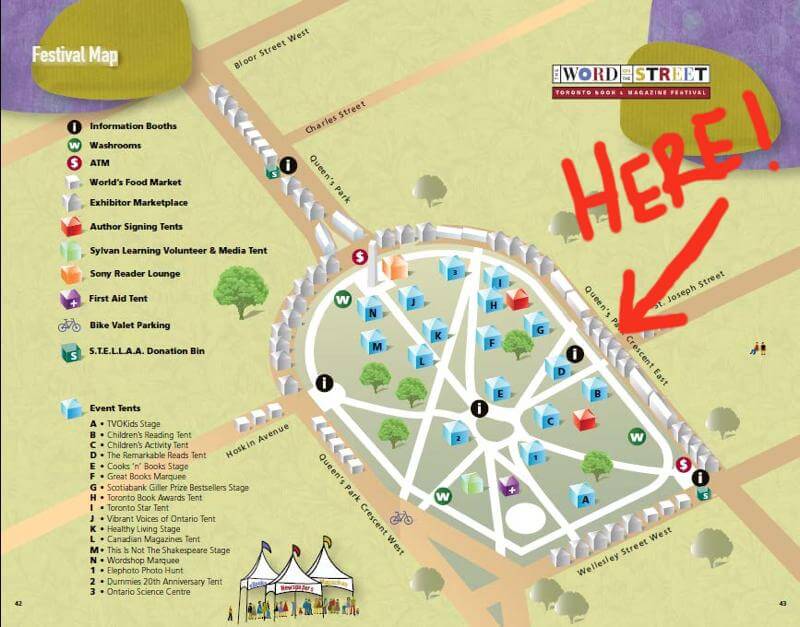
We’ll be offering WOTS-only discounts on subscriptions, back issues, and tote bags, and you can chat with some of our staff and volunteers. Come down and see us, along with the many other fine independent Canadian magazines that will be there. This year we’re also excited to be doing a talk — come see me and publisher Lisa Whttington-Hill chat and take questions about the joy of publishing a small magazine in the Canadian Magazines tent from 12:15 to 12:45. We’d love to meet you! Let’s cross our fingers for good weather, and hope to see you in the park on Sunday.
]]>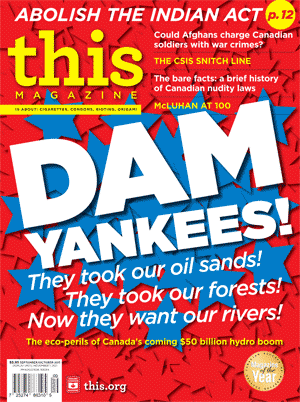 The September-October 2011 issue of This Magazine (that’s it on the left there!) is now in subscribers’ mailboxes (subscribers always get the magazine early, and you can too), and will be for sale on better newsstands coast-to-coast this week. Remember that you can subscribe to our RSS feed to ensure you never miss a new article going online, or follow us on Twitter or Facebook for updates and links to new articles as they’re posted.
Lots more great things to read this issue, including Will Braun‘s cover story on the coming boom in new hydroelectric projects in Canada. Hydro providers will invest billions in new dams in the coming decade, but energy experts, environmentalists, and aboriginal groups are skeptical of hydro’s green reputation—especially since much of this new electricity infrastructure is being built to satisfy the insatiable appetite of the U.S. power grid. On Marshall McLuhan’s 100th birthday, David Hayes offers a short history of the iconic media theorist’s rise, beginning with a curious Globe and Mail reporter’s 1963 profile. And we mark the 10th anniversary of the invasion of Afghanistan with a special roundtable discussion between Amir Attaran, John Duncan, and Graeme Smith.
Plenty more, of course: Katie Hyslop introduces us to Dechinta Bush University, the culmination of the 50-year dream of a university by and for the North; Katherine Laidlaw talks to the activists who are trying to cut sky-high smoking rates in Nunavut with a new public awareness campaign; Jason Tushinski investigates the “Suspicious Incident Reporting System,” a snitch line for CSIS and the RCMP that has privacy and civil rights experts concerned; Kaitlin Fontana spends eight hours watching Sun News Network so you don’t have to; Daniel Wilson argues for the abolition of the Indian Act; and Jackie Wong profiles photographer Roberta Holden, whose impressionistic images of the arctic capture the changing moods of the landscape.
Plus: Paul McLaughlin interviews Canada’s Nieman Journalism Fellow, David Skok; Teresa Goff on the constitutional right to a healthy environment; Joe Rayment on the rebirth of the company town; Lauren McKeon on Canada’s nudity laws throughout history; Graham F. Scott on the Tories’ tough-on-crime stance; Brigitte Noël on non-hormonal birth control; Heather Stilwell sends a postcard from newly independent Southern Sudan; Stephen Sharpe on origami and papercraft artist Drew Nelson; Navneet Alang on Big Brother in the age of the smartphone; Christina Palassio on Book Madam & Associates; and reviews of Kristyn Dunnion‘s The Dirt Chronicles, Hal Niedzviecki‘s Look Down, This is Where it Must Have Happened, Sam Cheuk‘s Love Figures, and Rebecca Rosenblum‘s The Big Dream.
With new fiction by Pasha Malla, and new poetry by Elena E. Johnson and Carolyn Smart.
]]>
Rosalind Russell and Cary Grant in 'His Girl Friday'. Newsrooms still have a long way to go toward achieving gender equity.
[Editor’s note: On a semi-regular basis, we survey a sample of recent back issues of This to analyze the topics we cover, how truly national our scope is, and the makeup of our contributor roster. See the last survey here.]
The new documentary Page One focuses on the state of journalism, its new technologies and decreasing revenues. And if you look closely, the trailer also reveals the struggling industry’s sweeping bias. The reporters and editors interviewed at the New York Times are mostly men (and they’re all white):
It’s old news that American print media is running a deficit on female contributors. Last year Elissa Strauss conducted a survey of major magazines in the U.S. The New Yorker had 27 percent female bylines. The Atlantic, 26 percent. Harper’s Magazine, 21 percent. And that’s just to name a few. You can view a more extensive list by VIDA here. And last February, CBC Radio followed up on the story, interviewing Canadian magazine editors about the same problem north of the border.
So when my editor asked me to survey a year’s worth of This magazines, I jumped at the chance to uncover our biases. Where did our stories take place? What topics did we write about? How many of our writers, and their sources, were female versus male? The results surprised me.
Methodology
My survey may not be 100 percent replicable at home. You can view the whole spreadsheet on Google Docs here, or download it as a CSV file. And you can check out the previous year’s stats (which tracked geography and topics, but didn’t track gender).
I kept track of every article that had a byline. I assigned each of these a location (e.g. Vancouver) and a general topic (e.g. environment). I also noted each contributor’s name and gender*. Then I took note of every person who was quoted. I chose to do this because a direct quote conveys the person’s voice to the reader. I also took note of each source’s gender. Quoted sources are very often referred to as “him” or “her” in an article. When they weren’t, I asked the writer or Googled names to find out.
As I surveyed the first magazine, an unexpected trend emerged. There seemed to be far more male sources than female sources. So I retraced my steps and added each source’s profession, title or expertise. I kept it up, hoping this would give me more insight if the trend continued.
Results
We haven’t changed much since last year in terms of geographic distribution. Ontario, particularly Toronto, appeared frequently (though we haven’t determined yet whether it’s disproportionate to Canada’s population). British Columbia, with particular emphasis on Vancouver, was a close second. This year it was the Yukon, Nunavut and PEI that went unmentioned (last year, it was New Brunswick that was non-existent between our purportedly national pages).
When it comes to our favourite topic, the environment is still number one. We also love technology and politics, as per the usual. Freelancers take note: we didn’t have nearly as many stories about racism or homophobia in this sample as we do about women’s rights. Transphobia was invisible between our pages.
This Magazine is a lefty indie not-for-profit with a male editor and female publisher, and our bylines are also pretty egalitarian: 53 percent of bylines over the year were female (76 out of 142). Compared to the male byline bias in the mainstream media, This Magazine constitutes a fair counterpoint.
However, when it comes to sources we’re not doing so well. Only 72 out of 256 sources quoted were female. That’s 28 percent. Suddenly we look a whole lot like those other magazines I mentioned. Are our writers biased, or are the numbers reflective of the status of women?
Both. Male writers were less likely to quote female sources (22 percent of sources quoted in their articles were female). By contrast, sources quoted by women were 33 percent female. This disparity suggests that credible, accessible, female sources exist—but men aren’t quoting them. Another factor could be that men tended to write more for our technology issue (13 out of 23 bylines), which acknowledged a lack of women experts in the field. Conversely the most female bylines (17 out of 23) could be found in “Voting Reform is a Feminist Issue.”
If our journalists are quoting people of the same gender as themselves and over half our bylines are female, shouldn’t we have a more even split of sources? Sadly it doesn’t appear that personal bias plays a strong enough role to account for the disparity. I have to conclude that the lack of females quoted reflects the status of women in society.
Think about it. Journalists quote people who hold positions of authority. As I read down the list of sources’ titles, I can say pretty confidently that our reporters interviewed the right people. Some of their sources are politicians, CEOs, judges, police officers, people of high military rank. In Canada, these positions are occupied by men and women—but women are decidedly the minority in those cases. In 2007, according to the Status of Women in Canada, 35 percent of those employed in managerial positions were women. According to a one-week old worldwide survey by the new UN agency for women, 44 percent of Canadian judges are female. Only 18 percent of law enforcement workers are female, says a 2006 StatsCan report. According to StatsCan the Department of National Defense, only 15 percent of Canadian Military personnel were female. It’s no wonder that our feature on Canada’s involvement in Afghanistan quoted no female military sources, and that our reporters interviewed few females involved in law when researching our “Legalize Everything” issue.
Solutions
The best thing journalists can do to eradicate bias is to be aware of it, which is why we do this kind of analysis in the first place. Without this first step, we can’t ever hope to challenge our points of view. Acknowledging bias includes direct and indirect bias. The first type includes journalistic and editorial perspectives. The second type includes structures that perpetuate the unequal status of women, such as advertising bias, media ownership, and hiring practices in the wider world. So although it’s a great start, seeking out female sources in law enforcement, engineering, politics and technology is not going to cure the gender gap. Those in positions of power must attempt to correct gender, race, sexual orientation and class biases when they hire and promote workers. Voting reform would help, too.
Don’t lose heart — there are also positive signs in the numbers. The equality of male-to-female bylines and the greater female tendency to write without using as many direct quotes (often considered a sign of reportorial confidence among journalists) challenges Strauss’ guess that women may be meek or passionless about politics and critical journalism. For a magazine with the slogan “everything is political,” this is simply not true. It could, however, still be correct for the magazines Strauss surveyed. After reading a year’s worth of This, I can safely say our writers (female and male) are unapologetically critical in their approach — and nowhere near shy.
We want to do better in terms of bias, and we welcome any and all suggestions on how to improve our coverage of underrepresented topics, locations and communities.
*I don’t believe gender is necessarily fixed, but it certainly has a binary status in our language. Whether the sources actually identified as one of two genders or not, our magazine certainly identified them as male or female; no articles used “s/he” or mentioned any other gender. Due to the superficiality and time constraints of this survey, it’s not possible to tackle the language problem right now. However, I would love to hear your thoughts on how this might be possible in the future. Email [email protected].
 The July-August 2011 issue of This Magazine (that’s it on the left there!) is now in subscribers’ mailboxes (subscribers always get the magazine early, and you can too), and will be for sale on better newsstands coast-to-coast this week. Remember that you can subscribe to our RSS feed to ensure you never miss a new article going online, or follow us on Twitter or Facebook for updates and links to new articles as they’re posted.
Lots of great things to read this issue. Like Lindsay Mar‘s cover story on Canada’s literacy crisis, and why comic books and graphic novels — long regarded as part of the problem — may be the secret weapon we’ve been seeking. And there’s Dawn Paley‘s report from Mexico’s Wirikuta region, where a Canadian mining company is preparing to dig for silver in the heart of peyote country. For the local Huichol people, it represents not just a potential environmental problem, it’s a spiritual crisis. Plus Chelsea Murray meets some of the dwindling numbers of farmers working in Ontario’s much-vaunted Greenbelt. Though the province saved 1.8 million acres of green space from Southern Ontario’s urban sprawl, it may not be enough to save the family farms working that land, who are increasingly leaving for more rural locales—and often selling out to agribusiness and rich hobbyists.
And there’s lots more, as always: Since we’re talking graphic novels, Paul McLaughlin interviews Chester Brown, author of the new memoir Paying for It; Jillian Kestler-D’Amours sends a postcard from the disputed landscape of Canada Park in Jerusalem; Jen Gerson surveys the fracturing of Alberta’s formerly unstoppable conservatives; Herb Mathisen points out four rookie NDP MPs to watch (the ones who didn’t get as much press as Ruth Ellen Brosseau); Whitney Light profiles the work of artist Kristin Nelson, who’s taken iconic Canadian bombshell Pamela Anderson as her muse; and Christina Palassio charts the resurgence of long-form essay journalism.
PLUS: Peter Tupper on Habitat ’76 and also on polygamy laws; Peter Goffin on LEED certification; Stephanie Law on Bill C-393; Allison McNeely on Calgary’s homelessness strategy; Hilary Beaumont on head-covering bans; Ken Draayer on the tyranny of educational standardization; John Michael McGrath on Ignatieff’s disastrous Iraq stance; Navneet Alang on the internet and desire; and Jane Bao on slam poet Lishai Peel.
With new fiction by Zoe Whittall, new poems by Sadiqa De Meijer and Greg Evason, and reviews of The Chairs Are Where the People Go, Prizing Literature, Six Metres of Pavement, and The Next Day.
]]>
Only five days remain until the deadline of the Great Canadian Literary Hunt! If you’re like me, you’re intimately familiar with those scarce final minutes.
My art teacher back in the day, Cynthia Lewis, lived by the mantra: “Good art takes a long time.” While there were obvious exceptions, there was never good reason to believe those hastily jotted charcoal lines would suffice. Good writing also takes a while to ripen. Here’s how to best spend your remaining time.
1. Write your entry
Perhaps you already have a Word document of golden prose saved for this very occasion. In that case, please skip to step four. If you’re the NaNoWriMo type, read on.
You’re going to need that internally-motivating idea that keeps you up at night, begging to be scribbled somewhere, anywhere. It feels like a crush. You’re also going to need externally-motivating factors. I like to write near busy people and a steady stream of coffee. Maybe your aid of choice is wine. Perhaps you can only write in the nude while listening to Bowie. Wherever your ideal environment may be, stay put until you have plenty of content on that page.
2. Edit your entry
Now walk away. Pull on some pants and leave your writing sanctuary. Talk to friends, strangers and mentors about your ideas. Drink more wine. Get lost in Value Village. Return with the will to kill your babies. By this I mean you have to be able to let go of words, sentences, even whole paragraphs (or verses, poets), that don’t add to your piece. Pluck these out like weeds and be glad you’re rid of them.
3. Title your entry
A title that evokes nostalgia for you could be bland for our judges, so something short and catchy might be best. Make it stand out in a crowd. Something like “Genital Lemonade” might do the trick, but make sure it pertains to the story or poem. (If you expect out judges to read about genital lemonade, it had better be great.)
4. Send us your entry
You can submit your story or poem electronically or by mail. Since the future of the mail is foggy, you might like to opt for electronic submission. Email your entry as an attachment to [email protected]. The entry fee is $25 — pay online, and we’ll take care of the rest. Click here for details on how to send your entry by mail.
The final deadline — drum-roll please — is 11:59 p.m. EST on July 4. Electronic entries must arrive by that time. Mailed entries must be postmarked on or before July 4.
]]> The first year we ran the contest was 1996 (that’s the issue cover at right). That year, Toronto writer John Burton won first place in This Magazine’s Great Canadian Literary Hunt. Burton’s entry, “Sisters,” was his first-ever published story. It triumphed over some 1,000 other entries. Burton was a virtual nobody in the literary world, his writing a well-kept secret—until This spotted his talent.
How did he do it? Was it his handwriting on the envelope? Did he bribe us?
Nope. But here are my four best guesses.
1. Burton applied! (And so can you.)
First prize in each category is $750. In some regions of Canada, that’s a decent month’s salary for a new writer. In Toronto, that’s almost rent.
To have your writing judged, send us original, unpublished work in one of three categories:
- Poetry (poems of up to 100 lines)
- Fiction (short stories of up to 2,500 words)
- Graphic fiction (by this we mean illustrated stories of up to two-pages, though we’re sure your first sexy Harlequin novel will be a smash.)
The entry fee is $25 for one short story, one graphic story, or two poems. Each entry fee includes a one-year subscription to This. Each additional entry is $5. Many more details can be found here.
2. Burton discarded convention!
“As my mother was leaving for the hospital to deliver me, she asked my sister, who was not much more than 2, what she wanted: a girl or a boy.
A cat, my sister said.”
Burton used an unusual structure. His story unfolded in brief, sometimes one-line acts. Above is Act I. From it marched an army of non-linear scenes, each revealing more about the protagonist’s three older sisters and his place in their world.
Why on earth did he do that?
“I thought that if I could put it all down, that would be one way. And next the thought came to me that to leave it all out would be another, truer way.” – John Ashbery, quoted at the top of Burton’s story.
3. Burton wrote on a broader theme!
Some say male feminists are like leprechauns: they don’t exist. Others think feminism is inherently man-bashing. But I would call them wrong on both counts.
Burton emphasized his mother’s love of Simone de Beauvoir, Germaine Greer and Adrienne Rich. He used strong verbs when writing about women. He described nuns as matriarchal in a patriarchal structure. He wrote candidly about his own emotion and how he often expressed varieties of it. Whether you like it or not, Burton’s broader theme was feminism — the brand that promotes equality and understanding.
You are under no obligation whatsoever to employ a theme. But if it fits your style, here are some other topics we care about: social justice, environmentalism, human rights, greed, poverty, sexuality, gender, race – anything political. Everything is.
4. Burton fit the demographic!
“In a country where publishing and writing is always an endangered activity, seeking out new writers is, we think, one of the most political moves you can make.”
– Clive Thompson, This editor for the first Lit Hunt
The Lit Hunt targets new writers because we want to affirm their value in the world. In his editorial 15 years ago, Thompson described poetry as “the quintessentially anti-market product” — a human act with no “for rent” sign on it. We want to show that your fiction, poetry and graphic stories have value. Send them in and we’ll prove it.
]]>
The Canadian Society of Magazine Editors held their annual Editors’ Choice Awards last night in Toronto, and for the second year in a row, This was named “Magazine of the Year” in the small circulation category.
Many, many people work very hard to make This happen, so it would be impossible to thank by name all the writers, editors, designers, photographers, illustrators, and researchers who put so much work into each issue. Thank you all so much.
A few particular thanks are definitely necessary. Our volunteer section editors who worked on the magazine in 2010 are a huge part of our success, so thanks to: Chantal Braganza, Lindsay Kneteman, Aaron Leaf, Lauren McKeon, Stuart Ross, Eva Salinas, Nick Taylor-Vaisey, Daniel Tencer, and Ivor Tossell. David Donald, our art director, makes us look champagne-good on a juice-box-budget. Lisa Whittington-Hill, our publisher, runs this whole miraculous show and manages the business of running a small magazine — no easy feat in Canada these days. Thank you also to the board of directors of our umbrella organization, the Red Maple Foundation, whose guidance and expertise has sustained This for 45 years now.
Finally, our thanks to you—our readers and supporters. Our mandate is to tell the stories that are going untold in big corporate media and break new talent, and your attention and engagement and interest is the only reason we exist. Awards are swell, but we do it for you, and your support means everything to This.
If you’re not a subscriber already, we’d like to encourage you to consider it. We’ll continue posting all our articles on the website for free, but a mission like ours needs financial support as well. At $27.99 for six issues mailed straight to your door, buying a subscription is easier and cheaper for you; subscriptions provide us with stable, predictable, and sustainable funding to support the magazine’s mandate. It’s win-win. You can also make a tax-deductible donation to the foundation to support our work.
Finally, telling your friends about This is a great — and free! — way to spread the word and help us reach more people. We don’t have big marketing budgets or advertising campaigns; word of mouth is how most people learn about us. So share a This story on Facebook or Twitter when you like it — just being out there and part of Canada’s public discussion is important to the magazine and our future. Thanks for reading.
]]>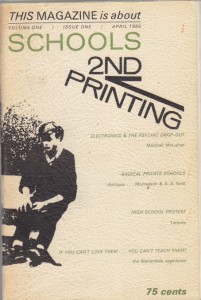 Today we’re very proud to be launching a special issue of This Magazine to mark our 45th anniversary. This Magazine is About Schools published its first issue (seen at right) in April 1966, and quickly established itself as a vital part of the country’s social, political, and cultural landscape. The This that splashed down in the spring of ’66 was a giddy mix of radical politics, pedagogical heresies, and groovy ’60s zeitgeist. It quickly sold out (which is why today, all the archival copies in our office still say “2nd printing” on them), and its message — that the old ideas about education, politics, economics, and culture were being swept away — caught the imagination of a generation of Canadian writers, who flocked to contribute.
In the intervening 45 years, This has been a launch pad, way station, or incubator for some of the most exciting talents in Canadian arts and letters: Margaret Atwood, Dionne Brand, Drew Hayden Taylor, Tomson Highway, Mark Kingwell, Naomi Klein, Dennis Lee, Linda McQuaig, Michael Ondaatje, Stan Persky, Al Purdy, Rick Salutin, Doug Saunders, Jason Sherman, Clive Thompson, and literally hundreds more have been involved in this remarkable and unlikely project over the decades.
For this special issue, we wanted to look back over that impressive history, but also to look forward, to the Canada of the next 45 years. To that end we asked 45 “alumni” of the magazine to each suggest a person or organization they believe is doing important or innovative work, whether in politics, art, activism, academia, or any other field. They came up with a fascinating collection of people and groups who are building our future and doing awesome stuff, and we’ll be bringing you that full list on the website over the coming weeks.
The issue is now arriving on a newsstand near you (it looks like this) and in subscribers’ mailboxes. You’ll be able to read the full issue online eventually, of course, but we’d like to take a moment now to suggest that you consider purchasing a subscription to the print edition if you haven’t already (if you have, thank you!). This is a shoestring operation — always has been, likely always will be — and subscriptions are the best way to enjoy it for a couple reasons. First, it’s cheaper and more convenient for you — the full issue delivered right to your door, at a 46% discount off the cover price, which is, like, wow; second, subscriptions help support the magazine’s mission, which is to bring you long-form investigative journalism, provocative commentary, and insightful culture reporting by Canada’s most exciting new talents. When you buy us on the newsstand, only a fraction of your dollar makes its way back to us; but when you subscribe, virtually all of the sticker price goes directly to support the magazine and its mandate.
OK, that’s enough lecturing on periodical economics for one sitting. Remember to keep checking this.org/45, where all the profiles will be made available over the next few weeks, and become a fan on Facebook or follow us on Twitter to keep informed about new articles as they’re posted. Finally — and this is so cool — take a look at our all-new online cover gallery, a way for you to browse and download images of every cover we’ve ever published over our 45 years.
After the jump, you’ll find the complete list of our alumni featured in the issue and the individuals and organizations they want you to know about. It makes for a very cool read. Thanks for 45 amazing years so far, and many more to come.
The This 45:
- Navneet Alang on blogger-of-the-future Tim Maly
- Joyce Byrne on open-source biologist Andrew Hessel
- Mark Callanan on Roy Miki‘s Mannequin Rising
- Luke Champion on music collective Tomboyfriend
- Susan Crean on indigenous theatre company Native Earth Performing Arts
- Lynn Crosbie on poet Paule Kelly-Rhéaume
- Andrea Curtis on socially responsible organic farmers Gillian Flies & Brent Preston
- Sarah Elton on community supported fishery Off The Hook
- Sky Gilbert on sex-workers’ rights group Big Susie’s
- Gerald Hannon on trans activist Syrus Marcus Ware
- Nicholas Hune-Brown on gospel-folk-rock choir Bruce Peninsula
- Jessica Leigh Johnston on teen feminist magazine Shameless
- Mark Kingwell on artist Olia Mishchenko
- Myrna Kostash on community arts hub Arts on the Avenue
- Katherine Laidlaw on Julie Booker‘s Up Up Up
- Gordon Laird on Buddhist teacher acariya Doug Duncan
- Canice Leung on Ivan E. Coyote & Zena Sharman‘s Persistence: All Ways Butch and Femme
- Chandler Levack on electronic musician Mantler
- Linda McQuaig with Katie Addleman on emergency humanitarian force UNEPS
- Hal Niedzviecki on novelist Dany Laferriere
- Arif Noorani on free speech advocates Canadian Journalists for Free Expression
- Ron Nurwisah on ultra-local food co-operative Not Far From the Tree
- Christina Palassio on book futurist Hugh McGuire
- Judith Parker with Kelli Korducki on war-resister defence lawyer Alyssa Manning
- Andrew Potter with Victoria Salvas on democracy researcher Alison Loat
- Rachel Pulfer on foreign correspondents Jessica McDiarmid and Jenny Vaughan
- Judy Rebick on indigenous rights activists Defenders of the Land
- Satu Repo on documentary photographer Vincenzo Pietropaolo
- Jessica Rose on Suzette Mayr‘s Monoceros
- Alex Roslin on journalism incubator the Canadian Centre for Investigative Reporting
- Ellen Russell on activist educators the Catalyst Centre
- Natalie Samson on Youth HIV educator Tamara Dawit
- Craig Saunders on environmental crusader Gideon Forman
- Doug Saunders with Dylan C. Robertson on poverty-fighter Ratna Omidvar
- Emily Schultz on fiction writer Faye Guenther
- Graham F. Scott on parliamentarian Megan Leslie
- Jim Stanford on youth activist trainer Kevin Millsip
- Rosemary Sullivan on fiction writer Lauren Kirshner
- Clive Thompson on zero-growth economist Peter Victor
- RM Vaughan on the late queer impresario Will Munro
- Sonia Verma on Haiti humanitarian Dominique Anglade
- Mel Watkins on alternative news muckraker Ish Thielheimer
- Alana Wilcox on book collective Invisible Publishing
- Mason Wright on civic technologist Susanna Haas Lyons
 The March-April 2011 issue of This is now in subscribers’ mailboxes and on newsstands. As usual, you’ll be able to read all the articles here on the website as we post them over the next few weeks. But also as usual, we encourage you to subscribe to the magazine, which is the best way to support this kind of award-winning journalism. You can easily buy a subscription online for one or two years, or we’re happy to take your call at 1-877-999-THIS (8447). It’s toll-free within Canada, and if you call during business hours, it’s likely that a real live human being will answer—we’re old-school like that.
Finally, we suggest subscribing to our RSS feed to ensure you never miss a new article going online, and following us on Twitter or becoming a fan on Facebook for updates, new articles and tasty links.
The cover story this issue is Elizabeth Wright‘s look at Canada’s broken drug approval process. The way that pharmaceuticals in this country get approved for medical use is needlessly secretive, rushed, and inefficient, many experts say, and its dysfunction puts everyone’s health at risk. And with Big Pharma in the driver’s seat—from the doctor’s office to the federal research labs, it’s increasingly clear that a more accountable, transparent, and independent drug approval process is necessary.
Also in this issue: Brad Badelt reports on the mystery of B.C.’s 2010 salmon run, which saw record-breaking numbers of fish returning to west-coast rivers. The fish-farming industry said it proved that Pacific salmon stocks are perfectly healthy and there’s no need to worry. But was last year’s boom a sign of resurgence—or a last gasp? Plus we bring you a special eight-page photo essay by Ian Willms from the dark heart of the tar sands. In Fort Chipewyan, 300 kilometres downstream from the world’s most environmentally destructive project, residents are living—and dying—amidst a skyrocketing cancer rate and deteriorating ecosystem.
And there’s plenty more: Paul McLaughlin interviews Silicone Diaries playwright-performer Nina Arsenault; Jason Brown explains how Canada is losing the global race for geothermal energy; Ellen Russell asks why we can’t have more muscular banking reforms; Lisa Xing sends a postcard from Jeju Island, South Korea, where the last of the pacific “mermaids” live; Dylan C. Robertson explains how the Canada-European Comprehensive Economic and Trade Agreement will change our world; Kapil Khatter shows why that “organic farmed fish” you buy may be anything but; Daniel Wilson untangles the right wing’s curious fixation on aboriginal tax exemptions; and Emily Landau sneaks a peek at the next genre-bending project from KENK publisher Pop Sandbox.
PLUS: Christina Palassio on poetry in schools; Navneet Alang on Wikileaks; Jackie Wong on painter Michael Lewis; Flavie Halais on the West Coast’s greenest city; Victoria Salvas on criminalizing HIV-AIDS; Denise Deby on the fight to save Ottawa’s South March Highlands; and reviews of new books by Renee Rodin, Lorna Goodison, David Collier, and David Lester.
This issue also includes debut fiction by Christine Miscione and new poetry by Jim Smith.
]]>