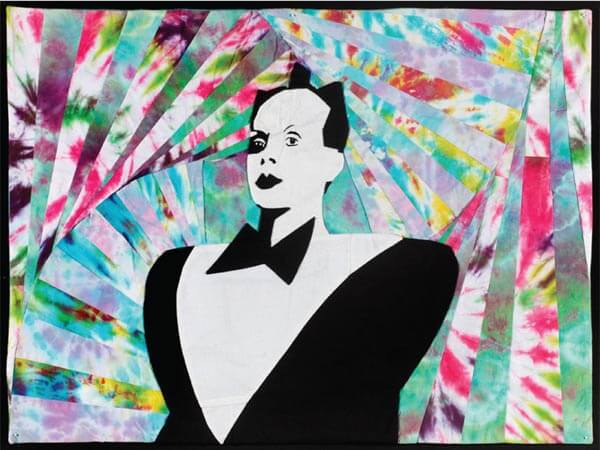
“Total Eclipse” (2005) by Will Munro. Photo by Sean Weaver, courtesy Paul Petro Contemporary Art.
It is impossible to speak of Will Munro. It is easy to talk about Will Munro(s).
Will Munro, the artist/activist/social wizard/impresario and all around wunderkind, passed away one lovely, clear-as-a-bell summer morning in 2010. He was 36.
In that too-short time, Will produced an enormous amount of highly influential, DIY-infused art, reinvigorated the Toronto, and by extension the Canadian, and some argue international queer club scenes—and I support that argument, having seen Will’s influence up close in countless cities far and wide. He empowered an entire generation of artists, who felt the ossified Canadian art scene was not for them, to simply make/display/distribute their art on their own terms.
You’ll note I’m using the “/” rather a lot—I have no choice. Will was so many things, Will made so many things.
I generally distrust the concept of “legacy,” but not in the case of Will Munro. His simplest and most inspired conceit was that queers of all stripes (homo-normative, hetero-normative, just plain fucking crazy, what have you) have far more in common than not, and can share a big sandbox with joy. And we did. For a decade, Will ran the legendary Vazaleen parties— mad, dressed-to-thrill events that spawned many, many subsequent cultural products and collaborations. And that’s putting it mildly.
The parties and the underlying concept—shared space for a diverse population—were both quickly copied, largely because a generation of queers had grown up under the segregationist, essentialist politics of the ’80s–’90s (dykes only go to dyke spaces, fags only go to fag spaces…oh, it was all so tiresome, so numbing), politics that no longer made sense, no longer reflected the day-today reality of the third wave of queer liberation. Suddenly, we all had a meeting place, and we used it.
Now it’s time for a more rigorous examination of Will’s beautiful, sexy art. Will’s social contribution is well-documented (and I’m doing it again), but his highly original art practice, one fuelled by punk-rock aesthetics, righteous rage, and delicious impertinence, rough homemade fashion, sex-worker rights, and queer youth advocacy, club and DJ culture, anti-corporatism, and, less remarked on, his long fascination with, and promotion of, queer cultural history (an interest that made him, again, unique in his generation) has been, to date, not as well-considered.
I sense a sudden boom in Munro studies coming. Retrospectives and monographs galore. More gifts from a relentless giver. It’s the least we can do.
But this is not the place for academic pursuits. Let other people get post-grad degrees off Will’s back.
Right here, right now, I just want to say thank you. I miss you, Will.
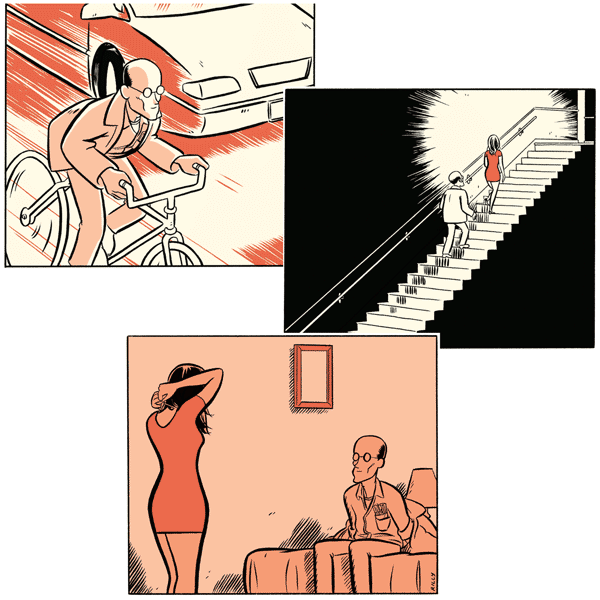
Illustration by Ethan Rilly.
Chester Brown, 51, is an accomplished graphic novelist whose new book, Paying for It, depicts his decision in 1999 to abandon romantic relationships in favour of paying prostitutes for sex. Along the way, however, he still seemed to find a version, unconventional though it may be, of true love.
This: How long did it take to do the book?
Brown: One year to write the script and four years to draw it.
This: The primary trigger for going to sex workers was when your romantic relationship with Sook Yin-Lee [the actor and CBC journalist] ended in 1999. When she had a new boyfriend move in with the two of you.
Brown: Right. But we’re still very close friends.
This: Why were you through with romantic love?
Brown: It brings people more misery than happiness, in a nutshell.
This: Haven’t I read that the most miserable creatures around are men who don’t have a relationship?
Brown: I think in large part that’s because of romantic love. They have this ideal in the mind and they’re failing to bring that into their life. If they didn’t want romantic love they then wouldn’t be miserable. It’s the ideal that’s the problem.
This: How many prostitutes did you go to over the years?
Brown: Twenty-three. Some I saw multiple times. Every single experience is in the book.
This: How much did you spend on them?
Brown: I’m not sure. I’ve never been asked that before. At roughly $200 each time…hmmm. I guess we could do the math.
This: In January 2003 you saw a sex worker you call Denise. Since then you have been monogamous with her and she’s been monogamous with you for the last four years. What is different about her?
Brown: She seemed more open. As time went on the connection between us seemed to grow. There were other things that happened to help establish a bond that unfortunately I can’t get into.
This: Because she doesn’t want her personal information revealed?
Brown: She told me to put her in my book as little as possible. I will say she’s an amazing person. Really wonderful and extremely trustworthy.
This: But you still pay her.
Brown: We have sex about every two weeks and, yeah, I pay her.
This: How do you define your relationship with her?
Brown: Hmmm. It’s not a boyfriend/girlfriend relationship. It’s not a romantic relationship.
This: You must have feelings for her.
Brown: I admit I have romantic feelings for her. And when you feel that way about a woman you want to talk about her. I wish I could blab away about her wonderful qualities.
This: Do you double date with friends?
Brown: No. Never.
This: Share holidays, like Christmas, together?
Brown: No.
This: What if she wanted you to stop paying her.
Brown: All of a sudden it would be like every other relationship. I think romantic relationships tend to fail. I’m happy with things the way they’re working.
This: Have you ever asked her to move in with you?
Brown: No.
This: It would ruin things?
Brown: Oh yeah. I think so.
This: Don’t many men who go to sex workers want the talking, the touching, the cuddling even more than the sex? Was that the case with you?
Brown: I definitely know that’s true of a lot of men. But I did want the sex.
This: They want the intimacy, even if it’s forced.
Brown: Yeah. Most of the prostitutes I saw would jump up and go to the shower after [we had sex]. Denise was one of the few who seemed to like to cuddle afterwards.
This: Was the intimacy you felt with her what was missing with the other sex workers?
Brown: Probably.
This: Which suggests that’s what you were looking for all along.
Brown: I hadn’t known that that’s what I was looking for but, sure, yeah.
This: Isn’t that what we’re all looking for?
Brown: Hmmm. I guess so.
This: You still down on romantic love?
Brown: I do change my mind at the end of the book. I come to think of it in a different way and I decide what I have a problem with isn’t romantic love but what I call possessive monogamy.
This: Where do you think your relationship is headed?
Brown: I’m pretty sure Denise is fine with the way it is right now. She doesn’t want me to be a conventional boyfriend. I think everyone else wants there to be a Pretty Woman type of story where we end up in a conventional marriage. But we don’t. No.
]]>
I moved to downtown Hamilton, Ontario, in 2005. We bought our three-storey Victorian home near Copps Coliseum at a price that would have been unheard of in Toronto. The corner we lived on had been labelled “the most dangerous corner in Hamilton.” But my shaved head and tattoos stood out less here than in the fashionable, gentrified neighborhoods of downtown Toronto.
I noticed that a) there were lots of sex-trade operations near our house— for instance, massage parlours and the Hamilton Strip strip club—and b) there were also two anti-abortion establishments nearby. Our neighbourhood was like many other Canadian neighbourhoods: some people believe sex is for fun and pleasure, whereas others believe sex is specifically for making babies.
That’s why I’m so proud of Big Susie’s. Big Susie’s is (to quote their website) “a working group by and for sex workers in Hamilton and the surrounding area.” Their purpose is to “fight back against the stigma and silence that degrades, devalues and dehumanizes sex workers and their work.”
The organization was born because of an odd and somewhat unfortunate intersection between politics and art. In 2009, a small local art gallery featured a series of photographs the artist had taken from the window of his studio, which was near a notorious alley used by hookers. The photographs were explicit and voyeuristic and—most importantly—were taken without the consent of the subjects. Trendy artists and people from the suburbs who visited the little gallery seemed entertained by a scandalous glimpse of Hamilton’s sexual working-class underbelly. But local sex-trade workers were angry. Weren’t they people too? Did someone have a right to photograph them and make an “artistic statement” about their bodies and their lives, without their permission? The protest against this exhibit led to the birth of Big Susie’s. Is all art political? Definitely, yes. Should artists be challenged when they consistently make work they characterize as apolitical, when in fact it is not? I (not to mention Bertolt Brecht!) would say yes.
As an out gay man and a drag queen, I have always been proud to be promiscuous. It makes me feel safe to have an organization in my town that is sex-positive and defends the rights of women to use their bodies in any way they wish in consenting sexual situations. Some feminists assume all prostitutes are victims, and proceed to speak for them, as if they didn’t have a voice of their own. But, lo and behold, they do.

So there’s this scandal: Bruce Carson, a former adviser to Stephen Harper’s prime minister’s office, allegedly claimed ties to the PMO in order to move forward a deal with an Ottawa company that would provide water filtration systems to First Nations communities. This deal would mean a handsome payout to an employee of that company—who also happens to be Carson’s fiancée. The press could not resist mentioning the fact that Carson’s spouse-to-be, Michele McPherson, formerly worked as an escort. It added a titillating edge to the story, a little dash of sex to go along with the otherwise fairly standard-issue story of a powerful political insider allegedly leveraging his influence for material gain. (The entire matter, it should be noted, is under investigation by the RCMP and the allegations have not been proven.)
Let’s be clear: Michele McPherson’s former line of work is not scandalous. There is plenty of actual scandal to go around here:
1. The shockingly bad state of water quality in First Nations and on reserves:
Compared to the general Canadian population, the Aboriginal population has 1.5 times higher risk of heart disease, a 3 to 5 times higher risk of developing Type 2 diabetes, and at a 8 to 10 times higher risk for Tuberculosis infection. In terms of water quality, according to Health Canada, for First Nations communities south of 60 degrees parallel, the management of safe drinking water is shared between the community and the Government of Canada and will provide funding and training for water quality testing. Still, communities like The Little Salmon Carmacks First Nation have been under a boil water advisory since 2006.
2. The abolition of the racist “Indian Act” was reduced to a political football:
Enacted in 1868, as part of the Constitution, the Indian Act gives the federal government exclusive authority to “Indians and lands reserved for Indians.” It also defines who qualifies as an “Indian.” Reports of the Carson scandal note that Assembly of First Nations National Chief Shawn Atleo was about to go into talks to negotiate the termination of the Act when Carson contacted him about the water deal. The day after this, Atleo announced that he would work to abolish the act within five years time. In exchange for help in getting rid of the Indian Act, Carson wanted Atleo’s support in promoting H20 Global Group. The abolishment of the Act was used by Carson as a pawn in getting his deal to go through with the Assembly of First Nations.
3. Bruce Carson and Michele McPherson allegedly abused political connections to get rich:
Frankly, who cares what Michele McPherson used to do to pay the bills? Let’s concentrate instead on the fact that she was poised to take a 20 percent commission on a government infrastructure project worth, potentially, eight figures; and that she and Carson appear to have improperly exploited his extraordinary access to the Indian and Northern Affairs ministry to do so. No one needs to tack on a juvenile preoccupation with McPherson’s sex life; the allegations are serious enough in their own right.
]]>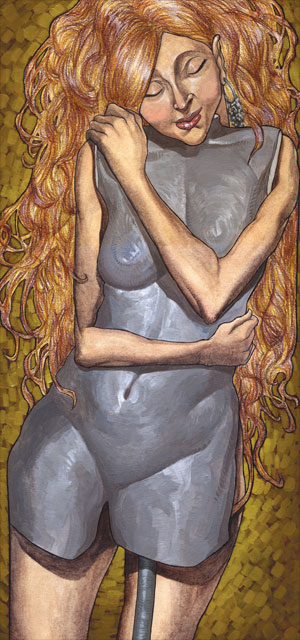
Nina Arsenault. Illustration by Chris Kim.
Nina Arsenault has spent a fortune changing her appearance from male to female. The 37-year-old used to work in the sex trade, but now supports herself as a playwright, performer, and motivational speaker to queer youth. Her one-woman show, The Silicone Diaries, recently had a second highly successful run in Toronto, was later performed in Montreal (where This caught up with her) and will open in Vancouver next year.
THIS: Where did you grow up?
ARSENAULT: In Beamsville, Ontario, in the Golden Horseshoe Trailer Park. It was a really tight-knit community. My memories of it are just great. But we moved when I was about six to a house in Smithville. It was very difficult to make friends because I was so feminine. Growing up in the trailer park and going to school with those kids, they always knew how girlish I was. With everyone on top of each other, you have no choice but to accept people. But being the new kid, it was very, very difficult to make friends. I have been a bit of a lone wolf all my life.
THIS: In The Silicone Diaries you talk about seeing a female mannequin in a store at age five. What was it that affected you that day?
ARSENAULT: I think just the harmony and symmetry of the face spoke to me. I knew that I was a girl inside but I had this boy body. Then, for my visual gaze to rest upon a face that was a sculpture of a woman’s face, I just seized on that as a child. It affected me. The perfection of it.
THIS: When did you decide to begin plastic surgery?
ARSENAULT: About age 23, but I didn’t have my first procedure until I was 25.
THIS: What did you have done?
ARSENAULT: At first just transsexual procedures to feminize myself. It got to a point where I looked as much like a normal woman as I possibly could. However, I still had masculine features. It was really traumatic on a daily basis to see those features. So I made the decision to really push the cosmetic procedures, knowing I would no longer look natural. That I would start to look plastic and artificial.
THIS: Like a mannequin?
ARSENAULT: Yeah. But I can’t say at the beginning of the journey I was trying to look like a mannequin or a Playboy bunny. I was just trying to be a woman.
THIS: Did you literally have 60 surgeries?
ARSENAULT: There were actually more. Some were just procedures, like a lip injection.
THIS: When was the last one?
ARSENAULT: In 2006.
THIS: How much did they cost?
ARSENAULT: Upwards of $200,000.
THIS: How did you afford that?
ARSENAULT: I was working in the sex trade and made an incredible amount of money so quickly there.
THIS: Men like “shemales”?
ARSENAULT: Yeah. In terms of supply and demand, there just aren’t a lot of us, but there’s a lot of interest. The first day I put my escort ad in the paper, I had 250 calls. I don’t think that’s something that’s spoken about that openly amongst otherwise heterosexual men. I could have worked from morning until night if I had wanted to.
THIS: What was it like working in the trade?
ARSENAULT: It was physically very tough. And I only did oral, no fucking.
THIS: A lot of transgender women work in the sex business. Why is that?
ARSENAULT: It’s one of the few places you can get work and feel safe. If you’re visibly transgender you’re going to be one of the most disenfranchised and disadvantaged people in culture.
THIS: You have two graduate degrees, right?
ARSENAULT: I do. But it’s tough to get straight work. You can’t imagine the amount of transphobia out there.
THIS: How long have you been out of the trade?
ARSENAULT: About three years. I support myself now as a performer.
THIS: In the play you mention that you have had your testicles removed. But you kept your penis. Why was that, if your goal was to be as close to a woman as possible?
ARSENAULT: I never knew what would happen to me financially so [if I still had my penis] I could always return to the sex business.
THIS: What has the play done for you?
ARSENAULT: It has been an incredibly healing ritual. I think I wrote it because I had a lot of emotional angst and suffering that I needed to express, that I needed someone to bear witness to. It makes me stronger every time I perform it.
THIS: Do you feel 100 percent female now or still a bit male?
ARSENAULT: I’ve always known I was a woman but I was socialized as a male. I have some qualities people see as male—I’m an aggressive thinker—but my core is definitely female.
THIS: Do you feel beautiful enough now?
ARSENAULT: I don’t work on the outside anymore. I concentrate now on inner work.
THIS: Any more surgeries ahead?
ARSENAULT: No. Not until I start to really visibly age.
Trailer for The Silicone Diaries:
]]>
John Mathenke, a Nairobi sex worker, was diagnosed with HIV in early July. He is working with the Sex Workers' Outreach Program to educate other sex workers about HIV prevention. Photo by Siena Anstis.
Blended into the colourful storefronts of Nairobi’s River Road area is the Sex Workers Outreach Program (SWOP), a discreet but accessible clinic offering HIV and STD testing and treatment to the estimated 7,000 prostitutes who work in the central business sector of Kenya’s capital city.
While the clinic was created in close consultation with Nairobi’s sex workers, its origins are the result of a partnership between the University of Nairobi and the University of Manitoba that dates back to 1980.
Shortly after the two schools first collaborated to start exploring the murky world of HIV-AIDS transmission through prostitution. Despite being a whole continent away and exploring a disease that was not yet a “hot topic,” the University of Manitoba was determined to continue the research it had started in Canada in the 1970s on STDs, and later HIV. The school’s initial findings attracted the attention of Herbert Nsanze, the then-new chair of medical microbiology at the University of Nairobi, who invited the U of M to work from Nairobi’s streets.
This partnership has resulted in some groundbreaking research, most notably, the discovery that some prostitutes are immune to HIV despite having more than 500 partners a year. The two universities have also launched two research and treatment clinics, including SWOP, which recently celebrated its fi rst anniversary.
Over the past year, SWOP has grown from a quiet start-up to a busy clinic that regularly treats 2,600 female and 65 male clients. To Joshua Kimani, the Kenyan-born, U of N-educated doctor who now oversees the clinics run by the two schools, these numbers are a sign of success.
Kimani is particularly excited to see the growing presence of male sex workers. “It takes a long time to win the confidence of men,” explains Kimani. “There is a double stigma, adding insult to injury, of men who have sex with men and who are also sex workers.” In Kenya, both homosexuality and prostitution are illegal.
Together, the University of Manitoba and the University of Nairobi have made a significant dent in the HIV rate among Nairobi’s sex workers. Majengo, one of their other clinics, saw the HIV rate drop from 10 percent to 1.5 percent over the past two decades. With research and technical support from the University of Manitoba, SWOP expects similar results in the coming years.
]]>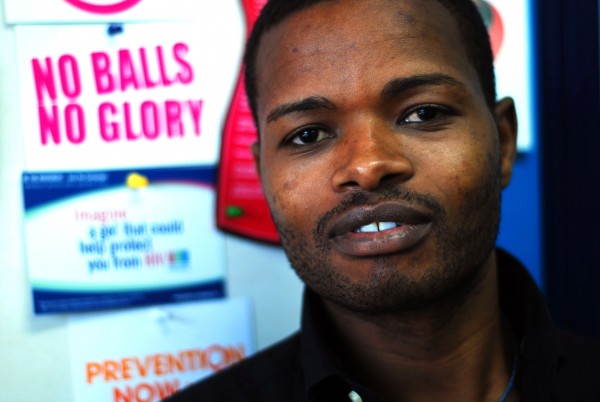
John Mathenke, a Nairobi sex worker, was diagnosed with HIV in early July. He has gone public with his story and started a health education organization to help other young gay sex workers avoid contracting the disease. Photo by Siena Anstis.
John Mathenke was once arrested for being gay but, after failing to pay the customary bribe, was forced to have sex with the policeman. He had an orgy with a priest who publicly excoriates homosexuality, along with five other Masaai boys. And his Arab trader clients curse him during the day, but come back looking for sex at night.
Such is the life of a homosexual prostitute in Nairobi, Kenya. “It’s better to be a thief than a gay in Kenya,” he says. Both are often punished by death, but being the latter means never revealing yourself to the public and remaining perpetually closeted. It means dealing with homophobes at day and pleasuring them at night.
Mathenke, a quiet-spoken young man, is forthright with his story. His gay identity has not been shamed or hidden by years of abuse. His ability to tell his intimate story to a stranger is testament to his bravery. He tells me that he wants to be openly gay – and to help those who want to do the same – in a country where all odds are stacked against him.
His forced silence is not only affecting Kenya’s gay population. According to the BBC, gay men in Africa have 10 times higher HIV rates because of homophobia. These gay men often have “cover wives” who are also eventually affected by HIV. It’s a vicious cycle in a country where the government has proved reluctant to address the mental and physical repercussions of homophobia.
In 2002, Mathenke left his poor community and followed other dream chasers to Nairobi. He paid a barber $30 to be trained as a haircutter. His perfect English eventually landed him a job selling textbooks in a lavish Westlands shopping center. This was the scene of his first same-sex experience. While, subconsciously, he knew it had always been a part of him—he says he used to wear long shirts when he was small and tied a rope around his waist to pretend it was a dress—he had never experienced sex with a man.
A Frenchman would come in, day after day, he says. He would open thick African history books and look at pictures of naked men. He bought many books; some that Mathenke would help him carry to the car. He never thought much of this flirtation, until the man took him out for dinner. Inebriated, they went back to the Frenchman’s home and had sex. The man took him home almost every night after that. In the same store, Mathenke encountered the priest with whom he had a five-person orgy.
At this time, Mathenke was discovering his sexual identity and decided to move to Mombasa, an area rumored to be less hostile to gay relationships. $700 in his pocket, he put himself up in a hotel. Eventually the money dried up and he was left desperate. He went to Mercury, a local bar, and was offered money for sex with an older European.
“When you’ve had sex with someone once, they don’t want you again,” explains Mathenke. Customers became few and far between and he continued to sleep on park benches, washing in the seawater in the morning. He also faced continued stigma: “Arab traders would insult us at day, and come looking for sex at night.” A lot of his clients were—and are—popular religious leaders who would curse homosexuals in public and find pleasure in paid homosexual company in private.
Mathenke eventually returned to Nairobi, where he settled in with a new boyfriend. He continued to see clients from the big hotels: the Hilton, the Serena, the Intercontinental. He had yet to use a condom.
Community outreach by Sex Workers Outreach Program (SWOP) in Nairobi eventually led him to his “second-home.” Provided with free health services and counseling, he tested positive for HIV/AIDS three weeks ago. So did his partner. Instead of bemoaning his future, Mathenke has launched himself into a new project. He is bringing together groups of young gay sex workers and helping them form an advocacy organization, Health Options for Young Men on HIV/AIDS. He is teaching these young men—some only 12 years old—about using condoms and lubricant when having sex with men.
Mathenke’s work is necessary. Many of the bars and hotels on the coast and in Nairobi are, by default, gay bars. The men frequenting these places pay off the police so that they’ll be left alone. But violent raids continue to happen. At the same time, homophobia ensures that these men are never reached by HIV/AIDS awareness. Changing public behavior is key to lowering the HIV rate and protecting all Kenyans, gay or otherwise.
While the government has long been reluctant to address the role of homophobia in increasing HIV/AIDS rates, there have been some positive changes over the years. Gloria Gakaki, a social worker at SWOP, highlights the brave role of Dr. Nicholas Maraguri, Head of the National AIDS and STD Control Programme (NASCOP), who is pushing the government to address HIV among Kenya’s hidden gay populations. Maraguri has also been meeting directly with male sex workers to get a more in-depth idea of what their problems are, and how government can help.
For further information on SWOP or to donate to Mathenke’s new organization, please contact Gloria Gakaki at [email protected].
]]>