
February 4 anti-Mubarak protest in Alexandria, Egypt. Creative Commons photo by Al Jazeera English
In Egypt, Libya, Bahrain, even Italy, citizens are rising up, risking their lives to protest their corrupt governments. Egyptians, in a historical event, have proven they can be successful in overthrowing years of dictatorial leadership. Canadians were mostly cheering along (though our government wasn’t), but’s hard to put ourselves in their place—Canada, flawed though it is, is simply not Egypt. Corruption here is less pervasive; the military less present in our everyday lives; we have a functional political opposition. But since freedom, democracy, and human rights are on everyone’s mind right now, perhaps it’s time for a little self-evaluation session.
The uprisings in the Middle East should prompt Canadians to take a closer look at the state of our own politics. For just one recent example, see the recent KAIROS “not” scandal and assess how democratic our government’s behaviour truly is. Murray Dobbin on Rabble stopped just short of comparing Steven Harper to ousted Egyptian president Hosni Mubarak, and called Harper’s Conservative cabinet a squad of “hit men.”
But would Canadians ever reach the point where we just couldn’t take it anymore? Could we rebel in Egypt-like protests? Would our rants to friends or angry blog comments ever manifest as rebellion in the street?
Stereotypically, Canadians are polite and retiring; unconfrontational if you’re being nice about it, apathetic if you’re not. But there’s data to prove that we really don’t like things to get politically messy. Besides our dismal-and-getting-worse voter turnout rate, A 2000 General Social Survey by Statistics Canada found that only 9 percent of Canadians (age 15 and up) had participated in a public debate that year (things like calling radio talkback shows or writing letters to the editor). Half of those individuals researched information on political issues, and 10 percent volunteered for a political party. We also seem naturally more inclined to express our opinions with a group that we know will share or agree with our own opinions.
Historically, if Canadians take the time to understand a politcal issue, then get mad about it, we will find a way to express it. Like the time time the Conservative government decided prorogue parliament; a 63 day break while 36 government bills lay untouched. While plenty of us apparently didn’t know what the heck that meant, 200,000 Canadians got angry, logged onto Facebook and joined a group called Canadians Against Proroguing Parliament. Many attended actual rallies across the country.
If you were in Toronto in the summer of 2010, you witnessed Canadians in a more traditional form of protest during the G20 conference. Over 300 people were arrested and the images of Toronto streets seemed almost unrecognizable, as if it were a different country altogether.
The erosion of Western democracy seems to be everywhere you turn lately. Paul Krugman identified the union-busting tactics of Wisconsin governor Scott Walker as just the latest example of a hemisphere-wide push by anti-democratic forces: “What Mr. Walker and his backers are trying to do is to make Wisconsin — and eventually, America — less of a functioning democracy and more of a third-world-style oligarchy,” Krugman wrote.
Dobbin’s Rabble column sounds the same alarm for Canada: He calls Minister of International Cooperation Bev Oda’s corrections of the CIDA report “political thuggery worthy of a dictatorship.” This seems to be just one example of our democracy moving backwards while citizens of Italy, Libya, Tunisia, Egypt, and Yemen are actively involved in taking back control of their respective countries.
]]>
Naomi Klein addresses the G20 Legal Defence Fundraiser concert at the Great Hall, Toronto, November 11, 2010.
The Canadian Civil Liberties Association has been hosting a public hearing into last summer’s G20 protests and the police response to them, and if you’ve been following the testimony being given there, things sound pretty grim. The CCLA has been doing amazing work live-tweeting the proceedings and the stories that people have to tell are shocking and saddening. We definitely recommend taking the time to read what they’ve already recorded in Toronto over the last two days; they’ll be continuing the hearings in Montreal today. To add insult to the injury many protesters sustained in the G20 police’s lockups, they now face the prospect of lengthy legal proceedings to defend themselves against the law that was supposed to protect them. It’s easy to feel down about the whole thing.
But it’s Friday, and this is Friday FTW! which means we’re going to look on the bright side (even though yes, I know, looking on the bright side isn’t my forté). Because despite the injustice of the situation, there are lots of people working hard together to help. Last night, that took the form of a big fundraising concert at the Great Hall in Toronto, where This alum Naomi Klein, comedian Martha Chaves, musician Hawksley Workman, and electronic ensemble Lal. Funds from the concert went into the G20 Legal Defence Fund, which provides financial aid to G20 arrestees. You can donate to the fund through Toronto Community Solidarity Network, which estimates up to $400,000 in legal costs by the time all is said and done.
Our friends at Rabble were there filming the whole event, and you can watch the rebroadcast right here or on their Livestream page.
]]>
UPDATE, Sept. 22, 1:55 pm: CanWest Postmedia reports that C-391 sponsor MP Candice Hoeppner “has all but conceded defeat” and “given up on last-minute lobbying” for today’s vote, and calls the eight liberals and 12 NDPers who voted in favour last time, “turncoats.” She estimates the government is one — one! — vote short, which is why it’s all hands on deck today: Jack Layton told reporters “Everybody will be there unless somebody gets struck by lighting.” The Prime Minister also flew back from New York where he was addressing the UN.
UPDATE, Sept. 22, 3:56 pm: There were questions about the registry during Question period, but seems to be nothing new to add based on that. However, Susan Delacourt just published a surprising and sad story about why Liberal MP Scott Simms, who originally voted to abolish the registry, has changed his mind today: because between the last vote and this one, his father took his own life, and the weapon he used was a long gun. Simms will not be talking about it publicly, but a colleague tweeted the story put the gun registry in “unprecedented perspective” during this morning’s Liberal caucus meeting. Addendum: Barb Adamski replies to us on Twitter that no gun registry is in a position to prevent suicides by a determined person, which it must be conceded is a fair point. However, it does not negate many other good reasons to register guns, and the fact that the story broke today is bound to be significant, no matter how indirect the connection to the vote itself. Addendum to the addendum: Delacourt explains on the Toronto Star blog why they published the story today before the vote.
*****
Today is the day that parliament will vote on bill C-391, An Act to amend the Criminal Code and the Firearms Act. This private member’s bill (full text here), introduced by Candice Hoeppner, the Conservative MP for Portage-Lisgar, Manitoba, on May 15, 2009, if passed would bring about the end of the long gun registry, which is one component of the Canadian Firearms Program.
Note that there is a difference between a gun licence and gun registration — the RCMP describes the distinction as being analagous to a driver’s licence and vehicle registration. There are also three classes of firearms that the program regulates: non-restricted, restricted, and prohibited. Ordinary hunting rifles and shotguns have always been “non-restricted” — that is, anyone over 18 can purchase and own them as long as they’re registered and licensed.
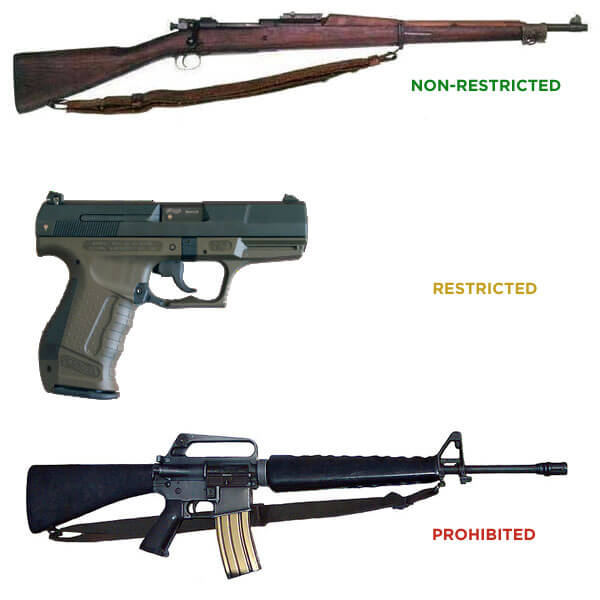
Bill C-391 does not affect licensing requirements; the only thing the bill would repeal is the requirement to register a non-restricted firearm — i.e., a rifle used for hunting game. The reason this distinction is important is because critics of the gun registry have focused on its cost, and they claim that repealing these requirements would save money. This claim, to put it bluntly, doesn’t hold water. The RCMP will continue to run a gun registry; almost all of the expense will continue to be incurred whether Bill C-391 passes or not.
The cost of the long gun registry has been widely misreported, misinterpreted, and deliberately overblown. An RCMP report (completed in February but not given to Parliament until August; it was promptly leaked to the CBC) has placed the cost of the long gun registry portion of the Canadian Firearms Program “in the range of $1.1 and $3.6 million per year.” The “$1 billion” figure that Prime Minister Stephen Harper and other Conservative politicians have repeatedly quoted is simply not accurate. According to that same report, according to The Tyee, the $1 billion figure actually refers to the entire cost of the whole Canadian Firearms Program from 1995 to 2007.
The other source of criticism of the long-gun registry is generally perceived to split along urban-rural lines, with many game hunters unhappy at the cost and inconvenience of having to register their firearms. Hoeppner, introducing her bill, claimed that “law-abiding Canadian hunters, farmers and sport shooters … have been treated like criminals” since the introduction of the registry (in its current form) in 2001. As James Laxer noted this week on Rabble, however, the urban-rural break is a red herring. Plenty of people in the country want the registry to continue, particularly rural women. When polled, 47 percent of rural women supported the registry.
The registry’s other important support continues to be police forces themselves, who have unambiguously spoken out in support of the gun registry for years. Toronto’s Chief of Police, Bill Blair, is also president of the Canadian Association of Chiefs of Police, and testified before parliament on Bill C-391 on May 26, 2010. He was clear on the position of law enforcement on the gun registry — it’s not a panacea, it’s a tool, and a useful one.
Like all of the tools we use, the firearms registry is not a perfect, universally effective tool. Not every criminal will register their weapons. Not everyone will obey the law. It will not deter every criminal nor will it solve every crime. The police never claimed it would.
What we do claim, with the authority that comes from actually using the information contained in the Firearms Registry every day, is that it is a tool that helps us do our job.
[…] In 1994, the CACP adopted a resolution calling upon the Government of Canada to enact legislation requiring the registration of all firearms, including long guns. This is a position from which the CACP has never wavered.
Leading up to today’s vote, police forces and other pro-registry groups from across the country — from Halifax to Toronto to Vancouver — have joined together to call for the registry’s continuation. The CACP, along with the Canadian Police Association and the Canadian Association of Police Boards issued this helpful one-pager correcting the “Top 10 Myths of the Canadian Firearms Program“:
Despite all this, today’s vote is expected to be a squeaker. When C-391 was last voted on, it passed with 164 votes in favour and 137 votes against, with 8 Liberals, 12 NDPers, and one independent siding with the Conservative government.
This time around, Liberal leader Michael Ignatieff has pledged to keep his party members in line to vote down the bill. NDP leader Jack Layton has not whipped his party, and NDP MPs will be free to vote their conscience. (Bloc Québécois MPs will all vote opposed, as they did last time). Layton has told the press that he is confident that the bill will be defeated, and that he has persuaded enough MPs in his caucus to switch their votes.
We’ll be following what goes on as we get closer to this evening’s vote, which is expected to happen around 5:45. Keep checking back here for details, or follow us on Twitter for any quick developments that crop up today. Have any questions about C-391 we haven’t answered here, or have any tips? Leave your questions and everything else in the comments below…
]]>You can also read the liveblog that I was furiously pecking out on an iPhone at the back of the room; of course, it was a little difficult to keep up with the pace of discussion on a three-inch keyboard.
Thanks to everyone who came out last night, to our partners at Rabble, the magazine’s board of directors and interns who did much of the organizing, and of course to the speakers: Robert Fox, Josephine Grey, Judy Rebick, and Antonia Zerbisias. The videos are below.
Judy Rebick:
Antonia Zerbisias
]]>
The G20 is less than two weeks away, and there’s a lot going on. You could just turn to the usual media suspects to get your news about the G20, but when it comes to the street-level collision of neoconservative colonialist plutocrats and anti-globalization activists (among many other blocs of interests), it pays to look off the beaten path for your news consumption. If previous G20 meetings and the demonstrations that accompanied them is any indication, you can’t trust big media to get beyond the usual hackneyed portrayals of anarchists in balaclavas and be-suited politicians doing photo-ops.
(We’ll be doing our very small part during the next two weeks by clipping and aggregating the best material we find on our G20 microblog — g20.this.org — and we welcome you to send us your photos, videos, blog posts, and links for sharing. Simply email [email protected] and we’ll take care of the rest.)
Here are the indie news sources we’ll be following in the next few weeks. Respond in the comments section if you have further sites that people should visit!
rabble.ca

Our friends at Rabble have put together one of their “issues” pages that collects all of their G20 news and commentary in one easy-to-scan package. At a glance you can see any G20 related video on RabbleTV, submissions to the G20 Flickr group, what they’re tweeting and retweeting, and what their lively commentariat is saying on their message boards, Babble.
Toronto Media Co-op
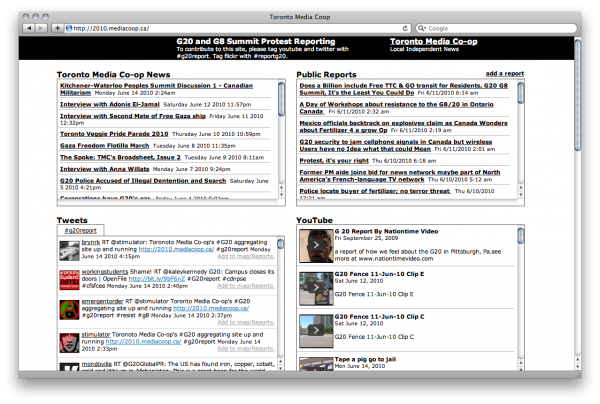
The Media Co-op is a grassroots network of independent news reporting collectives based in different cities coast to coast. Together, the co-op publishes The Dominion. The Toronto branch of the Media Co-op has set up a spartan but information-rich aggregation page for collecting photos, videos, tweets, news reports, and their own original reporting.
G20 Breakdown
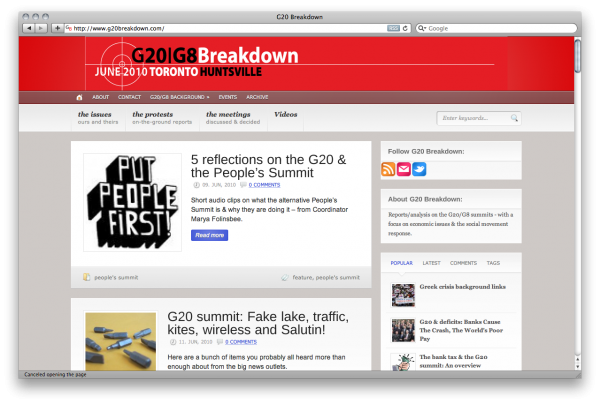
Darren Puscas started G20 Breakdown a few months ago and for a one-man operation, it features a lot of coverage. Puscas’ main areas of interest are economic and environmental issues, but he’s going to be on the ground in Toronto reporting directly on the People’s Summit this coming weekend, and the G20 itself the week after.
Toronto Community Mobilization
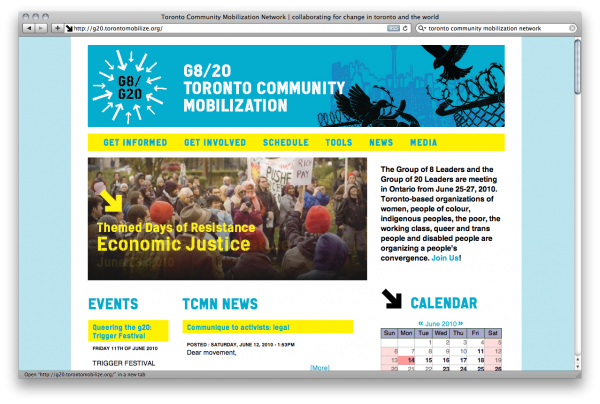
The Toronto Community Mobilization Network is the coalition of activist groups that is coordinating and publicizing the flood of social justice-themed events — demonstrations, concerts, panel discussions, parties, and more — in response to the G20. Their website won’t be so much a source of reporting as a place to keep on top of an ever-shifting schedule of stuff to do.
G20 Research Group

The G20 Research Group is an academic flying squad at the University of Toronto’s Munk School of Global Affairs, a largely student-run group that collects and sifts through the massive piles of information that the G20 produces. The emphasis here is on data, though there is some academic commentary (from across the political spectrum). The research group also sends students to the summit proper to report on individual meetings and press conferences. The academic analysis doesn’t always make for the most exciting reading, but when you’re the kind of reader who wants footnotes, this is your place.
]]>- Véronique Marino (INIS)
- Geraldine Cahill (The Real News Network)
- David Beers (The Tyee)
- Laurent Mauriac (Rue 89)
The second panel of speakers, above, featured three speakers presenting case studies of some groundbreaking media projects:
- Paulina Abarca-Cantin & Stéphanie Lagueux : Studio XX
- Wayne MacPhail : Rabble.ca
- Reisa Levine & Véronique Maléfant : CitizenShift/ Parole citoyenne
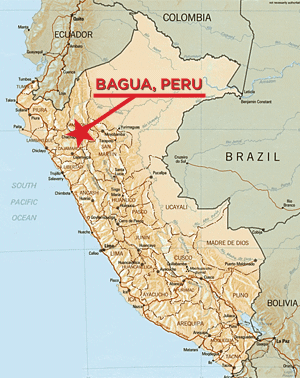
A war broke out this month. A war not to the east but to the south, that has been little covered by the media. It comes complete with human rights violations, murder, and corruption caused by the exploitation of the Amazon. The blood of this war is on Canada’s hands.
On Friday, June 5, an estimated 600 Peruvian police officers opened fire on thousands of peaceful indigenous protesters blocking the destruction of their Amazon homeland on a road near Bagua in Peru. This joint police-military operation went awry when 30 protesters and 24 police offers were killed in one of the worst clashes in a decade, causing a war between the Peruvian government and Indigenous peoples.
For the past two months, over 30,000 Indigenous Peruvians have mounted fuel and transport blockades to disrupt the exploitation of the Amazon rainforest. They are working to block the advancement of free trade agreements that opens the Amazon and indigenous land for business with foreign investors. The trade agreement, specifically with Canada and America, seeks oil, minerals, timber, and agriculture, which will in effect devastate the greatest carbon sink on the planet, accelerating climate change.
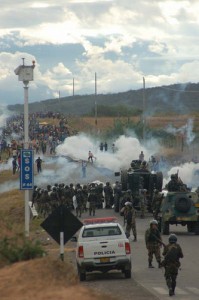
Police attempting to forcefully remove indigenous protesters blocking a road outside Bagua, Peru, June 5, 2009. Photo by Thomas Quirynen.
“If anyone still had doubts about the true nature of these free trade agreements, the actions of the Peruvian government make it clear that they are really about putting foreign investment ahead of everything else, including the livelihoods — and even the lives — of indigenous people,” says Jamie Kneen, Communications and Outreach Coordinator for MiningWatch Canada.
Earlier this month, Peru’s president, Alan Garcia, said the indigenous protesters were standing in the way of progress, modernity, and were part of an international conspiracy to keep Peru impoverished with their blockades.
“Garcia seemed to imply the Natives were a band of terrorists as he stood in front of hundreds of military officers in a nationally televised speech,” says Ben Powless, a reporter from the frontlines with Rabble.ca. “He continued to decry the Indian barbarity and savagery, and called for all police and military to stand against savagery.”
There are conflicting stories on the accounts of what took place on the June 5 bloodbath. Police dispatches claim that when they arrived to physically remove protesters, many officers were disarmed, killed, or taken prisoner by the protesters.
But indigenous people and families of missing protesters say that the police came looking for a fight. Police and military acted in a violent sweep, searching local towns and houses for protesters, shooting to kill.
A human rights lawyer in the region told the BBC that while 30 protesters have been officially proclaimed dead, hundreds still remain unaccounted for. Locals are accusing police of burning bodies, throwing them in the river from helicopters, and removing the wounded from hospitals to hide the real number of casualties.
Powless reports that a curfew has been imposed on the local towns near the area of Bagua and these Amazonian towns have become militarized. The government has begun persecuting and threatening jail for local indigenous leaders. And fear is growing that the government is trying to build support in further repressing the protesters.
“This is not a path to peace and reconciliation,” says Powless.
One Canadian company that will benefit directly from this rollback of indigenous rights is the Alberta-based petrochemical firm Petrolifera. The Peruvian government recently signed an agreement with Petrolifera to explore land inhabited by one of the world’s last uncontacted tribes, a blatant human rights violation for the purposes of enriching the tar sands development.
“Canada is the largest investor in Peru’s mining sector. If people are being killed on behalf of Canadian investors, to promote and protect investment projects on Indigenous land, then their blood is on our hands,” says MiningWatch Canada’s Kneen.
Last Wednesday, the Canadian Senate passed Bill C-24, which furthered the Canada-Peru free trade agreement by implementing legislation protecting it. Despite this bloody civil war for the Amazon and indigenous rights, the first bilateral agreement Canada has signed for the Americas since 2001 was approved, by the Conservatives and the Liberals. Prompting the question once again: whose interests are being looked after?
 Emily Hunter is an environmental journalist and This Magazine’s resident eco-blogger. She is currently working on a book about young environmental activism, The Next Eco-Warriors, and is the eco-correspondent to MTV News Canada.