
Justin Trumpdeau. Photo courtesy of Twitter (@JustinTrumpdeau).
On July 1, President Donald Trump posted a tweet congratulating Canada on its 150th anniversary and referred to the prime minister as “my new found friend @JustinTrudeau.” This might seem odd, especially in light of recent disagreements between the two leaders over the Paris climate accord and Trump’s threats to ditch the 20-year-old North American Free Trade Agreement (NAFTA). But despite their differences it seems a summer bromance is in full bloom.
While not quite at the stage of strolling together through a flowery garden path along the ocean—as Trudeau did with French President Emanuel Macron in May—Trump’s tweet did hint to some serious sparks. Far from genuine closeness, what Twitter is calling #TrumpDeau is instead the product of a well-thought-out tactic to lull the erratic president into letting Canada sit on his good side—at least for a while.
Following through with his “America First” campaign battle cry, over the last few months Trump has repeatedly attacked the U.S.-Canada trade relationship, particularly on softwood lumber, dairy, and most recently, steel. In April, Trump threatened to pull out of NAFTA, calling it a “catastrophe.” He later backtracked and said he is willing to renegotiate (though he might change his mind once more if they can’t reach a deal that is “fair for all”). Trudeau has weathered these hurdles with grace, and has yet to appear too worried.
He put it quite simply in a public event hosted by the New York Times this June in Toronto, when Trudeau was interviewed by Times journalists Peter Baker and Canadian correspondent Catherine Porter. He loosely quoted a former prime minister—he couldn’t remember which one—likening Canada’s proximity to the U.S. to sleeping beside an elephant: “No matter how even-tempered the beast, you’re affected by every twitch and grunt.” (In fact, the man behind the famous quote was none other than his own father, the charming and much-loved former Pierre Trudeau, in whose steps our current PM seems destined to follow.)
This elephant is now far larger, grumpier, and prone to shuffle around than any of his predecessors. As the protectionist rumblings of the new American president are turned to the north, Canada seems to be facing a shakedown as the government carefully balances friend and foe.
The Trudeau administration has been preparing for these uncertain times since Trump was inaugurated in January. Nearly three-quarters of Canada’s exports head to the States, and the real threat of losing NAFTA has the administration switching strategies. “He decided to take a diplomatic approach,” says Baker, who credits the PM’s tactics. “He’s going to smooth over the differences as much as he possibly can, but that doesn’t mean he’s not finding ways to advance his own agenda.”
But what that agenda is, exactly, remains uncomfortably vague. In last month’s Times event, Trudeau was quick to admit the policy differences between the two. Yet when asked about NAFTA renegotiations he stuck to his reasoning that no leader in their right mind would call off such a lucrative trade agreement with so much at stake. When pressed further about his backup plan should the renegotiations in August go bad he insisted, “There’s no need for a plan B,” later saying he was 100 percent confident in the existence of NAFTA in a year’s time.
From a diplomacy perspective, being chummy with Trump isn’t a bad place to be, and so far Trudeau has scored a position with the president that other leaders have not (cue Macron awkwardly clamouring his way to Trump’s side for G20 family portrait). But despite the eagerness of the Canadian government to insist upon its importance to its southern neighbour, the U.S. just simply isn’t as reliant on trade with Canada. A recent study by the University of Calgary has shown that in only two states—Vermont and Michigan—trade with Canada contributes to more than 10 percent of its annual economic output. Canada’s provinces, on the other hand, are far more reliant, with 49 percent of Ontario’s GDP and 31 percent of Alberta’s GDP depending on U.S. trade. This has produced a lopsided trade relationship, putting Canada in a precarious spot.
But Trump is not like any other United States president. Trudeau himself labelled the president a businessman and a dealmaker. “He knows how to interact socially on a very effective level,” he said, acknowledging that Ottawa has had to react likewise. “We realized we had to get connected with the folks who were coming in to government for the next four years.” Trudeau’s government has wisely noted Trump’s considerable value in personal relationships—he’s the kind of guy where a strong handshake goes a long way in his decision-making process. So how does one approach trade with businessman? Baker says it seems the prime minister has calculated that personal chemistry and connections matter to the new president. “While they’re going to disagree, he’s not going to do it in a way that makes President Trump angry or hostile in a direct way,” he says. “He thinks that will benefit Canada.”
Trudeau has made it clear that he believes any attempt to stiffen the border will negatively impact both sides of the deal, and in what Times columnist Max Fisher described as a “donut strategy,” Trudeau has enlisted multiple layers of government to go around him. Canadian officials are appealing directly to American mayors, governors, and small businesses to establish relations outside the boundaries of the White House—a move that Barker describes as successful. “Where Trump and he don’t agree he’s going to find other partners in America,” says Baker. “That’s clearly a way for him to avoid open conflict with the president, but in the end a president matters and he’s going to find a way to manage that relationship.”
Mimicking Trump’s own political strategy, the prime minister has used personal connections and past political ties to solidify a holistic working relationship with separate states. Former Canadian PM Brian Mulroney—who has personal connections to many U.S. officials, including Trumps commerce secretary, Wilbur Ross—was called back from retirement to act as Trudeau’s unofficial advisor. Ontario Premier Kathleen Wynne has been in communication with North Carolina Governor Roy Cooper, building ties against more “buy American” efforts, while other premiers are apparently making similar connections to cultivate access.
So what will happen if renegotiations go sour? If the deal is scrapped, it’s likely Canada and the U.S. will go back to a similar version of the previous U.S.-Canada Free Trade Agreement, or draft a new one altogether. In this event, things are likely to get messy with support for NAFTA divided across the United States. Millions of jobs rely on the free trade pact, especially in midwestern states where agriculture producers rely on exports to Mexico and therefore have more to lose, according to the Midwest media group Harvest Public Media.
As the summer draws to an anxious end, Canadians are forced to trust Trudeau and his government in their noble quest to secure a sturdy personal and trade relationship with the U.S. president. Undeterred by the unstable ground he seems to be standing on, Trudeau continues to hold his head. “What I’ve found from this president is that he will listen to arguments,” he said. “And that’s something we can definitely work with.”
If you say so, Prime Minister. Over to you.
]]>
Image via pixdesk.ca
The image of Stephen Harper “muzzling” anybody frightens me. Hair slightly un-coifed, half a glass of Chablis to the wind, his dog-eared copy of Atlas Shrugged has been tucked away on the dresser where his tighty-whiteys are neatly folded in the drawers below. It’s Friday night god dammit and Stephen’s here to party. The safe word is: prorogation.
My musings on our Prime Minister’s psychosexual tendencies aside, as most of us have heard, the real muzzling is going on in the research lab not the bedroom.
On September 22, the New York Times Editorial Board wrote a piece criticizing our government’s policy of obstruction between scientists and the media. The board notes, “There was trouble of this kind here [America] in the George W. Bush years, when scientists were asked to toe the party line on climate policy and endangered species. But nothing came close to what is being done in Canada.”
Let’s just all live with that quote for a few minutes.
I’m not sure what to be more embarrassed about: that the newspaper of record (in a country where 57 percent of the people believe that the devil is an actual real thing) has felt compelled to completely justifiably trash our government and characterize the issue as “an attempt to guarantee public ignorance.”
OR
That the shit-tonne of great Canadian reporting on this subject has gone largely un-read.
What I do know is that this government’s policy of stifling communication, particularly on the topic of scientific research, is indicative of controlling a message that is so at odds with what I identify as Canadian that it sickens me to think about it. Isn’t this consolidation of power precisely what a multi-party, bicameral legislature is designed to safeguard against?
So how does the Prime Minister, who has adorably said (with a straight face) that he “believes in small government” and “doesn’t believe in imposing his values on people” justify his government’s actions? He doesn’t of course. He does what researchers are being instructed to do: evade and avoid.
But wait, the Information Commissioner (a largely toothless position) Suzanne Legault (appointed by Harper) is investigating a complaint brought against the government that states their policy is illegal under the Access to Information Act. So Canadians have that going for them…
Until then, Canadian scientists will continue to stand in solidarity with their government-owned brethren, fighting for transparency in what is supposed to be an apolitical field. Also, organizations like Evidence for Democracy, the Canadian Science Writers’ Association and Democracy Watch are committed to being vocal about the issue and keeping it in the public consciousness.
University of Ottawa biologist, Jeremy Kerr, summed it up well at a rally against muzzling when he said: “The facts do not change just because the Harper government has chosen ignorance over evidence and ideology over honesty.”
The facts don’t seem to be much of an issue for the majority of Canadians, fearlessly led by the Harper government. However, anyone who believes that restricting Canada’s access to unfiltered scientific research is wrong will continue to get screwed. What was that safe word again?
]]>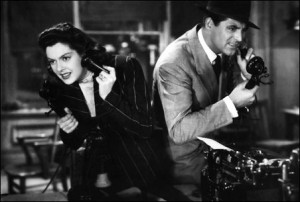
Rosalind Russell and Cary Grant in 'His Girl Friday'. Newsrooms still have a long way to go toward achieving gender equity.
[Editor’s note: On a semi-regular basis, we survey a sample of recent back issues of This to analyze the topics we cover, how truly national our scope is, and the makeup of our contributor roster. See the last survey here.]
The new documentary Page One focuses on the state of journalism, its new technologies and decreasing revenues. And if you look closely, the trailer also reveals the struggling industry’s sweeping bias. The reporters and editors interviewed at the New York Times are mostly men (and they’re all white):
It’s old news that American print media is running a deficit on female contributors. Last year Elissa Strauss conducted a survey of major magazines in the U.S. The New Yorker had 27 percent female bylines. The Atlantic, 26 percent. Harper’s Magazine, 21 percent. And that’s just to name a few. You can view a more extensive list by VIDA here. And last February, CBC Radio followed up on the story, interviewing Canadian magazine editors about the same problem north of the border.
So when my editor asked me to survey a year’s worth of This magazines, I jumped at the chance to uncover our biases. Where did our stories take place? What topics did we write about? How many of our writers, and their sources, were female versus male? The results surprised me.
Methodology
My survey may not be 100 percent replicable at home. You can view the whole spreadsheet on Google Docs here, or download it as a CSV file. And you can check out the previous year’s stats (which tracked geography and topics, but didn’t track gender).
I kept track of every article that had a byline. I assigned each of these a location (e.g. Vancouver) and a general topic (e.g. environment). I also noted each contributor’s name and gender*. Then I took note of every person who was quoted. I chose to do this because a direct quote conveys the person’s voice to the reader. I also took note of each source’s gender. Quoted sources are very often referred to as “him” or “her” in an article. When they weren’t, I asked the writer or Googled names to find out.
As I surveyed the first magazine, an unexpected trend emerged. There seemed to be far more male sources than female sources. So I retraced my steps and added each source’s profession, title or expertise. I kept it up, hoping this would give me more insight if the trend continued.
Results
We haven’t changed much since last year in terms of geographic distribution. Ontario, particularly Toronto, appeared frequently (though we haven’t determined yet whether it’s disproportionate to Canada’s population). British Columbia, with particular emphasis on Vancouver, was a close second. This year it was the Yukon, Nunavut and PEI that went unmentioned (last year, it was New Brunswick that was non-existent between our purportedly national pages).
When it comes to our favourite topic, the environment is still number one. We also love technology and politics, as per the usual. Freelancers take note: we didn’t have nearly as many stories about racism or homophobia in this sample as we do about women’s rights. Transphobia was invisible between our pages.
This Magazine is a lefty indie not-for-profit with a male editor and female publisher, and our bylines are also pretty egalitarian: 53 percent of bylines over the year were female (76 out of 142). Compared to the male byline bias in the mainstream media, This Magazine constitutes a fair counterpoint.
However, when it comes to sources we’re not doing so well. Only 72 out of 256 sources quoted were female. That’s 28 percent. Suddenly we look a whole lot like those other magazines I mentioned. Are our writers biased, or are the numbers reflective of the status of women?
Both. Male writers were less likely to quote female sources (22 percent of sources quoted in their articles were female). By contrast, sources quoted by women were 33 percent female. This disparity suggests that credible, accessible, female sources exist—but men aren’t quoting them. Another factor could be that men tended to write more for our technology issue (13 out of 23 bylines), which acknowledged a lack of women experts in the field. Conversely the most female bylines (17 out of 23) could be found in “Voting Reform is a Feminist Issue.”
If our journalists are quoting people of the same gender as themselves and over half our bylines are female, shouldn’t we have a more even split of sources? Sadly it doesn’t appear that personal bias plays a strong enough role to account for the disparity. I have to conclude that the lack of females quoted reflects the status of women in society.
Think about it. Journalists quote people who hold positions of authority. As I read down the list of sources’ titles, I can say pretty confidently that our reporters interviewed the right people. Some of their sources are politicians, CEOs, judges, police officers, people of high military rank. In Canada, these positions are occupied by men and women—but women are decidedly the minority in those cases. In 2007, according to the Status of Women in Canada, 35 percent of those employed in managerial positions were women. According to a one-week old worldwide survey by the new UN agency for women, 44 percent of Canadian judges are female. Only 18 percent of law enforcement workers are female, says a 2006 StatsCan report. According to StatsCan the Department of National Defense, only 15 percent of Canadian Military personnel were female. It’s no wonder that our feature on Canada’s involvement in Afghanistan quoted no female military sources, and that our reporters interviewed few females involved in law when researching our “Legalize Everything” issue.
Solutions
The best thing journalists can do to eradicate bias is to be aware of it, which is why we do this kind of analysis in the first place. Without this first step, we can’t ever hope to challenge our points of view. Acknowledging bias includes direct and indirect bias. The first type includes journalistic and editorial perspectives. The second type includes structures that perpetuate the unequal status of women, such as advertising bias, media ownership, and hiring practices in the wider world. So although it’s a great start, seeking out female sources in law enforcement, engineering, politics and technology is not going to cure the gender gap. Those in positions of power must attempt to correct gender, race, sexual orientation and class biases when they hire and promote workers. Voting reform would help, too.
Don’t lose heart — there are also positive signs in the numbers. The equality of male-to-female bylines and the greater female tendency to write without using as many direct quotes (often considered a sign of reportorial confidence among journalists) challenges Strauss’ guess that women may be meek or passionless about politics and critical journalism. For a magazine with the slogan “everything is political,” this is simply not true. It could, however, still be correct for the magazines Strauss surveyed. After reading a year’s worth of This, I can safely say our writers (female and male) are unapologetically critical in their approach — and nowhere near shy.
We want to do better in terms of bias, and we welcome any and all suggestions on how to improve our coverage of underrepresented topics, locations and communities.
*I don’t believe gender is necessarily fixed, but it certainly has a binary status in our language. Whether the sources actually identified as one of two genders or not, our magazine certainly identified them as male or female; no articles used “s/he” or mentioned any other gender. Due to the superficiality and time constraints of this survey, it’s not possible to tackle the language problem right now. However, I would love to hear your thoughts on how this might be possible in the future. Email [email protected].

February 4 anti-Mubarak protest in Alexandria, Egypt. Creative Commons photo by Al Jazeera English
In Egypt, Libya, Bahrain, even Italy, citizens are rising up, risking their lives to protest their corrupt governments. Egyptians, in a historical event, have proven they can be successful in overthrowing years of dictatorial leadership. Canadians were mostly cheering along (though our government wasn’t), but’s hard to put ourselves in their place—Canada, flawed though it is, is simply not Egypt. Corruption here is less pervasive; the military less present in our everyday lives; we have a functional political opposition. But since freedom, democracy, and human rights are on everyone’s mind right now, perhaps it’s time for a little self-evaluation session.
The uprisings in the Middle East should prompt Canadians to take a closer look at the state of our own politics. For just one recent example, see the recent KAIROS “not” scandal and assess how democratic our government’s behaviour truly is. Murray Dobbin on Rabble stopped just short of comparing Steven Harper to ousted Egyptian president Hosni Mubarak, and called Harper’s Conservative cabinet a squad of “hit men.”
But would Canadians ever reach the point where we just couldn’t take it anymore? Could we rebel in Egypt-like protests? Would our rants to friends or angry blog comments ever manifest as rebellion in the street?
Stereotypically, Canadians are polite and retiring; unconfrontational if you’re being nice about it, apathetic if you’re not. But there’s data to prove that we really don’t like things to get politically messy. Besides our dismal-and-getting-worse voter turnout rate, A 2000 General Social Survey by Statistics Canada found that only 9 percent of Canadians (age 15 and up) had participated in a public debate that year (things like calling radio talkback shows or writing letters to the editor). Half of those individuals researched information on political issues, and 10 percent volunteered for a political party. We also seem naturally more inclined to express our opinions with a group that we know will share or agree with our own opinions.
Historically, if Canadians take the time to understand a politcal issue, then get mad about it, we will find a way to express it. Like the time time the Conservative government decided prorogue parliament; a 63 day break while 36 government bills lay untouched. While plenty of us apparently didn’t know what the heck that meant, 200,000 Canadians got angry, logged onto Facebook and joined a group called Canadians Against Proroguing Parliament. Many attended actual rallies across the country.
If you were in Toronto in the summer of 2010, you witnessed Canadians in a more traditional form of protest during the G20 conference. Over 300 people were arrested and the images of Toronto streets seemed almost unrecognizable, as if it were a different country altogether.
The erosion of Western democracy seems to be everywhere you turn lately. Paul Krugman identified the union-busting tactics of Wisconsin governor Scott Walker as just the latest example of a hemisphere-wide push by anti-democratic forces: “What Mr. Walker and his backers are trying to do is to make Wisconsin — and eventually, America — less of a functioning democracy and more of a third-world-style oligarchy,” Krugman wrote.
Dobbin’s Rabble column sounds the same alarm for Canada: He calls Minister of International Cooperation Bev Oda’s corrections of the CIDA report “political thuggery worthy of a dictatorship.” This seems to be just one example of our democracy moving backwards while citizens of Italy, Libya, Tunisia, Egypt, and Yemen are actively involved in taking back control of their respective countries.
]]>
Irving Howe (the New York socialist) once wrote “Blessed New York Times! What would radical journalism in America do without it?” The newspaper was, to be sure, a tool of the bourgeois but a tool that reported the news with unequalled comprehensiveness. Read it and, ideology aside, you became the possessor of a full range of facts, dates and events. I had a similar feeling this weekend reading the Times coverage of the Afghanistan war.
Journalism is changing—this we know—but on the eve of (depending who you talk to) a cataclysm for old journalism or its reinvigoration the American paper-of-record still puts out an impressively thorough and relatively exhaustive edition, if politically problematic for a progressive. Contrast this to the newly redesigned Globe and Mail whose editor, John Stackhouse, told Toronto Life that “it’s fine for a typical news story to be 600 to 800 words… Most readers aren’t going to read more than that.” Anyway, I digress. This is supposed to be about Afghanistan.
It’s shocking how little we actually know, and how little what we do know tells us. Journalists, or should I say the organizations that employ them, have largely abdicated their responsibility to report the war in ways that allow readers to secure a nuanced understanding of what exactly it is that Western militaries are doing in south-central Asia. The Swat valley, Provincial Reconstruction teams, human interest stories all make an appearance in the Canadian press but little effort is made to draw connections or attempt some sort of synthesis. If there ever were a time for bold reporting, this is it. There are, of course, bright spots. Re-enter the Times.
First, if you have time, read this article. It deals with one aspect of the war that is, I think, neglected: namely the strategy that NATO is pursuing. In short, Western forces are adopting a hyper-aggressive posture to demoralize anti-occupation forces prior to NATO’s withdrawal. Knowing this, in addition to what we already know (that free societies cannot be ushered in under the aegis of an imperialist gun, etc.), will perhaps allow us, like Irving Howe, to develop more incisive, accurate and compelling critiques that will inspire dramatic democratic change. Here are five important points to note about the conflict in Afghanistan today, noted by the Times and Wired:
1) The current strategy. Canada, amongst other nations, is in the process of evacuating its military personnel from the region having declared that a decade-long commitment to the war is sufficient. The United States, the main antagonist in the war, has thus been required to shoulder more of the burdens of occupation. It, too, however, is maneuvering for an endgame. The Times:
“Since early last year, when President Obama took office, the overriding objective of American policy has been to persuade the Taliban to abandon any hope of victory. It was to make that point that 30,000 additional troops were sent here…the strategy has been to break the Taliban’s will, to break up the movement, and to settle with as many leaders as are willing to deal.”
2) The way to effect that victory
“In the past several months, General Petraeus has loosed an extraordinary amount of firepower on the Taliban insurgency. Special operations forces are now operating at a tempo five times that of a year ago, killing and capturing hundreds of insurgents each month. In the same period, the number of bombs and missiles aimed at insurgents has grown by half. And General Petraeus has launched a series of operations to clear insurgents from the southern city of Kandahar.”
3) This was done before.
“That strategy looks a lot like the one that brought General Petraeus success in Iraq in 2007 and 2008. With Iraq engulfed in apocalyptic violence, American field commanders reached out to nationalist-minded guerrilla leaders and found many of them exhausted by war and willing to make peace. About 100,000 Iraqis, many of them insurgents, came on the American payroll: The Americans were working both ends of the insurgency. As they made peace with some insurgent leaders, they intensified their efforts to kill the holdouts and fanatics. The violence, beginning in late 2007, dropped precipitously.”
“Awakening leaders and security officials [in Iraq] say that since the spring, as many as several thousand Awakening fighters have quit, been fired, stopped showing up for duty, or ceased picking up paychecks. During the past four months, the atmosphere has become particularly charged as the Awakening members find themselves squeezed between Iraqi security forces, who have arrested hundreds of current and former members accused of acts of recent terrorism, and Al Qaeda’s brutal recruitment techniques.”
5) The return of shock and awe?
]]>“Last month, NATO attack planes dropped their bombs and fired their guns on 700 separate missions, according to U.S. Air Force statistics. That’s more than double the 257 attack sorties they flew in September 2009, and one of the highest single-month totals of the entire nine-year Afghan campaign.”
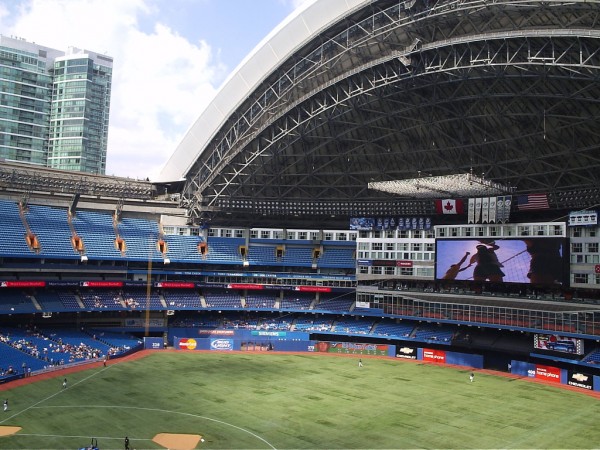
Toronto's Rogers Centre (formerly Skydome), built with public funds and later sold off to private business for a pittance. A major league sports team is often assumed to be more economically stimulating than actual results attest. Creative Commons photo by Mike Babcock.
The National Hockey League playoffs open this week and the abundance of emotion-laden storylines are sure to captivate a significant portion of the the Canadian sporting public’s hearts. But while three Canadian squads—the Vancouver Canucks, the Montreal Canadiens and the Ottawa Senators—vie for Lord Stanley’s coveted Cup, there’s another, less exciting, story unfolding that probably should captivate our minds, even those of the non sports-adoring variety.
Tomorrow, the city council of Glendale, Arizona will vote to approve the arena-lease agreements for the two bids put forward to purchase the suburban community’s NHL hockey club, the Phoenix Coyotes. But, as the Globe and Mail reported this weekend, even if the leading bid, submitted by Chicago White Sox owner Jerry Reisdorf, is approved the lease agreement may not survive. In an interesting twist of fate, a lawyer for the Goldwater Institute recently announced that the conservative watchdog group won’t hesitate to take the city of Glendale to court if it appears the agreements are in violation of Arizona laws against public subsidies for private corporations.
The concern for Goldwater is a piece of the Reisdorf “memorandum of understanding” that calls for local taxpayers and businesses to foot up to $165-million of the purchase price and annual operating losses. While this sort of stipulation isn’t unusual in the standard agreements between sports franchises and host cities, it is unusual that a powerful watchdog is calling both parties out.
For too long, the public has dogmatically accepted the connection politicians and team owners like to tout between sports franchises and local economic development. Massive public subsidies are regularly given to billion-dollar sports operations under the guise that they will bring an influx of new economic activity to the local community. This year alone, Winnipeg, Quebec City and Hamilton have all, at one point or another, flirted with the idea of bringing a professional hockey team home. And each has made claims about the economic benefit a pro franchise would bring. However, the problem is that justification is demonstrably false. There is, in fact, no economic rationale for publicly funded sports teams and stadiums.
According to Andrew Zimbalist, a prominent sports economist at Smith College in Northampton, Massachusetts, all independent scholarly research on the economic impact of sports teams and stadiums has come to the same conclusion: there isn’t any. As he told Stephen J. Dubner on the New York Times Freakonomics blog, contrary to the rhetoric often aired by local politicians and sports teams owners, “one should not anticipate that a team or a facility by itself will either increase employment or raise per capita income in a metropolitan area.”
The economics behind this are complicated, but, generally, three principles hold. First, sports stadiums rarely create new capital: consumer spending on sport is almost always a redistribution of existing dollars in the local economy. People don’t spend money they wouldn’t have otherwise; they simply spend some their entertainment budget on local teams instead of something else. Second, much of the income generated by the team ends up leaking out of the local economy. Millionaire owners and players have their savings tied-up in world money markets and often live and spend their money outside of the host city. Third, and perhaps most importantly, host governments typically contributes close to two-thirds of the financing for the facility’s construction, usually takes on obligations for additional expenditures and routinely guarantee a significant amount of revenue. In other words, it’s the taxpayers that bear most of the risk—not the multimillion-dollar franchises that make a city home.
That’s not to say there aren’t perfectly good reasons for cities to host big-time sports teams or build world-class sports stadiums. It’s just that the supposed “positive economic impact” of a sports franchise shouldn’t factor into local governments’ decisions. Cities spend millions of dollars on cultural activities that they don’t anticipate to yield additional revenue. Sports teams can have a powerful cultural impact on a community and are integral part of most cities’ social fabric. If local residents value sport they are obviously welcome to allocate public dollars toward it. In fact, I, for one, hope they do. But sports teams and stadiums should be sold as a source of civic pride—not as a source of economic development.
]]> The Dalai Lama is charged with watching over Buddhist tradition, but on March 29, 2009 The New York Times revealed a shadowy presence was secretly watching him, invisibly sending information about the religious leader to his anonymous attackers. When the story broke, the office of the Dalai Lama believed it was dealing with an ordinary computer virus. It turned out to be something more widespread, organized, and ominous.
Long before The New York Times, Canada’s Citizen Lab was on the case. Based at the University of Toronto, Citizen Lab is a global leader in documenting and analyzing the exercise of political power in cyberspace. The Lab’s 10-month investigation into the virus that had lodged in the Dalai Lama’s desktop revealed it was in fact just one of 1,295 compromised computers in 103 countries, many found in embassies, government agencies, and significantly, Tibetan expatriate organizations. The researchers at Citizen Lab dubbed the network GhostNet, which spread through a malicious software program—“malware,” in technical circles—called Gh0st RAT. Gh0st RAT spread via email to high value targets: diplomats, politicians, the Dalai Lama. Once installed on a target’s computer it provides barrier-free access to an intruder, giving them full control of the system as if it were their own. This allowed the thieves to bring sensitive documents back to four control servers in China. Worse, Gh0st RAT allows its operators to take control of an entire computer in real-time, giving them the unfettered ability to see and hear their targets through the computer’s webcam and microphone.
It’s virtually impossible to determine whether GhostNet was a work of cyber-espionage by the Chinese government or a single hacker who wanted to make it look that way. In January 2010, search giant Google admitted they were one of 30 companies attacked by the latest version of Gh0st RAT and threatened to shut down the Chinese version of its site. Computer security firm Verisign reported it had traced the attacks back to “a single foreign entity consisting either of agents of the Chinese state or proxies thereof.” Beyond China, countries around the world are increasingly using the internet for espionage and intelligence-gathering. Observers report more viruses, more trojan horses, more botnets, more surveillance, more censorship and more denial-of-service attacks. The tactics are being used by governments and independent groups alike for intelligence gathering, terrorism, national security and religious or political propaganda. Most of it happens secretly, obscured by layers of technical complexity. In the early 2000s, China was a leader in cyber-espionage, but it has lately been joined by more players: Saudi Arabia, Russia, North Korea, Iran, the U.S., and Canada.
We are witnessing, the Citizen Lab researchers believe, the weaponization of cyberspace.
“I realized there was a major geopolitical contest going on in the domain of telecommunications,” says Professor Ron Deibert, Citizen Lab’s founder and head researcher. “The information environment today is mediated through telecommunications. So being able to control, access and retain information through those networks are vital sources of intelligence. This was happening, but it wasn’t being talked about.”
Deibert isn’t new to the intelligence game. He worked as policy analyst for satellite reconnaissance in the Canadian Ministry of Foreign Affairs, but it wasn’t until he wrote a book about major technological shifts in history, and started researching his PhD—documenting how rapid technological changes of the information age affected global politics—that he began investigating the war that would set him on the path to being the “M” behind the Citizen Lab.
“Our technological advantage is key to America’s military dominance,” said U.S. President Barack Obama in a May 2009 speech on his administration’s plans for the militarization of the internet. “From now on, our digital infrastructure—the networks and computers we depend on every day—will be treated as they should be: a strategic national asset. Protecting this infrastructure will be a national security priority…. We will deter, prevent, detect and defend against attacks, and recover quickly from any disruptions or damage.” In the same speech he assured the world his security plan would not infringe on internet freedom or personal privacy. The U.S. Department of Justice, however, argues (though far less publically) it can’t be sued for illegally intercepting phone calls or emails—unless they admit what they’re doing is illegal, which they won’t.
It’s this kind of secrecy (in the name of national security or not) that Citizen Lab exposes. The small team of researchers and benevolent hackers, who work in the basement of the Munk Centre for International Studies at Devonshire Place in Toronto, watch the watchers and document the shadow war most are too busy updating their Facebook pages to notice. But more than that, Deibert wants to see Canada put its peacemaking reputation to work to lead the way in drafting a constitution for cyberspace among the nations of the G8. He believes Canada can be a leading guardian of the free and open internet, a valuable global commons worth preserving, on par in importance with land, sea, air and space.

Average internet users—the ones doing their banking, their shopping, or their FarmVille cultivating on the brightly lit thoroughfares of the web—are relatively safe from the cyber-spooks of the world. But if you challenge your government, expose injustice, or work for humanitarian ends in hostile places like China, Iran, Syria, Sudan, and Pakistan, it can become a dark, threatening place pretty quickly.
Deibert wanted to expose these injustices on behalf of citizens everywhere, but quickly discovered there were places he couldn’t go as a political scientist. So, with a research grant from the Ford Foundation, he launched the Citizen Lab in 2001 and began assembling a team dedicated to his two-pronged mission: monitoring and analyzing information warfare, and documenting patterns of internet censorship and surveillance.
The first major partner for the Citizen Lab was the SecDev Group, an Ottawa-based think tank that engages in evidence-based research targeting countries at risk from violence and insecurity. Its CEO, Rafal Rohozinski, was the man originally responsible for connecting all the countries in the former Soviet Union to the internet.
That meant he knew everyone who was anyone when it came to cyber-espionage in a region known for its deep ranks of hackers. This was the beginning of a vast network of agents who would later prove invaluable to all Citizen Lab operations. In those first days together with Rohozinski, Deibert also developed the methodology from which all Citizen Lab missions stem: A combination of technical reconnaissance, interrogation, field investigation, data mining, and analysis. In other words, the very same techniques used by government intelligence agencies like the National Security Agency in the U.S. and its Canadian equivalent, Communications Security Establishment Canada (CSEC). But this time, the expertise would be in the hands of the people.
“We wanted to take that combination of technical and human intelligence to turn it on its head,” Deibert said. “These organizations are using these techniques for national security purposes. They are watching everybody else, no one is watching them, and we wanted to watch them.”
Next, Deibert needed a powerhouse legal team. “We don’t break Canadian laws, but we do break the law in just about every other country,” he says. That’s why he partnered with the Berkman Center for Internet and Society. Based at Harvard Law School, this gives Deibert and his team access to a network of some of the best legal scholars in the country.
None was more vital than the final piece of the puzzle. All wars need soldiers and Citizen Lab needed the very best computer scientists, programmers, software developers and data analysts. All of whom were handpicked by Deibert from an unlikely recruitment pool: his own political science course.
The Munk Centre has all the architectural hallmarks of an English boarding school, left over from its days as a men’s university residence at the turn of the century. Few visitors have any idea what goes on beneath their feet in Citizen Lab’s dimly lit basement headquarters, but two of Deibert’s lieutenants have agreed to let me ride along on one of their online patrols.
Born and raised in Singapore, research associate James Tay has a personal stake in Citizen Lab’s mission. “I came from a country where those in power were willfully blocking access to the net. I just thought it wasn’t right, so when I heard about the lab tracking censorship and finally holding these governments accountable, I was like, ‘Okay, yeah, this is something I want to do.’”
That’s why, when riots broke out in Iran following its corrupted June 12, 2009, election, Tay was at Citizen Lab, keeping Iran’s lines of communication open. The Iranian government was blocking opposition leader Mir-Hossein Mousavi Khamenei’s website, along with Western-run sites such as YouTube and Twitter. Opposition supporters needed a way to stay connected online, to share information and coordinate their response to the crackdown.
The battering ram that broke through Iran’s online barriers is called Psiphon. Developed first by Citizen Lab, the software is now its own commercial entity, helping to fund the lab’s academic research. Through small chinks in the Iranian government’s armour, Tay was able to send a short, crucial message to people inside Iran who needed unrestricted access to the web: the snippet of text he was charged with sneaking over the border through TweetDeck—software that communicates through Twitter without requiring an actual visit to its website— was an encrypted link to the Psiphon web server, a tunnel through the blockaded border that allowed users to see the web unhindered by Iran’s online filters. Once connected, Psiphon is simple to use: It appears as a second address bar in the web browser and delivers internet traffic through proxy sites that haven’t been blocked yet. Block one, and the data simply changes its route to the user. During the crisis, Tay was trusted with making sure Psiphon ran without Iranian governmental interference, allowing thousands of people to liberate their internet connections.
“Psiphon is open-source and free to the user, but the BBC and big media pay us money for the right to spread our proxy to their readers and viewers,” says Tay.
Psiphon isn’t for everyone, though. It doesn’t provide anonymity, for one, something that Psiphon users are made aware of before using it. Even so, many Iranians still used the service, often at great personal risk.
“Some of them were trying to organize rallies,” says Tay. “I saw that on Twitter a lot.”
But even more dangerous research is directed by the lab, just collecting the data risks the threat of imprisonment or torture if discovered by the offending country’s oppressive government. The project is known as The OpenNet Initiative.
If you stumble upon a site a sitting government doesn’t agree with, it may simply look like a problem with your internet connection. But that error page could be a fake. “These governments may publicly claim to block sites to protect the morals of their citizens, then use the same technique to block the site of a politician they don’t agree with,” says Jonathan Doda, Citizen Lab’s software developer for OpenNet. “They set up the error page because they don’t want people to know. The good news is they’re pretty easy to spot.”
“What’s most popular these days is proxy based blocking,” Doda says—in which a country’s internet connection is shunted through a single gateway that allows a regime to filter all the web traffic in and out— “or some American filtering software—the same thing you find in libraries and schools or some private businesses.” In every case, the country’s internet service provider intercepts your connection and substitutes an error page.
Sometimes, the error is legitimate. After all, internet connectivity in many parts of the world can be slow and unreliable. That’s why Doda must gather evidence of governments’ intent through extensive testing. His team accesses sites multiple times and compares what happens from within Canada to what happens from inside the suspected country.
Doda’s been programming since he was a kid, making software in BASIC on his PC Jr. It was fairly easy for him to create “rTurtle,” the software that collects the data, looking for anomalies like dummy IP addresses, weird-looking address headers and missing keywords in the returned page. The lab needed a way to test within the offending countries, but the lists of blocked sites are determined by religious or political elites and implemented by centralized internet providers in target countries—closed systems that are virtually impossible to penetrate as an outsider.
But Rafal Rohozinski’s international reach gave Citizen Lab the ability to recruit agents within those ISPs and other high-value positions in repressive countries’ internet hierarchies. “In Central Asia alone, we have a network of about 40 individuals working for us,” says Deibert. Some of them are literally putting their life on the line—guilty of treason for working with Citizen Lab.
“Going to Burma and running the software that Jonathan developed in an internet café—that’s life-threatening research,” says Deibert. “The person doing that would have to be aware of the risks.” Those risks range from arrest, imprisonment, and interrogation, to torture and death. Deibert knows people have been arrested under similar circumstances, so OpenNet’s work requires a delicate protocol.
“Jonathan might not know the names of testers in certain countries. I might not even know their names,” says Deibert. “They’ll have a key and it’ll be used to unlock that data they need to run the software. We don’t know who they are. There will be a person who mediates their communication with us. If Jonathan were sent to Syria and got captured, he wouldn’t be able to give out a tester’s name.” For everything at stake, you’d never know the risks by stepping into the lab. Among the islands of computer terminals and the big red vinyl couch off to one side, the only thing remotely James Bond-ish is a hollow world globe stocked with contraband cigars and bottles of alcohol from the countries they’ve visited. But for all they do for others, the Citizen Lab largely ignores internet censorship and surveillance at home.
“I’m not worried as much about Canada. We have a government that’s largely accountable. Despite all the problems, we still live in a democracy that includes the benefits of humanitarian law and respect for human rights. If I did this research in Uzbekistan, I’d be jailed and tortured within the hour,” says Deibert.
Canada has cyber secrets of its own that often escape public notice. There are two bills before parliament collectively called “lawful access” meant to aid law enforcement in obtaining information needed to make an arrest. (Both bills were put on hold when parliament prorogued in December, but they appear to be Conservative government priorities and are likely to be reintroduced.)
“The approach we’ve taken is to respect civil liberties to the fullest extent possible by recreating in the cyber world the exact same principles that have been applied in the analog world. In order for police to obtain the content of emails, or intercept phone calls over the net, they will require a warrant,” says Peter Van Loan, Canadian Minister of Public Safety.
That isn’t the whole story, says David Fewer, director of the Canadian Internet Policy and Public Interest Clinic, based at the University of Ottawa’s Faculty of Law.
At the moment, police can’t force ISPs to hand over a customer’s name and address without a warrant, but the lawful access legislation will allow them to do just that.
“It’s bad enough that ISPs can give over that information if they want,” says Fewer. “Obviously our view is it shouldn’t be made available.” For now, there’s an unofficial compromise: for child pornography allegations, most ISPs give up the information, but for other crime such as fraud, police still need a warrant. Fewer says the informal understanding isn’t good enough.
“The system should be formalized, so there’s a formal response across the board,” Fewer says. “Police should be obliged to get a warrant except in cases of imminent harm, akin to a search warrant.” But police forces are currently demanding search warrant standards be relaxed. “There are sliding scales they’re demanding on certain search warrants. Ordinarily, police have to give ‘probable cause’ and they want that standard to be replaced with ‘reasonable suspicion.’”
Canada’s democratic laws don’t keep you immune from the government’s roving eye in cyberspace, either. “We have to start with the assumption that everything we do on the internet is public,” says Deibert, “and then work backwards and say, ‘What of my communication is private?’ Since potentially, at every step along the way, you can be monitored.”
In your terms of service agreement with Rogers or Bell they have the right to retain, store or turnover any information they provide you as a service including web history, web addresses, emails, and chat logs to the Canadian government for intelligence gathering and law enforcement purposes. CIPPIC is fighting various court battles around the disclosure of user identity to thirdparties online.
“We need courts to carve out some mechanism for preserving respect for privacy online,” says Fewer, “because privacy is a human right.”
Deibert wants the nations of the world to establish their own formalized treaty for the internet, one that treats cyberspace as a public commons and halts the aggressive arms race that threatens to further erode our basic rights. But drafting such an agreement will prove difficult, as security concerns continue to override basic rights.
Incidents like GhostNet demonstrate that even when all signs point to a massive national espionage plot, online attacks are difficult to trace, and governments nearly always enjoy plausible deniability.
“Even when we have lots of evidence that indicates a country may be behind it, the government denies any association,” says Van Loan. “Attacks are extremely hard to trace. What would likely happen is wholesome, good players would follow it, but the bad operators would continue to operate outside of it.”
And such a treaty could abuse as much as protect. “Anonymity is viewed [by governments] as a tool of terrorists and hate-mongers and—in the negative sense— whistle-blowers,” says Fewer. He fears any such treaty would inevitably morph into a cyberspace trade agreement, further tightening abusive intellectual property laws and scaling back civil liberties at an accelerated pace. “You need a tragedy for anything good to come out of a treaty like that. The International Declaration of Human Rights was the result of the First World War.”
With six billion people on the planet facing global problems, Deibert says the real tragedy is losing the open and unfettered ability to communicate globally, but Van Loan sees no other choice. “It is really the new arms race. Every time we erect new barriers and protections some smart, tech-savvy individual comes along and finds ways around those defenses.”
For the moment, it will have to be enough to know that Citizen Lab will be watching the watchers. James Tay admits he takes his work a little too seriously. “I don’t sleep,” he says. “This isn’t your typical 9-5 job. I regularly find myself responding to emails in the middle of the night. Ron wants us to sleep, but this isn’t a job for me. It’s something I live and breathe.”
]]>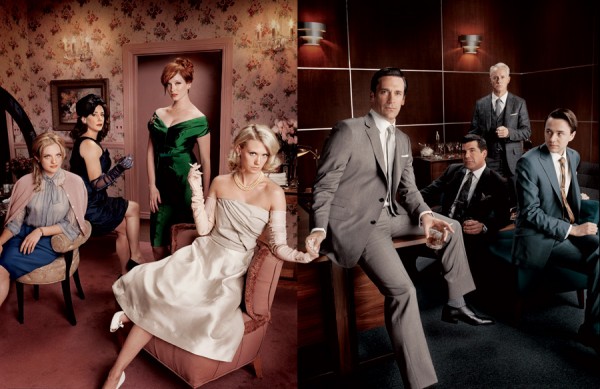
Mad Men is a hit. But are its ideas retrograde?
I’m a fan of the AMC series Mad Men, which premiered its third season last night. The show has always occupied an awkward cultural space, both fetishizing and pathologizing its subjects: meticulously styled and artfully shot, it depicts a glossy, nostalgic vision of the early 1960s in America, but continually undermines that nostalgia, exposing the cruelties, inequities, injustices, and hatreds that flourished at the time—and many of which still do.
I enjoy watching the show—it’s some of the most assured and polished storytelling on television right now—but I feel ambivalent about it, too. At what point does showing, and commenting on, the retrograde worldview these characters live become an endorsement for it? Can you separate the aesthetic aspects—the jet-age furniture design, the architectural hairdos—from the social, political, and ethical environment from which they emerged? When I hear people talk about the show, it’s the clothes they seem to focus on: Betty Draper’s dresses, Don Draper’s grey flannel suits, the men in hats and trenchcoats, the women in gloves. I think the fashion is the least interesting part of the show; It’s the social context, glimpsed in fleeting but crucial moments, that gives Mad Men its tension, vibrancy, and meaning. The show’s strict adherence to period detail—the black washroom attendants who go tipless as their white clientele glide past; the sad marriage of frustrated closet-case Salvatore; the secretary-pinching and child-slapping and litterbugging; the pandemic alcoholism—often ends up perpetuating, or at least sanitizing, many of the same cruelties it is supposed to be demolishing.
Latoya Peterson has been doing some thought-provoking writing at Racialicious recently on Mad Men, and how the show’s treatment of black and asian characters is nearly as retrograde as that of its characters:
Are people so conditioned to ignore black narratives that any representation will do? And are people so accustomed to commentary about race coming in broad, heavy handed “racial moments” that we will ignore the lack of nuance used to portray the lives of axillary black characters?
There have been a handful of “racial moments” on the show, but it’s of the black elevator-attendant/jewish mailroom boy/sexy-geisha-waitress variety, quick cuts, and often used for comedic relief, since modern audiences supposedly know better than to buy into such ideas. But what it means functionally is that Mad Men is a show steeped—suffocating, sometimes—in whiteness.
There’s also been plenty of chatter about whether Mad Men is “feminist” because it features some women in empowered roles, a kind of prelude to the women’s lib movement that we know is coming down the road. Tom Matlack wrote in the Huffington Post in July:
As it turns out the creator of Mad Men views his show as a feminist show exactly because of its painfully accurate portrayal of the treatment of women in the workplace in the early 1960s. Weiner told me the highest praise he ever gets is when a woman approaches him after a public appearance to say she was a secretary during that era that era and the show got the sexual harassment exactly right. They always thank him for putting a spotlight on what really happened.
I suppose “getting the sexual harassment right” is a kind of accomplishment. Jezebel fleshed out the argument with 15 “feminist moments” from Mad Men. Again, in most of those cases, such as “It looks complicated, but the men who designed it made it simple enough for a woman to use,” are intended as comedy for modern audiences, but again, the ambient misogyny of Sterling Cooper often feels (literally) oppressive.
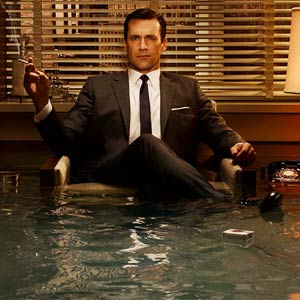 Having started its story in 1960, Mad Men started with certain necessary qualities: misogyny, racism, homophobia, and so on. I hope, and assume, that the story, now progressed to 1963, is poised to change its tone on many fronts, as the culture wars of the 1960s seep in. The ad campaign for this season, with Don Draper’s office waist-deep in water as he smokes, oblivious, hammers the point home. Frank Rich summed up my feelings in his Saturday New York Times column:
What makes the show powerful is not nostalgia for an America that few want to bring back — where women were most valued as sex objects or subservient housewives, where blacks were, at best, second-class citizens, and where the hedonistic guzzling of gas and gin went unquestioned. Rather, it’s our identification with an America that, for all its serious differences with our own, shares our growing anxiety about the prospect of cataclysmic change. “Mad Men” is about the dawn of a new era, and we, too, are at such a dawn. And we are uncertain and worried about what comes next.
That’s why, despite my misgivings about the politics of Mad Men, I’ll keep watching. On the show, as in real life, a change is gonna come.
]]>
First thing up is a severed head—young guy’s obviously a punk because he’s wearing a spiky blink-182 hairdo. The head is suspended slightly above the hoarding that has sprouted like industrial strength weeds along Washington Street. My wife and I head toward the hole where the towers used to stand. Soon we’re overtaken by a crowd of officious New Yorkers, smoking, looking bored, who impede our progress and route us onto wooden pathways. The sky is a brilliant blue. It’s breezy and warm, a lot like the day it happened.
The severed head is a fine example of New York guerilla art. Take that, touristas! You want to gawk, you want gore—you got it! The combination of Mayor Bloomberg’s nanny-state policies and the suffocating emotional patriotism of the New American Credo—“my country, right or wrong”—is enough to stifle expression. But here it is, a severed head staring at passersby. His face expresses the shock of having his gourd removed from his neck, confirmed by the jaggedness of the skin. A little aftershock comes when we notice a detached hand pulling the man’s hair, as if to indicate the head was simply ripped clean from his torso.
The head could mean a lot of different things. The mind doesn’t know what the body is doing—America beheading itself. Anarchist punks must die—America reinventing McCarthyism for the new millennium. If you don’t conform, your head might end up on a spike—disagree with Washington’s Weltanschauung and find yourself in Guantanamo Bay. Or, looking on the bright side—it’s a sunny day, after all—26 months after the attacks on Washington and New York, it’s okay to make outrageous statements again.
We turn the corner and gaze up at the oversized shrouds that still hang over damaged buildings, hiding gaping wounds. Walkways have been built around the perimeter to protect the curious. Chugging along, the site where the World Trade Center once stood is now as much a part of the New York landscape as Times Square. It’s easy to see the need to retain some of this outrageously expensive real estate for pensive reflection, instead of Hoovering up all traces of the attack like an oversized neat freak.
If there is a God, he’s probably a golfer, not Felix from The Odd Couple. The site looks like the Big Guy took one helluva divot on his approach shot. After such a foul swing, maybe he was angry and chucked his club at the Pentagon. Or maybe he was a lesser god—an admonishing, Chomskian scold—and this was his way of sending a message about Mammon and trammeling the rights of others in the name of profit.
As a construction zone, the area looks like the lid of the anthill has been scuffed away to reveal intense, ceaseless activity. It is a living, breathing project witnessed by thousands, the perfect space for an enormous environmental art installation, the scope of which Christo might have killed for. At the very least, it’s a time-lapse photography special for the Discovery Channel.
Were such a feature produced and televised, it couldn’t capture the psychological impact of the attacks. Humiliating millions of us to disrobe every time we fly, apparently because of an incompetent terrorist named Richard Reid. Waiting endlessly in line-ups at the longest unprotected border in the world. Having to put up with insufferable, oxygen-hogging bluster from the “might is right” crowd—it’s surprising the current government hasn’t manufactured an all-purpose stamp and branded its critics “unpatriotic” in public squares.
What used to be run-of-the-mill dissent is now considered treasonous. America was attacked, and now its staunch defenders must draw a line in the sand of free speech, a line visible only to the most fervent of patriots—all others will be judged accordingly. This doesn’t square well in a country where being quarrelsome is part of the definition of being democratic.
Is it still okay to make inappropriate comments publicly without fear—things people might not want to hear, but should? Ask Bill Maher, who said of the hijackers, “Staying in the airplane when it hits the building, say what you want about it, it’s not cowardly,” on-air six days after the New York and Washington attacks, only to lose his talk show, Politically Incorrect. He has rebounded on cable television after a humiliating apology on network talk shows didn’t save him, so maybe. Ask Steve Earle, who wrote an empathetic song about an Islamic foot soldier named John Walker Lindh, the nice American boy from Cali who went wrong, and was repeatedly accused of being unpatriotic. He went out on a musical and political tour as part of a collective called Tell Us the Truth that blasted the government, so maybe. Ask mainstream country music superstars The Dixie Chicks, who got roasted on the net and blacklisted on radio after singer Natalie Maines told an English audience they weren’t proud of hailing from Texas, because it’s the home state of President George W. Bush. Their most recent work, a double CD of their well-known songs recorded live, has few political references, but they won sympathy from their fans, so maybe. Ask Pulitzer Prize-winning illustrator Art Spiegelman, whose editor, David Remnick, censored his New Yorker cover illustration “Operation Enduring Turkey” because its parody of America’s attack on Iraq, Operation Enduring Freedom, went too far. Spiegelman wasn’t exactly a wilting violet about it, telling the Italian press he’s not working under any censor and doesn’t recognize the America he once knew, so maybe. Ask magazine writer William Langewiesche, who continues to be hounded online for portraying the Fire Department of New York as having somewhat less stature than the heroes descended from Mount Olympus. Langewiesche has moved on to other features, the FDNY has been nailed with scandals involving infidelity and fighting within its ranks, yet a website still chugs along merrily ripping the writer’s work to shreds, so maybe, maybe not.
I’m grappling with this notion of crossing the line in the noisiest, most dissenting town in the republic.

But enough time killed at Ground Zero. It’s time to head up to West 43rd Street. I’ve got a lunch meeting with Joseph Berger, a New York Times reporter whose specialty is neighbourhoods. I want to ask him whether reporters were shocked out of their usual methodical skepticism by the calamity and whether they became overly patriotic and perhaps a little sheepish in looking to Washington for guidance. It’s a nice theory—it could help explain why much of the press has been soft on what Times columnist Paul Krugman has termed the “revolutionary power” in office. It’s one thing to go after psychotic mass murderers, and quite another to use the manhunt as an excuse to plant the world’s most powerful military force on arguably the largest oil fields in the Middle East.
My idea hadn’t come out of nowhere. Langewiesche, author of American Ground, a best-selling book published in fall 2002 that gives a first-hand account of the WTC clean-up, tells me in a telephone conversation that the context of the aftermath was dishonestly reported. “Not in the sense that it was lying, but it was disconnected from what I was seeing on the ground.” Langewiesche takes issue with what he sees as depictions of cartoonish heroism. In his book, he says fire fighters came to be seen as “brawny, square-jawed men … who seemed to have sprung from the American earth like valiant heroes from a simpler time…. All this presented opportunities for image-making that neither the media nor the political system could resist.” Langewiesche had gained access to Ground Zero a few days after the attacks, and stayed there on and off for about five months. In his book, he portrayed a lively makeshift democracy as it was developing on the site after the attacks, and had little time for patriotic responses.
I meet Berger at 1:15. He’s apologetic because all the sources for his current story, about a Filipino family, seem to be phoning him back at the same time, and he’s only got an hour. We duck into a hole-in-the-wall deli around the corner. I’m looking for something like Montreal smoked meat and Berger says, “Forget it, it’s called a pastrami sandwich.” We both order one. It looks more like a meat mountain, which makes more sense later when I find French bistros serving super-sized portions. Between mouthfuls of processed, tenderized red slices, Berger politely dismantles my supposition. He is very deliberate and thoughtful, saying he doesn’t know any reporter who succumbed to any extreme emotionalism after the attacks. He says it’s probably true reporters were as shocked as anyone else—“I’m angry. I want to do something about this”—but it wasn’t long before their skeptical instincts returned. Hey, wait a minute, they would start to ask very quickly, why didn’t federal agencies get an inkling of this beforehand? “Whatever patriotic feelings kicked in,” Berger says, “were quickly overcome by the natural bent of reporters to question authority, question the establishment and find out what went wrong.”
Berger is an immigrant of Polish-Jewish descent and the author of a recently published memoir of growing up as a displaced person in New York City in the 1940s. His viewpoint is happily coloured by his immigrant background, and he wouldn’t be first in line to jump on the Bush government for negligence in dealing with the al Qaeda threat. He says he hasn’t noticed a surge in patriotism in the media for American policy in Iraq, despite the fact that many journalists covering the war were imbedded with the military. CNN still reports the latest Black Hawk down, the latest dead soldier, the latest suicide attack, he says, when it could be presenting positive features on newly functioning, civilized towns. He discounts the pervasiveness and influence of the tabloid press utterly, so the Jessica Lynch fiasco doesn’t count. He is a New York Times reporter, after all, and refers to the work of “serious reporters” at the Times, The Washington Post and The Wall Street Journal. He readily admits that papers like the New York Post became rabidly patriotic after the attacks, but says, “The extreme jingoism and bellicose patriotism expressed in the tabloid press was already there, at least to some degree, before 9/11. It wasn’t a fundamental change.”
I can’t help thinking this is an extraordinarily naive view of the world. More people watched Fox and saw Old Glory permanently pasted on the screen, and more people read the Post and agreed with the screaming front page headline, “W Wants Osama Dead or Alive,” than Berger would like to think. Among big network anchors, only ABC’s Peter Jennings objected to the flag-waving in the early days. There are more consumers of jingoistic news than there are consumers of sober reflection from the Times, The Atlantic, Harper’s and The New Yorker.
We’ve chowed down our little towers of dead cow and Berger saves his best thought for last. He’s been grappling with the notion of patriotism for an hour now and suddenly asks me to look at it this way: “It seems fair to say that journalists see themselves as, in some small way, helping society in writing and reporting and trying to get at the truth. If they see themselves this way, is it a stretch to see them as helping their country, too? In other words, is it a patriotic act to try to get at the truth in one’s writing and reporting?”
It’s an interesting and devious point, and gets to the crux of the dilemma about patriotism. After this pivotal event in American history, should a citizen be reduced to thinking, my country, right or wrong (with its essential sub-clause: I hope we’re right, but even if we’re wrong, my country)? Or should a citizen stay the course and continue to believe it is unpatriotic not to question authority? Both forms of patriotism—one hot and emotional, the other cool and detached—have existed in America at various times. Everyone from Stephen Decatur to J. William Fulbright to Emma Goldman to Oliver North has espoused one or the other. The question is not whether being patriotic is back in fashion—that’s a given—it’s whether this hotter, more emotional form of patriotism is moving the line of dissent back to an unacceptable level of intolerance. When perfectly reasonable, intelligent Americans are regularly pilloried for saying and doing things they’ve always done, images of Hollywood witch hunts come to mind.
There has, of course, been corporate and government censorship in most eras. McCarthyism might be a joke to everyone who doesn’t share Ann Coulter’s point of view, but in the 1950s it functioned very smoothly for a while as a government-sanctioned smear campaign that ruined many lives. A decade later, in an ostensibly looser era, the Smothers Brothers suffered the same fate as Bill Maher for cracking wise about the Vietnam War. On their CBS show, The Smothers Brothers Comedy Hour, which started broadcasting in 1967, the duo supported hippies and poked fun at religion, the presidency and the war. A couple of years in, they were openly at odds with corporate management and by April 1969 were unplugged. Maybe recalling these similarities is a good thing—it’s strangely comforting to know we’ve been here before, wondering where the line of dissent is.
When English folksinger Billy Bragg brings his electric guitar and oversized persona to a stage located on the second floor of Webster Hall in downtown Manhattan, there’s a sizzle in the air. Declamations like this one energize the crowd: “Someone has convinced Americans that the war on terror leads directly through the gates of Baghdad. Nowhere else in the world does anyone believe that—why?”
Bragg introduces each tune with lengthy rants on democracy and accountability. How, following the 2000 US election, he can only hear the word “democracy” in the ironic sense. How he prefers the word “accountability.” How we should hold elected officials to account every day. How he used to think it was a battle between communism and capitalism, but now it’s a battle between capitalism and accountability.
Bragg is part of Tell Us the Truth, a tour raising awareness against the Federal Communications Commission’s decision to allow increased corporate ownership of media properties. Alt-country hero Steve Earle is another big-name draw. Lester Chambers of The Chambers Brothers—the one-hit wonders of “Time Has Come Today” fame—is here, along with a tedious singer-guitarist named The Nightwatchman. In a former life he was Tom Morello, the fiery lead guitarist for rap-funk-metal-activists Rage Against the Machine. Jill Sobule, who once scored the unlikely hit, “I Kissed a Girl,” wins over the audience with her self-deprecating humour. “Raptivist” Boots Riley shouts into the microphone about how bad the system is, blowing away the Peter, Paul and Mary vibe. Webster Hall—a dowdy old Polish dance hall with ballrooms, side rooms and a banquet hall—for a brief stretch, is home to a rally th
at will make all that is right with the world left again.
Comments by musicians and organizers earlier in the afternoon at the press conference made it obvious the tour has become the Tell Us the Truth About Clear Channel bull session. New York on-air personalities like Dan Ingram and Zach Martin (who works for 104.3 FM, a Clear Channel-owned station) talked about the San Antonio, Texas, company as if it were the Borg (indeed, humans have been replaced with computerized on-air announcing to the point where stations from Seattle to Boston sound nearly identical). But during the evening there is little mention of this crusade. A banner above the stage says, “Tell Us the Truth About Corporate Globalization.” Standing around are mostly older fans and, inevitably, a few people who look suspiciously like hippies and activists. While it’s not exactly a “Take your castor oil, if you know what’s good for you” gig, there is certainly more raising of social consciousness than pints, as well as the pall of preaching to the converted. What is supposed to be a concert focusing on corporate control turns into a rally against Bush government policy. For every moment that feels uncomfortably like one of those uplifting, lefty, political rallies, there are an equal number of coolly patriotic comments. The musicians are indeed lovers of their country; they just don’t like where the country is going and they’re not afraid to tell you about it. They’re definitely crossing the line tonight, but in the safety of Webster Hall, appealing to the sympathetic, they will offend absolutely no one.
The one I’m here for is Earle. I’m hoping he delivers his song about Lindh, the infamous American Taliban, which created a stir last year among right-wing pundits. It’s not that memorable—I expected a three-chord rock anthem, instead it’s a relatively staid folk ditty—but the words were enough to cause a fuss. At the press conference Earle has this to say about his sudden pariah status: “I’ve been called unpatriotic by many people. They have first amendment rights, too, so if they want to call me unpatriotic, that’s their right. But I’m pretty sure my definition of patriotism and theirs are quite different.”
Earle has a way with a lyric, and his patter includes great phrases like “they’re hard dogs to keep under the porch.” He is very political, and has become a staunch death penalty abolitionist in the past few years. Sometimes he combines these elements into gut-wrenching rock ’n’ roll. Now, by questioning his right to create a work of art based on the story of a fellow American—Earle has often sympathized with underdogs facing very long odds—his right-wing critics have transformed him into a full-fledged Republican foe.
The emotional patriots concentrated on “John Walker’s Blues” and missed the real fire-starter on the Jerusalem album, “Ashes to Ashes,” with which Earle dutifully begins his short set. This is the song for New York and our times. Even without full rock-band accompaniment, the urgency of its simple chords pushes the words. The song contains a verse worth quoting in this context:
Now, nobody lives forever
Nothin’ stands the test of time
Oh, you heard ’em say, “Never say never”
But it’s always best to keep it in mind
That every tower ever built tumbles
No matter how strong, no matter how tall
Someday even great walls will crumble
And every idol ever raised falls
And someday even man’s best laid plans
Will lie twisted and covered in rust
When we’ve done all that we can but it slipped through our hands
And it’s ashes to ashes and dust to dust.
They ought to string a man up for thinking such thoughts. The Towers of Babel fall, the root-causes theory rises and American hegemony is ephemeral. Sometimes dissent comes in a very compact form.
Other times it doesn’t. As the night progresses, the protest becomes maudlin—and Earle is as guilty of sentimentality as anyone. Lord knows people who are angry at the US government response since 9/11 have a right to be, but it can make for sloppy progressive action. Too often the left has had a problem with the mundane process of our democracy—as if it weren’t good enough for them, as if the struggle to compete with the free enterprisers for votes were beneath them, as if they might touch anthrax if they used the same ballot box as the right-wing greed-heads. It’s a question of getting the hands dirty, but democracy always works best for the most fiercely organized. When a reporter at the press conference asks what citizens can do to combat corporate giants like Clear Channel, Earle says taking it to the streets works and writing your member of congress works. Maybe not immediately, but pressure works eventually. He says, “If we don’t, they win. Democracy is hard fuckin’ work,” and gives the example of an earlier, equally controversial time. “The Vietnam War stopped because it ended when my father came to oppose the war.”
The Republican brass preaches to the converted, too. They mobilize other Republicans to raise cash. Right now, there are “Rangers,” or fundraisers, who are bundling $200,000 in individual contributions each and delivering it to Bush-Cheney. Right now, there are “Pioneers,” or fundraisers, who are bundling $100,000 in individual contributions each and delivering it to the war party in Washington. Right now, there are “Mavericks,” or fundraisers under 40, who are bundling at least $50,000 in individual contributions each and delivering it to GOP coffers. That’s a lot of money, but all the centre and the left have to do is bundle the vote.
Bragg is the final act before the inevitable singalong. For the most part it’s rousing, but when he sings his Iraq war protest song, “The Price of Oil,” smugness permeates. “The generals want to hear the endgame/ The Allies won’t approve the plan/ But the oil men in the White House [oil woman, too, but hey]/ They just don’t give a damn/ Because it’s all about the price of oil.” We’ve gone from every vote counts to “oiligarchy” cynicism without blinking. Sobule flirted with cynicism earlier when she cracked, “Republicans are the kind of people who say, ‘I don’t have any intellectual curiosity’—proudly.” It’s good for a laugh, but it reveals a condescension that barely masks the insecurity of the powerless. The problem is, it isn’t just about oil. It isn’t just about empire. It isn’t just about remaking the Middle East in America’s image. It’s about all of these things, and what it really needs to be about is how to throw the rascals out. This is the message that gets lost. Notwithstanding the belief held by high-powered intellectuals like Chomsky, Nader and Lapham that it really doesn’t matter which party holds power, mobilizing the vote matters. Because of this lack of focus, nostalgic despair lurks beneath the joy. We need Woody here with us now. If only JFK hadn’t been shot 40 years ago. If only MLK were here telling us about the dream he just had.
My wife and I have had enough of the what-ifs and couldn’t-wes and wouldn’t-it-be-nices, and are about ready to leave. We’ve been standing up on the third floor behind the light man watching Riley harangue his audience and we’ve smirked a bit at a few limp attempts by some to get their groove on. I don’t know why we’re smirking—we’re beyond tired from traipsing around half of Manhattan all day and couldn’t shake a leg if we tried. Instead, we recline into one of the sumptuous, dilapidated couches. When the hyper-loquacious Bragg comes on he leaves
no doubt he’s one of the most articulate ranters of his generation of punk aestheticians. I close my eyes to concentrate as he rails against lack of government accountability. My wife taps me. Steve Earle is walking by. He looks at me, smiling. I had introduced myself to him after the press conference that afternoon, so he knew who I was.
“I’m closing my eyes to concentrate on Billy’s oratory.”
“Steve’s laughing because he caught you napping.”
Got to love these political rallies.
As we head downstairs, we find that the hall has exploded with hair gel and flesh. We don’t even have to look—we can smell the younger crowd. It’s noisy and joyous, if a little tense with anticipation. The dance floors—on both the main floor and in the basement—are steadily filling up as the crowd anxiously pushes through the doors. The music has a lot of bass and a lot of drums. There are some pinball-like noises on top, or maybe some keyboards, or maybe a moaning female voice, but there are no words. No words at all.
Why this commotion at 10:45 on a Saturday evening? No cover charge before 11. These are the people—the people who prefer their music with no words—who have to be convinced to vote, not the audience that paid 25 bucks a head upstairs to have their convictions confirmed. I imagine winning over this younger crowd will be a lot tougher. In Bush’s new America, how do we know the young people who like their music with no words won’t vote for the hard-line executioner from Texas?
Soho’s the kind of neighbourhood where you’ll notice an ad for a $2,200 two-bedroom, fifth-floor walk-up—and want to see it. I know the Bleeker Street flat is dinky, and its extras include baseboard electric heating and a cockroach floating in the toilet, because my wife chatted up the landlord about seeing it. As she was doing this, Whoopi Goldberg stopped to pet his dog. Goldberg was filled with concern, as the pooch seemed to have gotten its paw caught in the grating on the steps. A little farther north, on Greene Street, is where Rhonda Roland Shearer’s studio is located. It’s on the third floor, above a trendy, retro furniture store. Shearer says, “Oh, don’t shop there—it’s full of junk.”
Shearer is the widow of paleontologist Stephen Jay Gould. She’s a Marcel Duchamp scholar and the self-styled No. 1 nemesis of Atlantic scribe and American Ground author William Langewiesche. Shortly after the WTC attacks, she converted her Spring Street art warehouse into a supply depot for recovery workers at the site. Over a nine-month period she raised about $2 million in supply donations. She says before the attacks she knew only one cop—a guy who was a fan of her husband’s books—but over time became very good friends with many members of the Fire Department of New York, the New York City Police Department and the Port Authority Police Department.
I’m sitting on an overly comfortable couch, waiting for Shearer to come back from the kitchen with espresso. It’s 10:30 on Monday morning. Her space is a potpourri of Duchamp readymades, old furniture and humming computers. Persian rugs lie underneath antique pieces. She came up with the idea to surround a dining room table with exactly one chair from each of several periods of design, dating back a couple of centuries. Her main research subject, Duchamp, covers about three or four distinct movements from pre-World War I Stickley to post-World War II international modern.
I’m actually in the offices of something called the Art Science Research Laboratory, which Shearer and Gould founded as a way to “bring the humanities into the culture of science,” before the famous scientist succumbed to cancer in May 2002. There are about a half-dozen interns and volunteers busy at various computers scattered about the huge flat. Shearer says she has three journalism interns working on something called the WTC Living History Project.
Shearer is gracious, polite and casual. Her demeanour is typical of university intellectuals of my general cohort. The espresso will put her one over her daily limit, and two hours later, after coming at me with every argument she can think of to destroy Langewiesche’s book, she’s still got the jitters. The flashpoint of this attack is his account of exhuming a fire truck buried fifty feet below ground at the foot of the South Tower several weeks after the attacks. He claims that when the cab of the truck was lifted, pairs of new jeans were found. He then claims the construction workers at the site were incredulous and started swearing at and jostling with some of the firemen, because it seemed obvious to them that this particular crew had been engaged in a little pilfering—before the tower came down. Shearer has been doing her own investigation of this incident. She figured out which ladder company it was (which Langewiesche never mentioned), and deduced that it was impossible for the jeans to have come from The Gap, as he alleged. She says she cannot find anyone who will corroborate the story. The one person who claimed the incident happened now denies it, according to her.
That Shearer should attack this small, two-page section makes sense, as it is exactly where Langewiesche crosses the line in post 9/11 America. Here is where the myth of the noble fireman breaks down. They are not cartoon heroes. They are not gods sent to protect us from harm, to die if necessary to save us. They are human beings with the same petty temptations as everyone else. If Shearer can discredit Langewiesche’s story, then she can successfully clean up the history of the clean-up.
To buff the image of brave firemen and sell them as heroes, we succumb to another manifestation of hot patriotism. Author Barbara Ehrenreich calls nationalism the American religion, with its manifestations being the “cult of the flag” and the “frequent invocation of ‘God.’” In her book Blood Rites, she says, “The Gulf War evoked a burst of nationalist religiosity that, although clearly manipulated by television coverage of the war, seemed to be both spontaneous and deeply felt…. In effect, the war had reduced a nation of millions to the kind of emotional consensus more appropriate to a primordial band of thirty or forty individuals.” Substitute 9/11 for Gulf War and plus ça change.
In an interview last August, Langewiesche said that the story about the stolen jeans was simply the catalyst for his critics. Shearer and her uniformed friends knew he was reporting from the site, resented him for spending much of his time around Department of Design and Construction personnel and resented his point of view. Shearer confirms this. “Oh yeah,” she says, “we knew he was hanging around.” She mocks Langewiesche’s behaviour, accusing him of pompously walking around with a DDC badge hanging from his neck. She claims top DDC officials Ken Holden and Mike Burton “extracted their pound of flesh” from him because he owed his on-site access to them. This reading of the book is a stretch, as Langewiesche criticizes Burton’s zeal to finish the project. She claims Burton and Holden exploited their positions in the DDC in order to jump into the lucrative private sector, yet Langewiesche himself tells of Burton’s move back to the private world in the third installment. Holden’s private sector move is more recent, yet it is odd to criticize a man for moving up the career ladder after performing well on a job. By that reasoning, maybe George Washington shouldn’t have been elected president. Shearer, however, claims Holden’s peers thought him incompetent.
It comes down to the emotionalism involved in the removal of human remains. Shearer reflects the frustration of the firemen, who w
ere there to oversee the recovery operation. DDC personnel were sometimes callous about recovery concerns, which was made fairly clear in Langewiesche’s account. The point is that if the firemen were the heroes everyone made them out to be, remains would be required for proper ritual and burial in order for the myth to succeed. Jonathan Burgess, a classics professor at the University of Toronto, says this was necessary during the Hellenic Age. A human could achieve the status of divinity after death—as a hero he would have status beyond mortal and acquire some afterlife power—and be given perennial, ritual attention. Sometimes remains were dug up and moved to a more prominent position. But if the remains couldn’t be found, how would the ritual be enacted? In the context of 9/11, “it is an interesting problem,” he says. “In the modern world, it is very rare not to find the remains.”
As I’m leaving I realize that I’m pretty jittery from Shearer’s espresso myself. I think it best to tell her, finally, flat out, that I admire Langewiesche’s book greatly. “What about all the arguments I just gave you for the past two hours?” She looks hurt, saying further, “I hope you give me a fair shake.” I tell her I wouldn’t have bothered to come if I wasn’t going to try to be fair. And I really did want to understand her. I really wanted to see her stance, her website and her defence of the firefighters as a resilient symbol of hot patriotism. Nothing she has said has convinced me otherwise, yet she certainly doesn’t fit any Washington war-party mold either.
Earlier, I’d asked her why she persisted. After all, the firefighter lobby against the book had to be considered a success, as Langewiesche did not win any major awards (American Ground had been touted as an early favourite to win a Pulitzer Prize and/or a National Magazine Award). The paperback edition was not even promoted when it was released on the second anniversary of 9/11. The Atlantic’s unofficial policy was to move on. Langewiesche had nothing further to say on or off the record and he was, in fact, working on his latest book, The Outlaw Sea.
I ask Shearer if there is anything she likes about American Ground. She says, “Um, well, if you re-categorize it as fiction, it’s great.” I ask her why, instead of trying to take Langewiesche out, she won’t write her own account. She knew many of the participants in the drama, and claims to have been better connected than Langewiesche. She tells me she is writing a corrective account—her tabloid-style website critique of American Ground will form the basis of the book. Since Shearer got to know many of the firemen through her volunteer work, it seems easy enough to imagine her writing an account that leans heavily on uniformed workers and less on the DDC. If nothing else, it might be an intriguing look at the clean-up from the perspective of senior fire department brass.
Yet Shearer cannot seem to identify her own biases. Langewiesche made a conscious decision to tell the story through the eyes of DDC management, but she was the one who supplied uniformed workers with gear for months. She was the one who became very good friends with some of them, as did her husband, Gould. In fact, according to Shearer’s website, The Pipes and Drums of the Fire Department of New York played his funeral march in May 2002, and he was awarded a plaque that recognized his contribution posthumously. Shearer tells me in a later telephone conversation that I’m biased in favour of Langewiesche. I reply that she is biased in favour of the firefighters. She says, “I’m not biased in favour of the firemen, I’m biased in favour of the truth!”
The parallel between Shearer’s and Langewiesche’s stories remains tidy. Both started working on the WTC pile at about the same time. Both were secure in the knowledge that what they were trying to accomplish was right. Langewiesche tried to remain detached from the tragedy, and observe. Shearer latched onto and embraced the tumultuous emotions. Langewiesche wrote about the “unbuilding” of the disaster from the point of view of being a witness. Shearer willingly sided with the groups of men who had lost the most.
While Langewiesche’s cool detachment focuses on other topics, Shearer’s hot pursuit of perfect journalistic truth has embroiled her more deeply in the past. Down at Ground Zero, no frame has been mounted on the WTC’s sputtering economic engine, but it is being re-tuned and the chassis work is close to completion. The PATH station—the subway terminal that came very close to being drowned in Hudson River mud—opens the very day I interview Shearer. News crews arrive to mark the milestone, and the Times lands two features on its front page. Everyone remarks, anti-climatically, that it looks pretty much the same as it ever did.
What my wife and I really want is a photo of our severed head. Then we realize, what good is a photo of a severed head? There’s no World Trade Center in the background to give it context. It’s not there and, guess what, neither is the head.
]]>