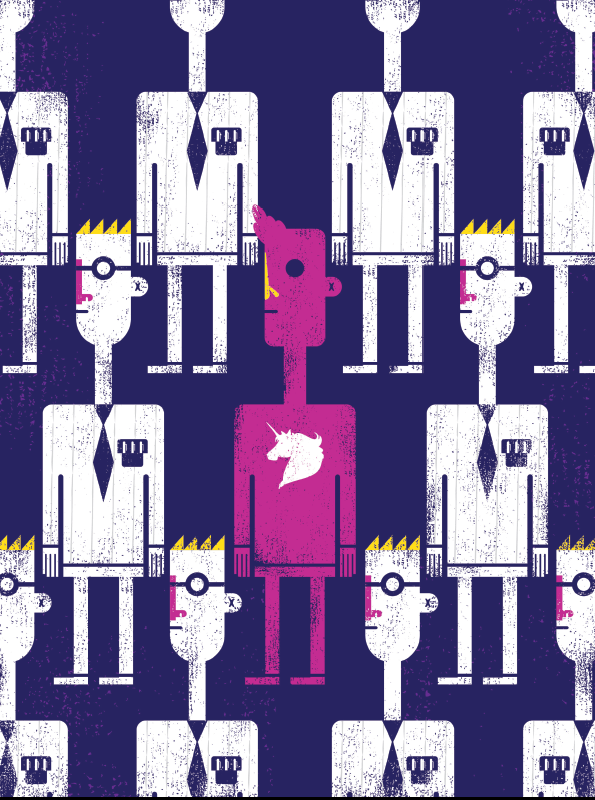
Illustration by Matt Daley
Straight, white men still dominate the technology industry. RM Vaughan introduces us to LGBTQ activists around the world who are fighting for change
STUART CAMERON REMEMBERS the first time Unicorns in Tech set up a booth at a major tech/IT conference. “People would stop and see ‘Unicorns’ and think, ‘Oh that looks like fun,’ and then see the subtitle, ‘LGBTQ in Tech,’ and run away! Or ask us why we were there. It was really terrible to see this reaction.” And that was only a few years ago, in very queer Berlin. As a Canadian who has lived in Berlin on and off for years, and who finds the city almost too informal and relaxed, to the point of difference-denying, I found this shocking. My first impulse was to be very Canadian about the story and become righteously indignant. And then Cameron started laughing. Sitting in his sunny Berlin apartment/office/hub with his two 20-something co-workers, the anecdote seems ridiculous to him, a story from a previous generation.
But the ugly truth of the tech/IT industry—that it is still overwhelmingly dominated by straight, white men—hangs over our giggling like a grey cloud. Despite its reputation for being the innovative and inclusive industry that propels our vaunted new Information Economy, most of the tech/IT world looks like the same old boys club. “The gear and the knowledge have changed,” Cameron notes with a shrug, “but the head office looks like 1975, not 2015. In terms of real representation, and money and decision-making power, we’re not even close to where we should be, especially since queers and women have always been present in the industry.”
Cameron, along with Jasmin Meiling and Marty Gormley, are the producers of Berlin’s massive Sticks & Stones, an annual LGBTQ-centric tech/IT Karrieremesse (a perfectly German word for this hybrid conference, career fair and party) that opens its sixth edition in June. From the funds that S&S brings in, the group puts together Unicorns in Tech events. Unicorns in Tech has a simple goal: to create events and meeting spaces in Berlin (and eventually elsewhere) where queers and their allies who are working in tech/IT can network and share information in safety.
Yes, safety. As Cameron points out, “in Berlin, tech is white and male and straight. There is still a shocking reaction of homophobia in that world. And, how does business work? It is built by networking and social circles: So why can’t queers make a ‘club’ the way straight men do?”
But it doesn’t stop at Unicorns in Tech. In May, S&S will launch #UNIT Festival, the world’s first queer tech festival, featuring over 40 speakers, performances, and art from all over the world all in one massive space. If Cameron is building an empire, it’s one that needs building. “We are trying to show the tech community that queers are a large community, a powerful community, and that we don’t want to just hear about ‘diversity’—we will instead make our own world.”
Angie Tsaros, a Berlin-based activist and co-founder of a monthly feminist crafting/gathering, puts it more bluntly. “I used to go to tech conferences and panel discussions and try to participate, but I’m a queer woman who does not look like a business woman, and it’s just too ridiculous to try to talk to a room full of expensive suits. I don’t belong there and they let me know that I don’t belong there very quickly.”
Why is the tech world so backward? Why does an industry based on knowledge sharing still need conferences and advocacy groups to teach them the basic values of diversity? Forget altruism, doesn’t everybody know now that being inclusive is profitable?
“Big tech has stopped pursuing diversity because now they know the right language and how to say the right things, so that they feel they have done their job just by talking about it. Also, when they talk about diversity, you never see any numbers for LGBTQ people,” Cameron shrugs. “I think it is better in North America than it is in Europe. When you tell European straight people you have a queer tech group, they think you are making pornography.”
It’s difficult to say, though, whether it is, in fact, better here. According to Canada’s Top 100, an annual list of businesses that acts as a guide to the “best places to work” in Canada, the “Best Diversity Employers” of 2014 (a list that marks LGBTQ inclusion) has everything from provincial governments to agri-business, all of whom, of course, rely heavily on tech workers. But there are no tech companies or startups
on the list.
Lukas Blakk, a Canadian tech expert who lives and works in San Francisco, and an old pal, recently spoke at a Unicorns in Tech gathering sponsored by SoundCloud. Blakk’s topic was a program Blakk created, in co-operation with a former employer, to build funded, safe spaces for marginalized people to learn how to code and thus gain entry to work in the tech field. The program was a stunning success, and several of the participants are now working in tech.
“Giving people space where they won’t be judged or feel excluded sounds obvious,” Blakk tells me one day while we hike up a massive canyon outside of San Francisco, chased by Blakk’s corgi Shortstack, “but it’s pretty rare. Some of the participants were living without permanent housing, and/or were gender-variant, or single mothers, and/or were underemployed—all people who have these amazing skills that they use every day just to get by. All we had to do was provide the space and the equipment.”
Blakk’s talk at Unicorns in Tech was well received, but Blakk is keenly aware of the pitfalls when social justice meets corporate profits. SoundCloud, the sponsor of the talk, is, after all, a third-party partner with Twitter and iTunes and is valued at between $1-2 billion (depending on which cranky music business executive you ask).
“Events that are purely social and don’t try to leverage the good fortune of being in a very competitive (read: well-paying) industry serve no tangible purpose for the marginalized community members who don’t have access,” Blakk emails me after the talk.
“Social get-togethers allow the company paying the bill to wash their hands of any actual accountability for changes in hiring practices, corporate culture, and civic responsibility,” Blakk continues. “It also lets attendees off the hook where they are being photographed and used as marketing for a very mainstream and privileged, top one percent agenda. Those who need jobs, access to better life quality, are in no way changed or helped by these types of events. I prefer hackathons and learning opportunities so that those who have are sharing back to those who don’t, yet. That, to me, is our responsibility to each other and how we make truly authentic community with others who share our marginalized identities.”
I put the same question to Cameron, and he welcomes it. “When I go to big tech events, I have to do so much explaining about who I am first. I feel safe, physically safe, but not maybe socially safe. I don’t think, however, in Germany, that companies are looking at what we do as a new way to make profits. For Sticks & Stones, companies have to apply to us and prove to us that they have good codes of conduct to protect queers before they can present. So, we profit off of them! What I have is a problem with companies selling products to the queer community, but they do nothing to improve their queer numbers. I hate that. Things are slower in Germany, and everybody here in tech checks to see what the U.S. companies are doing first.”
The core question of safety and, more importantly, of creating queer-inclusive spaces to thrive, remains mostly unanswered—even in Canada. In 2013, for instance, the Information Technology Association of Canada released a damning report on the representation of women in communications technology companies. The percentage of female-identified people on the boards of Canada’s largest tech companies was a mere 16.5 per cent. While there are no parallel statistics for LGBT representation, one imagines it is not much better. Queers-in-tech social groups come and go but appear, (unlike, say, HackerNest, a wildly successful, now international tech social gathering and information sharing group started in Toronto) to receive no corporate sponsorships. That’s not to knock HackerNest. Its open forum style and mission to spread prosperity via technology-sharing attracts a very diverse group of enthusiasts, even if LGBTQ participation is not specifically noted in the group’s PR.
Socializing and networking have value, actual handson activism has a deeper value, but the industry has a long way to go, and both Cameron and Blakk are still very much outsiders trying to bring change to a resistant monolith. “Being one of very few queer people in a company can sometimes feel lonely”, Blakk writes, “[Tech companies] need HR to make this sort of morale-building a priority to the level where people feel they can spend a few work hours a month on projects that improve the culture both inside the company but also build up connections with the larger community around us.”
A bitter irony of the tech boom is that companies tend to choose cities with high “gay indexes” (thanks again, Richard Florida), for their obvious cultural value, and then the actual workers displace the queers who make the city so interesting. It’s been going on for years in San Francisco, and has now reached the point, Blakk says, wherein “the SF tech world is primarily straight and male and it’s disrupting SF itself. We’ve got some amazing history here and people trying to stay here even as houses are being flipped out from under them.”
Berlin, with its low property costs and vibrant culture, is also quickly becoming a new tech wonderland. SoundCloud is based in Berlin, as is EyeEm, Wunderlist, and DeliveryHero, among others. It is also a start-up city for European tech entrepreneurs. And Berlin hosts the annual CEO-packed Tech Open Air festival. Subsequently, Berliners cannot stop talking, in increasingly panicked tones, about the rapid gentrification of their city. In the neighbourhood I live in, on the streets Isherwood once walked, cafes, bars, bookstores, and clubs are being replaced by kindergartens, modular furniture outlets, and“yummy mummy” clothing stores.
Cameron worries about the future he is partially helping to build as well. “The big thing is for the LGBTQ community to look at how we treat other groups ourselves. We have our own problems with sexism and racism, so until we fix our behaviour we can’t fix the behaviour of others. And of course sometimes straight people become interested in what you are building and then gradually take it over, away from you. But that will not happen as long as I can help it.”
Blakk offers a more blunt assessment. “Tech is supposed to be this ‘break all the rules’ industry that’s doing things differently but from most angles it doesn’t look that much different than the wolves on Wall Street I believe they (we) can do better.”
]]>Coworkers call Rabia Syed the “all star” of organizing. At 50 years old, Syed has spent more than half her life working tirelessly in union rights activism. Today, she is a full-time organizer for Workers United, a union that assists non-unionized workers in Canada and the U.S. to achieve the change they want to see in their workplace.
Her job title isn’t as simple as it may sound. As a union organizer, Syed listens to the concerns of non-unionized workers across the country and helps them come together to demand fairness in their workplace. She often takes bold actions opposing employers who are positioned firmly against unions, organizing for workers in health and retirement care, manufacturing, travel and tourism—to name just a few. Some of her biggest wins, as Syed calls them, include unionizing the first Sunrise Senior Living retirement home in North America in 2006. She also organized for a 62-year-old registered nurse to keep her job after her employer, essentially, deemed she was too old to work. “That brings me joy—that we can change the unions,” Syed says. “I couldn’t ask for a more meaningful career.”
Syed’s enthusiasm for helping others has long run through her blood. Born and raised in the Philippines, Syed came to understand what poverty was. As a child, she saw people around her struggling financially to feed their families. However, it was in the Philippines that Syed also discovered a sense of community: in dark times, people would find the help they needed from their neighbours. Her parents taught her to respect others who wanted help. Though Syed moved to Canada when she was 20 years old, it was in the Philippines that she decided to dedicate her life to helping others.
People have taken notice to Syed’s unconditional care for those seemingly without a voice. Workers United union organizer Matt Gailitis has worked with Syed for more than nine years and believes that she works tirelessly for other people by empowering and empathizing with them. “She brings a lot of hope to workers,” he says, “and makes people realize things can be better.”
Syed, however, rarely gives herself such credit—she considers herself to be like the workers she organizes. When talking about what motivates her to do her job, Syed attributes her co-workers for reminding her of the strides she has taken. And though she perhaps underestimates her ability to change lives, Syed is so inspiring even her children have taken up the battle of fighting for equality. Syed has four children, some of which have written and performed songs about workers rights and fair wages. The younger generation is taking workers rights seriously, Syed says. “It’s beautiful.”
Despite progress, Syed says that workers rights in Canada need more attention. “It’s important for workers to know their rights. Race, gender, age these are all barriers and discrimination people face today,” she says, “they also face it in the workplace.”
]]>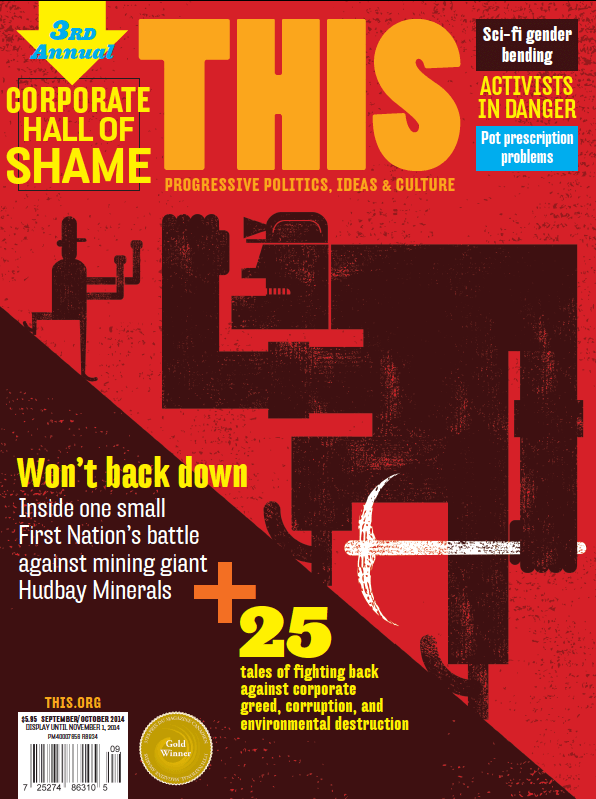
Cover illustration by Matt Daley
For the past three years, This Magazine has waded deep into the bad deeds of our country’s corporations. Each time, we scour hundreds of public records, court cases, company filings, and media reports to find our country’s most shameful corporate citizens. For 2013-2014, we found more than enough to enrage us. The now (unfortunately) familiar list of bad deeds included everything from shady ethics to eco disasters, and from oppressive labour practices to chilling human rights violations. There are also animal rights horror stories, bad aboriginal relations, and pukey corporate spin.
But, through all of it, this year we also found one thing to make us cheer: people are fighting back. They are protesting and marching, taking companies to court, and launching impressive awareness campaigns. They refuse to be silent. Ready to hold these companies to account? Go on and pick up This Magazine’s second annual Corporate Hall of Shame, on newsstands until the end of October!
]]>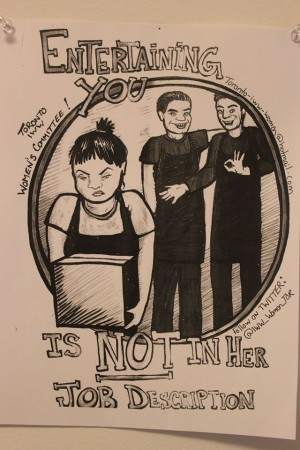
Image from the IWW Women’s Committee Facebook page
Since the Labour Day weekend new posters have been popping up throughout Toronto. They read messages like “Strength in numbers” and “Entertaining you is not in her job description.” The Toronto IWW Women’s Committee adds their Twitter handle to the posters, inviting questions and thoughts and encouraging dialogue regarding the harassment women face in the workplace as well as on the street (Other posters saying, “Don’t catcall us, creeps!”)
According to Canadian Labour Relations, a business resource on Canadian labour laws, “Equal pay for equal work is a major issue in many industries and areas of business.” Indeed a woman will make 74 cents to their male counterpart’s dollar—but that isn’t the only problem women face when going to work. Whether she is high up on Bay Street struggling to prove her worth or serving drinks across the street while being grabbed, or even being followed home after finishing a late night shift, a woman often faces discrimination and harassment in the workplace. Like Canadian Labour Relations points out, some employers’ fear women may not be as dedicated as men in the same job because women will be too family -focused, or not tough enough.
Though the site says there is no evidence proving women are too soft at work, there is evidence to the contrary: “In fact some studies show that women in positions of power are forced to be more cut-throat in order to keep the respect of others and to be considered one of the boys.”
The resource page also says women make up the majority of victims of sexual harassment in the workplace; the offenders, according to the site, could be supervisors, fellow workers, customers, suppliers and vendors.
“The struggles women face within the workplace is some of the most subtle, often ignored and over-looked ones,” says IWW women’s committee chair Summer (who asked we not print her last name). “Harassment in the workplace is such a common occurrence and we need to bring these issues to the fore-front.”
The committee started its poster campaign in April, one month after becoming an official committee to the IWW Toronto general membership branch. The poster campaign has been the committee’s first and worked as strengthening friendships and relationships within the committee while fighting against what the committee chair describes as a shared struggle with women in the community and workplace. There is hope that the campaign will inspire other women to organize within their own workplaces too, if not decide to join the committee themselves.
The committee’s meeting spaces are inclusive to all woman identified and gender non-conforming people. Though it is encouraged, a committee member does not have to join Industrial Workers of the World, a member-run union open to all workers.
“When we form committees of women we create a space for sharing our struggles with each other and more importantly, producing solutions together,” says Summer. “We allow ourselves to make demands with our collective action and, hopefully, get results. Strength in numbers, right? I believe women’s committees help strengthen the labour movement as a whole.”
A former This intern, Hillary Di Menna is in her first year of the gender and women’s studies program at York University. She also maintains an online feminist resource directory, FIRE- Feminist Internet Resource Exchange.
]]>Our southern neighbours have taken another step towards recognizing the need for equal pay for women.
This past Tuesday, president Obama vocalized his support for the Paycheck Fairness Act to be passed. The act points out the loopholes in the ironically titled Equal Pay Act and, if passed, would strive towards proper payment for working women across the nation.
Obama went as far as to taunt the Senate into making the correct choice.
“If Republicans in Congress want to prove me wrong, if they want to show that they, in fact, do care about women being paid the same as men, then show me,” Obama said. “They can start tomorrow. They can join us in this, the 21st century, and vote yes on the Paycheck Fairness Act.”
Unfortunately, the Congress did not pass the bill. Shocked? No. But you can’t blame a girl for hoping against hope.
Thankfully, Canada has its own warriors who are devoted to the cause. Toronto’s Mary Cornish, human rights lawyer and chair of Ontario’s Equal Pay coalition, has been gathering information on this for years. Cornish was the driving force behind the Pay Equity Act in 1987. Last year, she requested that Ontario’s premier Kathleen Wynne make April 9 Equal Pay Day.
It didn’t happen then, but good news, it’s happened now. This past Wednesday, our provincial government moved ahead and announced April 16 as Ontario Equal Pay Day.
The coalition’s website celebrated the government’s actions but acknowledge the war’s not won. Especially not for marginalized women.”Women of colour, aboriginal women and women with disabilities face the worst discrimination,” the website said.
Angella MacEwen, a journalist for rabble.ca, spoke on this issue in her piece “From he-cession to precarious she-covery”.
Her post included a table on “employment gains and losses” which identifies the vast gaps between payment for the two genders. But MacEwen also reminds readers that women of colour, women with disabilities and women new to the country were not included on this specific table. And let’s not forget about trans women.
But any and all visibility matters. The coalition recently posted a video reenacting the ridiculousness of the wage gap, featuring a male voice over. In it, the narrator calls the gap a “mystery of nature.” But the main character calls him out on his bull.
“[The wage gap] happens because society undervalues women’s work,” she informs the narrator. “But together we can change that.”
Hear, hear!
]]>
The changes allow agents of Human Resources and Skills Development Canada (HRSDC), the branch of government in charge of the program, to enter the premises of any business employing TFWs and search without a warrant.
Harper’s government has been reviewing the TFWP for some time, and have made other changes in the past few months: the workers must now be paid the “prevailing wage,” where before employers were permitted to pay TFWs 15 percent less than their Canadian co-workers. This decision, made in April, infuriated businesses and opponents, including the Canadian Chamber of Commerce, said it would push labour offshore.
Stephen Harper has made much of the issues surrounding the TFWP, particularly after the subject entered the limelight, with RBC under fire for outsourcing labour this spring. The program, designed to fill positions when Canadians are not available to work, provided cheaper labour before the change required employers to adhere to the prevailing wage. However, this latest amendment has consequences far beyond the program itself.
HRSDC officials can now enter any business they suspect of fraud relating to the TFWP—like businesses suspected of employing undocumented foreign workers, or misreporting their use of the program. Officials are also permitted, under the new rules, access to all documents on the premises—essentially, to search without a warrant.
In their report on the change, the Globe and Mail interviewed Richard Kurland, an immigration lawyer practicing in Vancouver. “This is a civil liberties grab,” Kurland said to the paper.
It’s a tough call: both the wage change and the new policing policies are arguably beneficial for temporary foreign workers, and will prevent at least some of the worst aspects of the previous policy—systemic (and often encouraged) exploitation that benefits business at the expense of poorly paid imported labour with very few rights in this country.
But since when does Stephen Harper care about the rights of foreign workers? The TFWP and the outsourcing of labour are hot topics for Canadians these days—some are concerned about exploitation, treatment, and rights, but many are more afraid of being replaced by cheaper labour. For many people, the most damning part of the RBC fiasco was the company’s audacity in demanding Canadian workers train the outsourced staff set to replace them. The story made headlines across the country, playing on recession-era anxieties about the dwindling job market—and this latest reform seems more tacked on to the end of that outraged bandwagon and less a result of finally listening to the years of activism surrounding TFW rights.
Harper’s positions just don’t add up. His interest in the rights of foreign workers over the profits of Canadian businesses is stunningly out of character. While it will force employers who participate in the TFWP to subject to random audits, raising the standards of TFW rights immeasurably and with good reason, it also gives officials powers they have in no other branch of government, powers to enter premises unannounced, take photos and videos and seize documents. It’s hard to trust motives. Instead of wage raises, will we get deportations? Abuses of power? Degradation of privacy?
A spokesperson for Justicia For Migrant Workers, a Canadian non-profit and advocacy group, says this is precisely the concern. “While theoretically inspections may improve some work places,” says Chris Ramsaroop, an organizer with the group. “There are many more issues that may arise from federal officials entering workplaces. Will these regulations be utilized by the Canada Border Services Agency (in collaboration with Citizenship and Immigration Canada) to undertake more immigration raids on migrant worker communities?”
The change sets a troubling precedent: The rights of foreign workers are a noble cause, and Harper has used that noble cause to his advantage—a smokescreen to introduce policies open and available to government abuse without, as Ramsaroop says, addressing the fundamental problems with the TFWP.
“There are numerous issues that could have been undertaken by the federal government to protect the rights of migrants,” he says, “Including addressing recruitment fees, providing workers the ability to apply for residency to Canada, and ensuring their human rights are respected. These regulations do not address any of these concerns.”
]]>

Photo: Target Canada Facebook
Forget St Patrick’s Day and Easter, March 2013 is Target month. The American big box store opened its first three Canadian stores yesterday, with one each in Guelph, Milton, and Fergus, Ont. These are the first of 24 set to open this month. By the end of this year, up to 135 Targets will cover the great white north. For the sake of comparison, there’s an average of 35 Targets per state in the US.
Is that the direction we’re heading in? Canada is already home to over 300 Walmarts, according to their website. When Walmart invaded in 1994 (was it only that long ago?) they bought out all of the 122 Woolco stores. History repeated itself in 2011, when Target bought 220 Zellers stores to renovate and move into. They even sold 39 locations to Walmart.
Sixty shoppers waited in line at the Target store opening in Milton yesterday. Two hundred people lined up starting at 6 a.m. for the 8 a.m. opening of the Guelph store. We get the hype: in place of Walmart’s in-store McDonald’s, all Target locations will have a Starbucks and an Apple shop. But I expected more from you, Canada.
How come our shoppers are so pumped about a store that supports unethical sourcing and sells cheap plastic merch, anyway? Or maybe it’s simpler to consider: What good can Target possibly bring? Target stores will supply 27,000 jobs upon completion, but try telling that to the former Zellers workers who lost theirs.
When most Zellers buildings were sold, employees assumed that they could stay. It’s only fair, they thought. It’s on the same turf and it’s practically the same store. However, Target wants to give all potential hires an “equal” chance — meaning these unionized Zellers workers would start from scratch. If they once held senior positions or received benefits, these would be lost. Target will have about double the workers per store than Zellers did.
American Target workers have come forward about their low wages and the company’s anti-union attitude. Recent US headlines like, “Workers Locked Inside Target Stores Overnight” and “Workers Cleaning Target Store Threaten to Strike” don’t bode well for the corporation’s reputation, either. This is the high cost of low price all over again.
At least customers can “expect more, pay less” as the slogan goes, or can they? Naysayers deny that Target can offer the same low prices as in the US. You’ve probably noticed, but stuff costs more here. Not to mention we have higher taxes and transportation and labour costs.
“A Target store with Canadian prices is no big deal, a Target store with American prices is what we want,” said a commenter on a Canadian Press article. And I can’t help but agree with that logic. Target has powerful branding and high-demand products behind them, but its discount prices won’t outdo those of Walmart anyway.
And that’s what we’re stuck with — two evil big-box bully stores instead of one. The red and white Target is shiny and new, but beyond the gloss is just another Walmart. “Buy Canada,” read a Canadian Tire sign near a Target on Monday. Either we tell Target with our loonies that they’re good fer nothin’, or watch other smaller businesses crumble.
]]>“Have any of you ever felt your life slipping away from your hands?” he told the audience in Spanish (through an English interpreter). “I have.”
His name is Abelardo Javier Alba Medina, and he is one of three survivors of the February, 2012 van crash near Stratford, Ontario that killed 10 Peruvian migrant workers and one Canadian. The crash, believed to be the worst in Ontario’s history, brought migrant workers’ rights and working conditions to the forefront of the Canadian media. And eight months later, there are still many Canadians fighting for the rights of these people.
Medina spoke at Ryerson University in Toronto on Oct. 2 for a panel event titled, “Local Food, Global Labour: Food Justice Needs Migrant Justice.” He called the crash a “very quick life-changing experience,” and explained how hard it is to be in Canada when the rest of his family is back in Peru.
“Love your family a lot,” he said. “Never stop helping your brother and sister. We are all human beings. The only thing we want is the opportunity to keep living and keep surviving; to tell our families, ‘I’m here and I won’t leave you.’”
Another survivor of the crash, Juan Jose Ariza Mejia, also spoke at the event. He told the audience he remembered looking out the window, while most of his co-workers were sleeping after a long day’s labour—then suddenly seeing a truck coming straight towards their van. Mejia locked eyes with the driver, Christopher Fulton of London, Ont. Fulton’s face, he said, was full of fear and surprise. Fulton veered to the right; if he drove head-on into the van, it’s likely there would have been no chance of survivors. “This is the vision I will keep with me for the rest of my life.”
The room was quiet as Mejia fought back tears, continuing to describe the terror of the crash (“the screeching of brakes”), the immediate aftereffect (“I started to realize I was in pain”), and the heartbreaking aftermath (“we saw the carnage all around us in the van”). He said that his liver bled so much it affected his gall bladder, and that the pain was so intense that doctors had to use medication stronger than morphine.
It was emotional, but it was also important to hear. One of the major issues surrounding migrant workers in Canada is that of deportation. Often when they get injured on the job—if they gather up the courage to speak up to demand compensation and health care, which many don’t—they are sent back to their home country. It’s one of the things that Justicia for Migrant Workers (a presenter at the event) hopes to change. Representatives from Toronto Food Policy Council, Food Secure Canada, and United Food & Commercial Workers Union also made presentations.
A small memorial for the victims of the crash was set up to one side, a silent testament to their sacrifices and a vow to change the fate of migrant workers in the future. It’s easy, as born-and-bred Canadians, to forget about what those who come here seeking a better life have given up; they leave behind family, comfort and familiarity, even language. And as proud as we are of our country, it’s about time we stopped to think: is the Canada that we see the one that they see, too? And if not, is the Canada they see really one we want to represent our country and all it has to offer? If we claim multiculturalism as one of our nation’s strongest qualities, perhaps it’s time we made those other cultures feel a little more welcome. For Medina, Mejia (and many others like them), a crash like the one in February isn’t all that rare—in fact, accidents like this happen often. How we deal with them is perhaps most important.
“This is the biggest obstacle I’ve ever endured but I take it with dignity and with strength,” said Mejia. “Life is a constant battle. You have to fight.”
]]>
This Magazine's May/June 2012 cover story
The meat counter at the Cambie Street Whole Foods in Vancouver is thirty feet long, filled with choice cuts of beef, lamb, chicken, pork, and at least 20 different kinds of sausages. Two clerks, dressed in white smocks, black aprons, and Whole Foods caps, hustle around behind the counter, making sure everything looks just right. One of them wraps up an antibiotic-free chicken breast; the other offers instructions on how to grill a $33/pound cut of tenderloin to a young, attentive shopper.
Philip Dunlop used to be one of these workers. From October 2009 to April 2010, he spent forty hours a week slicing meat, making sausages, and serving customers, all in workplace conditions he found increasingly depressing. The sturdy, dark-haired 30-year old recites the list: lack of respect, uneven wages, uncertain pay bumps, short staffing, inability to rectify grievances, low job security—it goes on and on. He lodged complaints about these issues to store managers in letter after letter. Each time he did, the managers spoke to him, placated him, assured him things would change. Only they didn’t. Dunlop felt more and more like he was being handled—that he had no real voice in his workplace. After less than two months of working at what Dunlop calls “The Meat Pit,” he started thinking about unionizing the store.
Labour in the retail sector is notoriously difficult to organize. The position of retail clerk is now the most common job in the country, at over 1.8 million workers. Yet, the field remains one of the least unionized. In Canada, nearly 30 percent of all workers are union members; less than 11 percent of workers in the retail sector are unionized. Membership is particularly low among young workers. Just under 15 percent of those aged 15-24 are union members, half the rate of workers in any other age bracket. Even worse, labour organizers are grappling with a concerted effort among companies to change corporate culture—an insidious new way to convince workers that labour and management are playing for the same team. With such stacked odds, the future of unions in retail looks increasingly grim.
Dunlop lives in an old white house in the affluent Point Grey neighbourhood in Vancouver. It’s one of the few run-down homes. He shares the space with six roommates, all of whom are students or recent graduates like Dunlop, who has a Master’s degree in history. It’s a February afternoon and Dunlop is making everyone sandwiches with clearance deli meat. He’s dressed in old cargo pants and a much-too-large black sweater with rips along the seams, supporting his claim that he gets all of his clothes second-hand. The toonie-sized red sale sticker is conspicuous as he pulls slices of salami from the package. This is what he could afford to buy on his $11/hour wage at Whole Foods and it’s the kind of meat he still buys now that he’s unemployed and living off a combination of EI and meagre savings.
Dunlop was finishing up his Master’s degree when he landed the job at Whole Foods in late 2009. His thesis was an exploration of the Sino-American influence on the Cambodian genocide. There wasn’t much of a market for that slice of knowledge; he wound up working as a meat clerk instead. Dunlop had also studied labour history in school and had developed a sense of class consciousness. When he arrived at Whole Foods, he both was surprised and dismayed with working conditions.
Dunlop was impelled to act. He tried to build relationships with his coworkers and strengthen bonds with informal gatherings outside of the store. In conversations with his fellow employees, Dunlop suggested the possibility of alternative dynamics between labour and management. He outlined a place where workers weren’t obliged to accept everything they were told without question. He was in small ways trying to break the illusion that labour and management are always playing for the same team. Months later in his kitchen, Dunlop recounts the obstacles and feelings of impossibility in between bites of the salami sandwich he’s filled out with mustard, mayonnaise, tomato and a slice of Kraft singles cheese.
In January, Dunlop began to look for allies in an organizing drive. He started with his coworkers in the Meat Pit, but soon branched out into other departments, striking up conversations with grocery clerks, workers at the specialty foods counter, and a few cashiers. All of the workers he approached were under 30. The longest any of them had been at Whole Foods was a year and a half. As Dunlop flitted about the store, he sought to get a sense of workers’ attitudes toward their jobs and workplace conditions, as well as their feelings about organized labour. He was discouraged by the response. “Far from having an opinion,” he says, “some didn’t know what a union was.”
Canada’s early trade unions were established in the second half of the19th century in response to the spread of industrial capitalism. As production accelerated in the early 20th century, so did labour activity. Escalating tensions between wealthy employers and workers facing high unemployment and inflation led to the Winnipeg General Strike in 1919, the largest general strike in Canadian labour history. In the 1930s, the Depression helped boost union appeal and by the end of World War II, workers were organized enough and militant enough to demand better wages, hours, and conditions. Strike activity surged. Unions continued to fight for rights and to gain strength, with union density (the proportion of unionized workers in the workforce) peaking in the 1980s. Since then, however, union activity has been on the decline.
Unfortunately, it’s easy to see how some workers, and particularly young workers, have become less aware of unions and the role they played in shaping the 20th century. Unions aren’t in the media as much as they once were—and labour news isn’t exactly a hot topic on social media. There is the sense that unions are a thing of the past, unnecessary now that Canada has labour laws and minimum wages. Corporations have capitalized on this sentiment, suggesting that unionized workplaces are inefficient and outdated, and that unions just get in the way of healthy, fluid relationships between workers and management.
Just as discouraging, the Conservative government is now encroaching on workers’ hard-won right to strike. In June 2011, the Harper government enacted back-to-work legislation after postal workers went on a rotating strike and were subsequently locked out of work by Canada Post. The Canadian Postal Workers Union is challenging the legality of this legislation. In March 2012, similar legislation was used to prevent Air Canada workers from striking. Without the right to strike—or even to present a legitimate threat of strike action—unions lose one of their key bargaining chips.
“The influence of unions has slowly been diminishing,” says Andy Neufeld, director of communications and education at United Food and Commercial Workers Local 1518, which, along with UFCW local 247, represents most of the unionized supermarket workers in B.C. (As the largest retail union in Canada, UFCW would have been the most likely union for Dunlop and his coworkers to join.) Flagging awareness is exacerbated in the retail sector by the huge number of young workers with no previous union experience, he says. About 65 percent of workers in his local are under the age of 30. Many have little or no previous experience with unions.
Neufeld makes an extra effort to capture the enthusiasm of these workers, many of whom are disinclined to pay union dues and don’t see the benefit of membership—proven wage premiums, increased job security, better benefits, and a chance to have a stronger voice in the workplace. Neufeld says the union is trying to get this message out there, but is sending information into a glutted market. “We’re competing for people’s attention,” he adds, “just like everybody else.”
Young workers also have a high turnover rate (the turnover rate in Canada’s retail sector is 25 percent), making it difficult to keep a strong, stable core of workers in place long enough to push an organizing drive through to success. Dunlop has firsthand experience with this phenomenon: During the course of his rabble rousing, half a dozen potential allies quit or were fired. Neufeld says high turnover is the number one cause for stagnating unionization rates in retail. It’s no happy accident, either. “Employers can rely on this churn in the base of the workforce,” Neufeld says.
In fact, at Whole Foods many of those interested in the idea of collective bargaining were afraid of reprisal to the point of inaction. Even Dunlop worried his union talk would find its way to management before he was ready—lest he prematurely land in hot water. As Dunlop puts it: “Nobody likes to stick their neck out.”
Kyle Attwaters and Jillian Brooks were fellow meat clerks at the Whole Foods in Vancouver. (Brooks was employed from April 2009 to October 2009; Attwaters from January 2010 to May 2010.) Both are in their mid-twenties and both say they would have signed union cards despite their fear of being fired at a time when unemployment was high. When asked how they perceived the store’s attitude toward unions, their responses are unqualified. “It was very frowned upon,” Attwaters says. “They told us that right off the bat.” Brooks is more frank: “The mention of unionizing would piss so many people off.”
Attwaters says that when he first started at Whole Foods, he had to watch an introductory video with a segment on unions. Although the video didn’t expressly forbid workers from unionizing or engaging in organizing activity, he says message was clear that workers didn’t need a union—Whole Foods’ employment system worked fine without one. That system, it turns out, is to dictate the terms of employment and working conditions, leaving workers to accept them or find another job. Neufeld explains that employers are able to exploit their daily interaction with workers to influence opinion: “They’re able to convince employees that they’re better off without unions,” he says. “Employees are very quick to pick up on those cues.”
Whole Foods CEO John Mackey has been infamously outspoken in his contempt for unions. He once told a reporter in the ’80s: “The union is like having herpes. It doesn’t kill you, but it’s unpleasant and inconvenient and stops a lot of people from becoming your lover.” This strong anti-union sentiment is woven into the ethos of his 300-plus stores. (As of press time, Whole Foods had seven stores across British Columbia and Ontario, six in the UK, with the rest in the States.) Like many corporate retail stores, Whole Foods carries its fight against unions—and its own boosterism for the company—right down to the language workers are required to use. Whole Foods doesn’t have employees or workers or clerks; it has “team members.” And, despite clear distinctions in authority, there are no bosses or managers, only “team leaders.”
In December, for instance, Dunlop submitted a long list of grievances to store team leaders. Among his complaints was unpaid overtime. At closing time, he’d observed workers clocking out and then returning to finish tidying up the area, readying it for the next day. Dunlop participated in this process once, on his first day. But when he realized nobody was getting paid for this extra work, he raised the matter with his superiors. Dunlop says that in the resulting conference between himself and an assistant store team leader, the team leader insisted on stressing the distinction in terminology—namely, Dunlop’s use of the word manager—before addressing any of his actual complaints.
Such workplace jargon exists to influence the way employees perceive their relationship to the store—and it works. The idea is to create a feeling of allegiance to the company and not to fellow workers. “It was extremely difficult to convince people that workers and management have mutually antagonistic interests,” says Dunlop.
In a list of things to expect during an organizing drive, the UFCW cites the “We’re a family, we’re a team” line as a likely scare tactic employed by companies. In some cases, as at Whole Foods, this team approach is undertaken pre-emptively to stop workers from even considering an organizing initiative, as it might be seen as playing for the other side. But capitalism by nature pits labour and management against each other. Management is interested in minimizing costs, which means keeping wages low; labour is interested in maximizing wages. These fundamental differences in interest make it impossible to be part of the same team.
Once obtained union certification is a challenge to maintain. Wal-Mart shut down its Jonquière, six months Quebec store in 2005 after workers voted to unionize (and failed to reach a collective agreement). More recently, in 2011, Target expanded into Canada, buying out over a hundred Zellers stores, including a handful of unionized locations. It refuses to honour any union contracts and is planning to fire all current Zellers employees. Instead, Target welcomes employees to reapply for non-union positions, foregoing any accumulated wage increases or benefits they may have earned over years of work. Whole Foods biggest push to unionize a store was in Madison, Wisconsin in the early 2000s. Although workers voted for union certification, contract negotiations were drawn out for years and the union effort eventually ran out of worker support—especially after Mackey showed up at the store to hand out pamphlets titled “Beyond Unions.” When Madison decertified in 2004, Mackey went on a nine-month “Beyond Unions” tour of his stores.
If unions are to stay relevant, they have to adapt. In some ways, they seem to be trying. The UFCW now requires every one of its locals to devote 10 percent of resources to organizing initiatives, leading to some positive results. Earlier this year, a Future Shop in Montreal gained union certification. And in late 2011, an H&M store in Mississauga became the first in Canada to unionize, prompting organizing activities in many other locations. Notably, the campaign used social media to keep young workers interested in the drive. The UFCW has also launched a campaign to fight the anti-union Target takeover of Zellers. The “Target for Fairness” campaign raises awareness of Target’s plans for Zellers workers and awareness billboards have been erected in cities across the country.
More innovation is still key. Unions need to be more creative in their organizing approaches, says University of Manitoba labour studies professor David Camfield. One of the best ways for unions to increase appeal, he adds, is to engage in significant action—something they’ve been doing less and less. This may mean more strike action, more political action, or even stronger responses to concession demands by employers. “It’s not a question of sticking with the tried and true,” Camfield says. “There’s a lot of room for experimentation.”
Part of this experimentation has to include greater democracy within unions, allowing for an increase in both worker participation and worker control. Enduring change must come from the bottom up. Currently, most unions are controlled by a small number of officials, who dictate how the organization will run. “Unions need to become more worker-driven, worker-run,” says Camfield, “and that will only happen when workers themselves make it happen.”
Unfortunately, current economic conditions aren’t exactly encouraging workers to engage in union activity. Camfield says that higher unemployment and low job security have contributed to an environment in which workers are encouraged to compete amongst themselves. Such a situation is disastrous for the idea of solidarity, but it’s terrific for employers, who constantly promote it, even with initiatives as seemingly harmless as Employee of the Month awards. In the difficulties and discouragements, though, Camfield also sees opportunities for workers to find commonalities with each other, to identify and work with each other rather than submit to competition. “There are all sorts of ways,” he says, “in which people could see that collective action would be a much better way to solve our problems than by being pitted against each other.”
Recent activism have proven the power of solidarity and collective action. The Occupy movement, the Arab Spring, the student protests in Quebec have all brought huge masses of people together to resonating effect. Camfield says that these examples of effective collective action outside of the workplace can serve as inspiration; they could have the potential to feed into the workplace by influencing the way workers think about what they can achieve and how they can achieve it.
Had Dunlop stayed at Whole Foods longer, he might have been able to do more—of course, that’s largely the point. Dunlop was fired after six months. He says he arrived to work one day in April, was allowed to work for one hour, then told to go home. He adds a store manager alleged he’d uttered a threat of physical harm against his immediate supervisor, a claim Dunlop disputes. Whole Foods has faced previous allegations of firing pro-union employees on trumped-up charges. During the campaign in Madison, two of the workers involved in the organizing activity were reportedly fired for dubious reasons. One of them made a latte the wrong way and gave this defective beverage to her co-worker instead of throwing it out. Both were let go for their parts in this breach of store policy.
Dunlop filed a claim with the labour board in November 2010 for having been fired without cause or notice. He says although Whole Foods maintained that they had sufficient grounds for dismissal, they decided to settle the matter without litigation. Dunlop was paid the week’s worth of wages to which workers are entitled when fired without notice. He is now using his knowledge of labour law to help former coworkers challenge the power of the corporation. He has written a letter to the store managers offering his experience free of charge to anyone who’s been fired from Whole Foods. It’s a small, but cheeky contribution that helps him feel like he and his fellow workers haven’t been pushed to resignation.
As Dunlop sits in his kitchen, finishing his budget salami sandwich, he says he’s not surprised by his lack of success—he feels the deck was stacked against him. He doesn’t regret the effort, though. “We have to try to stand together,” he says. “If we don’t at least try, where are we?”
]]> The organic food industry in Canada is booming. As of 2009, more than 3,900 certified organic farms were in operation across Canada, accounting for just under two per cent of the country’s total farms. This number is growing fast, too—along with knowledge and consumer preference for organic food. Retail sales from 2008 (the most recent year for which statistics are available) show a market of $2 billion, including imports, exactly double that of 2006. Canada produced more organic items than any other country in the world in 2009. Nearly half of the market is in fruits and vegetables, largely from organic farms in Saskatchewan, B.C., Ontario and Quebec. All of it—every single strawberry, carrot, and head of broccoli—is subject to strict standards and regulations.
Organic regulations give value to everything from animal welfare, soil systems, and biodiversity to watersheds and air quality—concepts of sustainability focused almost exclusively on the physical environment. Farms go to extreme lengths to close the gap between farmer and eater: consumers are invited to open farm days for tours, food is meticulously labeled and sourced, and farm owners are no longer faceless, appearing on websites, packaging and TV commercials. In all this effort to exist outside conventional food practices and eat guilt-free, however, there is one link in the food chain consumers know shockingly little about: the migrant worker producing all this wonderful food.
The myth of the family run, locally staffed farm has somehow remained despite fundamental changes to both the scale and style of organic agricultural production in Canada. While many farms are still family owned and operated, the labour usage line is blurring between large-scale organics and conventional agriculture. Some of the country’s largest organic farm operations already employ migrant labourers—and many farmers and workers believe migrant labour will become necessary to churn out organic food at a production scale that meets growing consumer demand and allows farm owners to make a profit.
Short of visiting every organic farm in Canada, there is currently no way of knowing how many migrant workers are on organic farms, or how they’re all treated. Migrant labour employment numbers for organic farms are undocumented—partially because labour isn’t regulated under organic certification standards. The best that can be said of organic farms is that some migrant workers have good working conditions and relations with their employers, and many do not. Mistreatment ranges from discrimination, to the inability to form unions, poor safety training, and, in some cases, negligence so extreme it results in death. With little recourse for even the most severe violations, bad behaviour is often ignored, if not actively covered up. If such bungles are discussed at all, the conversation is often automatically centered on conventional agriculture—and many proponents of organic farming are happy to remain silent.
Farming in Canada is in a crisis. A 2011 brief released by the National Farmers Union (NFU), one of the major lobbying organizations for farmers in Canada, lays out a perfect storm of social, cultural and political factors. The trend across Canada, is towards larger farms, operated by an aging, farmer-operator (2011 statistics Canada pegs the average at 51). At the same time, profit margins have been narrowing for farmers across Canada–and many farmers are under the pressure to scale up and take on more debt. While the gross revenue, or total amount a farm takes in a year, has increased the net income, the amount the farmer realizes as profit, has decreased. This can be partially explained by the instability of farm product prices versus stable (and increasing) farm expenses like seeds, machinery, and labour. As Canadian farming has become increasingly competitive and financially focused, there is a growing demand for reliable, available and affordable farm labour—especially as more rural Canadians move to cities.
Organic farms are no exception. In fact, thanks to its growing popularity and labour-intensive production process–workers can’t use chemicals to spray weeds and must pick out weeds by hand–organic farming often needs more human power than conventional farming. Good agricultural workers that won’t skip town to ditch farm life are a must. “We need a reliable source of labour. Canadian labour is unreliable,” say Colleen Ross, NFU vice president and co-owner of Waratah Downs, an organic farm located in the Ottawa area, “We’ve also had people flake out on us during the middle of the season. We really can’t have [that] as an organic production farm.” Short season fruit and vegetable crops, in other words, do not stop or slow down for the whims of a worker.
The first government-initiated response to the growing demand for farm labour came in 1966 with the Seasonal Agricultural Workers Program (SAWP). SAWP was originally a bilateral (country to country) agreement with Jamaica to employ workers on up to eight month contracts to work for a single farm. The program is still under the federal provision of Human Resources and Skills Development Canada (HRSDC) and has expanded to include new participant countries, most notably Mexico. The HRSDC has also expanded the use of migrant farm labour through the Temporary Foreign Workers Program (TFWP), which is designed to fill in the gaps of SAWP by including more participant countries and requiring less education, training, and monetary investment, making the TFWP a more flexible labour source for farmer-owners.
A farmer-owner looking for SAWP participants applies through the HRSDC, which ensures that the farmer tried to use local labour before using SAWP. Once approved by the HRSDC, the provincial government regulates the working, living and processing of foreign workers to Canada. In Ontario, this is through a third party organization called Foreign Agricultural Resource Management Services (FARMS), which acts on behalf of the employers. FARMS works with foreign recruiters, based in host countries to bring migrant labourers to Canada as well as coordinate transfers and terminations during their contract periods.
Originally conceived as a Band-Aid solution to shortages in farm labour, the migrant labour pool in Canada has grown to over 28,000 migrant workers through SAWP and TFWP across Canada. Estimates for Ontario, the largest participant, are roughly 18,000 with the majority, half of which hail from Mexico. Most workers are employed at fruit, vegetable and tobacco farms that range in size from small family run teams of four employees to large multi-million dollar operations employing more then one hundred migrant labourers. As Rachel Currie, a migrant labourer advocate and researcher with Wilfred Laurier University points out: “There is no typical farm that employs migrant labour.” SAWP and TFWP participants are responsible for growing food throughout Canada, from large-scale mono-crop conventional farms to small- to mid-scale organic vegetable farms.
Organic and alternative food systems are presented and defined as separate from conventional agriculture. Organic farming’s biggest goal—to push Canada’s food system toward a more sustainable framework— is commendable. So are its principles of equity and justice. Unfortunately, these things are exactly what makes the silence surrounding farm labour and migrant workers most troubling. As it stands, SWAP has remained largely unchanged since 1966. Talking with agricultural workers, migrant labourer rights advocates and support workers across Ontario, the consensus is that the system is broken, allowing for stunning human rights violations.
Under organic production methods, there’s a fundamental need for labouring bodies—the usual figure cited is one person per acre. Small to mid-sized organic vegetable farms often use a combination of volunteers, interns, apprentices, local labour and on-farm help. With organic farm expansion and increased demand there’s now a more pressure for labour then ever before. With the overall farm labour shortage in Canada, and declining rural population, more and more farmers are turning to migrant labour, including organic ones. While Ross does not currently use migrant labour, she says she would definitely consider it–and makes no apologies for saying so. “We are a production farm. We need to be able to scale up and make money in order to have a life and raise a family,” she says, “Migrant labour is not hands down bad—it doesn’t have to be that way.”
Ross has hit on a growing split in the organic farming community. Some farmers see the migrant labour system as flawed and not one they would even consider participating in—opting to meet their growing production goals with apprenticeship programs that pay lower wages in exchange for housing and learning experience. Other farmers, like Ross, are willing to employ SWAP and TFWP participants and feel, as Ross puts it, that they should not be judged harshly for it. She thinks of it this way: She would rather migrant labourers work with good quality organic farms than on a conventional farm with chemicals. “People working on the land is one of the oldest parts of human history,” says Ross, “There’s absolutely nothing wrong with your career being farm work.”
Unfortunately, there is something wrong with the way migrant labour is used in much of Canada’s organic agricultural sector. There are a number of large scale systemic and structural issues embedded in seasonal migrant labour that perpetuate an unbalanced and inequitable labour system. To start with, workers have no way to obtain status in Canada. Participants of both migrant programs pay into the Canadian pension plan, employment insurance and may rack up years of living experience in Canada. However, because workers are categorized as ‘unskilled labour’ by the federal government, and required to return to their home country at the end of their contracts, they cannot gain status in Canada.
This lack of recognized status is often (but not always) compounded by the social exclusion many labourers experience in Canada. Selena Zhang who worked on an asparagus farm alongside a number of migrant labourers in Leamington, Ontario during 2009. In Leamington, the population is about 35,000, with roughly 5,000 – 6,000 migrant workers in town each year. This makes for a big racial divide, says Zhang. Many locals won’t go to banks or grocery stores on Fridays, when the thousands of migrant workers had their days off and travelled to town. “Most Canadians, weren’t very accepting,” says Zhang, “[Workers] often get called names and aren’t welcomed in certain areas.” This tense dynamic is unlikely to change just because the workers are coming from an organic farm.
Under Ontario law, agricultural workers are not allowed to unionize or collectively bargain. In late 2010, the United Nation’s International Labour Organization (ILO) criticized Ontario’s Agricultural Employees Act, 2002 which makes collectively bargaining illegal for agricultural workers. The ILO said both Ontario and Canada as a whole were guilty of a discriminatory attack on human rights. Its comments reinforced a 2008 Ontario Court of Appeal ruling that found the Act in violation of the Charter of Rights and Freedoms. That ruling was overturned in April 2011 by the Supreme Court of Canada. Questions on the usefulness of unions for migrant labourers aside, not having a unified voice makes it difficult for labourers to advocate for their rights and communicate within their home countries and in Canada. “Ontario must end its blatant abuse of the rights of the workers who grow and harvest our food,” said Wayne Hanley, president of Canada’s United Food Commercial Workers Union, at the time, “These are farm workers, not farm animals, and people have human rights.”
Perhaps the most glaring gap, however, is the lack of protection for migrant labourers at their work places. It was not until 2006 that agricultural work was incorporated under the Occupational Health and Safety Act (OHSA), and the industry standards are still vague. In Alberta agricultural work is still not under OSHA. The result is little to no training, protocol, or safety precautions for workers who are often using equipment and chemicals that are dangerous and toxic. When provided, instructions and training are often inappropriate as most workers do not speak or read English. One worker in Leamington, who was not trained properly on using a power-washer accidentally blew a dime-sized hole in his leg. When he went to get health services, his employer had him sent back to Mexico.
Being sent back, or the practice of repatriation, is all too common for SAWP and TFWP participants. Without providing reason or excuse, an employer can send a labourer back to their home country, terminating their contract immediately. Repatriation leaves the workers in a legal grey area as they are denied pursuing their case under federal or provincial law, as workers are not considered permanent residents. They are often sent home fast, too, leaving no way for many activist to contact them in time to intervene on the worker’s behalf. Even if never used, the stories and threat of being ‘sent back’ hangs over the work environment on many farms; the attitude is work hard, do not rock the boat and you can stay.
With no set standards, the resulting accidents and incidents only become visible in the courts. Take the death of two Jamaican workers at Filsinger’s Organic Food and Orchards in Ayton Ontario. Paul Roach, 44, and Ralston White, 36, suffered from environmental asphyxiation (fumes) trying to fix a vinegar tank pump in September 2010. This particular case was investigated by the Ontario Ministry of Labour, who eventually laid multiple charges on the farm’s three owners and a supervisor, including failure to provide training, equipment, and a rescue plan for working in a dangerous, confined space. The day before the case was supposed to go to trial this January, the Crown agreed to drop all but one charge. The farm supervisor, stuck with the last charge, pleaded guilty and was fined $22,500 for not preventing the workers from entering the vinegar tank where they became trapped and eventually died.
The case is one of the first ever related to migrant labour brought before the Labour Ministry and the $22,500 fine is the lowest ever given. Since the charges were dropped, the case will not be subject to a full criminal investigation, leaving many details surrounding the conditions Roach and White worked under unknown and even more questions about what precautions and training were provided to the workers to ensure their safety. It’s tough to believe much was: According to reports, the workers weren’t removed from the vats until they’d already lost vital signs–and even though they were revived, both died at the hospital. This case is also one of the first migrant labour legal actions taken against an organic farm, forcing organic farming to acknowledge its position in the nation-wide migrant farm labour system.
What this case also indicates is that the working conditions and culture of silence on many Canadian farms will continue without change. The low fine and the lack of policy or law change for the agricultural industry suggests that the crown is willing to let the program stay as it stands: as a piecemeal and reactionary system that hopes to do better next time. At the time of the decision Tzazna Miranda Leal, an organizer with Justicia for Migrant Workers, told the Toronto Star: “This decision implies that employers have carte blanche to engage in health and safety violations, and that the legal mechanisms meant to protect workers in fact shield employers from any form of accountability for deaths of their employees.”
The silence and invisibility of migrant labourers is partially due to the power imbalance in the way the program is set out and their precarious citizenship and employment status. “It’s vulnerable for any of the stakeholders to speak up,” says Currie, pointing to farmers, workers, host countries, and the Canadian government, “There’s a big question mark as to who defines the rules of the program. The whole [Seasonal Agricultural Workers] program is enshrined in fear. Everyone has such a big stake.”
It’s debatable, however, how much the different stakeholders have their hands tied—especially when the Canadian government has only moved to protect migrant labourers in the face of legal action. The silence and lack of accountability perpetuates a broken, unmonitored system—especially considering workers’ legal and social vulnerability. Many have not been given any tools to form a voice and are treated as if they used to handling tough, post-plantation work climates. “Migrant labourers are indentured. They are tied to one employer and one site,” says Chris Ramsaroop from Justicia for Migrant Workers, “They have no labour or social mobility.”
Using migrant labour should not be immediately viewed as a black spot on a farm’s record. While SAWP and TFWP are fundamentally flawed and implicated in problematic global structures, the programs have the potential to benefit all of the stakeholders—if they’re used with better protection for workers. For organics, the contradiction lies in not addressing migrant labour rights and farm labour issues, while concurrently claiming sustainability and justice as food system virtues. Part of the silence, can be explained by the fairly recent boom: Canadian labour—whether through volunteer and intern programs or the local rural population—can no longer meet demands.
As for the rest? Ramsaroop admits there haven’t been many attempts to work with food justice and local food organizations, but adds that there is potential. “A lot of it is about challenging peoples assumptions,” he says, “and highlighting why it’s important to talk about migrant workers in the context of local food.” Current attitudes aren’t enough to bring about real change to the Canadian food system. By not acknowledging the use of migrant labour in producing food, organic and alternative agriculture advocates are arguably in complicit agreement with the exploitative status quo maintenance of SAWP and TFWP.
“There needs to be rules and regulations that ensure that people are being treated with dignity and respect,” says Ross. Groups and stakeholders in relative positions of power, like the Canadian Organic Growers and more localized groups like the Toronto Food Policy Council, need to take an active stance. A lack of knowledge or ignorance is only excusable to a point. Propping up a localized food system with a broken, exploitative and imbalanced labour system is simply not sustainable, nor is it just.
]]>