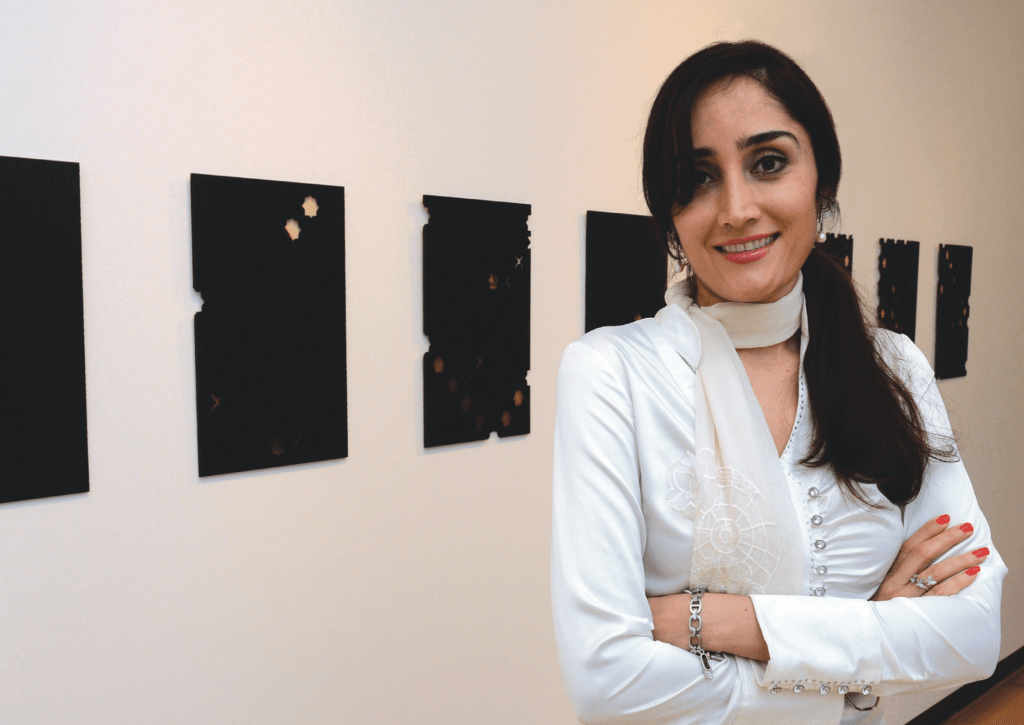
Photo by Tom Sandler.
Behind black lattice, parts of women’s eyes, lips, and noses peer out of the art piece, fighting to be individualized. While women in Iran are not the shrouded masses that the media stereotypes them as—a walk through Tehran, the country’s capital, usually includes women dressed in fashionable colours, patterns, and makeup—they are nevertheless required to abide by a modesty code. Hair, arms, and legs are to be covered while outdoors. A composite of woodwork, photography, and computer graphic design depicting hidden women’s faces comes into being to criticize Iran’s mandatory hijab law. This is Outcry #3, the third in a series of multimedia pieces of the same name created by Manitoba’s Zahra Baseri.
When Baseri speaks about some of the propaganda directed toward women in her home country of Iran, her voice zigzags between steady seriousness and giddy irreverence. “One time, we were told by a school teacher that if we ride our bicycles, because our legs were moving, we would be burned in a big bonfire that God made in hell,” she says with measured speech. “And I remember thinking: what kind of stupid God would do that?”
The contradiction that she often speaks of bleeds into her perceptions of the lives of the women in her society. At once both emancipated by past progress and oppressed by the country’s current government, Baseri believes that the lives of Iranian women are defined by their paradoxes.

Outcry #3, 3mm plywood, India ink and laser print photos, 2015-2016. Courtesy of Zahra Baseri.
The Pahlavi family presided as royalty over a then secular Iran, before the 1979 revolution occurred, bringing about the country’s Islamic Republic. Before the Pahlavi took over Iran during its 1953 coup d’etat led by the British, Islamic religion was deeply woven into the country’s politics under the Qajar monarchy. Iran’s religious and political history is complicated—ironically, after the overthrow of the Qajar monarchy, wearing a hijab was rendered illegal in Iran—and the country has been under everything from enforced secularity to a theocratic, unitary state. “Before the revolution, the Pahlavi brought modernity into the country, albeit by force, and the women are still using it,” Baseri says.
Today in Iran, women outnumber men in universities. Because technology is prevalent, women are no longer limited to the propaganda around them, allowing them the ability to question the world around them.
Still, “we are not very powerful, literally, against the constitution of the country,” Baseri says, speaking of Shariah law. “It’s totally misogynistic.”
In trying to capture this experience, Baseri turned to art. An engineer in Iran, Baseri immigrated with her husband to Canada four years ago. She decided to take a risk and entered the University of Manitoba’s fine arts program. In 2016, when she was in her last year of the program, she created Outcry #3. The piece is made out of photos of her Iranian friends with wooden panels placed on top.
Baseri’s professors were impressed by her design and suggested that she enter her piece into BMO Financial Group’s first national student “Art!” competition. That year, the competition accepted submissions from 100 institutions all over the country and gave out both a provincial and national prize. Outcry #3 beat out all of Manitoba’s competition.
In the coming year, Baseri will be pursuing a master’s degree in art at the University of Waterloo. When asked how she feels about being an Iranian- Canadian artist at a time that seems to be defined by xenophobia toward her people, Baseri does not skip a beat in offering an answer.
“The message behind my piece is that women are being masked, but at the same time, are putting in effort to break free from this environment: to get out of the shell and have their voices be heard.”
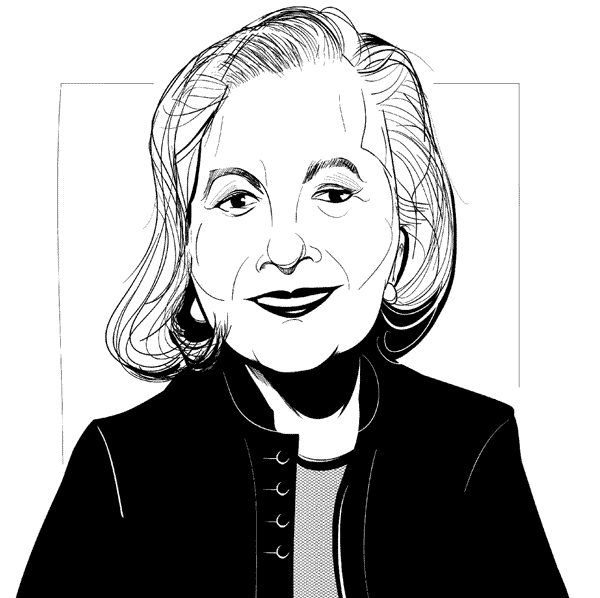
Ratna Omidvar. Illustration by Antony Hare.
“This journey of learning how to become a Canadian has been one of the most exciting and one of the most frustrating journeys in my life,” says Ratna Omidvar.
Born in India, Omidvar earned her bachelor of arts before going on scholarship to Germany, where she met her Iranian husband. The two moved to Tehran before fleeing the Islamic Revolution. They landed in Germany with few prospects, ultimately seeking asylum in Canada.
Both arrived with a wealth of education, skills, and experience, but it took them six years to find stable employment. She remembers befriending other credentialed immigrants who worked in unskilled labour or drove taxis, all seeking the elusive but vital Canadian work experience that would lead to better jobs.
Profiled by The Globe and Mail as this decade’s nation-builder for citizenship, Omidvar now works to ease immigrants’ path to prosperity as president of the Maytree Foundation, a private Canadian charity dedicated to reducing poverty.
Maytree sees systematic poverty as the main threat to Canadian society, and uses more than just money to fight it. Among the foundation’s tools at hand are grants, training programs, research, networking, policy proposals, and scholarships.
Instead of just studying the problem of poverty, “we have the capacity to put some of these really good ideas into action, and see if they work or not,” says Omidvar. In that way, Maytree has become a kind of angel investor for poverty-reduction schemes, experimenting with pilot projects, scaling up the ones that work and learning what they can from the ones that fail.
Since Omidvar joined Maytree in 1998, the foundation has oriented its focus to immigration, integration, and diversity. Two recent Maytree projects aim to empower new Canadians and help those in power to reap the fruits of diversity. One Maytree project, for instance, the Toronto Region Immigrant Employment Council, helps skilled immigrants get Canadian credentials, teaches businesses how to hire, train, and integrate immigrant employees, and lobbies government to adopt policies that encourage immigrant employment. DiverseCity, a program launched in 2008, aims to increase racial diversity on boards of directors and in the media by building a directory of experts from minority communities.
With an appointment to the Order of Ontario, an honorary diploma, and a book set to launch in September, Omidvar has thrived in Canada. But she laments the lost time and productivity she and many immigrants endure.
“I lost 10 years—the best 10 years of my working life—and I’ve kind of dedicated myself to making sure others don’t lose 10 years, 20 years of their working life; that they can ease into life, far better and quicker than we were able to.” But Omidvar says the real reason she advocates for immigrants is because when they thrive, everyone does.
“It’s because I know, intuitively and substantively, that the well-being of immigrants leads to the well-being of Canada,” she says. “And what’s good for Canada is good for immigrants.”
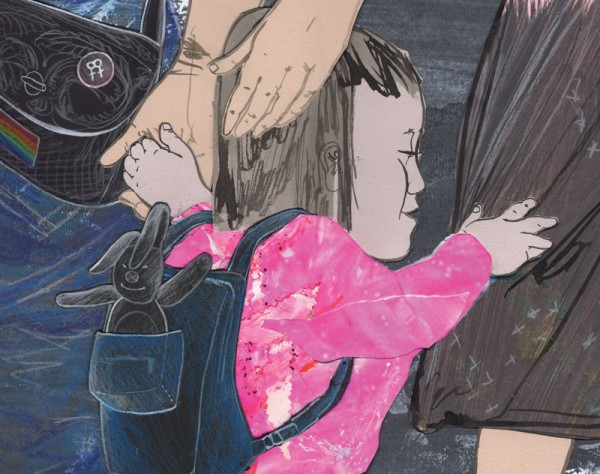
Illustration by Sylvia Nickerson
The test kitchen of the Bayview Village Loblaws grocery store in North Toronto is packed. Around 30 women and men sit clustered in pairs in a horseshoe, framed by the cupboards and counters lining the room. They are almost all white, aged 30 to 60 years old. Some small houseplants sit on the counter, the floor is the colour of cream of carrot soup, and the cupboards are dark green; the aesthetic is vaguely gradeschool. Orchestral pop floats in from the grocery store, while outside the window, one floor below, shoppers select their salad greens. Some of the couples talk quietly amongst themselves. Others wait silently with an air of anticipation. No one is here for a cooking lesson.
A cheery woman in an argyle sweater takes up her position in the centre of the chairs and begins to speak. Welcome to “How to Adopt.” This seminar, hosted by the Adoption Council of Ontario, is Adoption 101 for prospective parents interested in the idea but unsure where to start. The class outlines the various types of adoption and introduces attendees to parents who have gone through with adoption and who can speak about their personal experiences.
There are three types of adoption in Ontario: public, private and international. ACO executive director Pat Convery stresses that each kind of adoption offers its own challenges and rewards, and the route a couple or individual chooses to pursue depends on their own personal situation. What she does not say, however, is that some personal situations affect the available options more than others.
Growing up in her home country of Iran, Shirin* never imagined she would find herself in this situation. For many years, Iran promoted the virtues of large families. Shirin herself has many siblings. But now the Iranian government is thwarting her maternal ambitions. Shirin now lives in Canada and wants to adopt an Iranian child, but her birth country has declared her unfit. She came to the ACO meeting to learn about her adoption options, but unlike the couples here tonight, Shirin faces an additional obstacle. According to many countries, including Iran, she’s an unacceptable candidate because she’s gay.
Shirin is just one of an increasing number of queer women to pursue the option of international adoption, only to find that most countries classify them as substandard parents. Single mothers and lesbian couples disproportionately face barriers to international adoption because, not being in a heterosexual marriage, they’re classified as single parents. Many countries explicitly state they will not allow single women, or gays and lesbians, to adopt children, favouring a family structure that includes a mother and father. While some countries do allow single women to adopt, no other country among those usually sourced for foreign adoption, with the exception of the United States, permits openly gay women to parent their children.
International adoption is popular in Canada, with Canadian citizens and permanent residents adopting around 2,000 foreign children each year. Canadians apply to private adoption agencies licensed by specific countries to place children with parents here. Of the three types of adoption, international adoptions are the most expensive, costing parents $25,000 to $50,000 per child. The $85 that couples pay to attend sessions like the Adoptions Council seminar is just the beginning. Every prospective parent must undergo a “homestudy”—a series of in-home evaluations by adoption practitioners to ensure the applicants will be prepared and competent parents—as well as complete the mandatory adoptive parents training course known as PRIDE (Parent Resources for Information, Development and Education). While the Children’s Aid Society does not charge for these services, many individuals opt to pay the thousands of dollars it costs to go through private agencies, because it cuts down on wait times.
For many Canadians, the expense is worth it. International adoptions are popular because younger children are more readily available; at the very least there is a perception that kids up for adoption through the Children’s Aid Society may be older, part of a sibling group, or have special needs. With private adoptions, there is the risk that a birth mother will change her mind and an adoptive parent’s money and effort will be spent in vain. International adoption provides prospective parents with a formulaic stability. There is lots of paperwork, months of waiting, and usually travel abroad, but the path to parenthood is clear and understandable. Parental age is another factor: women who delayed having families, whether to pursue careers or for any other reason, face barriers within the domestic adoption process that can often be avoided with international adoption. Women over 50 are unlikely to be given an infant domestically, for instance, but several countries, such as Bulgaria, have higher parental age limits for infant adoption. Some women, such as Shirin, have a connection to a certain country or region and would like to adopt a child from that part of the world. For all these reasons, international adoption is an important option—and for many, it is a last resort after the domestic adoption process fails. Yet a growing subset of potential parents are being excluded by the countries where Canadians adopt from most. Almost one quarter of all children within Canada adopted internationally in 2008 came from China—a country that only permits heterosexual couples to adopt.
Many lesbian, bisexual, and trans women dismiss international adoption, because of its near impossibility for them and also because they object to their sexual orientation being treated as a liability. Some queer women, however, view these discriminatory policies as just one more problem they have to solve in order to adopt. These women opt instead to conceal their sexual orientation and go through the rigorous application procedures closeted, and in many cases they successfully adopt children from countries that discriminate against LGBT individuals.
As for Shirin’s plan, she is unsure of her options. She is a tall, fit woman with rich brown eyes and a few smile lines around her mouth. She has a discernable accent when she speaks. Shirin looks younger than she is, but in her late thirties she knows her options for adoption are narrowing. “I never admitted it to my family,” she says, “but I want to have children.” She wants a baby, preferably a healthy one, and while a child from the Middle East is no longer a possibility, there are still other alternatives open to her. Shirin does have one advantage; she may be gay—but she is also single.
There are 83 contracting states to the 1993 Hague Convention on Protection of Children and Co-operation in Respect of Intercountry Adoptions. In the nearly two decades since the agreement was concluded, it has had a profound influence on international adoption for LBT women.
Designed to safeguard the interests of children and to combat child trafficking, the convention has changed how countries regulate adoption in several significant ways. Under the convention, keeping children within their own families or countries is prioritized. Foreign adoption is considered a last resort, to be taken only when all other domestic options have been exhausted.
“It’s taken away some of the worries that adopting families would have,” says Pat Convery, meaning that certain key questions are answered: “Was this child actually legally relinquished? Did the parent have every opportunity to parent the child? Did they really look to make sure there were no family members? Was there for sure no money that changed hands in those areas that would be illegal under Canadian law?”
But while the Hague Convention has been a positive measure for inter-country adoption in general, it has also made it more difficult for queer women to adopt. The U.S., as the only source country that permits openly queer parents to adopt, used to be a haven for many LGBT and non-LGBT would-be adoptive parents. Since signing onto the Hague Convention, however, more emphasis has been placed on securing domestic adoption for American children in need of homes.
More than the Hague Convention, however, it is countries’ own value systems that pose the largest obstacles to queer Canadians adopting abroad. Chris Veldhoven is the Queer Parenting Programs Coordinator at the 519 Church Street Community Centre in Toronto, and he teaches a seminar to would-be fathers entitled Daddies & Papas 2B that explores the topic of adoption among other parenting models and family creation practices.
“The screening tools for some countries are becoming more explicitly heterocentric,” says Veldhoven, “so it’s much more difficult for people to find a country that will officially welcome someone and not discriminate on sexual orientation or gender identity.”
Historically, Veldhoven says, lesbians led the queer community in adopting, but increasingly gay male couples are also looking to adopt. Despite domestic legal victories that prevent discrimination on the basis of sexual orientation, there remains a stigma surrounding single men (or “single” men) adopting kids. Within inter-county adoption, this stigma is magnified. Single women may find their international adoption choices limited, but their situation is still better than that of single men—few countries even consider male applicants.
Elizabeth’s house is on a quiet street in the east end of Toronto. It sits across from a park where kids are playing, despite the grey morning sky. Birds chirp from the trees. Inside, the living room is cozy with wooden floors and little purple coffee tables on which Elizabeth serves tea.
When Elizabeth adopted her daughter in the late ’90s, she knew many other lesbians who were exploring adoption. But none of her other gay friends were adopting from China; Elizabeth was able to do so because at that time the country had not yet banned single women from adopting. She began her homestudy process in late 1995 and had her daughter by the summer of 1997. Most of the girls up for adoption in China at the time were there as a result of the one-child policy and, unlike in many other countries, were from poor families rather than ones with drug and alcohol problems, which meant the babies were more likely to be healthy. The adoption process was well regulated; China seemed like the ideal country to adopt from.
“I felt like it would be a clean process,” she says, “and that I would be adopting a child who otherwise wouldn’t have had a family.” Elizabeth is in her 60s now and has been with her partner for over 20 years. In addition to her adopted daughter, they have a biological child together. She is a strong-framed woman with short hair that is a mixture of dark and lighter shades of grey. She sits with her legs crossed in jeans and a black cardigan, her purple shirt matching the frames of her glasses. Going to China without her partner to collect their daughter was difficult. “I really had to censor myself all the time,” Elizabeth says. She went with several heterosexual couples from the same agency and struggled with the urge to be honest about her sexuality as everyone bonded over the experience of meeting their children. The trip lasted two weeks.
“My deal with myself, when I actually went to China,” she says, “was, no matter what the circumstances, I would not reveal my real self and real situation.”
Elizabeth pulls out photo albums of pictures from her trip to collect her daughter. She reminisces about the time abroad and gushes about her daughter: “Isn’t she adorable?” she coos, and indeed, she is.
Elizabeth found her social worker through a referral from friends who were adopting as out lesbians domestically. She says she felt comfortable with the social worker that conducted her homestudy but won’t talk about the experience of closeting herself. She feels unable to confirm or deny whether she lied about her sexuality for the evaluation process. Regardless of her evaluation, Elizabeth was adopting from China during the best possible period for LBT women to adopt from that country: before China declared it would no longer permit single female applicants. In 2007, the country amended its requirements so that all single women were forced to sign an affidavit swearing they were not gay. “If you were a single woman you had to write a letter saying you weren’t a lesbian,” says Elizabeth, taking a sip of tea. “That would have been a huge crisis for me if that had been the case when I was in the process. I don’t know what I would have done.”
Paradoxically, as social equality for LGBT individuals has strengthened within Canada, international adoption has become more difficult for queer women. Adoption practioners who conducted the homestudies of lesbian or bisexual women 10 or 15 years ago might have been willing to take a “Don’t Ask, Don’t Tell” attitude; if they thought someone would make a good parent, they could opt to keep a parent’s sexual orientation out of their homestudy report. That’s significantly less likely to be the case today.
“If you’re going to be out and you have to have your homestudy done by a domestic social worker, they’re not as willing to censor anymore because of the ethics of it,” says Veldhoven. “In the face of decreased homophobia domestically, social workers are saying, ‘Now we have to be true about your family configuration because we don’t want to hide it, because you shouldn’t have to hide it.’ But for many countries internationally you do hide it.”
The process of the homestudy itself has also changed considerably over the last decade. Jackie Poplack is a social worker who has been working in the field for four decades and has been an adoption practitioner, which includes conducting homestudies, for the last 14 years. According to Poplack, homestudies have become much more standardized and involve a lot more verification than they used to. Poplack has worked with queer couples seeking children and says that for social workers, looking the other way is not an option. “I’m going to be 100 percent honest and if I have a question or concern I say it,” she says. But for prospective parents who are single, there’s a certain degree of plausible deniability. In her years as a practitioner, Poplack has had one or two clients who said they were heterosexual, and who might have believed that themselves, but who she thought could have been gay. When it comes to homestudies, she acknowledges that, regardless of sexuality, people will try and smooth over any aspects of their character that they think will diminish their chances of securing a child.
Lisa is one woman who hid it. In 2005, she adopted a baby girl from Haiti. She was closeted to her social worker, so the woman classified her as heterosexual on her homestudy report. Lisa was single, so while there were some fridge magnets to remove and books to hide, there was no life partner to implausibly pass off as a roommate. Today she is wearing blue jeans and an olive T-shirt with “garden hoe” written across it in black letters. As she sits sipping her mug of coffee, she smiles, talking about the process of adopting her daughter, who arrived in Canada at nine months old and who is now happily enrolled in grade school with no idea of the half-truths her mother told to secure her.
“My goal was to never lie,” says Lisa, picking her words carefully. “But not necessarily to say everything.”
The Sherbourne Health Centre sits at 333 Sherbourne Street in downtown Toronto, a massive structure of glass and concrete with wood accents elevated from the road.
Across the street is Allan Gardens. People sit on benches and soak up the sun by the greenhouse. Squirrels play in the bare branches of the trees and scurry up the wrought iron lampposts that dot the grounds. Rachel Epstein’s office is on the second floor of the centre. Epstein is coordinator of the LGBTQ Parenting Network at the centre. The parenting course she designed, Dykes Planning Tykes, has been running since 1997.
In Epstein’s years of experience working with queer parents she has seen women closet themselves and get children. But today she is more pessimistic about the possibilities for LBT women to adopt from abroad.
“Basically, queers do not see international adoption as an option,” she says. More countries are selective about who adopts and who doesn’t, and choose heterosexual married couples over single individuals. Epstein worries about the personal toll exacted by denying your sexuality. “In the past, either you are single or you closet yourself. You closet your relationship,” says Epstein. “I mean, even single people find it hard to go closeted for this process, and it can be not just the adoption process but for a while afterwards.”
For a potential LBT parent, finding a social worker to whom she can be open about her sexuality—and who is willing to omit her sexual orientation from the homestudy report—is rare. How open a woman will be with her social worker is a crucial decision that can set her adoption back months if the wrong choice is made. If a woman chooses to be honest and the social worker is unwilling to lie, then the woman must find another social worker and start the process again. “It’s more feasible if you’re single,” says Epstein. “You don’t get defined by your sexual orientation in the same way and it’s easier to not talk about that.”
Indeed, there are those within Canada’s tight-knight LGBT adoption community who feel that the less said about queers and international adoption the better. Many blame U.S. media coverage of queer adoptive parents as being instrumental in China’s decision to ban single women from adopting. As awareness of the issue grows in diplomatic circles, they say, more consulates close their doors, shutting off the few remaining channels available for women seeking this route to parenthood. One Canadian adoption advocate refused to be interviewed for this article and strongly discouraged publishing any story at all on the subject.
There are no easy answers to a problem of such emotional, legal, and cultural complexity. For Canadian social workers, having to lie about sexual orientation in a homestudy report is a serious dilemma. “That’s unethical; I would never do that,” says Poplack. “It’s tough sometimes, because some of the rules you think are really unfair. I think we have to respect other countries—but it’s really crappy for gays and lesbians.”
Lisa made the decision to out herself to her adoption practitioner after her adoption was finalized and, as a social worker herself, she has spent a long time thinking about the ethical implications of her decision. “How do you reconcile that you are going against our Charter of Rights and Freedoms? Okay, it is the other country’s rules—but they’re homophobic and they go against our codes. Social workers haven’t been able to work it out in a way that enables most of them to feel comfortable,” says Lisa. “So the people who are doing it are like the people who work as social workers for Catholic charities and then pass condoms out under the table; they’re basically doing it very quietly, very silently, afraid themselves to come out.”
The Loblaws seminar draws to a close. Everyone stands to put on their coats, wrapping scarves around their necks. The music drifting in from the grocery store has changed to the Beach Boys. Shirin thinks she may not adopt. “I can’t lie about this fact,” she says. “The homestudy is going to be really one-to-one, close work between me and the social worker or case worker, and that is going to be based on trust. The person should know about me, should know about my past, should know about my family, should know about everything. How is it going to be possible to not say such a big fact?” She’ll do some more research and talk to a friend who is also looking into inter-country adoption, but she’s still skeptical. Shirin did not come out as gay until later in her life, and after being closeted for so long she doesn’t want to be in that situation again. “I don’t approve of it; to lie about it,” she says. “You should be honest.”
Lisa, however, is contemplating adopting another child from Haiti. She will need to find a new social worker, one who doesn’t know she’s gay. Then she’ll undergo another homestudy, closeted again, but she’s willing to do it for another child. “I think I’m a seasoned pro now at it,” she says. “I’ve guided other people about how to do it; I can do it myself again and I’ve been through it once so it’s not as scary.” When she thinks back to the emotional toll of concealing her sexuality the first time, she reflects, “I never really lost connection to who I was as a person; I was just playing the game.”
It is a game that Shirin and countless other queer women may simply decide not to play.
]]> The Dalai Lama is charged with watching over Buddhist tradition, but on March 29, 2009 The New York Times revealed a shadowy presence was secretly watching him, invisibly sending information about the religious leader to his anonymous attackers. When the story broke, the office of the Dalai Lama believed it was dealing with an ordinary computer virus. It turned out to be something more widespread, organized, and ominous.
Long before The New York Times, Canada’s Citizen Lab was on the case. Based at the University of Toronto, Citizen Lab is a global leader in documenting and analyzing the exercise of political power in cyberspace. The Lab’s 10-month investigation into the virus that had lodged in the Dalai Lama’s desktop revealed it was in fact just one of 1,295 compromised computers in 103 countries, many found in embassies, government agencies, and significantly, Tibetan expatriate organizations. The researchers at Citizen Lab dubbed the network GhostNet, which spread through a malicious software program—“malware,” in technical circles—called Gh0st RAT. Gh0st RAT spread via email to high value targets: diplomats, politicians, the Dalai Lama. Once installed on a target’s computer it provides barrier-free access to an intruder, giving them full control of the system as if it were their own. This allowed the thieves to bring sensitive documents back to four control servers in China. Worse, Gh0st RAT allows its operators to take control of an entire computer in real-time, giving them the unfettered ability to see and hear their targets through the computer’s webcam and microphone.
It’s virtually impossible to determine whether GhostNet was a work of cyber-espionage by the Chinese government or a single hacker who wanted to make it look that way. In January 2010, search giant Google admitted they were one of 30 companies attacked by the latest version of Gh0st RAT and threatened to shut down the Chinese version of its site. Computer security firm Verisign reported it had traced the attacks back to “a single foreign entity consisting either of agents of the Chinese state or proxies thereof.” Beyond China, countries around the world are increasingly using the internet for espionage and intelligence-gathering. Observers report more viruses, more trojan horses, more botnets, more surveillance, more censorship and more denial-of-service attacks. The tactics are being used by governments and independent groups alike for intelligence gathering, terrorism, national security and religious or political propaganda. Most of it happens secretly, obscured by layers of technical complexity. In the early 2000s, China was a leader in cyber-espionage, but it has lately been joined by more players: Saudi Arabia, Russia, North Korea, Iran, the U.S., and Canada.
We are witnessing, the Citizen Lab researchers believe, the weaponization of cyberspace.
“I realized there was a major geopolitical contest going on in the domain of telecommunications,” says Professor Ron Deibert, Citizen Lab’s founder and head researcher. “The information environment today is mediated through telecommunications. So being able to control, access and retain information through those networks are vital sources of intelligence. This was happening, but it wasn’t being talked about.”
Deibert isn’t new to the intelligence game. He worked as policy analyst for satellite reconnaissance in the Canadian Ministry of Foreign Affairs, but it wasn’t until he wrote a book about major technological shifts in history, and started researching his PhD—documenting how rapid technological changes of the information age affected global politics—that he began investigating the war that would set him on the path to being the “M” behind the Citizen Lab.
“Our technological advantage is key to America’s military dominance,” said U.S. President Barack Obama in a May 2009 speech on his administration’s plans for the militarization of the internet. “From now on, our digital infrastructure—the networks and computers we depend on every day—will be treated as they should be: a strategic national asset. Protecting this infrastructure will be a national security priority…. We will deter, prevent, detect and defend against attacks, and recover quickly from any disruptions or damage.” In the same speech he assured the world his security plan would not infringe on internet freedom or personal privacy. The U.S. Department of Justice, however, argues (though far less publically) it can’t be sued for illegally intercepting phone calls or emails—unless they admit what they’re doing is illegal, which they won’t.
It’s this kind of secrecy (in the name of national security or not) that Citizen Lab exposes. The small team of researchers and benevolent hackers, who work in the basement of the Munk Centre for International Studies at Devonshire Place in Toronto, watch the watchers and document the shadow war most are too busy updating their Facebook pages to notice. But more than that, Deibert wants to see Canada put its peacemaking reputation to work to lead the way in drafting a constitution for cyberspace among the nations of the G8. He believes Canada can be a leading guardian of the free and open internet, a valuable global commons worth preserving, on par in importance with land, sea, air and space.

Average internet users—the ones doing their banking, their shopping, or their FarmVille cultivating on the brightly lit thoroughfares of the web—are relatively safe from the cyber-spooks of the world. But if you challenge your government, expose injustice, or work for humanitarian ends in hostile places like China, Iran, Syria, Sudan, and Pakistan, it can become a dark, threatening place pretty quickly.
Deibert wanted to expose these injustices on behalf of citizens everywhere, but quickly discovered there were places he couldn’t go as a political scientist. So, with a research grant from the Ford Foundation, he launched the Citizen Lab in 2001 and began assembling a team dedicated to his two-pronged mission: monitoring and analyzing information warfare, and documenting patterns of internet censorship and surveillance.
The first major partner for the Citizen Lab was the SecDev Group, an Ottawa-based think tank that engages in evidence-based research targeting countries at risk from violence and insecurity. Its CEO, Rafal Rohozinski, was the man originally responsible for connecting all the countries in the former Soviet Union to the internet.
That meant he knew everyone who was anyone when it came to cyber-espionage in a region known for its deep ranks of hackers. This was the beginning of a vast network of agents who would later prove invaluable to all Citizen Lab operations. In those first days together with Rohozinski, Deibert also developed the methodology from which all Citizen Lab missions stem: A combination of technical reconnaissance, interrogation, field investigation, data mining, and analysis. In other words, the very same techniques used by government intelligence agencies like the National Security Agency in the U.S. and its Canadian equivalent, Communications Security Establishment Canada (CSEC). But this time, the expertise would be in the hands of the people.
“We wanted to take that combination of technical and human intelligence to turn it on its head,” Deibert said. “These organizations are using these techniques for national security purposes. They are watching everybody else, no one is watching them, and we wanted to watch them.”
Next, Deibert needed a powerhouse legal team. “We don’t break Canadian laws, but we do break the law in just about every other country,” he says. That’s why he partnered with the Berkman Center for Internet and Society. Based at Harvard Law School, this gives Deibert and his team access to a network of some of the best legal scholars in the country.
None was more vital than the final piece of the puzzle. All wars need soldiers and Citizen Lab needed the very best computer scientists, programmers, software developers and data analysts. All of whom were handpicked by Deibert from an unlikely recruitment pool: his own political science course.
The Munk Centre has all the architectural hallmarks of an English boarding school, left over from its days as a men’s university residence at the turn of the century. Few visitors have any idea what goes on beneath their feet in Citizen Lab’s dimly lit basement headquarters, but two of Deibert’s lieutenants have agreed to let me ride along on one of their online patrols.
Born and raised in Singapore, research associate James Tay has a personal stake in Citizen Lab’s mission. “I came from a country where those in power were willfully blocking access to the net. I just thought it wasn’t right, so when I heard about the lab tracking censorship and finally holding these governments accountable, I was like, ‘Okay, yeah, this is something I want to do.’”
That’s why, when riots broke out in Iran following its corrupted June 12, 2009, election, Tay was at Citizen Lab, keeping Iran’s lines of communication open. The Iranian government was blocking opposition leader Mir-Hossein Mousavi Khamenei’s website, along with Western-run sites such as YouTube and Twitter. Opposition supporters needed a way to stay connected online, to share information and coordinate their response to the crackdown.
The battering ram that broke through Iran’s online barriers is called Psiphon. Developed first by Citizen Lab, the software is now its own commercial entity, helping to fund the lab’s academic research. Through small chinks in the Iranian government’s armour, Tay was able to send a short, crucial message to people inside Iran who needed unrestricted access to the web: the snippet of text he was charged with sneaking over the border through TweetDeck—software that communicates through Twitter without requiring an actual visit to its website— was an encrypted link to the Psiphon web server, a tunnel through the blockaded border that allowed users to see the web unhindered by Iran’s online filters. Once connected, Psiphon is simple to use: It appears as a second address bar in the web browser and delivers internet traffic through proxy sites that haven’t been blocked yet. Block one, and the data simply changes its route to the user. During the crisis, Tay was trusted with making sure Psiphon ran without Iranian governmental interference, allowing thousands of people to liberate their internet connections.
“Psiphon is open-source and free to the user, but the BBC and big media pay us money for the right to spread our proxy to their readers and viewers,” says Tay.
Psiphon isn’t for everyone, though. It doesn’t provide anonymity, for one, something that Psiphon users are made aware of before using it. Even so, many Iranians still used the service, often at great personal risk.
“Some of them were trying to organize rallies,” says Tay. “I saw that on Twitter a lot.”
But even more dangerous research is directed by the lab, just collecting the data risks the threat of imprisonment or torture if discovered by the offending country’s oppressive government. The project is known as The OpenNet Initiative.
If you stumble upon a site a sitting government doesn’t agree with, it may simply look like a problem with your internet connection. But that error page could be a fake. “These governments may publicly claim to block sites to protect the morals of their citizens, then use the same technique to block the site of a politician they don’t agree with,” says Jonathan Doda, Citizen Lab’s software developer for OpenNet. “They set up the error page because they don’t want people to know. The good news is they’re pretty easy to spot.”
“What’s most popular these days is proxy based blocking,” Doda says—in which a country’s internet connection is shunted through a single gateway that allows a regime to filter all the web traffic in and out— “or some American filtering software—the same thing you find in libraries and schools or some private businesses.” In every case, the country’s internet service provider intercepts your connection and substitutes an error page.
Sometimes, the error is legitimate. After all, internet connectivity in many parts of the world can be slow and unreliable. That’s why Doda must gather evidence of governments’ intent through extensive testing. His team accesses sites multiple times and compares what happens from within Canada to what happens from inside the suspected country.
Doda’s been programming since he was a kid, making software in BASIC on his PC Jr. It was fairly easy for him to create “rTurtle,” the software that collects the data, looking for anomalies like dummy IP addresses, weird-looking address headers and missing keywords in the returned page. The lab needed a way to test within the offending countries, but the lists of blocked sites are determined by religious or political elites and implemented by centralized internet providers in target countries—closed systems that are virtually impossible to penetrate as an outsider.
But Rafal Rohozinski’s international reach gave Citizen Lab the ability to recruit agents within those ISPs and other high-value positions in repressive countries’ internet hierarchies. “In Central Asia alone, we have a network of about 40 individuals working for us,” says Deibert. Some of them are literally putting their life on the line—guilty of treason for working with Citizen Lab.
“Going to Burma and running the software that Jonathan developed in an internet café—that’s life-threatening research,” says Deibert. “The person doing that would have to be aware of the risks.” Those risks range from arrest, imprisonment, and interrogation, to torture and death. Deibert knows people have been arrested under similar circumstances, so OpenNet’s work requires a delicate protocol.
“Jonathan might not know the names of testers in certain countries. I might not even know their names,” says Deibert. “They’ll have a key and it’ll be used to unlock that data they need to run the software. We don’t know who they are. There will be a person who mediates their communication with us. If Jonathan were sent to Syria and got captured, he wouldn’t be able to give out a tester’s name.” For everything at stake, you’d never know the risks by stepping into the lab. Among the islands of computer terminals and the big red vinyl couch off to one side, the only thing remotely James Bond-ish is a hollow world globe stocked with contraband cigars and bottles of alcohol from the countries they’ve visited. But for all they do for others, the Citizen Lab largely ignores internet censorship and surveillance at home.
“I’m not worried as much about Canada. We have a government that’s largely accountable. Despite all the problems, we still live in a democracy that includes the benefits of humanitarian law and respect for human rights. If I did this research in Uzbekistan, I’d be jailed and tortured within the hour,” says Deibert.
Canada has cyber secrets of its own that often escape public notice. There are two bills before parliament collectively called “lawful access” meant to aid law enforcement in obtaining information needed to make an arrest. (Both bills were put on hold when parliament prorogued in December, but they appear to be Conservative government priorities and are likely to be reintroduced.)
“The approach we’ve taken is to respect civil liberties to the fullest extent possible by recreating in the cyber world the exact same principles that have been applied in the analog world. In order for police to obtain the content of emails, or intercept phone calls over the net, they will require a warrant,” says Peter Van Loan, Canadian Minister of Public Safety.
That isn’t the whole story, says David Fewer, director of the Canadian Internet Policy and Public Interest Clinic, based at the University of Ottawa’s Faculty of Law.
At the moment, police can’t force ISPs to hand over a customer’s name and address without a warrant, but the lawful access legislation will allow them to do just that.
“It’s bad enough that ISPs can give over that information if they want,” says Fewer. “Obviously our view is it shouldn’t be made available.” For now, there’s an unofficial compromise: for child pornography allegations, most ISPs give up the information, but for other crime such as fraud, police still need a warrant. Fewer says the informal understanding isn’t good enough.
“The system should be formalized, so there’s a formal response across the board,” Fewer says. “Police should be obliged to get a warrant except in cases of imminent harm, akin to a search warrant.” But police forces are currently demanding search warrant standards be relaxed. “There are sliding scales they’re demanding on certain search warrants. Ordinarily, police have to give ‘probable cause’ and they want that standard to be replaced with ‘reasonable suspicion.’”
Canada’s democratic laws don’t keep you immune from the government’s roving eye in cyberspace, either. “We have to start with the assumption that everything we do on the internet is public,” says Deibert, “and then work backwards and say, ‘What of my communication is private?’ Since potentially, at every step along the way, you can be monitored.”
In your terms of service agreement with Rogers or Bell they have the right to retain, store or turnover any information they provide you as a service including web history, web addresses, emails, and chat logs to the Canadian government for intelligence gathering and law enforcement purposes. CIPPIC is fighting various court battles around the disclosure of user identity to thirdparties online.
“We need courts to carve out some mechanism for preserving respect for privacy online,” says Fewer, “because privacy is a human right.”
Deibert wants the nations of the world to establish their own formalized treaty for the internet, one that treats cyberspace as a public commons and halts the aggressive arms race that threatens to further erode our basic rights. But drafting such an agreement will prove difficult, as security concerns continue to override basic rights.
Incidents like GhostNet demonstrate that even when all signs point to a massive national espionage plot, online attacks are difficult to trace, and governments nearly always enjoy plausible deniability.
“Even when we have lots of evidence that indicates a country may be behind it, the government denies any association,” says Van Loan. “Attacks are extremely hard to trace. What would likely happen is wholesome, good players would follow it, but the bad operators would continue to operate outside of it.”
And such a treaty could abuse as much as protect. “Anonymity is viewed [by governments] as a tool of terrorists and hate-mongers and—in the negative sense— whistle-blowers,” says Fewer. He fears any such treaty would inevitably morph into a cyberspace trade agreement, further tightening abusive intellectual property laws and scaling back civil liberties at an accelerated pace. “You need a tragedy for anything good to come out of a treaty like that. The International Declaration of Human Rights was the result of the First World War.”
With six billion people on the planet facing global problems, Deibert says the real tragedy is losing the open and unfettered ability to communicate globally, but Van Loan sees no other choice. “It is really the new arms race. Every time we erect new barriers and protections some smart, tech-savvy individual comes along and finds ways around those defenses.”
For the moment, it will have to be enough to know that Citizen Lab will be watching the watchers. James Tay admits he takes his work a little too seriously. “I don’t sleep,” he says. “This isn’t your typical 9-5 job. I regularly find myself responding to emails in the middle of the night. Ron wants us to sleep, but this isn’t a job for me. It’s something I live and breathe.”
]]>
A friend recently sent me an email commenting on the Twitter craze provoked by the recent riots in Kampala, Uganda. Within the first few minutes of the first sign of rioting, Twitter was chock-full of witness reports on the events.
Just like Tehran earlier this year, Twitter delivered an instant “news” source. While Twitter provides largely unverified information, I was able to track events via a series of people whom I trust because we have either met or because they have honed a flawless track record of articles, blogs and informal citizen news production eventually verified by mainstream news agencies.
While I was impressed by the f requency and detail of the updates, one of my acquaintances seemed less so. He asked why rural Ugandans — such as our mutual connection “Norman” who runs an orphanage in Mbale, Western Uganda — would be interested in minute-by-minute updates on rioting in Kampala. He writes: “I don’t think their lives [Norman and other rural Ugandans] would be demonstrably altered by knowing facts two or three hours earlier.”
However, as a Ugandan friend who is social-entrepreneur insists, this argument misses the point. It does not matter whether anyone wants or needs to hear information on a minute-by-minute basis. The importance of Twitter lies not only in providing a security mechanism when news is lacking, but also in offering everyone a “personal microphone.” This personal microphone extends far beyond news updates by offering a new knowledge-production mechanism which expands beyond limited village-based traditional information-sharing networks to a virtual global network. Writ large, Twitter and other social media are tools to counter the hegemony of Western knowledge-production, both in news and in international development.
While Norman might not be as interested in the instant updates on riots in Kampala (which, I would argue, he would be, considering family and friends living in the capital city), he has a stake in terms of funding his own orphanage project through instant updates. Sure enough, Norman is a prime example of just how effective this type of social media marketing (Facebook, Twitter and so on) can be. On any given day, I receive at lease one or two updates from Norman on his orphanage in Mbale. And, while an overflow of information has often turned me off from reading every update and contributing to the project more than just once in a while, it does inspire a sense of trust and confidence to see that the project is constantly evolving (for better or worse). It also enables Norman to foster a wider network of people contributing to his project, honing more funding and opportunities.
A key point in the development of social media tools like Twitter is that they are being used to circumvent all types of “traditional” structures that are rigid in control and content. Twitter enables news to circumvent the tightly controlled radio stations and newspapers in Uganda and ensures that citizens are given an idea of how their friends and families are doing; social media in general is circumventing time worn international aid structures that have consistently hampered the development of home-grown ideas and projects through foreign-controlled and imposed development ideas and ideals. Individuals who have built a Twitter “reputation” for accurate information can provide live, in-the-field updates; others can provide an up-to-date source of information showing the traceable and digestible development of their projects. The latter, moreover, offer a personal connection to the project, which secures further donations.
Based on the huge growth of social media, it is safe to presume that over the next few years, we are going to see social media emerging as a tool for the marginalized: those whose voices have been silenced by bigger “machines” such as the ever present bureaucracy of large aid organizations like the United Nations and powerful Western news agencies such as CNN.
While the Internet does give everyone a chance to “re-invent” themselves as they wish, a unique trust system based on complex virtual and face-to-face relations is becoming a stop-gap for the potential fabrications that come with unregulated information. As I mentioned before, I have developed a network of friends whom I have met, or been referred to by trusted friends, or who have proven themselves to be accurate in their reporting and observations. Besides this, active Twitter users are engaged in a parallel activity, “tweetups”, which brings users together on a more human basis, providing far more trust than the forever elusive structures of big development systems like USAID and the “parachute journalism” of chronically underfunded newspapers.
So, contrary to the myth that social media, particular Twitter, are irrelevant to human development, I believe individuals like Norman show the great potential in investing in this type of information sharing and networking. Moreover, it is high-time for a tool to challenge the mainstream knowledge structures that are forever dominated by the West. with its bottomless finances to manipulate information, and thus to ensure a more even distribution of knowledge production. As Foucault said, “Knowledge is Power” and social media — increasingly accessible to the masses — is helping reverse the unfair distribution of information which has tainted the reputation of regions like the Middle East (remember Edward Said?) and Africa keeping them forever marginalized.
]]>
Ahmadinejad speaking at the U.N. General Assembly in 2008
Almost one year ago Mahmoud Ahmadinejad, the currently contested President of the Islamic Republic of Iran, delivered his infamous speech at the U.N. General Assembly. Putting aside for a moment that the U.N. has failed its mandate to prevent wars between countries and, therefore, is rather debunked as an institution, it has also been a microphone-box for some of the world’s most notorious self-proclaimed leaders.
In his 2008 speech, Ahmadinejad alternately wooed and unsettled the audience with his defiant, confident and eloquent rhetoric that challenged everything from the U.S. occupation of Iraq to the existence of gays in Iran. The reaction of the crowd was mixed: some lamented the fact that the world was forced to choose between leaders like Bush and Ahmadinejad, while others lauded Ahmadinejad’s criticism of the U.S. occupation and chastised Colombia’s president for his hypocrisy (Bush, whose track record is worthy of war-criminal stature, after all, received a reception that was much more welcoming).
The problem with some portions of the left is that in the quest to establish a genuine alternative to Western—and, especially, American—imperialism and hegemony, some of the most unsavoury and unscrupulous characters are embraced. After all Ahmadinejad has met with Chavez, the darling of so much of the left, and supports Cuba, leaving activists somewhat confused and befuddled.
However, illusions cannot be easily maintained after this summer’s disputed Iranian elections and the ensuing atrocities. Regardless of how Ahmadinejad may have appeared before—sometimes as the defiant underdog who will not be intimidated, sometimes as the goofy, ugly-yet-comical figure—there should be no room for confusion anymore: Ahmadinejad represents a callous, bloody and tyrannical regime.
The reality is that the current Iranian government doesn’t care about the peoples of Afghanistan or Iraq or Palestine – it doesn’t even care about the people of Iran. The events following the contested June elections are testament to this fact. Wide-spread documentation of systematic imprisonment, torture, abuse, rape and death of protesters is all too well known now, though still vehemently denied by the regime. Unfortunately, the Iranian government is capable of much more painful, despicable and violent acts than those which met Neda Agha-Soltan’s fate. At least she died by a bullet wound and not due to the “rupturing of her womb and anus.”
But a question that is often asked among leftist circles, or anyone trying to challenge any status quo, is what to do now, knowing what we know? How should we proceed? What strategies can we employ? And, perhaps above all, what is our objective? For those Canadians of Iranian descent, who have ties with Iran, or who are simply concerned citizens who feel that injustice anywhere should be opposed everywhere, the options are fairly limited. But creativity sometimes grows in the most desperate of situations.
One Toronto-based group, Cycling for Human Rights in Iran (CHRI) decided to express their solidarity with the peoples of Iran by biking from Toronto Ottawa’s Iranian embassy to deliver a petition that features the following demands:
- immediately and unconditionally release the political leaders and activists arrested on June 15th, and all others who have been arrested for the peaceful exercise of their rights to freedom of expression and assembly;
- allow them immediate access to their family members, lawyers of their choice and to any medical treatment they may require, and that they be protected from all forms of torture or ill-treatment;
- allow peaceful demonstrations by those wishing to express their opinion of the elections, even if critical.
The positive response to the Ottawa ride has encouraged CHRI to plan another one, this time a four-day, 800 km journey, starting this Saturday, September 19th, to New York. Information about the bike ride can be found here, and it is not too late to participate/volunteer for the ride.
Why New York? Ahmadinejad is planning another speech, after all.

This Magazine spoke to CHRI founder Ali Bangi and asked the following questions:
Why are you riding to New York?
Mr. Ahmadinejad’s (Iran’s controversial president) visit to the U.N. General Assembly is a good opportunity for us to raise awareness about the situation of human rights in Iran. We believe extreme forms of human rights violations have happened and continue to happen during his presidency and he has failed to respond and address the issue. Instead, he has endorsed government sanctioned violence against peaceful protests by Iranian students and ordinary people who have expressed their critical opinion about the recent presidential elections.
Why bike?
We use cycling as a tool to raise awareness. Cycling from Toronto to New York is kind of a mental and physical challenge that we believe is kind of similar to those facing many Iranian students, activists and political leaders that have been imprisoned for exercising their right to freedom of expression and assembly, which are both recognized rights by Iran’s constitution and the universal human rights. Cycling also keeps us together. We bike every Sunday and that’s how we have become a team/group. Finally, cycling long distances for human rights is what draws the necessary media attention and helps us deliver our message to the Iranian government that people in Canada are concerned about the human rights situation in Iran, as well as send a message to the Iranian people that we have not forgotten them.
What is CHRI position on Ahmadinejad being able to travel to New York? Do you feel like he should be arrested on spot?
No, he should not be arrested yet! If he was convicted of crimes gainst humanity and the U.S. was a member of the International Criminal Court (ICJ) he would/should have been arrested. He is not yet convicted of any crime and the U.S. is not a member of ICJ. So, he should be able to travel there and return to Iran. Iran is a member of the U.N. and he is going to the UN General Assembly meeting to represent a member state, Iran. The recent presidential election was controversial and there are allegations/evidence of vote rigging. However, Iran’s Guardian Council approved the election and announced him as Iran’s president. I disagree with the decision of the Guardian Council but I believe we should deal with the issue through lawful acts. Finally, I disagree with isolating Iran and its leaders. We should keep them engaged and deal with them within the established international law and customary international law.
If you were able to actually speak to Ahmadinejad, what would you tell him?
I would provide him with extensive evidence of human rights violations by his government and ask him to respond.
What concerns you most about the situation in Iran, and why do you feel that Canadians should pay attention to it?
The human rights situation in Iran is unfortunately getting worse. Widespread arrests, intimidation of the opposition, closure of newspapers, torture, rape in the prisons by the prison guards, etc. have proliferated at an alarming stage. Why should Canadians pay attention? Iran’s elections are partly an internal matter (if we want to strictly observe Iran’s soverignty) and there is not much Canadians can do about them. However, human rights are universal and it is the responsibility of everybody, regardless of their background and nationality, to protest violation of human rights, anywhere, when it happens.
How can people get involved with CHRI?
- They can come bike with us on Sundays (contact our volunteer coordinator at [email protected]) or join us as a member and attend our events and meetings, etc. If they are interested in human rights advocacy this is a great group to join (just email the noted email address and you will be added to our email list serve).
- They can come and see us off on September 19th, at 12pm, at Hart House, when we leave Toronto to NYC (more info on our website or Facebook event page)
- They can donate at: http://www.cyclingforhumanrightsiniran.org/donation/ or write a cheque to CHRI
- They can also check our website, spread the word about CHRI and post CHRI links on their Facebook walls, these are great awareness raising support.
Who’s funding this? How can people donate if they are unable to participate in the ride?
We are an independent and non-partisan group. All our funds come from supports from individuals who care for human rights in Iran.
People can donate online, at the above link, or write a cheque to CHRI or just donate during our many fundraising events, usually in the busy parts of Toronto. We set up our bikes, hand out flyers and ask for donations. Here I would like to thank people of Toronto for their very generous donations/support. I also want to thank people from almost all over the world who have made online donations.
What else can be done?
A lot more and there are many other good organizations doing great work, some of whom we are partners with. We are organizing a conference on advocacy at the University of Toronto on October 17th, with support from the University of Toronto we are helping Iranians to by-pass the Internet filters put in place by the Iranian government to block them from access to many internet websites, we are involved in cultural events, we organize panel discussions by professors, activists and students, etc. Recently Iranian students from Toronto colleges and universities have got together and created Iranian Students Federation of Colleges and Universities (ISFCU). By joining our efforts together we can achieve and have already archieved a great deal
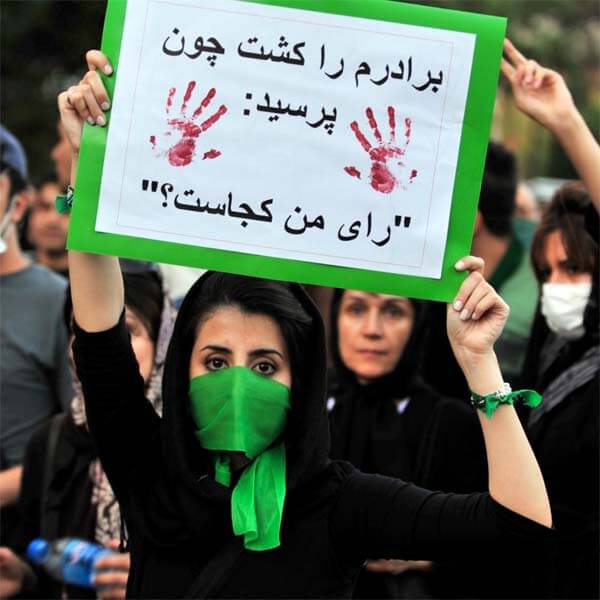
A protester on the streets of Iran, June 17, 2009. The sign reads "They Killed My Bro Koz He Asked "Where's My Vote." Creative Commons photo by Hamed Saber.
Two elections. Two women. Two killings. One legacy?
Not really. One victim became a world icon, while the other barely registered on the books of the international media. Such are the divergent post-mortem fates of Neda Agha Soltan and Zeina al-Miri. The former was shot in the streets of Tehran during post-election disturbances in June. Her story made headlines, and her name became the household kind for those who follow world news. The latter was shot in the streets of Beirut barely a week later, after clashes between supporters of two of Lebanon’s political factions following parliamentary elections. Locals barely remember her name.
Al-Miri’s anonymity is not unique. Videos of Israeli soldiers shooting unarmed pro-Palestinian protesters, in some cases fatally, surface regularly on the internet. North American mainstream media is hardly moved or concerned. Israel is on the good books of Western governments—those who demonstrate against its policies cannot be pro-democracy activists. Not so for Iran, where any opposition to the theocratic regime is cheered on, even if it is backed and led by the mullahs themselves.
The coverage of the Iranian crisis was a lot more than another case of double standards. It was a missed opportunity to understand the political dynamics at work in Iran after decades of bias and demonization of that country. It was also a missed opportunity to create genuine links of solidarity with the Iranian people that outlive the euphoria of mass street action. But instead of understanding, with a few exceptions, we got sensationalism. Instead of grassroots, long-term solidarity, we got sensational vows of support and government-driven initiatives of interference.
During Iran’s disturbances, the social networking site Twitter famously went so far as to move a planned maintenance blackout to correspond with nighttime in Iran, at the request of the U.S. State Department. Researchers at the University of Toronto who had developed an online censorship avoidance tool jumped into the fray and urged Iranian activists to use it to reach websites banned by the Iranian government.
Where did all these efforts go when Israel banned all journalists from entering Gaza during its bombardment of the strip last January?
Instantaneous solidarity with ordinary Iranians seeped all the way to the higher echelons of power. North American and European heads of state, the same ones whose countries have imposed sanctions and waged proxy wars on the Iranian people for decades, were suddenly touched by the fate of Neda and felt compelled to express their support. Dozens of protestors killed in China or Honduras or Yemen around the same time simply did not tickle the right solidarity glands. When the Iranian protests started dying out, the voice of cold realism, The Economist, wondered whether the “dream” was over.
Whose dream of change was it, anyway? Shouldn’t it have been the Iranians’? The highly romanticized and superficial coverage of events exposed two key things. First, a deep-seated belief that Iran wants to be “just like us”—democratic, liberal, civilized—and that a shadowy force called the Islamic revolution is stopping it (the fact that Islamic rhetoric dominated both sides in Iran’s conflict seemed to fly right above the heads of North American and European media analysts).
Second, the coverage demonstrated the continued, powerful influence of Western governments and political elites over the tenor and content of news from foreign countries. Without a serious overhaul of how this coverage is conducted, North Americans will continue to receive a largely skewed and one-sided portrayal of events, one where pro-Western forces of good are battling anti-Western forces of evil. You would hope this cartoon notion had been demolished along with George W. Bush’s silly decree that “you’re either with us or against us.”
Around the same time, Bush’s successor, President Barack Obama, remained conspicuously vague on the question of a possible strike by the Middle East’s only nuclear power, Israel, on alleged Iranian nuclear facilities. Such a strike would spark another conflagration in the Middle East, and the security repercussions would be felt worldwide.
Shouldn’t Western mainstream media be just as worried about that scenario? And in light of such possible escalations, shouldn’t that drive them to make better sense of what happened in Iran? Crucial questions are going unasked: What is the long-term impact of the Iranian crisis on the nuclear file? Who are the power groups mobilizing both camps? Why did the protests fizzle out the way they did? How can an influential man like Iranian politician Ali Akbar Hashemi-Rafsanjani, accused of corruption, be leading a “democratic” movement of change?
Even if media outlets wished to make better sense of events affecting millions of people, they would have had little airtime or space to discuss these secondary matters at hand. After all, the King of Pop had died.
]]>
Nova Scotia NDP Premier Darrell Dexter has a lot of reading to do, including This Magazine. Illustration by David Anderson.
The September-October 2009 issue of This Magazine should now be in subscribers’ mailboxes (subscribers always get the magazine early, and you can too), and will be for sale on your local newsstand coast-to-coast this week. All the articles in the issue will be made available online in the weeks ahead, though, so keep checking back for more. We suggest subscribing to our RSS feed to ensure you never miss a new article going online, following us on Twitter or becoming a fan on Facebook for updates, new articles and other tasty links.
On the cover of the September-October issue is Anthony Fenton‘s special investigation into the world of Canadian private security firms, armoured-car manufacturers and oil companies that are profiting from the chaos in Iraq. While Canadians are justly proud of the fact that we declined to join the misbegotten “coalition of the willing” that occupied Iraq in 2003, Fenton finds that in many ways — politically, economically, militarily — Canada’s involvement in Iraq today is deeper than ever. Three years after the legalization of same-sex marriage in Canada, Paul Gallant surveys the terrain of LGBT activism and finds it increasingly deserted. Marriage certificates in hand, middle-class gays and lesbians have drifted away from the movement, he finds, while the underfunded and burnt-out activists left behind say there’s still plenty of work to do. And reporting from Israel, Grant Shilling meets the beach bums, peace activists, and former soldiers who believe that the region’s world-class surfing could be one way to bring Israelis and Palestinians together—if only he can deliver a load of wetsuits to Gaza.
There’s plenty more, including Paul McLaughlin‘s interview with new Nova Scotia NDP premier Darrell Dexter; Sienna Anstis profiles the remarkable long-distance relationship between the University of Manitoba’s microbiology lab and a sex-worker clinic in Nairobi, Kenya; Andrew Webster meets the independent videogame designers who make Canada an increasingly important player in an emerging art form; Hicham Safieddine says that during the election uproar over the summer, Western mainstream media got it wrong about Iran—again; Soraya Roberts finds that, in choosing Veronica over Betty, freckle-faced comic-book icon Archie Andrews has subverted seven decades of cultural expectations; RM Vaughan tests the limits of his solidarity during Toronto’s great municipal strike of summer 2009 as the litterbox threatens his sanity; Laura Kusisto digs into the real numbers behind Saskatchewan’s plan to pay $20,000 to recent graduates who choose to settle there; Souvankham Thammavongsa sends a postcard about the strange nighttime happenings in Marfa, Texas; and Darryl Whetter asks why, when 80 percent of Canadians live in cities, so much of our fiction takes place down on the farm.
PLUS: Chris Jai Centeno on University of Toronto budget cuts; Emily Hunter on overfishing and the seafood industry; Jenn Hardy on the DivaCup; Milton Kiang on better ways to recycle e-waste; Navneet Alang on microblogging service Tumblr; Jason Anderson on the Toronto International Film Festival; Sarah Colgrove on Len Dobbin, the Montreal jazz scene’s most important audience member; Kelli Korducki reviews Who’s Your Daddy?: And other writings on queer parenting; and Graham F. Scott on net neutrality and the CRTC.
With new poetry by Sandra Ridley and Lillian Nećakov, and a new short story by Kathy Friedman.
]]> With his friendly countenance, placid voice and unerring kindness, the last thing you’d expect Hossein Derakhshan to be is an agitator. But put him in front of a web-enabled laptop, and this mild-mannered fellow becomes a political pitbull. A former Tehran journalist, Derakhshan is a blunt critic of Iran’s theocratic regime, which stifles liberalism and tries to smother dissent. Since publishing a Persian guide on how to build a weblog, he has been credited with politicizing a generation of Iranian youths—and drawing the ire of the supreme leader, the Ayatollah Ali Khamenei. Cognizant of the risk of continuing his countercultural activities, Derakhshan and his wife, Marjan, moved to Canada in 2000. But he didn’t give up his activism; he merely intensified it. From his condo in downtown Toronto, Derakhshan operates Editor: Myself www.hoder.com, a bilingual weblog (English and Persian) that advocates Iranian democracy and acts as a locus for the Persian diaspora.
How big is the internet in Iran?
There are more than three million internet users out of a population of 70 million, which is not bad. They’re mainly students and middle- and upper-class. The access is now much easier than it was six, seven years ago. For the past five years, there are different ISPs, private ISPs, and they have calling cards that they sell. Ten hours of internet access is 10 bucks. It provides people with anonymity, because that’s a big thing for internet users in Iran. And it gives them an option not to stick with one ISP; if the service goes down and anything happens, they can change to another ISP. But recently there have been regulations passed, both in government and the judiciary, that want to limit this anonymous access through these cards. This is a very important development, and it could harm the increasing number of internet users in Iran.
Is it fair to say that the government sees the internet as a threat?
The government is good toward the internet. It’s not controlling it. It’s helped to develop the infrastructure and they’ve allowed private ISPs to operate. But there is another part of the regime, which is more powerful than the government. The leader himself and security organizations have been trying to shut down the internet or, as much as they can, prevent people from accessing the political opposition websites or anti-religious websites.
How bad is web censorship?
Since [May], it’s stepped up very, very heavily. You can say that almost every popular website, whether it’s political or entertainment, has been filtered and has lost almost half of its users. Several years ago, on July 9, there was a student protest. Every year, on the anniversary of that day, [the regime] gets paranoid. They always think that the CIA or [Israel’s intelligence service] Mossad is conspiring against them. On the eve of this day, or one month before that, they start to shut down everything, to effectively disconnect Iranians inside from the outside world.
Does the Iranian regime consider you a public enemy?
Unfortunately, yes. That’s why I can’t go back. I mean, I can go back, but it’s risky. One of my friends was arrested—he was a blogger and journalist—and now he’s in Holland, because he escaped after he was held for 20 days. We have had phone conversations, and he said they were interested to know about his relationship with me, and the part that I’ve been playing in promoting these weblogs, who’s supporting me, what kind of family I come from. It wasn’t good news for [the regime] when they heard that my family was very religious. For example, my uncle was among the top officials. In the beginning of the revolution, he was killed in a bombing. He was very close to the party of the current leader, the hardliners. When they heard that I came from that kind of family, they were disappointed, but still very suspicious. They can’t believe that one person with his laptop can still start this whole thing.
]]>