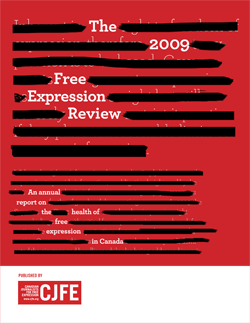
 Today, which is, appropriately, World Press Freedom Day, Canadian Journalists for Free Expression released their first in what will be an annual series of reports on the state of free expression in Canada. As the authors note in the introduction, 2009 was a notable year in Canadian press freedom:
- The Supreme Court of Canada established the new “responsible communications” defence to claims of defamation, providing greater latitude in reporting on issues of public interest and beating back libel chill;
- Federal government transparency took a decisive turn for the worse, so much so that the access to information commissioner pronounced it being at risk of being “totally obliterated”;
- There were two attacks on members of the “ethnic press” in Canada—a physical assault of the editor of the Canadian Punjabi Press in Brampton, Ont., and the vandalization of the offices of the Uthayan newspaper in Scarborough, Ont.;
- The Vancouver 2010 Olympics produced a handful of troubling incidents, with reporters harassed by law enforcement, detained on dubious grounds, or turned away at the Canadian border on specious grounds.
The study includes a report card that assigns grades to different institutions and their openness to public scrutiny, or their actions that make that scrutiny possible. The Supreme Court gets an A for the new defamation defence; The Canadian Human Rights Commission gets a B for deeming the hate speech provision of the Canadian Human Rights Code unconstitutional in the Marc Lemire case; on publication bans in the courts, appeals courts get a B+, while trial courts get a C-. Continuing the drumbeat of discontent over the federal government’s lack of transparency, it gets an F:
Here, the only assessment can be a failing grade.We remain bedevilled by the antics of those federal entities that invoke national security at the drop of a hat to restrict the dissemination of vital information to journalists and, in turn, the public. Perhaps this attitude is best exemplified by a recent exchange between a federal government lawyer and the Military Police Complaints Commission, in which the lawyer not only challenged the commission’s right to obtain certain government documents on detainee transfers but went so far as to indicate that he was not at liberty to discuss when those documents might be available. Add to this the countless delays and roadblocks put in the way of access to information and we are left wondering how the prime minister could praise the media’s attempt to hold government accountable while abandoning his own promises of access reforms so loudly trumpeted on the campaign trail.
 Anthony Fenton, the investigative journalist who wrote “Hostile Takeover: Canada’s outsourced war for Iraq’s oil riches,” the September-October cover story in This Magazine, has been on the air three times in recent weeks, talking about the article, Canada’s part in the Iraq occupation, and the private businesses that profit from the conflict.
Here’s Anthony talking with the American investigative radio magazine Flashpoints on KPFA 94.1 FM, broadcasting out of Berkeley, California. (Drag the slider to about the one-third mark to skip straight to the interview.)
A few days before that, Anthony was on the Jeff Farias Show, a progressive podcast from the U.S. (the show is one and a half hours, and he is the last half hour. You can listen to the broadcast through Jeff’s website.
Finally, later in September Anthony was heard on Gorilla Radio, the Victoria, B.C. social justice radio show, heard every Monday at 5 PM PST on CFUV, 101.9. His interview is the first part of the program.
]]>
As the large networks close small affiliate stations, is there hope for the future of local television news?
The sky is falling on news, said Mike Katrycz, but this isn’t the first time.
The veteran news director joined a panel discussion called “Local TV News Under Siege” at Ryerson Journalism School on Wednesday night. With him were CTV managing editor Adrian Bateman, CBC managing editor Sophia Hadzipetros, and CITY Toronto reporter Farah Nasser.
Katrycz used the rise of the Toronto Sun from the ashes of the Toronto Telegram as an example of news organizations adapting to changing times. When the Telegram closed in October 1971, a group of the newsroom staff started the Sun immediately. The new tabloid sized paper was radically different from its broadsheet predecessor, and is still in print.
CHCH’s story is similar. Katrycz and his team were told the station was up for sale, and slated to close at the end of August if no buyer emerged. The newsroom managers changed the format to all-day news to try something different. The station sold a few weeks ago, but Katrycz and his staff will have to wait to see the numbers before they know if their gamble paid off, or hiring any new staff.
The panel members seemed eager to share the innovations they’d made at their stations to “save the news.” CHCH adopted a news wheel format, like CP24, repeating pre-packaged burst of news which are periodically updated. CBC stations nation wide switched to a new 90 minute supper hour newscast, similar to what CITY was already doing. Both Hadzipetros and Nasser said their long-format local news offers them the chance to tell each story from different angles.
While this all sounded very hopeful, it doesn’t really match up with what we’re seeing. Slashed budgets, and stations and newspapers folding across the country are high on my radar, being a recent J-school grad with looming student loan payments. Longer local newscasts are just that: longer. The same number of staff, and in some newsrooms fewer staff, are filing an extra half hour of news.
Near the end of the question period, a recent journalism grad stepped up to the mic. Her story echoed my thoughts. After graduation, she moved from Toronto to Brandon, MB to work for a small TV station. On her second day of work, the station manager announced they would close by the end of the summer. Now she’s back in Toronto looking for another job.
The road may be paved with technological advancement in Toronto, but the GTA is double the population of the four Maritime provinces combined. Smaller centres, the ones who rely on TV news, are in trouble. The networks need to realize that the small local stations are the roots that feed the big network stations, Adrian Bateman said to loud applause last night. It was a nice sentiment, but he was preaching to the choir in a room full of journalists and current journalism students—who will soon be out looking for their own jobs.
RTNDA Canada plans to podcast a video of the discussion on their website in the future.
UPDATE: The podcast is now online.
]]>If you’re a journalist and still brave enough to announce that fact on social occasions, you can be more or less assured what the next question will be. “Don’t you worry,” someone will always begin with a sheen of sympathy, “that journalism is dying?”
There are a range of responses from which to choose: pull out some far more dire stats about the future of the car industry, offer a lukewarm endorsement of the Huffington Post-model, or remain in denial and pretend to be distracted by an incoming plate of hors d’oeuvres. But if journalists are smart – and as glamour and riches fade away, intelligence may be one of our only remaining virtues – we will stop bristling about defending our professional worth and personal sanity to perfect strangers, and instead feel honoured that people still care enough to ask the big question: “Is the mainstream media dying?”
Which is why it’s great that the relatively new Canadian Centre for Investigative Reporting is getting together a discussion panel to ask that question, as well as the follow-up: “Can investigative reporting save it?” And then, perhaps the biggest question of all: “Should it?”
Bilbo Poynter, the executive director of the centre, admits these questions are more about creating provocation than seeking resolution. And there is no doubt that the CCIR has assembled a distinguished panel of journalists — including the evening’s moderator Gillian Findlay of the premier investigative program The Fifth Estate, John Cruikshank of the Toronto Star, and several other important voices in Canadian journalism.
Still, on first glance, the idea that investigative journalism will save the mainstream media looks like a tough case to make indeed. As investigative reporting budgets are among the first things to go at most newspapers and magazines, muckracking looks more like a gangrenous limb on the sick old man that is mainstream journalism. Investigative journalism is great, most editors agree, but it is also slow, expensive and not always guaranteed to produce racy — or any – results. Hardly a winning combination in the fast-moving, commentary-heavy blogosphere.
Yet when journalist stop quipping long enough to let those awkward cocktail party conversations continue, it becomes clear that what people fear most about losing with the death of journalism looks very much like the work of investigative reporters: protecting the underdog, uncovering corporate malfeasance, and holding democracy to account. Will investigative reporting save journalism? I’ll let the panel convince you of that or not. But the really compelling question is a variation on the CCIR’s third question: Without investigative reporting, does journalism deserve to survive? It is a question without an easy answer. And as any investigative journalist will tell you, those are the best kind.
The panel takes place Wednesday, Aug. 5 at 6:30 p.m. at the NFB Mediatheque. 150 John St, at Richmond, in Toronto. Admission is a donation.
For more information call 905-525-4555 or e-mail [email protected]
]]>