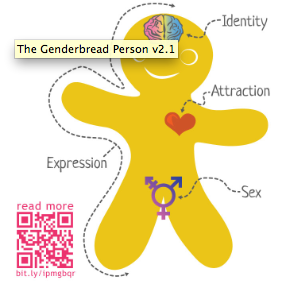
Sam Killermann’s Genderbread Person
On April 29, B.C.’s Maple Ridge-Mission MLA voted against allowing people to change their gender designation on their birth certificate if they haven’t had gender reassignment surgery.
Bill 17 was first introduced March 10. Maple Ridge-Mission MLA Marc Dalton voted against Section 115, saying, “My concern is it might lead to more self-acceptance issues with young people.” In the past, Dalton has called homosexuality a moral issue, like pornography, adultery, gambling and abortion as well as promoting a church that aims to cure homosexuality in the legislature.
Perhaps Dalton should read GLAAD’s tips for allies of transgender people: “It wouldn’t be appropriate to ask a non-transgender person about the appearance or status of their genitalia, so it isn’t appropriate to ask a transgender person that question either.”
Gender and sex can be independent from each other. As the World Health Organization explains, “sex” refers to a person’s biological and physiological characteristics, where “gender” is about socially constructed roles; what a society sees as masculine or feminine behaviours. Things like sexual orientation are not dependent on an individual’s gender; a transgender person, for instance, is not automatically gay.
Dalton doesn’t get it, and probably never will. Gender, like sexual orientation, is not a choice. As teacher and staff liaison for the gay-straight alliance at Thomas Haney Secondary, Kathryn Ferguson, says: “Thank you, Mr. Dalton, for reminding me why we do need gay-straight alliance groups in the public school system.”
]]>
Picture by Blake Emrys
When the Holocaust ended almost 70 years ago, and we said it would never happen again. Yet, there have been six genocides since then. The systematic murders in Darfur are ongoing, and the country’s government won’t address them. Many groups have been founded to tackle genocide in the past 15 years—such as United to End Genocide, Genocide Watch, and Genocide Prevention Program—all with the intent to halt any potential genocides.
And now, there’s a new genocide prevention group that’s been getting some well-deserved buzz. The Toronto-based NGO, Sentinel Project, uses its website and other technology to keep track of early warning signs of genocides. What makes it so revolutionary is its interactive hate-speech documenting website, Hatebase, that launched this past March.
The database is made up of slurs regarding ethnicity, religion, sexual orientation, disability, class and gender, including information on what country and language they were said in. Anyone can sign up and input overheard name-calling in their area, or search the categorized lists. The point of all this is to discover any hate speech trends per area and address them before violence strikes. As outlined in the eight stages of genocide by Genocide Watch, mass murder begins with classification and symbolization. Classification is distinguishing “us from them” and symbolization is the name-calling we’re talking about here. The ultra-scary next step is dehumanization—denying that those they nickname are even human at all.
Scrolling through Hatebase lists, I’ve learned new words that will never cross my lips. However, I can unfortunately see some of this language easily added to other people’s repertoire. Just look at what happened to Urban Dictionary. What was once a website for teenage slang definitions has now been taken over by made-up (and often sexist) user-written slurs.
Twitter has had a sharp increase of “hate-spewing hashtags and handles” this year, according to the annual report by the Simon Wiesenthal Center, a racism history museum. For further proof, visit the Alberta-based website No Homophobes. Any time the words “gay”, “faggot”, “dyke”, or “no homo” are posted on Twitter, it automatically pops up on the site. It even shows the stats. Last week, “faggot” was tweeted 395,087 times. The site urges us to consider how often we use hurtful language without thinking. It’s an effective, albeit depressing, reality check.
Hate speech at that stage does not a genocide make, but as those at Sentinel Project know all too well, this is where it can start. Offensive material can be reported on the social networking sites themselves. Every post and picture on Facebook carries with it an option to report it to an FB team who removes it. Where to report Twitter abuse is more or less hidden in the settings section. “Reporting” the instances of hate speech is what Hatebase does too. So where does it go from there?
First, it draws upon themes. Hatebase has noticed that those of the Baha’i religion in Iran are increasingly being shunned from society, for example. It also fears the apparent ethnic rivalry in Kenya could escalate into genocide. With this information, it can try to prevent attacks by “countering websites that incite hatred, using mobile phones networks to document abuses and warn threatened communities, and employing GPS technology to guide targeted people to safe areas.” The organization is not without limitations, as it lacks the tools to physically intervene, but it’s a start.
Referring back to the eight stages of genocide, the last stage is denial. After a genocide has taken place, the perpetrators always attempt to cover up any evidence. But Western denial could be labelled as one of the first steps of genocide. Countries with the power to stop ongoing genocides often don’t. As far as the Sentinel Project is concerned, if catching the warning signs can save a life, it’s worth it.
]]>
Rosalind Russell and Cary Grant in 'His Girl Friday'. Newsrooms still have a long way to go toward achieving gender equity.
[Editor’s note: On a semi-regular basis, we survey a sample of recent back issues of This to analyze the topics we cover, how truly national our scope is, and the makeup of our contributor roster. See the last survey here.]
The new documentary Page One focuses on the state of journalism, its new technologies and decreasing revenues. And if you look closely, the trailer also reveals the struggling industry’s sweeping bias. The reporters and editors interviewed at the New York Times are mostly men (and they’re all white):
It’s old news that American print media is running a deficit on female contributors. Last year Elissa Strauss conducted a survey of major magazines in the U.S. The New Yorker had 27 percent female bylines. The Atlantic, 26 percent. Harper’s Magazine, 21 percent. And that’s just to name a few. You can view a more extensive list by VIDA here. And last February, CBC Radio followed up on the story, interviewing Canadian magazine editors about the same problem north of the border.
So when my editor asked me to survey a year’s worth of This magazines, I jumped at the chance to uncover our biases. Where did our stories take place? What topics did we write about? How many of our writers, and their sources, were female versus male? The results surprised me.
Methodology
My survey may not be 100 percent replicable at home. You can view the whole spreadsheet on Google Docs here, or download it as a CSV file. And you can check out the previous year’s stats (which tracked geography and topics, but didn’t track gender).
I kept track of every article that had a byline. I assigned each of these a location (e.g. Vancouver) and a general topic (e.g. environment). I also noted each contributor’s name and gender*. Then I took note of every person who was quoted. I chose to do this because a direct quote conveys the person’s voice to the reader. I also took note of each source’s gender. Quoted sources are very often referred to as “him” or “her” in an article. When they weren’t, I asked the writer or Googled names to find out.
As I surveyed the first magazine, an unexpected trend emerged. There seemed to be far more male sources than female sources. So I retraced my steps and added each source’s profession, title or expertise. I kept it up, hoping this would give me more insight if the trend continued.
Results
We haven’t changed much since last year in terms of geographic distribution. Ontario, particularly Toronto, appeared frequently (though we haven’t determined yet whether it’s disproportionate to Canada’s population). British Columbia, with particular emphasis on Vancouver, was a close second. This year it was the Yukon, Nunavut and PEI that went unmentioned (last year, it was New Brunswick that was non-existent between our purportedly national pages).
When it comes to our favourite topic, the environment is still number one. We also love technology and politics, as per the usual. Freelancers take note: we didn’t have nearly as many stories about racism or homophobia in this sample as we do about women’s rights. Transphobia was invisible between our pages.
This Magazine is a lefty indie not-for-profit with a male editor and female publisher, and our bylines are also pretty egalitarian: 53 percent of bylines over the year were female (76 out of 142). Compared to the male byline bias in the mainstream media, This Magazine constitutes a fair counterpoint.
However, when it comes to sources we’re not doing so well. Only 72 out of 256 sources quoted were female. That’s 28 percent. Suddenly we look a whole lot like those other magazines I mentioned. Are our writers biased, or are the numbers reflective of the status of women?
Both. Male writers were less likely to quote female sources (22 percent of sources quoted in their articles were female). By contrast, sources quoted by women were 33 percent female. This disparity suggests that credible, accessible, female sources exist—but men aren’t quoting them. Another factor could be that men tended to write more for our technology issue (13 out of 23 bylines), which acknowledged a lack of women experts in the field. Conversely the most female bylines (17 out of 23) could be found in “Voting Reform is a Feminist Issue.”
If our journalists are quoting people of the same gender as themselves and over half our bylines are female, shouldn’t we have a more even split of sources? Sadly it doesn’t appear that personal bias plays a strong enough role to account for the disparity. I have to conclude that the lack of females quoted reflects the status of women in society.
Think about it. Journalists quote people who hold positions of authority. As I read down the list of sources’ titles, I can say pretty confidently that our reporters interviewed the right people. Some of their sources are politicians, CEOs, judges, police officers, people of high military rank. In Canada, these positions are occupied by men and women—but women are decidedly the minority in those cases. In 2007, according to the Status of Women in Canada, 35 percent of those employed in managerial positions were women. According to a one-week old worldwide survey by the new UN agency for women, 44 percent of Canadian judges are female. Only 18 percent of law enforcement workers are female, says a 2006 StatsCan report. According to StatsCan the Department of National Defense, only 15 percent of Canadian Military personnel were female. It’s no wonder that our feature on Canada’s involvement in Afghanistan quoted no female military sources, and that our reporters interviewed few females involved in law when researching our “Legalize Everything” issue.
Solutions
The best thing journalists can do to eradicate bias is to be aware of it, which is why we do this kind of analysis in the first place. Without this first step, we can’t ever hope to challenge our points of view. Acknowledging bias includes direct and indirect bias. The first type includes journalistic and editorial perspectives. The second type includes structures that perpetuate the unequal status of women, such as advertising bias, media ownership, and hiring practices in the wider world. So although it’s a great start, seeking out female sources in law enforcement, engineering, politics and technology is not going to cure the gender gap. Those in positions of power must attempt to correct gender, race, sexual orientation and class biases when they hire and promote workers. Voting reform would help, too.
Don’t lose heart — there are also positive signs in the numbers. The equality of male-to-female bylines and the greater female tendency to write without using as many direct quotes (often considered a sign of reportorial confidence among journalists) challenges Strauss’ guess that women may be meek or passionless about politics and critical journalism. For a magazine with the slogan “everything is political,” this is simply not true. It could, however, still be correct for the magazines Strauss surveyed. After reading a year’s worth of This, I can safely say our writers (female and male) are unapologetically critical in their approach — and nowhere near shy.
We want to do better in terms of bias, and we welcome any and all suggestions on how to improve our coverage of underrepresented topics, locations and communities.
*I don’t believe gender is necessarily fixed, but it certainly has a binary status in our language. Whether the sources actually identified as one of two genders or not, our magazine certainly identified them as male or female; no articles used “s/he” or mentioned any other gender. Due to the superficiality and time constraints of this survey, it’s not possible to tackle the language problem right now. However, I would love to hear your thoughts on how this might be possible in the future. Email [email protected].
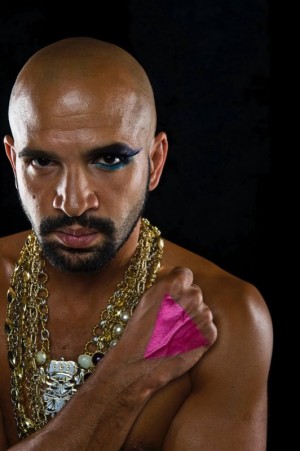
Berend McKenzie
Nggrfg
. For most people, the title of Vancouver actor and playwright Berend McKenzie’s play is nearly unsayable. But for McKenzie, naming his one-man play after the two slurs that plagued his childhood is the best way to understand and neutralize hatred. Audiences seem to agree: his play was a hit at the Edmonton and Vancouver fringe festivals and has since toured Vancouver high schools and even, with tweaks, elementary schools, where McKenzie talks with students about racism, homophobia, and bullying.Extended Q&A
This: Where did the play debut?
McKenzie: It premiered at the Edmonton fringe, and then came to Vancouver and did a run at the Firehall arts centre. We garnered a Jessie Award nomination, which is our theatre award here for original script, and then we’ve done a run in Halifax for the Queer Acts theatre festival. Then the Vancouver School Board has picked it up, and I’ve done 14 secondary schools in Vancouver. We’ve adapted part of the story to work with elementary students, kindegarten to Grade 4, and another adaptation for Grades 5 to 7.
This: Really? How has it been adapted?
McKenzie: The last story in the play is called “Tassels,” and it’s based on the first time that I saw the miniseries Roots, and the subsequent bullying I received growing up in High Level and Valley View, Alberta. So we call for the Elementary schools it’s not called nggrfg, it’s called Tassels. It’s about me and my character, “Skip,” and he has a skipping rope that’s pink and he loves it and knows how to skip really well, and it has sparkly metallic tassels on each handle. A girl on the playground dares him to skip with the girls, and so he does, and then the schoolyard bully uses it as a whip and chases him around the schoolyard. So for Kindegarten to Grade 4 adaptation, we’ve taken out the words “nigger” and “fag,” because they don’t really understand it—we’ve put in “sissy” and boy and girl and cowgirl. For the Grade 5 to 7 show, we do the full thing. The story is still called Tassels but we haven’t changed any of the wording. I’m called “nigger” and some of the slave names from the show. We have some fairly lively talkbacks afterward.
This: So there’s a talking session after?
McKenzie: Definitely, a debrief after.
This: What kind of responses do you get from the kids in elementary school?
McKenzie: Everything from shock to a sense of almost relief that they can actually talk about it.
This: These are things that are present on the playground already?
McKenzie: Yeah. They’re words that they hear all the time, but they’re told “Don’t say them.” Well, to a child, I know from myself as a child, if you told me not to do or say something, and didn’t give me any sort of reasoning behind that, I would do it all the time, just because you told me not to.
These students, they hear it in music and on TV, they hear it everywhere, but they’re told “just don’t say the words.” We got a comment from a Grade 6 blonde girl at the end of one talkback—her teacher who had a Grade 6 and 7 split class, so he got permission from all the parents to bring them to the show at a high school—and in front of 300 strangers, she asked me how does the word “nigger” affect me now. And she didn’t say “the N-word,” she said the word “nigger,” and it was really awesome, because I thought: when will she ever use this word in this context ever again? When will she feel safe enough to use it? The only time she will ever probably use this word—if she chooses to use it—will be probably in a confrontational, possibly violent way.
This: How does the word affect you now? Obviously it affected you negatively when you were younger and that’s what led to the themes in the play. How does it affect you now when you hear it?
McKenzie: It depends on the context. Often, in writing the show, I had to come to terms with how I felt about the words. I kind of had a feeling about how I felt about the word “faggot,” but I didn’t know how I felt about “nigger,” because I had shut down a lot of those memories. I never used the word, I hated the word, and at one point I thoght the word should be banned and that we should get rid of them and that would take their power away. But I sort of talked my way out of that. Now, performing the show, it’s a day-to-day thing for me: some days I can say the title nggrfg without hesitation and depending on who it’s in front of, say it without shame. But sometimes, depending on how I’m feeling and who I’m talking to, I’m a little apologetic about the title, I will not say the name, I’ll spell it out, N-G-G-R-F-G. It depends on how I feel about the word on that specific day.
I think there are still better words in the English language to say hello to a brother or a sister, or a friend, or a loved one. The word “nigger” doesn’t need to be used. As for “Fag”—gay culture, we’ve really been known to take what’s used as weapons and flip them around, put a feather boa and some sequins on them and maybe some high heeled shoes, and then throw it in your face, and say, “You think that’s a fag? This is a fag.” And then we use it on each other.
It depends on context. I’ve sat in movie theatres, and I still cringe when I see same-sex couples kissing, not because it makes me uncomfortable to see them kissing, but I wait for that often-heard mumbling of the word “faggot.” We’re in the dark, no one knows who’s there, but it feels like it’s directed towards me. And that makes me feel unsafe. The words make me feel unsafe often, and this play has allowed me to feel safer using the word “nigger.”
What I’ve realized is that it’s not the word. It’s not the words themselves that are the negative—it’s the people and the reasons why the words are being used and in what context. It’s a different thing when a young student says I hear the word “nigger” all the time in the hallway, or I was called “faggot” last year all the time. When Aaron Webster was being chased through Stanley Park being beaten to death, being called a faggot, or blacks being called “niggers” all the time in the South in the U.S., it’s a different thing.
That’s all that we’ve understood up to this point, that’s all we’ve heard are the negatives about the words. If there are any positives—which I don’t know—it’s that the words have shown us where we have come from. And the words show us that if we’re not careful we could be back there very, very easily. And now the word “nigger” is being replaced by “Muslim.” Or “terrorist.” Anything that’s different is deemed unsafe or something to be scared of.
This: There’s a lot of debate, obviously, about what words we should be allowed to say. Can you give me some thoughts on why censorship misses the point in this case? If no one said “nigger” or “fag” again, some people would make an argument that that would be a great thing.
McKenzie: Yeah, it would be a great thing. I think we would find something to replace it that would be just as evil. I think the words “nigger” and “fag” exist for a reason. I don’t believe in accidents. I believe that everything here is here for a reason, and that’s my own way of being in the world. I grew up believing that God made a mistake with me, when It or He chose to make me. I was put up for adoption. I was adopted into a white family, so I was the only black child. And being the only black child in many of the small towns we lived in, I felt alone. Even though there were a lot of us in the family, I still felt alone. And when I realized that I was gay, which was at a very young age, I thought that God hated me. And through living now—I’m 42, I never thought I’d live to see 42, I didn’t think I’d live to be 12, let alone 42—I’m starting to realize that the words are here for a reason.
Language is not something to be feared. Language is delicious. I don’t necessarily believe that the word “nigger” is delicious, but I think that what happened within the school system here in Vancouver, and will be happening in Toronto in the next year or two, what’s happening with the students is delicious, because for the first time they’re able to exhale and tell their experiences and their fears, and their experiences with the words and what those words have done to them. That’s delicious to me, there’s nothing better than listening to a group of kids, students, discussing.
After the discussion they walk away with written commitments saying that we will stop homophobia and bullying and racism in our school. In places like Surrey. Surrey has a reputation, a Surrey Girl is easy, it’s kind of trashy, and low rent, and you know, I went out to the schools with my own ideas and notions of what Surrey was, and was blown away by how accepting [they were.] They had one of the largest Gay/Straight alliances that I’ve seen in all the schools I’ve been to—like, 20-strong, where queer youth can be themselves and walk through the hallways without fear of being beaten. Or if they are harassed, they feel safe enough to go to someone to get help.
I have my own prejudieces around the words. I used to think that black people smelled—I don’t know where I got that from. But I had somebody tell me that black people smelled differently than white people. That was a drag queen doing my makeup, believe it or not. And I was like, “Oh, Really?” And he’d kind of said what I’d always thought, and I’d always thought that black people smelled. But I’ve been around a lot of black people in my adult life, and there’s no difference, unless you don’t wear deodorant—we all smell if we don’t wear deodorant.
This: That’s an odd thing to hear from someone who’s doing your makeup.
McKenzie: Yeah, from a Drag Queen who’s doing your makeup. From someone who’s experienced their own forms of homophobia. And racism and homophobia are so exactly the same, I feel. They’re exactly the same, what happens to the person who is the target of either, the same things happen to them, in identically the same way. You feel fear, you feel less-than, you feel, at least for me, unsafe, unvalued, not worthy, the list goes on and on and on. I think the blacks that were hanged, and slaves that were caught and tortured and whipped, feel the same things that Matthew Shepard did when he was tied up to the fence and left to die. It’s the same thing that women feel when they’ve been assaulted. Women feel the same type of thing. There’s another word for women that’s the identical word for the replacement for “nigger” and “fag,” and you know what that is and I don’t need to say it. It’s all meant to oppress.
This: You’ve personally reclaimed those two words; do you think that society could ever reclaim them the same way that queer groups have reclaimed “queer,” the way that the black community has, to some extent, reclaimed the N word? Do you think that these things are desirable or possible?
McKenzie: I think as we become, as a society, more enlightened—and in some ways we are more enlightened—I believe as we go on, we will be able to. But it’s a long road. We seem to be going leaps and bounds in Canada as far as gay rights and human rights—gay rights being a part of that experience, or women’s rights—and teaching in school about bullying and homophobia and Gay-Straight alliances, and gay marriage, and all that stuff. And then you read in the paper 15 kids in North America killing themselves because they’re bullied because they’re perceived as, or are, gay or lesbian. And so there’s a disconnect there, and it’s confusing. It was confusing for me to see that happen in such a short span, and I think here in Canada… I think Vancouver’s the first school board in North America, and I think the world, putting a show called nggrfg in front of students. I don’t know any other school board is doing that.
]]>
John Sewell, left, at a 1979 rally; George Hislop, right, with campaign manager Susan Sparrow on election night, 1980.
If you’ll oblige, take a trip with me back to the Toronto municipal election of 1980 — an election shaped (maybe even decided) by, I kid you not, the KKK, neo-fascists, virulent homophobia and a reactionary police force.
Click here to download a PDF of the February-March 1981 article from This Magazine.
John Sewell was running for a second term as Mayor. An environmentalist, a critic of the Toronto Police, a leftist (much more radical than mainstream progressives today) and an opponent of development (read gentrification) projects, he beat two conservative candidates for Mayor who split the right-wing vote in the 1978 municipal election. Two years of controversy, however, provoked liberal and conservative voters to reconcile and in 1980 they united behind alderman Art Eggleton (now a Liberal senator).
There wasn’t too much that distinguished the candidates in the campaign: Sewell was definitely the further to the left and Eggleton was much more pro-development but these questions, while of tremendous importance, did not animate the contest. Rather, the major campaign issue was Sewell’s decision to endorse George Hislop’s candidacy for city council. Hislop was a gay rights activist and had he been elected would have been the first openly gay elected official in Canada.
The spectre of a Sewell-Hislop gay axis motivated reactionaries to organize. The Toronto Sun started to talk about “gay power:” a term that, as Leo Casey wrote in the February 1981 issue of This, “came to symbolize a mythical hedonist monolith of lesbians and gays which threatened public morality.” The “League Against Homosexuals” (an organization that — and remember this is just 30 years ago — advocated for the elimination of queer communities and queer individuals) circulated leaflets warning parents that “Your child or any child (could be) kidnapped, tortured, raped repeatedly, and finally murdered by sexually depraved deviants that now prowl our schools…” A flyer from “Positive Parents” took a similiar line: “Militant homosexuals (come) into your schools to seek recruits among your children.” Renaissance International, a group with unclear origins, distributed over 100,000 pamphlets urging people to vote against Sewell and Hislop on account of their support for gay rights.
Many of these groups were formed by neo-fascists (mainly members of the KKK, the Nationalist Party and the then recently dissolved Western Guard) but they also had a broader appeal, particularly with the Toronto police force. A League Against Homosexuals publication entitled Queers Do Not Reproduce, They Seduce was found in a literature stand at Toronto Police headquarters. Whether it was strategically placed there by a right-wing activist or whether the police themselves were distributing is not known but, either way, its tone fit well with the homophobic orientation of the Toronto police.
One year later police would mount the famous bath house raids and five years earlier the police’s Orwellian Morality Squad suppressed an issue of Body Politic because of a cartoon in it that depicted two men engaged in oral sex. Nor were queers eligible for police protection. Each Halloween Eve during the ’70s and ’80s there was a large party for gay men at a Yonge street bar and each year many queers, cross-dressers in particular, were queer bashed. Organizers asked police that that they be allowed to park large trucks outside the bar to provide some cover for party goers. The answer was a firm no. “The gay community is not going to tell us how to do our work,” one police officer told the Toronto Star.
Nor would police allow the gay community any sort of representation at city hall. Sewell recalls that “signs were placed in police locker rooms advising officers to ‘flush Sewell down the drain,’ among other things, and pamphlets excoriating homosexuals were distributed from police stations.” People were afraid of wearing Sewell campaign buttons or feared the consequences of putting up his campaign signs.
Despite the virulent and obvious attacks, however, leftists and progressives failed to intervene. Eager to win as many wards as it could for itself the NDP ran a candidate against Hislop and remained quiet while he was attacked. This is not, however, to suggest that the party would have lept to his defence had such a defence been politically expedient. Considering itself a party for working people first it, the NDP had difficulty convincing itself that queer issues deserved explicit and full attention. As one New Democrat put it: anyone should have freedom to choose “who they go to bed with” but the question of “how you earn the money to get the bed” is politically more important.
Even Sewell offered only muted support for gay rights. Homosexuality “is a difficult one for anyone to deal with, myself included,” he said at one debate. “I neither approve nor disapprove of homosexuals,” he told the Globe. Meanwhile Eggleton, distancing himself from the reactionary right but still tacitly endorsing homophobia, warned that the kind of alliance Sewell struck with Hislop risked turning Toronto into a city like San Francisco: that is, dominated by homosexuals.
In the end Hislop and Sewell both lost, the latter by 1,767 votes. The day after the election the Toronto Star’s Marina Strauss wrote that Sewell’s loss could be chalked up, in large part, “a strong rejection, by some people, of support for homosexuals.”
The political lessons of the 1980 election are manifold: progressives must defend each other, the police force should not be allowed to become politicized, etc. Most importantly, however, remembering the 1980 campaign forces us to notice that many of its themes remain leitmotifs in the current contest. This said, (bearing in mind that there are very important issues being debated) the past prominence of neo-nazis in municipal politics put the Jarvis bike lanes into perspective.
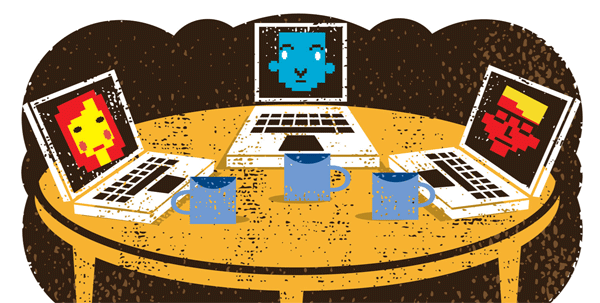
Online communities bring together people who would never talk in real life. Illustration by Matt Daley.
Though you can count the joys of graduate school on one hand—without even using all of your fingers—spending an evening with like-minded friends just chatting is definitely one of them. As the drinks flow and discussions stretch late into the night, it’s easy to feel the glow of both comfort and belonging.
But as much as I love the company of my peers, it’s hard not to notice that we usually talk about the same things in the same way. You know: Mad Men is great but problematic, and, well, what’s the deal with this Harper guy? Still, even the most polite among us have to admit that, in the interest of challenging complacency, blunt disagreement is an occasional necessity—and when everyone comes from more or less the same background, that can be hard.
The internet, that grand messy swirl of ideas, might seem to offer an answer. But alas, it suffers the opposite problem: on the web, genteel discussion is about as rare as the average unicorn. Exchange is notoriously confrontational, irrational, and pointless. Users are always warned to never feed “the trolls”—the online agitators whose sole purpose is to provoke and annoy, and who frequently capsize the entire conversation.
But if you are looking for discussion that will challenge and provoke without devolving into mudslinging, there is hope—and it comes in the unlikeliest of places. It’s called the “off-topic section.”
Case in point: it isn’t exactly something I’m proud of, but I spend a good deal of time on NeoGAF, an online message board that bills itself as the premiere video game community on the web. It may sound a bit like boasting about “the diveyest dive bar on the block,” but NeoGAF is, surprisingly, a bit of a paragon for both the best and worst of online dialogue.
Most of the chatter is about the stated subject of the site—video games. Forum moderators constantly struggle to keep these conversations on topic. As a result, NeoGAF, like almost every one of millions of web forums out there, has an “off-topic section” where members can blow off steam and rant about almost anything they want. Spend a bit of time there, and you’ll find people from radically different viewpoints actually talking about things they might hardly dare to in real life.
“A question for gay guys: would sex with a woman disgust you?” reads one naive post. “Muslim racism in Norway!” loudly claims another. But while that may sound like a breeding ground for ignorance—and occasionally is—a lot of the time, it’s the opposite. Recently, when a poster ominously linked to a piece about the failure of some newly black-owned farms in South Africa, I cringed; after all, Canadian public discourse and the web have very different standards of what’s acceptable to say, and even in a moderated space like NeoGAF, prejudice isn’t uncommon. Instead, what transpired was a generally reasoned discussion of race-based policies in South Africa, and multiculturalism in general. By the end of it, people committed to absolute ideals of equality had to admit that there were complex reasons behind things like cultural relativism or the machinations of politics and history.
Similarly, in those other discussions, a teenage boy, unfamiliar with simple truths about the fluid spectrum of sexuality, learned some valuable lessons, while a poster with a set of Islamophobic beliefs had his assumptions and discourse soundly and smartly critiqued. In engaging with viewpoints they might not otherwise hear, people were having their beliefs and views challenged in a way that would not have happened offline.
NeoGAF’s community formed around shared interests rather than a set of shared beliefs. As a result, it is composed of a staggeringly diverse group of people: young and old, male and female, left to right, and everything in between. Few things capture the site’s heterogeneity like the fact that, as I type this, a thread about the low median income for single black women sits right under one simply entitled “Boobs!”
This isn’t limited to video game communities. The same basic dynamics apply to web forums the world over, be they about urban affairs, technology, or craft-making, and in these quiet, nerdy corners of the web, people who may not otherwise talk are actually conversing.
In the offline world, this radical mixture rarely happens. Peer-groups often form because friends think the same way, and many of us spend our time surrounded by the like-minded, comfortable in the feeling that what we believe and know is right and true. It’s not so much that familiarity breeds contempt, but that it simply breeds more familiarity—what we might less generously term “a rut.” The off-topic sections of message boards offer something more hopeful: people who have gathered around a topic that unites them often proceed to talk about the topics that don’t.
Find a community that is tight-knit and with a few bright lights, and you could find real, diverse engagement often lacking in the offline world. And if you’re lucky, rather than wasting your energy feeding the trolls, you might end up nourishing your brain instead.
]]>Remember the good old days when Canadians used to think the government was supposed to help everyone share in economic prosperity and prevent anyone from shouldering the brunt of economic adversity? We thought we’d learned the bitter lessons about the perils of the free market from the Great Depression. A welfare state was needed to moderate the harsh forces of the market, with government programs that entitle all citizens to certain social and economic rights.
Today, the welfare-state programs of the 1960s and 1970s seem like a distant memory. Free marketeers have attacked everything from employment insurance to welfare to education funding.
One response of progressives to the shredding of the social safety net is the impulse to go back to where we were before the bad stuff happened. Remember the good old days, when most unemployed people could actually qualify for unemployment insurance? When the discussion was about how to fix or improve public services, not what price the government could get for auctioning them off? After losing so many fights over the decades to protect social programs, you can appreciate this nostalgia for the way things used to be. Wouldn’t it be great to have adequate income support programs again instead of having to rely on the not-so-tender mercies of seedy payday loan joints?
But nostalgia for the past overstates the virtues of the welfare state. Carleton University sociologist Janet Siltanen’s research shows that—even on its best days—the welfare state paradigm was far from paradise. Even in the “golden age” of the Canadian welfare state, politicians were long on rhetoric and short on substance. Income security programs were modest, and social programs were often not extended to everyone. Plus, a weak commitment to full employment meant that the Canadian government fell far short of placing the rights of citizens above market forces.
Some might argue that—despite its flaws—the Canadian welfare state of a generation ago is still preferable to today’s neo-liberal nightmare. But Siltanen argues that viewing the welfare state with rose-coloured glasses is not a great starting point for a new vision for Canada.
The welfare state paradigm was predicated on an agenda of redistribution: the idea that the government should take from the affluent to help out those who are struggling.
Under such a redistribution scheme, socially marginalized groups must fight over whose agendas will be supported from a limited pot of tax revenues. Groups that battle racism, sexism, homophobia or other forms of discrimination are badly disadvantaged when it comes to determining who are the deserving beneficiaries. For them, the welfare state is not a paradise lost.
Not that redistribution is a bad thing—far from it. And maybe we could sort out our oppressive prejudices enough to ensure that welfare state programs are not designed around the heterosexual male breadwinner household, and to ensure that many more groups (women and First Nations come to mind) receive the benefit of this redistributive vision.
But there are other problems with welfare-state-style income redistribution as a political agenda. Taking from the haves and giving to the have-nots occludes a bigger question: Why is it that the economy produces haves and have-nots?
This is a question about more than just income redistribution. Rather than relying solely on government to try to improve on an economic system that reinforces inequality, wouldn’t it be better if we had a more egalitarian economic system? If the economy weren’t creating such gulfs between rich and poor, there would be less damage for the government to fix.
This line of reasoning leads in a number of interesting directions—directions we don’t pursue if we are stuck in the past with the same redistribution mindset we had a generation ago. Siltanen poses her own provocative question: Who said markets are sacred? The market economy, with all of its imperfections, is not some force of nature; it is socially created. So for Siltanen and others, we should not just set our sights on a return to some imaginary, glorious past, but on creating a future where the economic system itself is up for debate.
]]>
The first step to getting help, they say, is admitting you have a problem. That part took me years of halting, painful introspection and self-doubt.
Later, I told friends—just a handful at first. They weren’t surprised; some of them even admitted to the same problem.
Finally, I decided it was time to get serious, and that I needed to call in the professionals.
Nervous, faintly humiliated, I dialed the number to the National Anti-Racism Council of Canada and explained myself. I think I might be a little bit racist, I said. And I’d like to change.
If this story were scripted in Hollywood, it would end with a scene of me dancing at a great big crazy ethnic wedding—my own. If there’s adversity at the beginning, you know how it’s going to end.
But the truth is, this story will always be unfinished. I can’t prove that I’ve kicked the habit, and any transgressions will never be known outside the privacy of my own brain. I’m not sure whether this is comforting or alarming, but I know I’m not alone in my feelings. In a 2007 poll on racial tolerance, almost half of Canadians were honest enough to admit to being at least “slightly racist.” Tempting as it is to despair about this number, I felt that it was, in a way, also hopeful. An admission of prejudice is not necessarily a proud admission. In my case, it sure as shit wasn’t—it was a problem in need of a solution. If the next question in the poll had been “Would you like to be less racist?” I would have answered with an unqualified “yes!” and, again, I would not be alone.
Canada talks a good game on acceptance and diversity: our official bilingualism, our policy of multiculturalism, the crazy-quilt ethnic jumble of our big cities, the throat-singers and tango-dancers and tabla-players who share the stage at Parliament Hill each Canada Day. But I came to feel a strange disconnect between this image of a national rainbow-coloured paradise and my daily reality, which featured a grim mixture of resentment, misunderstanding, and petty grievance. I liked the idea of the paradise, but I couldn’t live up to it. I began to wonder if the failing was mine or theirs.
Now, it wasn’t anything nutso. I was never proud of my feelings. I didn’t believe that I was right in any absolute sense. I was a liberal, tolerant person by and large, and I loved living in a city where so many different ethnic groups rubbed elbows. But, ironically enough, it was moving into one such community that started me off on my path to intolerance.
I had been warned. A friend of mine moved to the neighbourhood several years earlier. He was quite vocal about his dislike of his neighbours, who I’ll call the Quiddinese*. He described them as “rude” and “insular.” His friends were shocked at his blunt appraisal, and I secretly judged him for it. Hmm, I thought. Xenophobic. It must be because he’s Québécois.
A few years later, the turn was mine.
Oh, the Quiddinese. Time and again, these people refused, it seemed to me, to give me a reason to like them. They were grouchy when I visited their shops—grouchier, I thought, with me than with each other. The men appeared to spend all their days smoking and kibitzing. The women looked to me hunched and joyless from years of hard work. Their children seemed to specialize in noisemaking: blatting, thumping cars, shouted conversations. I tried to make nice at first, but was soon defeated by their surliness and gave up. My dislike metastasized: I began to project it onto the peculiarities of Quiddinese home decor: Ugly people, I thought. Ugly dwellings. I dismissed the entire culture.
For years I lived like this, grumpy in a grumpy land. I narrowed my eyes when I passed their houses. I resigned myself to the most perfunctory transactions with them riding on the bus, passing on the sidewalk, in the local stores. A sense of home and belonging should not stop once you’ve left the house, yet I felt rejected in my own city, in my own neighbourhood. I tried to get used to living in a cloud of vague hostility, like background radiation. But I couldn’t. I just couldn’t submit to it. It wasn’t just that I was mad at my Quiddinese neighbours; I was mad at myself. I had failed. I had surrendered to intolerance.
And so my quest began to unbias myself. In doing this, I knew I would be putting Canada to the test as well as myself. We all know the rhetoric: as Ayman Al-Yassini of the Canadian Race Relations Foundation told me, “As a country we are committed to multiculturalism.” Well, okay, I thought. But how committed? Enough to help out the almost 50 per cent who admitted to being racist?
The CRRF was, Al-Yassini said, in the business of dealing with “situations of racism and discrimination, or how to deal with it if you are the one having these thoughts or tendencies … and how to work on addressing it.” Perfect, I thought: maybe there’ll be a support group I can join, Racists Anonymous or something. Bring on the 12 steps.
That’s not quite how it works, as it turns out. The CRRF has a few different initiatives, mostly bureaucratic in nature, but “we don’t deal with individuals,” Al-Yassini told me.
I began scouring the web for someone else who might be able to help. Eventually I found a local woman whose website described her as being “trained in the areas of diversity leadership, equity, education, and workplace issues.” I decided to give her a call.
As soon as I explained myself (“Hi, I’m just wondering what kind of resources you might have for someone who believes themselves to be racist. I think I might be a little bit racist”) she was, it seemed to me, sternly vigilant. She wanted the full spelling of my name, where I worked, my phone number. (In my paranoid fantasies, she was preparing to file a police report.) She said she didn’t like to use the word “racism,” because people recoiled from it; instead, she preferred to talk about “anti-racism.” This sounded like crazy talk, but I was too cowed to argue. She said she would consider the project and call me back. She never did.
I supposed a moral climate checkered with both judgment and sympathy was all anyone in the process of reforming could expect. But it was humiliating, and not for the faint of heart. I took a perverse kind of solace in the thought that plenty of people might harbour dark feelings, but I was actually woman enough to dredge them up and examine them. “I think the numbers are probably higher than 50 percent of Canadians who are racist,” said Tina Lopes, a Toronto-based race-relations educator. “I would be surprised if it was not closer to 80 percent of people who learn to be racist and sexist and homophobic.”
Nor would I. But what, then, were we supposed to do about it? Anorexics, alcoholics, people with anger management problems, sex addicts—all of them can find treatment in any mid-size city. The prejudiced? That’s another story. No wonder we tamp our feelings down, will them not to exist, and hope for the best.
Denial might work in the short term—it always does—but as any dime-store psychologist will tell you, trying to ignore something pretty much guarantees it will surface later. If we don’t admit to “owning” our own prejudice, as the shrinks say, we are certain to express it in oblique ways, ignorant to any harm we may be causing.
When Suaad Hagi Mohamud—a black woman whose identity was questioned by the Canadian High Commission in Nairobi—was detained there for three months, no one involved in the incident dared to suggest that cultural bias played into it, when how could it not? She was a) dark-skinned, b) a woman, and c) veiled: three traits that, whether or not they should, carry a certain baggage. Yet no one in a position of authority was willing to say, “Yes, we were wrong, because we were ignorant and prejudiced.” That would belie our national mythos.
Probably because the United States’s identity is so tied up with a history of stunningly obvious racial inequity that has forced blacks and whites into contact—and conflict—with each other, Americans seem more fluent in race relations—and more inclined to wear their biases on their sleeve. But racism in Canada, as author Pasha Malla wrote in an insightful Globe and Mail article in 2008, is the province exclusively of others. When it manifests in unseemly outbursts, we’re quick to judge, and seldom ask ourselves if we might harbour similar feelings.
As a muslim in the post 9-11 world, Nouman Ashraf is better qualified than many to talk about the discrepancy between what values Canadians say they hold and what they actually do. “Preferences and biases always exist,” he told me. We were chatting in a café on the campus of the University of Toronto, where he was head of the department of anti-racism and cultural diversity. “The question isn’t to illegalize them. The question is to ask people about how this affects our behaviour as individuals, as organizations, and broadly as a nation.”
A big man with a salt-and-pepper beard, he’s fast-talking and approachable, verging on cuddly. As we spoke, he scribbled organizational charts—reflecting his background in management studies—on paper napkins.
There are, he said, espoused theories—“the theory to which you give allegiance in your mind, and sincerely believe,” he explained—and theories-in-action, which are reflected in what we actually do.
“Our espoused theory,” said Ashraf, “is one of a multicultural nation.” Our theories-in-action, individually and collectively, are another story. Established Canadians may think they are generous, but newcomers arouse their baser instincts, according to Ashraf. All of us are reduced, by perceived threats to shared resources—such as jobs or spots in university—to the level of wildebeests locking tusks over a watering hole.
Professionally, Ashraf dealt with these conflicts by holding panel discussions at the university “on everything from religion and sexuality to race and culture.
“I think that we are a microcosm of the most diverse city on the planet.” He gestured at the lineup at the café counter, where students of all stripes stood gabbing as they waited to be served. “And one of my core beliefs is, if we don’t allow opportunities for our students to engage with this difference … we will have failed them.”
Yes! I thought. I wanted to high-five him. Engagement: that’s what I, in my clumsy way, was striving for. Someone who could talk to me on the level, who could challenge me without tipping into defensiveness. What I needed to do, suggested Ashraf, was seek out young Quiddinese who were, in his words, my “peeps.” The obvious retort was that they weren’t my peeps and that was the problem. Then I remembered Avery.
Avery (not his real name) was a former co-worker of mine, a Quiddinese guy who was so witty and sharp that I didn’t trust myself not to try to impress him, so I just stayed out of his way. What better way to impress someone than to tell them that you hated their ethnic heritage? I sent off an email explaining my project and hoped for the best.
Like al-Yassini, Estella Muyinda ran an organization—the National Anti-Racism Council of Canada—that was committed to fighting racism. And, like him, when I spoke to her on the phone, she had no resources for me. “If you’re talking about programs, we’re not hands-on, give-you-thisprogram-to-do, because no government organization is funding anything of that nature,” she told me. What NARCC does, she said, is support grassroots organizations that act on a local scale, by providing them with
educational materials. Although it was not within her purview, professionally, she did try to take on my problem. “What triggered it? Where is this coming from? These are the questions that you have to answer first because there’s no panacea to this,” she told me. “If you don’t get to the root of your bias,” she said, “you’ll have a lot of problems accepting any solutions that are out there.”
Well, I knew what triggered it: feeling like I was constantly being treated poorly in my own neighbourhood was one part of it. The other part was daily coming up against what I saw as conflicting values. Muyinda told me I should stop thinking of the difference in our values as a barrier. I knew I was being difficult, but really: wasn’t that advice a kind of a panacea? What if I really was getting secondary treatment from my Quiddinese neighbours because I was different from them? Was I supposed to continue trying to be friendly or patronizing their shops anyway, even though they might be discriminating against me just as much as the reverse?
And then there were deeper issues than social niceties: one of the problems I had with Quiddinese culture was that homosexuality was not accepted, but littering apparently was. What was I supposed to do, try to reframe these behaviours as merely “colourful” even though I found them untenable?
It didn’t help that the more I talked to people about my project, the more grumblings I heard from every direction.
“It isn’t the [Quiddinese], is it?” said Pasha Malla. “A friend of mine…called this morning and was like, ‘Ah, fuck, these [Quiddinese] people are driving me crazy!’”
My friends—who I had thought a pretty tolerant and broadminded group of people—began to tell me their stories. One had dated a Quiddinese guy. “His family didn’t like me one bit,” she said. “They would have rather he married his second cousin.”
Another had fallen off his bike on an icy street, in front of a group of five or so Quiddinese men. “They didn’t say anything,” he said. “They didn’t ask if I was alright or help me up. They just stared at me.”
“This sums up the [Quiddinese] community for me,” said Peter. He had been watching a sports game on TV but he missed the end. So, later, passing by a Quiddinese bar, he stopped to ask a small group of men how the game ended. “They looked at me,” said Peter, his voice hushed with remembered shock, “like I’d just asked them for money. They had these … dark looks, and they were like”—Peter made his voice gruff—“‘Two to one.’ And I was like, ‘Oh really, who scored?’… and I thought to myself, ‘What the fuck is wrong with you?!’ Anybody else would have been like, ‘Yeah! Right on! We won! Okay!’… They had this look of complete distrust and I walked away, and I was disappointed and furious.” Doubly disappointed and furious, perhaps, because Peter himself is Quiddinese-Canadian. “The people certainly aren’t friendly,” he said.
Having this company was sort of comforting—but only in the way that being part of a mob is comforting.
The problem with this scenario, of course, was that it relieved me of any responsibility. In this version of events, I was an innocent who had stumbled into a snakepit of malice. There had to be more to it than that. For one thing, I was wildly generalizing. As Pasha Malla said to his incensed friend, “It’s not all the [Quiddinese] people in the world that are driving you crazy.”
Ascribing a bunch of traits to a people in the name of culture was a crude but tempting tool that robbed people of their individuality. Yet it wasn’t baseless, exactly—the quality of the exchanges I had in Japan, for example, were different from exchanges I had elsewhere. It was like a pointillist painting: up close, each person retained his or her particular qualities, but when you stepped back, the sum total made a distinct picture.
Yet ascribing certain qualities to any group of people—cheerful, spontaneous, family-oriented, devout, say—opens the door for others to call them childlike, chaotic, lazy, superstitious. Straightforward becomes rude, politeness seems remote or chilly. Still, we apparently need the idea of a shared culture and shared values: this is what makes us a nation, instead of just a bunch of random people on a big patch of land. That shared culture is what causes us to root for our countrymen and -women at the Olympics, or to stitch the flag on our backpacks when we travel.
So, yes, I was allowing for the fact that this was a group of individuals I was dealing with, but that they also existed within a cultural matrix. And some of those broad cultural traits aligned with my neuroses like a key in a lock.
After all, while there are, as Ashraf pointed out, some general conditions that can lead to discrimination, our targets are not arbitrary. If I was to take on the full responsibility for my problem, I was going to have to look into the murky depths of my own psyche.
Some schools of analysis suggest that we revile in others traits that are unrealized aspects of ourselves. According to Sylvia Brinton Perera, a Jungian psychoanalyst I spoke to who wrote a book on the topic of scapegoating, the revulsion I felt for the Quiddinese swagger and machismo (among other qualities) was, according to this theory, a result of having been taught not to externalize emotions, not to indulge in noisy selfglorification, not to be exhibitionistic.
This felt truer to me than anything I’d yet heard. At the same time, nothing in me particularly wanted to nurture those qualities in myself. The resistance went deep, and for good reason: “You probably internalized [your family’s values] before you were five,” she said. Overcoming deeply learned things was a life’s work. I needed something a little more immediate.
“How many individuals do you know?” Perera asked me. “Because as long as it’s collective it’s harder to manage.”
Which brought me back to Avery. Incredibly, he had responded to my email. “I’m not sure I’ll be much help,” he wrote back. “We may end up drawing up the blueprints for the internment camp together.”
Needless to say, Avery had a complicated relationship to his heritage. Both his parents were Quiddinese but he grew up immersed in mainstream Canadian culture. Rather than thinking of himself as having a foot in both camps, he thought of himself as having a foot in neither. “I always think of this James Branch Cabell thing,” he said, “where he’s like, ‘Patriotism is the religion of hell’—because it is.” What most irked him, it seemed, was the obsession many Quiddinese had with defining themselves by their patrimony, to the exclusion of other cultures and influences.
To some extent, Avery felt Canada’s ethos of multiculturalism was to blame. “You tell people to celebrate diversity. So … what you eventually build is a street lined with [Quiddinese] flags, a street of people speaking their own language.”
It wasn’t just the Quiddinese though. He disliked any cultural hegemony.
After I moaned about the Quiddinese being so loud, he asked me this: “What if you were living in the Gay Village?” he said. “That’s pretty loud. You walked into a bakery and you were holding hands with your boyfriend, you might not get the nicest service … Do you think after a year you’d be like, ‘Those fucking gays,’ or anything like that?”
“I might be,” I said. “It’s possible. But I’m not such an idiot that I would cluster all gays together.” I was, apparently, idiot enough to cluster all Quiddinese together. But it was a question of exposure, as well. I’d grown up isolated from the Quiddinese. They stayed among their kind and I with mine. “The celebration of diversity,” Avery said, “is also really a cause of ghettoization.” Although our conversation was full of such textbook phrases and lofty ideas, it also acted as a kind of confessional. No matter how stupid or offensive my questions, Avery was gracious and forgiving. I came away feeling kind of … melty inside. If, as Joni Mitchell says, “Love is touching souls,” so is this kind of open, unafraid dialogue.
Later, riding my bike home, I passed a few older Quiddinese men shooting the breeze on the street corner, and I had this thought: Hey, one of those guys could be Avery’s father. It was ludicrous in its simplicity, not to mention deeply corny, but it was also refreshingly effective. For the first time since beginning my project, I had softened.
Of course, all that sympathy evaporated the next time I passed a group of Quiddinese men who stared at me as they threw their cigarette butts on the sidewalk. Or the next time I was given the cold shoulder at a shop where they clearly knew me.
Given all the conversations I’d had, I felt safe in saying that it wasn’t my imagination or some cultural misunderstanding: I really was getting a frosty reception. In that case, all I could do was hope to understand why.
“I personally think the distrust comes from a lack of confidence,” said Peter, who had recently moved into the neighbourhood and found himself troubled by the same questions I was. “Like, ‘Why do you care about us? Why do you want to know about us?’”
Like Avery, he implicated multiculturalism. “In a community like Toronto’s, where it’s big enough that you can be selfsufficient, it becomes ignorant and mistrustful.
“What I would love to come to an end,” he said, “is, when you arrive in Canada, the sense that you keep doing whatever you’re doing.”
But was integration that easy? In addition to being cut off from their own culture when they moved, said Avery, the community is “also refused access to being Canadian.”
And this, according to Tina Lopes, was at the heart of the matter.
The Quiddinese were and are underdogs, both in the city and on a global scale. They come from a region of the world that gets little respect, and when they moved here, their status didn’t change—except now they’re out of their element, too. So they created a safe haven, a defensive perimeter.
“The unfortunate thing,” said Lopes, “is that I sometimes see that when someone who’s part of the dominant society … comes into their neighbourhood, there’s a bit of ‘We’re going to give you a taste of what I get.’”
What they got? In all the service jobs I ever worked, I was patient with people who struggled with English. I even got selfcongratulatory goosebumps from successful transactions.
But then I remembered Avery telling me how, after high school, he had changed his name. He was brilliant and articulate, but his Quiddinese name alone was enough to discourage employers. In school fights, he said, it was always the Quiddinese kids who took the blame. And at work, his boss once suggested he was absent because he’d been napping in the stock room; it was half-joking—but half-not.
The whole thing was much bigger than me. Each of us was, in the eyes of the other, accountable for transactions involving the worst of our ilk. Mutual mistrust flavoured every meeting, with the result that both parties ended up acting edgy and unfriendly. “I don’t think it’s a good human response,” said Lopes, “but I have some compassion for what is behind it.”
It was weird, but I didn’t want to hear what Lopes was saying. “How much out of your 24 hours do you experience that ‘you’re not welcome’ vibe?” she asked me. “And then think about if you were in their shoes and you were experiencing that eight hours—more!—how much it would eat away at you.”
Basically, I didn’t want to hear about anything that pointed up my own privilege. The slightly insane reality was that I worried it threatened to delegitimize my unhappiness. I wanted the occasional right to wallow in self-pity without having to think, “But then, in absolute terms, my life doesn’t suck as much as my Quiddinese neighbour’s.” But the fact remained: I moved through society more easily than they did, enjoying successes—professional, social—that weren’t available to them. Which was another troubling matter for me. Was my success at the cost of theirs, somehow? If they were oppressed, was I therefore the oppressor? I (somewhat guiltily) doubted it: humanity has an unmerited love affair with absolutes. Most of us are made up of more complex matter. After all, as Peter told me, the Quiddinese can be racist themselves. No one has a monopoly on tolerance.
While it would be tempting to conclude that, at the end of this process, I’ve “crossed over to the other side”—racist no more!—the pat answer is not the honest one. It may not even be fair for us to ask such radical transformations of ourselves—do we really need the burden of another expectation we can’t live up to? Aside from a commitment to a complete psychic overhaul, the best we can do is exercise an honest awareness of our own shortcomings.
I’m still petty sometimes, still cursing Quiddinese choices in home decor, still mad that some of the men seem to spend their days loafing while the women do the work. But I also look at each person and try to imagine a world of alienation, of being second class wherever I go.
As for me and Avery? Well, maybe I’ll get that big ethnic wedding yet.
]]>
Out of the country, back into the closet. Illustration by Don Charles.
I am on a gay beach, surrounded by half-naked, toned, tanned, Speedo-sporting gay men. Somewhere a random diva is belting out a dance hit. The tropical sun has ensured all bodies are dripping. At the makeshift beach bar, ice is plunked into orange and incarnadine cocktails, and the bartender screams, “Cheers to queers,” kissing each customer on the cheek.
Except for my own, every body on this beach is black. It’s definitely not Mykonos, Fort Lauderdale, or even Vancouver’s Wreck Beach. It’s the annual gay party on Sierra Leone’s Black Johnson Beach (yes, fitting name) and everyone on it has trekked tricky rainforest paths in order to find this one strip of private blue coastline where they can openly be pink for the day.
I don’t live in Sierra Leone anymore, but when I think back to those days on Black Johnson I can still feel the sand in my toes and the esprit de corps of a group of men who risk their lives in order to be themselves for just one thrilling day. While we Canadians debate the end of our gay rights movement, gay people elsewhere in the world are only just now testing the waters of their own inchoate struggles.
Having spent the last three years working in media development in Namibia, Sierra Leone, and the occupied Palestinian territories, I was forced to climb back into the closet and—for the first time— learn to navigate queer life in some very homophobic places. It wasn’t easy.
Growing up in free-thinking Winnipeg, with Glen Murray (the first openly gay mayor of a major North American city) in power, my coming out wasn’t all that tough. Of course there was taunting in school, the confusing bisexual phase, and all the other requisite boxes most Canadian gays and lesbians tick on their way out of the closet. But, compared to the rest of the world, most of our Canadian stories are rather more Clay Aiken than Matthew Shepard.
Elsewhere there seems to be a sliding scale. Namibia has underground gay bars, but, like most countries in Africa, homosexuality there is illegal and carries a punishment of prison time. In Sierra Leone, life imprisonment is not unheard of. In the West Bank, gay sex acts are also illegal, and the societal taboo surrounding homosexuality is tantamount to life in prison for anyone who dares come out.
Legal implications aside, day-to-day life for a gay person in certain parts of the world is fraught with risk. Gays and lesbians live a hidden life, often marrying someone of the opposite sex to ensure their protection. In the West Bank there are stories of blackmail—gay people forced to pay money if they’re found out. Even online, which seems to be the only tangible gay community in Palestine, gay men often won’t post their pictures on chat sites, and they struggle to find places to meet in a part of the world where there’s no such thing as real privacy. It is a very lonely, isolated existence.
My mom bought me a battery-operated stuffed cat when I moved to Bethlehem last year. It takes two giant D-size batteries and sleeps in a tiny cushion. When working, its stomach moves up and down, making a purring sound. I named it Tammy. My mom told me it was to keep me company. It was really her way of telling her gay son to be careful in Palestine—stay home and pet Tammy. And I did, for the most part, until she ran out of batteries.
It was a relief to know I still had all the internal and external hardware necessary to understand and participate in the system of glances, stares, eyelash-batting, and smiles that facilitate a gay pickup in countries where people get beat up, killed, bullied, raped, and denied access to housing, jobs, and health services because of their sexuality.
It’s a back-to-basics, roughing-it kind of gay life. Having lived in Toronto and London, U.K., where with a hop, skip, and a mince just about anywhere in the city, I could find myself in a gay bar, sauna, bookstore, or pet shop, the Middle East and Africa were a challenge. Being gay in these places felt like an extreme sport of homosexuality. More difficult than getting laid, however, was dealing with the fear that I would be found out. One can never know how people will react, and I lived with a constant, nagging dread, watching every word and gesture.
Being outed would have likely meant I had to leave my job and start worrying about my safety. When homophobic comments were made—and they often were—I had to train myself to keep a straight face, not redden, and keep my mouth shut. I self-censored everything, hesitated to have colleagues to my apartment, and two-stepped around all conversations about my private life.
Even now, I sit in my Bethlehem kitchen, listening to the nearby muezzin calling the Muslim faithful to prayer and contemplating a farewell conversation I’d like to have with my closest Palestinian colleague before I finish my current contract. It’s possible she already suspects, but I don’t have the guts to say anything until the last minute, worried it will completely transform our relationship. I will try to tell her face-to-face, but even if I don’t, I can get on a plane, leave forever, and send it in an email. I might even do it on Facebook, which I’ve had on high security ever since moving to the Middle East, for fear that local colleagues would want to be “friends” only to discover pictures of my gay pride escapades and Black Johnson parties or status updates from my wonderfully raunchy transsexual friend in Montreal.
Sadly, for my African and Middle Eastern gay friends, escape isn’t so easy. The societies in which they live have a lot of work ahead before they can march down the streets waving rainbow flags. The gay denizens of the developing world still mostly live in both poverty and fear. Although I think it’s premature to label our Canadian struggle done and over, if there is any surfeit fight left in liberated Canadians, there are certainly plenty of places to direct it outside of Canada. In the meantime, we must never take our hard-fought battles—and successes—for granted.
My boys on Black Johnson beach would likely give up the sand and sun for just one day of what we have in Canada. Lucky for me, I’m headed back for some of that. A battery-operated cat just doesn’t cut it.
To protect the author’s safety on future assignments abroad, David Logan is a pseudonym
]]>
Last January, Helen Kennedy sat behind the Hockey Night in Canada desk with CBC’s Ron MacLean, explaining why her organization, Egale Canada, had filed a complaint about sports commentator Mike Milbury. Milbury had worried on-air about the “pansification” of hockey. To suggest that a pansified league is inferior is to say that pansies are inferior, Kennedy argued.
“Why can’t young boys be effeminate?” asked Kennedy, a lesbian with a devilish glint in her eye. “Why is it seen as lesser? You’re less a person if you’re not macho?”
Since taking over the national lobby group for lesbian, gay, bisexual, and trans people in April 2007, Kennedy had spoken at many rallies and public meetings. But that six-minute TV conversation took her into 1.3 million of the most testosterone-filled homes in Canada, where she evidently touched a nerve. “I received hundreds of emails after Hockey Night in Canada, and some of them were vile, absolutely vile,” says Kennedy. “That level of discrimination and homophobia is still there.”
The “pansygate” confrontation allowed Kennedy to speak to a wide audience about homophobic bullying and safe schools, one of Egale’s key projects. But the kerfuffle was a sticks-and-stones debate over a made-up noun. Arguing semantics would not likely woo the hearts and minds of Canadians who have a problem with LGBT people, nor was it likely to improve the quality of life for LGBT people who are harassed and discriminated against. The pansy issue, while important, just didn’t have legs, and it slipped off the agenda in one news cycle. It was an illustrative episode for Egale, an organization used to making front-page news. For Egale Canada, nothing has ever equalled the remarkable three-year final battle for same-sex marriage. The group was nearly ubiquitous on the national stage from the same-sex “summer of love” in 2003 through to Parliament’s final vote in December 2006. Those years put lesbian and gay issues at the centre of the national consciousness. Egale Canada and its spinoff, Canadians for Equal Marriage, raised nearly $1 million to back the court challenges that started the nuptial landslide, then led the lobbying to persuade Parliament to uphold marriage equality laws.
Same-sex marriage was, arguably, the final piece of a decades-long project for full legal equality for gay men and lesbians. In the words of Michael Leshner, a lawyer and long-time activist, “With marriage, you win the pot of gold at the end of the rainbow.” His marriage to Michael Stark was one of the first legal same-sex marriages in the country. Mission accomplished. Right?
If queers were going to advocate for something more—and Canada, pink as it is, is still not quite a gay utopia—activists would have to look beyond changing discriminatory laws. But the transition from wartime to peacetime has not been easy. At the height of the marriage debate, Egale’s annual operating budget peaked at $538,000; now it’s about $160,000, plus donated office space in Ottawa and Toronto. This year the Coalition for Lesbian and Gay Rights in Ontario packed up shop after more than 33 years, during which time it had successfully advocated to include gay and lesbian people in Ontario’s Human Rights Code and get the Toronto District School Board to adopt a non-discrimination policy that included LGBT people.
In January a group of six queer health activists launched a human rights complaint against Health Canada, accusing it of discriminating against gay, lesbian, and bisexual people in its spending. The complaint got limited mainstream media coverage. “I naively thought our complaint was going to be a sexy issue, but it’s not sexy like marriage,” says Gens Hellquist, executive director of the Canadian Rainbow Health Coalition and an activist since 1971. In 2004 the CRHC had a budget of $2.3 million to promote better health care for LGBT people. Now it has an annual budget of approximately $10,000.
Marriage was a victory that came with a price—complacency. Activists who believe that LGBT people are still oppressed are struggling to find issues to rally the troops. Kennedy has taken Egale into schools with a student survey about homophobia in the classroom and into the world beyond Canada’s borders, asking that musicians who sing anti-gay lyrics be denied entry to Canada. The new directions are expanding to include more health care workers, teachers, artists, and people of colour. Kennedy seems prepared to throw lots of ideas at the wall and see what sticks, but some of her peers wonder if the issues that attract the most public attention—and the most donations— are actually the most important ones for LGBT Canadians.
Susan Ursel came out in the late 1980s, when Canadians could be fired or refused housing for being gay or lesbian, a time when police would turn a blind eye to—or worse, perpetrate—harassment and assault. At first Ursel confined her lesbian life to socializing, but then, as a lawyer, she started doing activist work. Ursel joined a legal community that had successfully removed several forms of institutional discrimination, but still had much more to accomplish. Going into the 1990s, gay men and lesbians were legally acknowledged as people, but not as couples, and with tangible rights like pensions, child custody, hospital visitations, and inheritance riding on relationship recognition, the next step was obvious. “The work around same-sex relationship recognition is what brought in the churches and other groups,” says Ursel. “It was a tremendous focal point and it crossed all kinds of lines to unify people.”
In 1995 Egale and several lawyers who had been handling the relationship-recognition cases convinced a gay couple to walk away from a Supreme Court challenge over the right to marry. The lawyers, believing that the courts and the public weren’t ready, worried that a negative ruling would ruin their momentum. But in 1999, the Supreme Court of Canada ruled on the famed M. v. H. case concerning the acrimonious split of a lesbian couple. The court ruled that they had financial obligations to one another—effectively granting same-sex couples the same status as heterosexual common-law spouses. The M-word was, at long last, openly tossed around. Suddenly, longtime activists found themselves surrounded by gay and lesbian couples they had never before laid eyes on.
“I could tell at fundraising events that it mobilized a segment of the queer community that had more money,” says Cynthia Petersen, a lawyer who worked on M. v. H. and many other groundbreaking Charter cases.
Earlier activists usually had more radical roots. They wanted equal treatment before the law, but they were also interested in what made gay and lesbian people different: a more open approach to sex that included promiscuity, open relationships, and the commercial sex culture of bars and bathhouses. Their defiant attitude toward public morals and mainstream expectations alienated gay and lesbian people who just wanted to fit in. Marriage, with its formal clothes and kitschy cakes, changed the equation.
Same-sex marriage was, in fact, a perfect storm. Established middle- and upper-class gay and lesbian couples who normally avoided anything other than traditional party politics wanted it. Sympathetic straights—people who didn’t understand things like cross-dressing or anonymous sex in parks—could relate to the desire to marry. And the vehement opposition, which highlighted the sway religious beliefs still have over public policy, was a tremendous motivating force. Everything was so delightfully black and white: at some specific moment, there would be a definitive thumbs-up or thumbs-down. Queer Canadians would be equal or not. For pure drama, no other issue could touch it.
Not even a legal case that dealt with actual depictions of sex could compete with the sex appeal of marriage. Petersen had represented Little Sister’s, a Vancouver gay and lesbian bookstore, against Canada Customs, successfully arguing to the Supreme Court in 2000 that the border cops were targeting gay and lesbian pornography. People offered Little Sister’s good wishes, but not much cash.
“Marriage affects everyone, even if you choose not to marry,” says Petersen. “With Little Sister’s, censorship affects everyone, too, but a lot of people would say, ‘I don’t consume pornography so it’s not my issue.’”
It would shock most outsiders to know how much of the equal-marriage leadership was, in fact, quite cold to the idea of marriage itself. The activists leading the charge were the ones who had honed their skills during the bathhouse raids, the AIDS crisis, and anti-censorship campaigns, and many saw the institution of marriage itself as a tool of the patriarchy and symbol of assimilation. Like Christian missionaries who shrug when Jesus’ name is mentioned, this faction had no appetite for church weddings and happy honeymoons—only for ending discrimination.
“I was supportive of the equal-marriage campaign, but I wasn’t enthusiastic,” says Kaj Hasselriis, a journalist and former Winnipeg mayoral candidate who, in 2006, was the chief spokesperson for Canadians for Equal Marriage. “I think, ‘Why can’t we do our own thing, define our relationships our own way?’ But I believe in choice. And once the courts had given us the right to marry, it would have been a disaster to have that taken away.”
The community’s marriage skeptics waited quietly and patiently for the circus to end, knowing there were many other things that needed attention. Marriage had steamrolled most other issues: in 1998, for example, Ontario delisted sexual reassignment surgery from the list of procedures covered by the province’s Health Insurance Act, forcing transsexuals to pay tens of thousands of dollars for the procedure. Canada Customs (now operating as Canada Border Services Agency), mostly ignoring the Little Sister’s ruling, continued to target gay and lesbian materials at the border. In 2004, Hamilton police raided a gay bathhouse, charging two men for consensual sexual activity.
There were rumblings that activist groups, Egale in particular, had become too focused on marriage and too distant from racier topics like sex laws and censorship. “I think we allowed the issues of sexuality to get buried. It was an apologetic position—‘Please like us because we’re just like you,’” says Hellquist. “If you were skeptical of marriage as the most important issue, you had to be careful what you said.”
The Civil Marriage Act, introduced by the Liberal government of Paul Martin, was passed by the House of Commons on June 28, 2005. After defeating Martin the following year, Prime Minister Stephen Harper put the issue to another free vote on December 7, 2006. Harper’s motion lost, 175 to 123.
The Conservatives wouldn’t be snatching back the pot of gold. The question was not only settled in law, but in the court of public opinion. In 1997, 63 per cent of Canadians opposed same-sex marriage, according to one survey. By 2006, the percentage of Canadians who supported it was as high as 60. No wonder people are always asking Kennedy, “We have same-sex marriage. What else do we need?”
The list of remaining LGBT issues in Canada can be filed under two headings: “Complicated” and “Divisive.” Ask an activist to name the number one issue and the answer is bound to be safe schools—which fits under the “Complicated” heading. Schools are where gay kids still get beat up, children of same-sex parents get taunted, and straight children form their impressions about queers.
Under Helen Kennedy, Egale Canada’s largest project has been its National Climate Survey on Homophobia in Canadian Schools. Phase One, released in March, found that 75 percent of self-identified lesbian, gay, bisexual, trans, queer, and questioning students feel unsafe in at least one place at school. Six out of 10 LGBT students had been verbally harassed at school, one in four physically harassed. (An earlier study suggested that 32 percent of lesbian, gay, and bisexual youth contemplate or attempt suicide.) The report recommended that schools implement anti-homophobia and anti-transphobia policies— things as simple as assuring students that it’s okay to bring a same-sex date to a dance—and supporting Gay-Straight Alliance clubs. Some principals and school boards actively block the clubs, which allow students to talk peer-to-peer about sexual orientation and homophobia.
If marriage was about getting the Supreme Court and Parliament to do the right thing, education advocacy means getting nearly 500 school boards across Canada to do the right thing—and spend money doing it. Some boards are receptive to LGBT issues, while some are emphatically not. Some have policies about issues like homophobic bullying but don’t have the money or the will to enforce them. A national group like Egale, which is accustomed to supporting court challenges and lobbying politicians, now runs around responding to the disaster of the moment. It’s important work, but negotiations with ministry bureaucrats seldom garner headlines. Unlike marriage, school issues are also hard to keep resolved. Responding to a human-rights complaint, British Columbia has introduced an optional high school course on social justice that would include sexual orientation, race, ethnicity, and gender topics. The case started in 1997 and even now, two years after implementation, the issue is still with the B.C. Human Rights Commission and the original complainants, Peter and Murray Corren, claim that the Abbortsford school board continues to create obstacles to the course being offered.
“I’ve seen great documents coming out of the education ministry recently,” says j wallace, a trans man whose job description for the Halton District School Board includes facilitating GSA clubs. “But there’s such a gap between the policy and the implementation, especially at the Catholic school boards.”
The rights of transsexual and transgendered people—those whose gender identities don’t match the physical characteristics they were born with—are also a top priority for Egale.
Like gay and lesbian people 30 years ago, trans people continue to suffer blatant discrimination and are often the victims of violence—they’re easier to target if they have trouble “passing” as their chosen gender. Though adding gender identity to the hate provisions of the Criminal Code remains a political priority, access to good health care is considered the most pressing concern. The hormones and surgical procedures that help trans people change their gender are expensive and difficult to access, especially outside major urban centres. But, as with education, health-care decision-makers are spread across the country, and just when one problem is dealt with, another emerges. After several human rights complaints spent years wandering through the labyrinth of the Ontario Human Rights Tribunal, the province relisted sexual reassignment surgery last year. Hooray. Then Alberta delisted SRS this year. Boo.
Though Ontario expects to pay for eight to 10 SRS procedures annually—Alberta paid for 15 last year—many trans people choose not to have surgery, using hormones, clothes, language and sensibility to shape their gender identity in distinctive ways. Many live mainstream lives, choosing not to call attention to their trans identity. All of which makes their concerns a hard sell. Trans health issues involve money and training as much as they do political will. Even obvious allies like gay and lesbian people tend to have a shallow grasp of their needs and even of their numbers.
“There’s a lot of preconceptions about transsexual people,” says Diane Grant, one of the organizers of Toronto’s Trans Pride March. “Throughout my life I’ve taken as much grief from the gay community as I have from the straight community.”
There are also simpler issues to grapple with, but little consensus around them. Before it decided to close up shop, the Coalition for Lesbian and Gay Rights in Ontario had campaigned against the Conservative government’s raising the age of consent to 16 from 14 while maintaining the clause that restricted anal sex to married people over 18. That clause is seen to target gay men. CLGRO argued that the Conservative bill criminalized consensual sexual relationships between young people and did nothing to address the discriminatory clause.
But more conservative gay and lesbian people, especially those who had been attracted to activism by marriage, didn’t want to touch the issue, which conjured stereotypes of gay sexual predators who wanted to fuck 14-year-olds. CLGRO has also lobbied against Canada’s bawdy-house laws, which criminalize anyone found in a place used for prostitution or “acts of indecency.” Depending on police attitudes, gay bathhouses or even homes where group sex takes place might be considered bawdy houses. Despite some attempts at partnering with prostitutes’ rights groups, a coherent sex-law reform campaign never took off. “In the end we didn’t have an issue we were able to take up and engage the community,” says CLGRO co-founder Tom Warner. “We had a membership that was dwindling and aging, making it difficult to get things done.”
Some have accused Egale of pushing questions of sexual freedoms to the bottom of its to-do list, and although Kennedy says these concerns remain, she does not bring them up herself in conversation. Call her prudish, but the fact is there’s not enough pressure for Egale to take up this work. And though HIV-AIDS has been an integral part of gay activism since the 1980s, Kennedy says the issue is not in Egale’s mandate (though some of its legal repercussions, like the Canadian Blood Services ban on gay men donating blood, are). She’s also quick to point out that most HIV-AIDS organizations, with their access to government dollars, are much better funded than her organization.
The legal atmosphere has changed too. Though the courts were the main engine of the marriage train, they have become harder to use. In 2006, the Conservatives suspended the Court Challenges Program, a federal grant system that had helped fund many previous LGBT rights cases. Now Egale must rely solely on its own dwindling funds and the pro bono work of lawyers. Its current flagship case, Heintz v. Christian Horizons, is expected to go before the Supreme Court in December. The case pits a publicly funded Christian service organization against a lesbian employee who says she was fired because of her sexual orientation. This perfect charter duel—religious freedom versus gay rights—is sure to generate headlines, but there are some who would rather leave established religion alone to lick its wounds after its marriage defeat.
Egale’s Stop Murder Music campaign, launched in 2007, urges the government to deny entrance to Canada to certain Caribbean singers, and this stance has also raised eyebrows. Few would defend Elephant Man lyrics like “Battyman fidead! Tek dem by surprise!” (translated as “Queers must be killed! Take them by surprise”). But demanding that the government ban hateful singers is, for some, a little too close to censorship—a practice that gay activists, in cases like Little Sister’s, have historically fought against.
“If I’m saying that I should be able to produce or write pornography without committing a criminal act, then I think I’m also saying that hate mongers have the right to do what they do without committing a criminal act,” says Warner. “Frankly, I think there’s something to be said for letting some idiot get up and spew hate.”
But Kennedy says it’s a matter of life and death for LGBT people in the Caribbean, who are frequently harassed and beaten by people singing these songs. The lyrics are not just insults, they are threats, she argues—and therefore covered by the Criminal Code. And the symbolism will hopefully resonate back in the singers’ home countries.
“We are very mindful of free speech,” she says, “but if something violates hate-crime laws, we are going to speak up. You have to take responsibility for what you say.”
Though the Stop Murder Music campaign has alienated some free-speech advocates—and many activists whose roots go back to the 1970s fit in this category—it has helped Egale grow in other directions. Often seen as a white, middle-class organization, its increasingly international perspective has attracted more people of colour, while Canada’s relatively welcoming attitude to LGBT refugee claimants has brought fresh blood from the Caribbean, Latin America, and the Middle East. These are places where state-sanctioned or state-tolerated attacks on queers are ongoing realities, not things that happened 30 years ago. Marginalized by their sexuality in their native countries, the new arrivals are often marginalized again here by their skin colour or accent. New Canadians have the least to lose and the most to gain by advocating for change, and any advocacy group would be foolish to leave their energy untapped.
Leonardo Zuñiga arrived in Canada in 2004 as a refugee from Mexico, where he was persecuted for being gay. He didn’t think much about the marriage debate that was going on around him when he arrived because he had a more pressing concern—not getting deported. He joined Supporting Our Youth, a program for queer young people, and soon became a volunteer. He joined the Toronto Youth Cabinet and is still active in the Youth Advisory Group and the Toronto LGBT community police consultative committee, as well as organizing No One Is Illegal, a grassroots movement to stop the mistreatment of undocumented people living in Canada. Zuñiga is typical of his generation—it’s hard to know where his queer activism ends and his immigration activism starts.
Back in Mexico, Zuñiga had no interest in social change. “But when I got here and got myself settled, I wanted to do something for other youth and to pay back the support I’d been receiving,” he says. “For me, queer activism is a humanrights platform where I can connect other issues.”
While partnering with sex workers to get the bawdy house laws repealed now seems like a stretch, “imported activists” like Zuñiga are creating intersections between communities and issues that nobody would have imagined existed as recently as a decade ago. Of course, nobody realized what a monumental project marriage would be until we were in the thick of it.
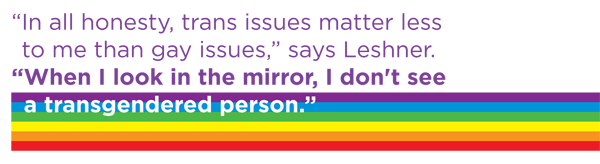
“I don’t know what the next issue is,” confesses Hasselriis, who has forsaken politics for a writing career. “I don’t know if we’ll bring it up ourselves or have it forced upon us. I look at Winnipeg Pride, which I’m involved in. We have it at the steps of the Manitoba legislature as if we’re still asking for things. But we’re not. Why are we still there?”
In the U.S., of course, gay activists are very much engaged in the marriage fight. In May, California’s Supreme Court— which had granted marriage rights to gay and lesbian couples the previous year—upheld the results of last November’s referendum on Proposition 8, which rescinded the legal victory. In contrast, Vermont, Maine, and Iowa have established marriage equality rights in the past year. With U.S. politics so much more polarized and freewheeling than Canada’s, marriage will unify American gay activists for years to come.
At Egale, people talk about finding a wedge issue such as safe schools, something that will push buttons. But usually that means the buttons of urban middle-class people with time and money. Marriage has been so successful at helping these people integrate into the mainstream, it’s become hard for them to imagine the lives of queer teens committing suicide because of homophobic bullying, small-town landlords denying housing to same-sex couples, or transsexuals unable to find a doctor who will see them.
“What ramparts are there for us to mount at Bloor and Bay?” wonders Leshner. Youth issues? He and Stark don’t have kids so it’s not something he’s thought much about. Supporting people from ethnic communities where it’s harder to come out? “I’d love to be involved in being a symbol for Orthodox Jews and Hasidic Jews who want to be gay, but when I think of what it’s like to be gay in that community, I figure the only way for them to deal with it is to leave,” says Leshner, who does support Toronto’s Inside Out Lesbian and Gay Film and Video Festival because it’s celebratory.
“I understand there are other issues,” says Leshner, “but, in all honesty, trans issues matter less to me than gay issues because when I look in the mirror, I don’t see a transgendered person.”
Kennedy has inherited a community filled with Leshners, people who have found their pot of gold and know the neighbourhoods they should stick to to avoid being called a pansy. The big money has come and gone, leaving behind a small group of activists who feel burnt out.
Kennedy’s no fan of the institution, but does admit that marriage has made things a little easier, at least on the personal level. Although equal marriage no longer dominates the headlines, every same-sex wedding brings a new crop of aunts and nephews and grandparents into contact with queer people, forcing them to rethink their prejudices. Married couples may not give the most accurate or comprehensive picture of queer people or what they want, but with every wedding invitation they send, they’re announcing their right to exist and to love people who would otherwise have no reason to rethink their relationship to LGBT people.
But awareness only gets you so far. It can make governments, institutions, and citizens more conscious of the needs and demands of LGBT people, but it doesn’t get these needs met. That job requires more hard work from a community that has earned its laurels, but must fight the temptation to rest on them.
]]>