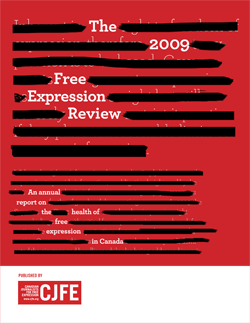
 Today, which is, appropriately, World Press Freedom Day, Canadian Journalists for Free Expression released their first in what will be an annual series of reports on the state of free expression in Canada. As the authors note in the introduction, 2009 was a notable year in Canadian press freedom:
- The Supreme Court of Canada established the new “responsible communications” defence to claims of defamation, providing greater latitude in reporting on issues of public interest and beating back libel chill;
- Federal government transparency took a decisive turn for the worse, so much so that the access to information commissioner pronounced it being at risk of being “totally obliterated”;
- There were two attacks on members of the “ethnic press” in Canada—a physical assault of the editor of the Canadian Punjabi Press in Brampton, Ont., and the vandalization of the offices of the Uthayan newspaper in Scarborough, Ont.;
- The Vancouver 2010 Olympics produced a handful of troubling incidents, with reporters harassed by law enforcement, detained on dubious grounds, or turned away at the Canadian border on specious grounds.
The study includes a report card that assigns grades to different institutions and their openness to public scrutiny, or their actions that make that scrutiny possible. The Supreme Court gets an A for the new defamation defence; The Canadian Human Rights Commission gets a B for deeming the hate speech provision of the Canadian Human Rights Code unconstitutional in the Marc Lemire case; on publication bans in the courts, appeals courts get a B+, while trial courts get a C-. Continuing the drumbeat of discontent over the federal government’s lack of transparency, it gets an F:
Here, the only assessment can be a failing grade.We remain bedevilled by the antics of those federal entities that invoke national security at the drop of a hat to restrict the dissemination of vital information to journalists and, in turn, the public. Perhaps this attitude is best exemplified by a recent exchange between a federal government lawyer and the Military Police Complaints Commission, in which the lawyer not only challenged the commission’s right to obtain certain government documents on detainee transfers but went so far as to indicate that he was not at liberty to discuss when those documents might be available. Add to this the countless delays and roadblocks put in the way of access to information and we are left wondering how the prime minister could praise the media’s attempt to hold government accountable while abandoning his own promises of access reforms so loudly trumpeted on the campaign trail.
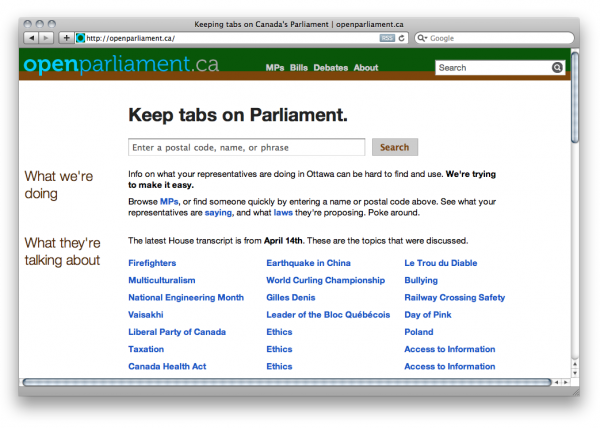 April 10 saw the launch of OpenParliament.ca, which aims to make it easier to follow what’s happening on the Hill. You can quickly and easily search for topics, people, communities, and more, and see what’s in Hansard, the official record of what’s said in the house of commons. Hansard has been available online officially for some time, but the interface is clunky and unhelpful; OpenParliament is much more user-friendly and speeds the process up considerably. You can sort the records by the activities of individual MPs, particular bills being considered, and subjects up for debate. The site also provides RSS feeds or email alerts that you can subscribe to, giving you instant updates on what parliamentarians are up to. Click on Libby Davies’ profile, for example, and you’ll see what she’s Tweeted, mentions in media outlets, motions she voted on, and statements she made in the house. Individual Bills also get profiles, collecting together who their sponsors are, who voted in favour or against, and what stage it’s at in the digestive tract of Canadian democracy.
The strength of OpenParliament.ca isn’t the information itself, which was always publicly available; its strength is that it pulls it all together in a way that is intuitive, fast, and beautiful. We’ll definitely be keeping an eye on it. You can also follow @openparlca on Twitter.
Just yesterday, writer/activist/consultant David Eaves threw the switch on Datadotgc.ca, another citizen-built website meant to liberate the flow of government information. Here’s their own statement on the purpose of Datadotgc:
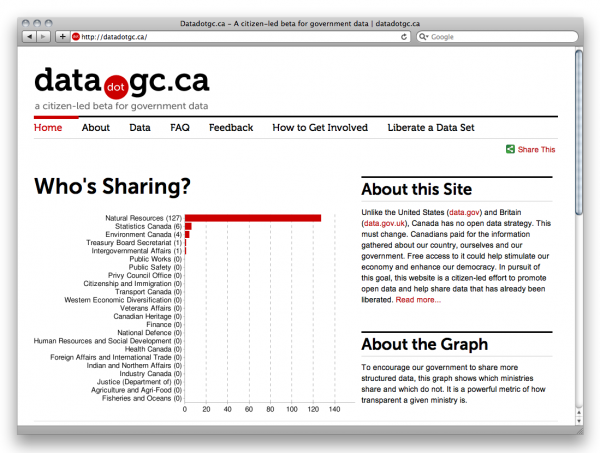
Unlike the United States (data.gov) and Britain (data.gov.uk), Canada has no open data strategy. This must change. Canadians paid for the information gathered about our country, ourselves and our government. Free access to it could help stimulate our economy and enhance our democracy. In pursuit of this goal, this website is a citizen-led effort to promote open data and help share data that has already been liberated.
The site displays a chart on its front page showing the sources of its data, and which ministries and departments are providing open access to government data, to how many documents and databases; tellingly, the bar chart shows a bunch of zeroes, for everything from the Privy Council to Defence to Health Canada to Fisheries and Oceans. Unlike OpenParliament, which launches with 16 years worth of publicly accessible records already loaded, Datadotgc.ca (a homophonous play on the .gc.ca government of canada domain extension) will grow over time as volunteers add more links to the database. The project seems more technically complex, focused on building a huge structured database that will be of use to democracy nerds who want to build other sites (like OpenParliament) that slice and dice raw information in helpful ways.
So, while the government may not be getting more open, citizens are doin’ it for themselves with projects like these two. Got more examples? Leave some links in the comment section below!
]]> From the Afghan Detainee torture scandal to the Helena Guergis Magical Mystery Police Adventure, governmental transparency is at a dangerously low ebb and risks being “totally obliterated,” says the interim access-to-information commissioner Suzanne Legault. Her report, released yesterday, gave low ratings to 13 out of 24 government institutions on their compliance with requests for information, and that delays — either due to incompetence or deliberate foot-dragging — are the most common offence:
“While timeliness is the cornerstone of the Act, delays continue to be its Achilles’ heel,” said Legault. The findings of a special report tabled in Parliament this morning “show that little progress has been achieved so far to remedy the root causes of delay across the system.”
The bottom line is, important parts of Canadian government have become near-completely opaque, operating out of the oversight of citizens. They aren’t small departments or ministries, either: we’re talking big, important divisions of the bureaucracy, and their report card scores are much worse than “needs improvement.” The Globe story:
…core departments including the Privy Council Office and Foreign Affairs were singled out for slow response times and for creating a bottleneck that causes delays in other departments.
Five departments received F rankings and seven earned Ds, while the performance of Foreign Affairs was deemed so poor that its report card ranking simply states “red alert.”
There’s a little ray of sunshine here, the launch of OpenParliament.ca, which launched yesterday — good timing! — and allows you fast searching of Hansard records to easily follow what’s going on in the House of Commons. Different MPs’ statements are tagged by topic, party, and more. So it’s not all bad news. Just most of it.
]]>As our youth delegates head off to Europe, I wish to support them. Knowing Stephen Harper’s government has not changed its position as of yet, I share a call. I’ve written an open letter to world leaders and climate negotiators at the United Nations Climate Change Conference in Copenhagen. Please borrow this letter or write your own to other world leaders. Google and post their addresses—share, tweet and email away.
An Open Letter to the Copenhagen delegates:
Dear Sir or Madam,
I write you as a young citizen of Canada. It is a country which has contributed significantly towards a global view of human rights, peace and multiculturalism. Canadian governments of the past have led on environmental matters such as acid rain and ozone depletion. We have achieved much as a nation of modest population.
Today we head into one of the defining events of human civilization. You will choose actions which will mean the betterment of society, or which may imperil the lives of hundreds of millions globally. Your commitments will be important, and this time must be followed up by strong action to transform the sectors of energy, industry, transportation and agriculture, and be beneficial and just to the world’s marginalized citizens. Your nations have prepared for these meetings since last December at various conferences, and for many years prior. It is time for a strong, binding, global deal on climate.
You are aware of the position of the Government of Canada. I am writing to tell you that this position does not reflect my own. Leaders in nations including the United States, France, Maldives, China and Nigeria have spoken eloquently about the need for swift and strong action. Canada’s leadership does nothing of the sort.
Please: do not let my government slow you down.
Last year other nations made Canada withdraw its pressure to weaken deals. This year, leaders of the world’s developing countries walked out on Canada when our negotiators attempted to change the rules of the game.
Remain strong and forthright in your goals. My government advocates short-term profits over long-term sustainability. It was elected in the lowest voter turnout of any election since Canada’s confederation in 1867, with 22% of the voting population. Here we have no coalition government. This vote gave the Conservatives a majority. And these are not Angela Merkel’s conservatives.
As a young person, I don’t claim to have a stronger say than any other citizen in the selection of our government. But I do have a greater stake in our future. To show you what my generation and those younger than me are thinking, I show you a vote among over 500,000 students across Canada which gave the Conservative Party 25.6%, Green Party 23.8%, New Democratic Party 22.9% and Liberal Party 18.6% of the vote. All three opposition parties had, to varying degrees, commitments to act on climate change and discussed them widely.
I will be better represented in Copenhagen by the Canadian Youth Delegation than the Government of Canada. The Delegation will represent a cross-section of Canadian young people. I am glad they are there, and I ask you to listen to their views and the views of other youth delegations at least as strongly as you hear those of Prime Minister Stephen Harper.
With faith in your better judgment,
Darcy Higgins
Toronto, Canada
]]>
CRTC: making a tangled mess of broadband policy?
The Canadian Radio-television and Telecommunications Commission announced today new rules for how internet service providers are allowed to monitor, control, and throttle your internet access. After years of ponderous thought on the issue of how much control ISPs can wield over their customers’ web access, the CRTC has ceded the issue to the internet providers themselves, deciding that “transparency” is a suitable substitute for regulation. Now, with 30 days’ notice, ISPs get to set the rules and enforce them, and it’s up to the public to complain about oversteps and unfair consumer practices. With proven, repeat-offender oligopolists like Bell, Telus, and Rogers in charge, what could ever go wrong? Reports the CBC:
“It approves all of the throttling practices that ISPs currently engage in. It requires consumers to prove something funny is going on and consumers don’t have the means to figure out what ISPs are doing and they don’t have the resources to bring that to the commission’s attention,” said PIAC counsel John Lawford.
“There’s a lot of fine-grained double-speak here. There is no requirement for any of it.”
NDP digital issues spokesman Charlie Angus, who last year introduced a net neutrality private members bill to the House of Commons, also criticized the framework.
“Basically the CRTC has left the wolves in charge of the henhouse,” he said in a statement. “ISPs have been given the green light to shape the traffic on the internet toward their corporate interest. This decision is a huge blow to the future competitiveness of the internet.”
The real kick in the teeth is that the U.S. Federal Communications Commission is apparently poised to introduce a set of net-neutrality-positive laws into Congress as early as tomorrow, and last week two congressional reps introduced the Internet Freedom Preservation Act of 2009, which would catapult our neighbours to the south far ahead of Canada in terms of ensuring broadband availability and openness.
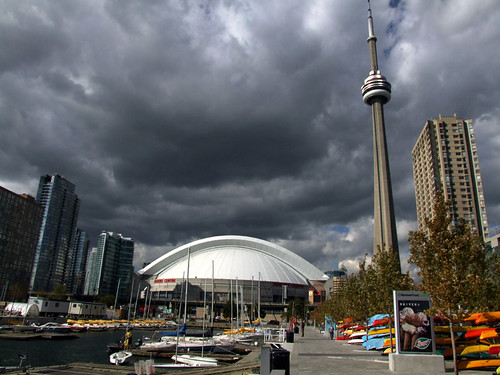
Toronto netted more mentions in This Magazine over the last year than the Maritime and Prairie provinces combined. Ontario was mentioned more than all of the other provinces combined.
To prepare for our regular staff meeting earlier this week, we flipped through the last year of This to see what we covered well, and what we’ve missed. The findings clearly showed us the kinds of stories we tend to cover—and pointed to a few things we need to work on.
First a word on the informal nature of this survey: my count was quick and dirty, and may not be 100 per cent reproducible at home. I counted all articles: features, short articles, This & That, graphics, and so on, from our November/December 2008 issue up to, and including, our upcoming issue. I assigned each a topic (environment, books, queer issues, etc) and a location (Japan, Newfoundland, Toronto, etc).
We love the environment—who doesn’t? We love the environment so much that it was our most covered topic in the last year. We brought you articles about learning to live without cars, and people at home and abroad practicing permaculture. We also did well coving Canadian art and government.
This Magazine started out way back in 1966 as This Magazine is About Schools, but somehow we avoided stories about education almost entirely over the last year, with the exception of our cover story about Africentric schools. Race and immigration were two other topics we only touched on. Stories about the economy, the internet, women’s issues, First Nations, and queer issues landed in the middle.
We also seem to love Toronto and Ontario. We focused on people and issues in Ontario (heavy on Toronto) as often as we focused on the all of other provinces combined. British Columbia was the runner up for most covered province. New Brunswick, P.E.I., and the Northwest Territories didn’t even get an honourable mention. Ouch. Rest assured that we’re already working on fixing these gaps.
Here’s a link to view the spreadsheet on Google Docs. If you’d like to slice and dice the spreadsheet yourself, you can download it as a CSV spreadsheet file. (Warning! It hasn’t been spell-checked.)
So here’s where we appeal to you, our readers. What places, people and topics do you want to see in This in 2010? What do you think we did well this year, and what do you want to see covered more often? Comment below or send us an email and tell us what you think. We keep track of data like this because we want to improve and broaden our coverage, to represent every inch of this country and give a voice to people who are underrepresented in mainstream media. Obviously we still have work to do; we hope you’ll help us make This Magazine even better.
]]>