 For our special 50th anniversary issue, Canada’s brightest, boldest, and most rebellious thinkers, doers, and creators share their best big ideas. Through ideas macro and micro, radical and everyday, we present 50 essays, think pieces, and calls to action. Picture: plans for sustainable food systems, radical legislation, revolutionary health care, a greener planet, Indigenous self-government, vibrant cities, safe spaces, peaceful collaboration, and more—we encouraged our writers to dream big, to hope, and to courageously share their ideas and wish lists for our collective better future. Here’s to another 50 years!
In the cocaine-tinted days of shoulder pads and synth pop, urban professionalism propelled a mantra of “run government like a business.” The 1980s were a reactionary rebellion against what was seen as government inefficiency, and a terrible idea from which we’ve never recovered.
At the time, I was a teenager working my first job as a cook at a family restaurant in suburban Ontario and wondering about the future amidst daily headlines such as “13,000 face temporary layoff at GM,” “Shutdowns affect 835 employees at IPSCO units,” and “Half of head office staff at Kidd Creek lose jobs.” Those were all from just one day in 1986. The mid-’80s had record unemployment in Canada—around 11 percent when I got that steak cook job for three bucks an hour, and down a bit from when it broke 13 percent a year or two earlier. (By contrast, it’s about seven percent today.)
That’s the first reason not to run government like a business: Businesses are focused on profit regardless of the human cost. The second reason is that business isn’t necessarily a good model, even for businesses.
According to Industry Canada, 83,240 small and medium enterprises disappeared in 2013. And that was a good year. Thousands of companies go belly-up every year because their primary objective is to turn a profit, and higher risk breeds higher profits. Governments should not participate in such high-risk behaviours. They should provide stable, long-term services that a community needs. And therein lies the most fundamental reason why we need to stop running governments like businesses: They exist for different reasons.
Like many of my generation, I headed west during the 1991 recession. I landed in Alberta, which was still reeling from the late-’80s oil bust. As I took piecework jobs on construction crews, or stood on “Workers’ Corner” hoping for landscaping gigs to pay for groceries, many of my neighbours were clinically depressed. I visited them at Holy Cross Hospital because of their suicidal feelings or, on occasion, suicide attempts.
Then Ralph Klein’s cuts pushed the hand of the hospital’s directors, who took a “run it like a business” decision and closed the downtown hospital and its psychiatric ward, making a distant suburban hospital the nearest facility—abandoning the city’s most vulnerable residents.
Every city has stories like this.
In Ontario, where I live today, corporate taxes are at a record low thanks to a decade of cuts. Toronto has some of the lowest property taxes anywhere. Windsor has frozen property taxes for nearly a decade. There’s room to restore services if we believe that serving the people should be the priority of a government, rather than turning a quick budget buck.
And the quick budget buck is very much the latest trend in running government like a business. It began with public-private partnerships (P3s). They were supposed to take advantage of the efficient ways in which businesses operate, unlike sluggish, bloated governments. After a couple decades of tragedies, we know businesslike greed outweighs any inefficiency our governments may once have had. Ontario famously has the most expensive toll road in the world because of a ridiculous P3 contract.
P3s are popular with governments because they transfer up-front costs off the balance sheet and appear to shift risk to the private sector. That is not, as a recent University of Calgary School of Public Policy paper reveals, the reality. The Golden Ears Bridge in B.C., for instance, came in 25 percent above initial estimates. The cost of Kelowna’s W.R. Bennett Bridge jumped 44 percent. A rapid-transit line in Vancouver went from $1.35 billion to $2.1 billion. In fact, most P3 projects only come in on schedule and on budget because the schedules and budgets get adjusted along the way.
And now Canadian governments are in the throes of just handing public assets over to the private sector for short-term gain. These actions do nothing more than hide a deficit on the government’s balance sheet until after the next election. As with P3s, it’s not really about benefiting the public; it’s about political expediency.
Stop running governments like they’re businesses. Start running them like, well, governments.
Illustration by Matthew Daley
]]>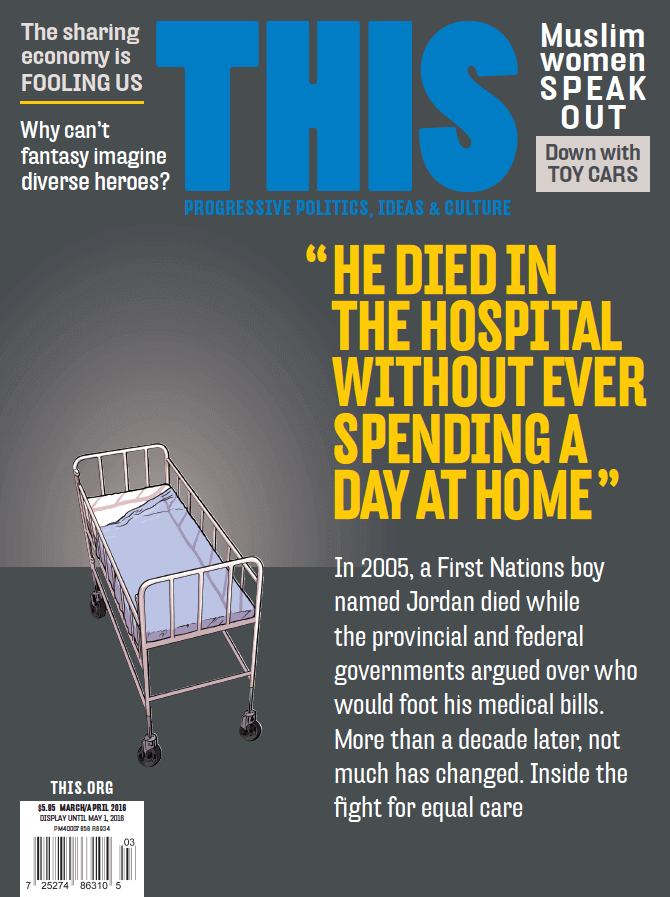
Cover illustration by Nick Craine
WHEN MAURINA BEADLE WAS CARRYING HER SECOND CHILD 20 years ago, the doctors told her she should terminate her pregnancy. The fetus was showing signs of hydrocephalus, also known as “water on the brain.” As excess fluid builds up in the brain, it places abnormal amounts of pressure and stress on important regions, and can cause varying degrees of brain damage, including mental retardation, different forms of motor disability, cerebral palsy, and death. It didn’t dissuade Beadle. She gave birth to her son, Jeremy Meawasige, on December 9, 1994.
The doctors were right. Jeremy was eventually diagnosed with hydrocephalus, cerebral palsy, spinal curvature, and severe autism. He has required around-the-clock care since birth. He can’t walk on his own without the support of others, he can’t eat on his own, he is incontinent and needs to wear a diaper, and he isn’t able to speak or write. He has very limited means to communicate with others, and he doesn’t make eye contact with people he doesn’t know. Only those who are close to him, like his mother, can understand what he wants or needs from the sounds and movements he makes.
“When Jeremy slept,” says Beadle, “that’s when I took a sleep. Whenever he was awake, I was awake with him. And if he fell asleep in my arms, then I would fall asleep too.” Sometimes, he’s self-abusive. Once, when he was about 15, he repeatedly smashed his head against the wall so hard that he was in a coma for four days. Beadle says he looked like Sylvester Stallone coming out of a boxing match. The doctors told her they would have to drill a hole into his head to release the fluid build-up resulting from the trauma. Luckily, as they were preparing the operating room, Jeremy woke up from his coma, narrowly dodging the invasive surgery. Beadle also has another son, Jonavon, six years older than Jeremy. But taking care of her second son has been her full-time job since the day he was born.
While Jeremy was growing up, the family didn’t spend much time at home, not even during Christmas holidays. He was often ill and was hospitalized numerous times—too many to count. Beadle can’t remember going longer than one month between hospital trips. Jeremy’s immune system is extremely weak. When he catches something (a bacterium or virus that a healthy child could easily fight off) it could turn serious, requiring a hospital stay or even surgery. His shunt system, put in place to treat his hydrocephalus, is largely to blame. The long tube transfers the excess fluid in his brain to his abdominal cavity where it can be properly absorbed. An infection could travel to the shunt tubing, infecting it too. When this happens, surgeons have to remove the old shunt, clear the infection using antibiotics, and then put in a new shunt.
Every day, Beadle has to help Jeremy dress, shower, change diapers, and spoon feed him his meals. She also has to keep a vigilant eye on him to make sure he doesn’t hurt himself. She spends a lot of time singing with him, which she says is the one thing that always makes him smile and laugh. It has never been easy. Beadle and her two sons live on Pictou Landing First Nation reserve, a two-hour drive from the hospital in Halifax, called the IWK Health Centre. Beadle always took Jonavon with her on the long trips, both of them sleeping in a cot beside Jeremy during the extended hospital stays. In those early days, Beadle tried to get part-time help to take care of him. She would write to the local health centres to ask for support and fill out all the necessary forms, but help never came. Eventually, Beadle gave up hope. She carried on, as a single mother of two, doing the best she could to keep her sons happy and safe.
But everything changed in May 2010. At the age of 50, Beadle suffered a stroke that left half of her brain damaged. The doctors told her she might not be able to walk again, nor regain full movement on her right side. Beadle felt helpless, but was determined. She would walk again. And she did. She walked out of the rehabilitation facility and returned home after a month of hospitalization. But when she returned, she quickly realized she was not able to provide the care Jeremy needed while still recovering from her stroke. It was hard for both of them to accept. “He wanted me to snuggle with him and cuddle with him,” she says, “and I wasn’t able to do that.”
She needed help. But as an Aboriginal family living on a reserve, help was hard to get.

IF BEADLE AND HER FAMILY DIDN’T LIVE ON A RESERVE, GETTING home care and caregiving support would be a much easier process. She could have reached out to her provincial Disability Support Program. From there, the provincial program would do an assessment of their needs, and then provide the necessary financial support. As far as hassles go, it would only be a small one—and more importantly, there would be scant delay between contacting the program and receiving support.
Things are a lot more complicated when a person lives on a reserve. The federal government, rather than the provincial government, funds health and social services on reserves. The federal government provides funding through block contribution agreements to a reserve’s band council, which is the elected government of a particular First Nation—in Beadle’s case, the Pictou Landing First Nation.
The band council then decides how the money is spent. In theory, the band council is supposed to receive enough funding to provide care and services at a level similar to what is available to off-reserve residents in the same province. But problems arise when there simply isn’t enough money in the budget.
The person in charge of delivering health care services on Pictou Landing First Nation reserve is Philippa Pictou, the health director. When she found out about Beadle and Jeremy’s situation, she insisted he receive daily at-home care immediately, even though she knew it would quickly eat up the entire health budget. She hoped there would be a way to obtain extra funding and, in the meantime, asked the province of Nova Scotia to send a nurse to perform an assessment—she wanted to know what level of care the family would receive if they lived off-reserve. The assessment was performed in October 2010, after which Beadle’s 24/7-hour care was reduced to 8:30 a.m.–12:30 p.m during the week, and 24-hour care over the weekend. The care services still cost about $8,200 per month, nearly 80 percent of the band council’s entire monthly budget for personal and home care services. For a small reserve of 600 members, it was unsustainable.
Pictou asked the two federal departments responsible for funding home care, Indigenous and Northern Affairs Canada and Health Canada, to top up the band’s funding. But both departments denied her request and told her it was up to the band to properly budget for the extra costs. “It became clear,” says Pictou, “that Jeremy was already starting to get treated differently than if he was living off-reserve.” In 2012, Beadle and the Pictou Landing Band Council took the federal government to court, demanding the right to be treated equally and to receive the services band members needed—and deserved.
The decision to fight the federal government was easy for Beadle. She knew it was the right thing to do, not just for herself and her son, but also for all the First Nations children across Canada. And, it wasn’t just about equal treatment of children on- and off-reserve. Jeremy’s case connected to a wider issue that’s deeply gutted First Nations communities across Canada: the forced removal of First Nations children from their homes and communities, often as a direct result of low funding and services on reserve. The battle was going to set a legal precedent one way or another.
If Beadle and the band council won, it would give First Nations families a better chance in the future to access services at a level equal to their off-reserve counterparts. More children would be able to stay at home, instead of given up to foster care or institutions. If the federal government won, it meant current funding agreements with First Nations communities didn’t need to allow for exceptional circumstances that warranted additional funding. Everything would remain the same—if not worse—for First Nations families.
BEADLE SPEAKS WITH A SOFT YET EXCITED VOICE. SHE ISN’T ONE TO dominate a conversation. Her home on the reserve is a small, minimally-furnished bungalow, which she shares with both her sons. When I visited her, it was during the dead of winter in February, just ahead of a massive snowstorm. Everything seemed a little dreary. Houses on the reserve are spaced far apart—not like in wealthier Canadian neighbourhoods, where the space is for meticulously landscaped yards and gardens, but haphazardly, with unplowed snow-covered roads connecting them. Life is generally quiet for Beadle and her family, especially during the winter months. Going outside meant risking infections for Jeremy. The only time Beadle stepped outside the day I was there was to huddle in front of her door to smoke a quick cigarette.
The events post-stroke, she tells me, disrupted her family’s life, but also put a strain on the entire community. While looking for a way to relieve that strain, Beadle and Pictou discovered Jordan’s Principle. A child-first principle adopted by the House of Commons in a unanimous vote in 2007, its intention is to ensure jurisdictional disputes don’t cause First Nations children to experience delays, disruptions or denial of services available to other children. The principle is named after Jordan River Anderson, who was born in October 1999 on Manitoba’s Norway House Cree Nation reserve. Thanks to an extremely rare neuromuscular disorder called Carey-Fineman-Ziter Syndrome, Jordan spent the first two years of his life in a Winnipeg hospital, 800 kilometres away from his home. When he was two years old, the doctors decided he was ready to leave the hospital, provided he had special home-care services.
This led to a long fight between the provincial and federal governments over which was on the hook for the bill. They argued over high-cost items, such as home renovation needed for installing a wheelchair ramp, to very low-cost items, like a showerhead. The dispute lasted for over two years until 2005, when Jordan died in the hospital at five years old, having never spent a single day at home with his family. If Jordan were a child living off-reserve, the province would have immediately covered the costs to provide home-care for him.
The sad reality is, Jordan’s situation—like Jeremy’s—is not unique. In the same year Jordan died, a First Nations Child and Family Caring Society of Canada report found that across 12 First Nations child welfare agencies in Canada, 393 children faced denied or delayed services because of jurisdictional disputes. And, that’s just the tally from a handful of agencies—there are 108 in Canada. They’re all services that would be readily available to an off-reserve child. Jordan’s Principle was designed to stop the disparity. When the private member’s motion to adopt the principle was introduced, there was very little debate. Everyone agreed what happened to Jordan shouldn’t happen again. Before the vote, Conservative MP Steven Blaney, who spoke on behalf of the Conservative government, told the House that the feds were already working hard to “transform the commitment we make here today into a fact of daily life for First Nations parents and their children.”
Yet in 2011, four years after the historic vote, neither Beadle nor Pictou could find a single successful application of the principle in Canada. It seemed clear to them that Jordan’s Principle should apply to—and, therefore, help—Jeremy. Under it, the first governmental department a family approaches should foot the bill for necessary and eligible care and services. If the principle had been properly implemented in Jeremy’s situation, the provincial government should have provided services immediately after its nurse’s assessment of the family. It could negotiate with the federal government over costs and reimbursement later, on its own, in the background.
Devastatingly, after many meetings with provincial and federal officials to discuss Jeremy’s case, the federal official in charge of implementing Jordan’s Principle in Atlantic Canada decided it didn’t apply. Both the province and the federal government agreed the amount of care requested exceeded the provincial normative standard of care, a maximum of $2,200 per month. Thus, since the two governments weren’t technically in dispute, it wasn’t a Jordan’s Principle case—help hinged on the two governments battling over costs. As an alternative, the governments suggested Beadle place Jeremy into a longterm institutional care facility. They promised all the costs of his care would be fully covered by either the federal or provincial government. The estimated daily cost of institutionalized care for Jeremy was $350 per day. The cost to keep Jeremy at home was roughly $270 per day. Beadle was horrified. It felt like the government would rather spend more money to take Jeremy away than to spend less to help her keep him home. There was no way she would give up her son. Court was her last chance to save him—and to broaden Jordan’s Principle so it could finally help children on reserves.
AT THE END OF MARCH 2011, THE NOVA SCOTIA SUPREME COURT ruled on a case similar to Beadle’s. It involved a Nova Scotia off-reserve resident named Brian Boudreau who required 24-hour care. Unfortunately, his in-home care was capped at $2,200 per month—the same cap Jeremy faced. Boudreau was fighting to have the funding cap abolished. In the end, a judge ruled in favour of Boudreau, finding the monthly cap unlawful. The judge ruled the cap contravened the Nova Scotia Social Assistance Act, as well as the province’s Direct Family Support Policy from 2006, which specifically states that funding exceeding $2,200 per month may be granted in “exceptional circumstances.”
When Pictou heard about Boudreau’s win on the radio, she believed she’d found the smoking gun she needed to get Jeremy’s care covered. She shared the Boudreau decision with the federal official in charge of Jeremy’s files, but the government still insisted Jordan’s Principle didn’t apply. Unwilling to give up, Pictou contacted Cindy Blackstock, executive director of the First Nations Child and Family Caring Society. She thought maybe Blackstock, who has been at the forefront of advocating for Jordan’s Principle since 2005, could suggest options. Certainly, Blackstock was outraged. How could a government deny Jeremy the care and support he needed to stay at home with his mother, but willingly offer a more expensive solution to institutionalize him? “That just doesn’t make sense to me at all,” says Blackstock. “I can’t square that circle.”
She’s spent the last decade working to close the gap between what children get on- versus off-reserve. For Blackstock, the government’s failure to properly implement Jordan’s Principle is a symptom of a much greater problem facing First Nations children across Canada. Prior to her current role, Blackstock was a child protection worker on- and off-reserve in B.C. During that time, she became exceedingly aware of the differences in care and services available to the children on either side of a reserve line. She felt it wasn’t a problem of remoteness, but systemic racism against First Nations. After all, inequality existed even in First Nations reserves near big cities. “Just stepping across that imaginary line was like going thousands and thousands of miles away,” she says, referencing a Squamish First Nation reserve close to North Vancouver. “I could not believe how restrictive the services were.”
This belief has led to her own legal battle. In February 2007, the First Nations Child and Family Caring Society of Canada and the Assembly of First Nations launched a human rights complaint against the federal government. It’s the first time in history a country has been held accountable for its present day actions towards an Indigenous population. The complaint alleged the Canadian government discriminates against First Nations children like Jordan and Jeremy by providing them with less child welfare funding than other children in the country. The government’s own documents estimate the funding gap between on- and off-reserve child welfare services is at anywhere between 22–34 percent. Hearings for the case took place in front of a three-person panel at the Canadian Human Rights Tribunal and concluded in October 2014.
At the crux of the tribunal hearings: that the Canadian government provided flawed and unequal services to First Nations children, and that it failed to implement Jordan’s Principle. The ripple effect, argued Blackstock and her allies, meant First Nations families were often forced to surrender their children to foster care or institutions. First Nations children are 12 times more likely to be placed in foster care than non-Indigenous children. They account for 30–40 percent of all Canadian children in child welfare care, even though they make up only five percent of the Canadian child population. What Blackstock wanted was the same thing Beadle wanted: the right and ability to keep First Nations children at home and in their communities.
In the end, Beadle’s case reached its conclusion before Blackstock’s. After spending $300,000 to win its case, the federal government lost. The court ruled in favour of Beadle and the band council in April 2013. The judge agreed with Beadle that the federal government made the wrong judgement on Jeremy’s case, and that Jordan’s Principle did apply. The provincial government, as dictated by the Social Assistance Act, would, in fact, have to cover Jeremy’s care costs if he lived off-reserve. And thus, the federal government should cover those costs to ensure equality for First Nations children living on a reserve. The court ordered the federal government to reimburse the band council for all legal costs, the fees for the services Jeremy had been receiving since Beadle suffered her stroke, and to cover all future costs related to his care.
It was the first time Jordan’s Principle was successfully applied in Canada. And the only time. The Canadian government has made it virtually impossible for families to apply for Jordan’s Principle. First, a narrow definition of qualification exists. A child must have multiple complex health care needs—not just one or two, but many. Second, there’s still the sticking issue of what constitutes a dispute and who it is that must be feuding. That is, if two federal departments, like Health Canada and Indigenous Affairs, couldn’t agree over which should cover the costs of a service, the principle would not apply. And finally, there is just too much red tape to access services using the principle. Even though Beadle won against the government and now has the support she needs to keep Jeremy home, she knows the fight isn’t over. She thinks about how Jordan River Anderson died and knows that he is dead because the principle that’s his namesake didn’t exist when he was alive. She wonders if it would have helped him even if it did.
AFTER SEVEN YEARS AND NUMEROUS EMOTIONAL TESTIMONIES across Canada, the Indian Residential Schools Truth and Reconciliation Commission published an executive summary of its final report in June 2015. Number one on its list of calls-to-action was to reduce the number of Aboriginal children in care. Number three was to fully implement Jordan’s Principle. The statement was clear: the inequality faced by children and families living on reserves today perpetuates the horrific legacy of Indian Residential Schools.
Seven months following its release, at the end of nine long years and more than $5-million later, the Human Rights Tribunal also released its ruling on Blackstock’s case. On January 26, 2016, it found the Canadian government racially discriminated against 163,000 First Nations children. It ordered the government to reform its First Nations Child and Family Services program so that its child and family welfare agencies are provided with the same level of funding and resources as its provincial counterparts. It also ordered the government to “cease applying its narrow definition of Jordan’s Principle” and “immediately implement the full meaning and scope of Jordan’s Principle.”
Indigenous Affairs Minister Carolyn Bennett spoke to reporters the day the Tribunal released its decision. She said her department will move quickly to start coming up with solutions and, in doing so, will be working closely with First Nations communities and the Assembly of First Nations. She also said there will be a proper needs assessment done in order to determine how much money is required to reform First Nations child-welfare programs. “My job,” she told media, “is to go forward and fix these things.”
This is the news that Blackstock, Beadle, and all the other advocates for First Nations children across the country have been waiting for—a wait that has spanned decades, and involved years of hard work. Yet, although there has been a lot of excitement rippling through First Nations communities across Canada, it has been accompanied by a certain level of skepticism. It will take years to tell whether the ruling will actually change the realities of First Nations children and families. If it does, Canadians should see the number of First Nations children in foster care or institutions fall to a level that is proportionate to their population size.
Recognition of the government’s discriminatory policies against First Nations children alone does not create change. The government can continue to make apology after apology for its treatment of First Nations children, but that also does not lead to positive change. It will take proactive action and continual pressure on governments to make the changes First Nations children need. After spending so many years battling with the government, Blackstock knows this all too well. She knows the road ahead will not be a straightforward one. But she has a clear vision for the future that she will give everything she has to attain: “I want to see a generation of First Nations children that don’t have to recover from their childhoods, and I want to see a generation of non-Aboriginal children who grow up healthy and proud, and never have to say sorry for the treatment of First Nations kids again.”
]]> IN 2007, the federal government signed the UN Convention on the Rights of Persons with Disabilities. Ratified in the House of Commons several years later in 2010, the convention recognizes the rights, dignity, and worth of those with disabilities, while providing a framework for a high-quality, equitable life. This is all great stuff—and yet, the government has not signed the “Optional Protocol,” as it’s been dubbed, which would allow Canadians to file complaints under the convention. Essentially, this move gives the government all the benefits of feel-good optics, without having to commit to actually improving the lives of those with disabilities. Sneaky, sneaky.
Also problematic: In 2010, when the Conservatives cut the long-form census, they also nixed the Participation and Activity Limitation Survey, better known by its acronym, PALS—those who received the survey were the same people who, on their census form, said they had a disability. PALS was used to track the needs of Canadians with disabilities, and looked at everything from rates of poverty, violence and abuse, to quality of housing, education and employment, and participation in community and civic activities. From there, government, but also more importantly advocacy groups, could use the data to better determine needed supports. The government has since introduced the Canadian Survey on Disability, but acknowledges that its data sets can’t be compared to PALS because of different questions and, notably, a different definition of the actual term “disability”—stunting a body of research. The new survey also received fewer responses, which advocates feared.
Perhaps that data could have been used to help the government figure out how to spend the near $40-million budget for the Opportunities Fund, a fund designed to help those prepare for, maintain or find employment. Unfortunately, in 2013-2014, the government failed to allocate one-quarter of its funding—undermining yet another promising initiative for those with disabilities.
]]> HERE ARE JUST A FEW of the things that keep James Turk up at night: Unapologetic fear mongering; trampling over fundamental civil rights; limiting access to information; an invasive gaze cast over Canadians protesting in public, leading to their arrest; an iron fist that limits Canadians’ ability to move freely across borders; the introduction of the sprawling, new general terrorism offences, a broad term that has the ability to indict Canadians for private conversations the government deems “reckless”; and much more. Though the list sounds like plot points in a dystopian thriller, all these things are happening in Canada right now. No wonder Turk, the director of the Centre for Free Expression at Ryerson University, believes Canada needs to urgently reform its information legislation.
After nine years of Stephen Harper’s federal Conservative government, Canadians know less than ever about how their government is governing. We have now seen an onslaught of legislation, media protocols, and funding cuts designed to keep information hidden and people silent. Scientists, academics and librarians are all subject to The Media Relations Protocol, an Orwellian piece of legislation implemented in 2007, that was once meant for climate change researchers, but has now bled into all areas. It states that government employees should have one unified voice and stipulates that if government scientists and academics are approached by media or concerned citizens, that they respond to inquiries with “approved lines.”
But of the various changes we have seen throughout the nearly, decade-long leadership of Mr. Harper, Bill C-51 offers perhaps the most nefarious implications to democracy in Canada. Under Bill C-51 confidential information can be disclosed “to any person, for any purpose.” Canadians’ tax information, health and passport applications are just some of the information now freely shared between government departments. Private conversations can be interpreted as terrorism and result in the detention of Canadians for up to five years. Online posts will be censored under C-51 and internet service providers and telecom providers can be directed to remove any content deemed as terrorist propaganda. If a you teach political science, and want your students to see a video from a group like ISIS or Boko Haram, as well as material condemning them, the material could be forcibly taken down from your web and social media sites. C-51 would also allow for you to be identified and located for posting such materials, says Turk.
Any group activities that are considered to challenge the security of Canada, including those that affect the economic stability of Canada, such as a strike of auto workers or oil workers, are offences under Bill C-51. Protests and strikes that lack the proper permits will also become causalities of this new legislation—something that could, for instance, negatively affect protests to defend aboriginal land claims or to oppose pipelines. A protest can be deemed “unlawful,” adds Turk, for reasons as trivial as violating a noise by-law by using a megaphone.
To add to the list of various civil rights violations, Canadians’ ability to move freely across borders may be limited under C-51. The bill extends the Passenger Protect Program so the government has the ability to add anyone to the no-fly list. People on the list could be denied boarding passes. No transparency will be offered—a person can be denied a boarding pass without being given a reason. Bill C-51 will also empower Canadian customs officers with the increased ability to search through people’s possessions and confiscate anything they consider to be terrorist propaganda, including “writings, signs, visible representations or audio recordings.” This newfound authority could include computer and phone searches, and would give border officials full discretion to choose which materials to seize. “The bigger threat than terrorists is a government that tries to take away our democracy,” says Turk, “in order to try and fight to save democracy.”
A recent analysis conducted by the Toronto Star, spanning from June 2013–July 2014, reveals the disturbing lack of transparency offered by the Canadian Government when it comes to the public’s right to know. Of the 28,000 requests made for government records, for instance, a mere 21 percent were returned redaction-free. The report also found the government was unable to find records 18 percent of the time. Only 26 percent of information requests directed to Environment Canada were left uncensored.
Such trends have deeply disturbed Mark Bourrie, Carleton University professor, political activist, and author. His latest book, Kill the Messengers, is a 400-page investigation into the Harper government’s unofficial mandate of muzzling. Bourrie describes the Harper-imposed media protocol documents as a “willful blindness.” If the federal government convinces itself that it does not see issues such as climate change, for instance, he says, it can believe they don’t exist. In that case, the media relations protocol controls information so that a specific narrative on history, science, and public policy can be set, he adds. “It’s like going into a card game with a deck of cards up your sleeve,” says Bourrie. “Because you can’t argue science with people if you don’t know the science.”
In Kill The Messengers, Bourrie reveals that between 2007–2012, media coverage on climate change issues fell by 80 percent. In his research, Bourrie found that the Harper government held meetings on ways to cut Environment Canada’s budget by $60 million in the 2012 federal budget and made sure that media and communications specialists were present in the room to weave a Harper-friendly narrative. These trends have put many people in the academic community on alert. Organizations such as Scientists For The Right to Know have formed with a mission to educate Canadians on the dismantling of freedom of speech and to advocate for more transparency surrounding government research. “Canadians are paying for this research,” says Chloe Shantz-Hilkes, executive director of Scientists for the Right to Know. “These are tax-funded studies that we don’t get to hear about because of the communication protocols. That is an absolute violation of our right to know about ourselves, the world around us, our environment, and how it’s changing.”
Not only is the Canadian government keeping publicly-funded research under wraps, it also eliminated the long-form census in 2010—a chief method of collecting data needed to research issues such as poverty, income inequality, and transportation. And it has done so in spite of the protests of its citizens. Killing the long-form census, says Turk, stripped Canadians of the ability to bring evidence to bear on these issues. To illustrate the overwhelming opposition to the government’s decision Turk lists a lengthy catalogue of organizations of Canadians who fought to keep the census, including such disparate groups as the Vancouver Board of Trades, the Canadian Jewish Congress, and the Evangelical Fellowship of Canada. “The government could find no organization that supported its position,” says Turk, who testified at several parliamentary hearings on the subject. “Labour unions, chambers of commerce—everybody was saying, ‘You can’t do this.’ But they did it anyway.”
Through media protocols, legislation and funding cuts a government has become all-powerful and all-seeing—yet it’s left a society that is conversely uninformed and because of this, ultimately, powerless. “The government has an ideological agenda and is absolutely single minded about imposing it,” says Turk. “And that’s what is really frightening.”
]]> THERE ISN’T MUCH OF A GROWING SEASON in Old Crow, the Yukon’s northernmost community. Yet a vegetable garden has flourished there for the past three years, thanks to the efforts of the Vuntut Gwitchin First Nation and funding, in part, from the territorial government. In June, residents planted cauliflower, garlic, kale, cabbage, onions, potatoes, lettuce, celery, and tomato plants. Already, the raised beds and two greenhouses, located in Old Crow’s tiny downtown area, boast green leaves and stalks poking up through the soil.
It’s not a cheap project to run—because of permafrost, growing soil has to be flown to the community. But Vuntut Gwitchin staff say the garden is important for the community, to provide both a place for people to come together and fresh, locally-grown food. Old Crow isn’t accessible by road, so groceries arrive on a plane and they’re expensive. “Because we’re so far north, there’s a sense of pride in what can be grown,” says Lindsay Johnston, the First Nation’s recreation coordinator. “Here’s this good local food. You know where it came from.” The garden is a grassroots effort to increase Old Crow’s food security and affordability.
Johnston says produce availability and prices have improved since a new co-op grocery store opened in town, but she admits costs are still much higher than in southern Canada. A pineapple, for example, costs $9. A two-litre carton of milk costs about $7.99. A bag of cherries costs $12 per pound.
Food’s hefty price tag is a problem in northern communities across the country, from the Yukon to Nunavut to Labrador. As an attempted remedy, the federal government introduced the Nutrition North program in 2011, offering retailers subsidies on staple perishable items such as eggs, milk, meat, and frozen fruits and vegetables. Retailers are then responsible for selling these goods at a discounted price.
But an audit completed by the Attorney General of Canada in the fall of 2014 found that Aboriginal Affairs and Northern Development Canada (AANDC) hadn’t properly verified whether retailers were doing this. It’s not the only Northern issue that critics argue the government has bungled. They point to a overall flawed approach to dealing with Canada’s massive North.
Take, for instance, Prime Minister Stephen Harper’s six-day sojourn across the region, which last year cost taxpayers more than $786,000—at the same time many Northerners struggle daily to pay for food and housing. Harper’s annual tour of the North has been described by some as nothing more than a photo op, a hurried trip of funding announcements, staged photos with beautiful backdrops, and little else. Yet Harper claims to love the North; he’s said before his tour is the highlight of his summer. (This year, he didn’t embark on the journey; instead he’ll be focusing on the October election, according to reports.)
On these tours in the past, Harper has posed for photos wearing a parka, firing a gun, and eating seal meat. He’s called the expansive area “a great treasure house” due to its plentiful minerals and resources. But does his emphasis on resource development and Arctic sovereignty come at the expense of giving proper attention to the North’s social issues, such as health and lack of affordable housing? Reporters have questioned him about this, and about whether he’s left social problems up to the territorial governments—but have received few satisfactory answers. Mental health services remain a grave concern for northern residents, particularly in Nunavut, where the suicide rate is the highest in Canada. The territory of 36,000 experienced 45 suicides in 2013, a record number, and 27 in 2014, including that of an 11-year-old boy. Yet, on his Northern tour last summer, Harper made no mention of mental health, even though he stopped in the suicide capital.
“Our government understands that Canadians who live, work and raise families in this part of the country face unique challenges,” the prime minister said at the tour’s kick-off in Whitehorse. “Let’s call them Canadian challenges because after all Canada is the North and the North is Canada.” The key to transforming these challenges into opportunities, Harper said, is—apparently—scientific knowledge
and discovery, going on to announce a new $17-million Arctic program through the National Research Council.
The cries for an inquiry into missing and murdered aboriginal women are also heightened in the North. Rates of violence against women are significantly higher in the territories than in the rest of Canada: four times, nine times and 13 times the national average in the Yukon, NWT, and Nunavut, respectively. Despite this, Harper has rejected calls for such an inquiry. While in Whitehorse last summer, he said the country’s 1,000-plus cases of missing and murdered Indigenous women and girls aren’t a “sociological phenomenon,” but a crime. Opposition leaders and aboriginal organizations quickly, and harshly, criticized Harper for his remarks. Marian Horne, president of the Yukon Aboriginal Women’s Council, told the Whitehorse Star his comments showed the prime minister’s “flagrant disregard” for First Nations people and their well-being.
Yukon First Nations chiefs were also angered over the federal government’s Bill S-6. Approved in the House of Commons in June, it contains amendments to the Yukon Environmental and Socio-economic Assessment Act. The chiefs have vowed to fight the bill in court, arguing they had no input on four amendments they say violate their land claim agreements and threaten the independence of the assessment board. And in Nunavut, trouble is brewing between the territory’s planning commission and the Harper government. Last year, the commission sued, accusing Ottawa of trying to interfere in a land-use plan for future development in the territory. Created out of the 1993 Nunavut Land Claim Agreement, the commission alleges AANDC refused to provide $1.7 million needed to conduct a final public hearing on the plan, required before it can become law. Then head of the commission, Percy Kabloona, told the Canadian Press at the time that the federal government has shown little support for Inuit management of their own lands.
Meanwhile, back in Old Crow, residents continue to tend to and take pride in their garden. Caitlin Cottrell-Lingenfelter, the Vuntut Gwitchin’s director of health and social programs, says she understands the premise behind Nutrition North, but it just hasn’t worked for people in the country’s remote communities. Bluntly put, she says, it’s failed. The same could be said for much of Harper’s actions, and inactions, in the North.
]]>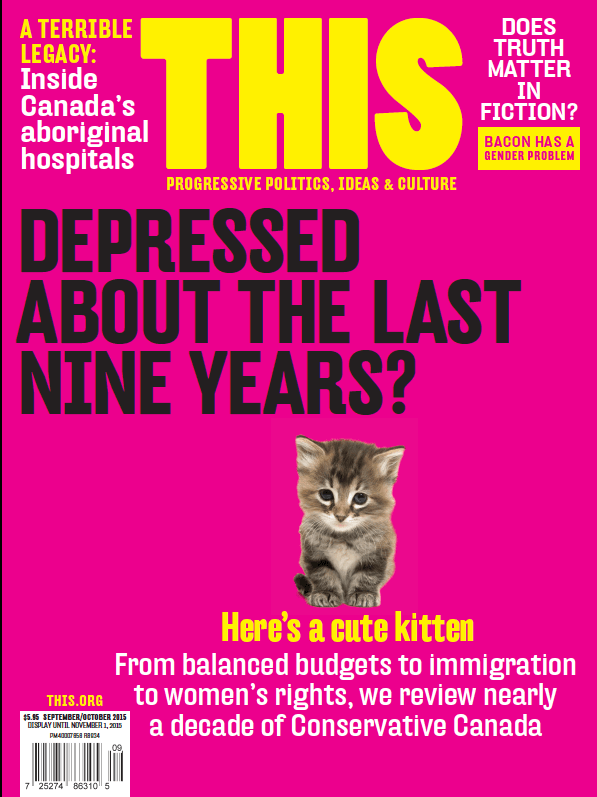
With the upcoming election, Canada is set to take a different path—if we want it to. But to what new direction? To answer that question, we first decided to look back over the past nine years of Conservative Canada. While we didn’t have space to examine every aspect of policy (which could, in itself, fill an entire book), we did pick 10 areas that we believe are worth reviewing to help choose a path forward. So if the cute kitten didn’t help, get ready to dive in as we review the Conservative government’s track record. From balanced budgets to immigration to women’s rights, we examine how 10 key Canadian issues have fared after nearly a decade of Conservative leadership.
]]>He shared this opinion with the staff of an Etobicoke home for teens with autism, owned by the Griffin Centre, a non-profit mental health agency. The Etobicoke Guardian reports that Ford held a public meeting with the centre’s staff last Thursday. He informed them the home’s neighbours were upset about police calls, noise disruption, and not receiving advanced warning about the residents. Deanna Dannell, the director of Griffin Centre, sent an email to the Canadian Press, stating that the centre had spoken to Ford before the home opened and explained their housing situation.
Apparently, Ford sympathizes with the teens but believes they should not be allowed to leave the house. He is willing to buy the house and sell it, if need be, the Guardian says.
There has been some warranted backlash against his beliefs.
“It was disappointing to hear that kind of reaction from [Ford],” Dannell told the Star. “Certainly we had hoped for something different.”
John Tory, a Toronto mayoral candidate, released a statement calling Ford’s comments “from another age”.
“For years, it was thought the best way to help people with disabilities, including those with autism, was to place them in large institutions—a kind of confinement away from the community,” Tory wrote. “Today, we know what is best for us and best for them is to include them in every possible way—at school and in our community.”
Former Ontario premier Bob Rae expressed his disgust with Ford on Twitter.
“This is the opposite of leadership on mental health. Doug Ford should be ashamed of himself—hurting not helping,” the tweet said.
Of course, Ford has a response for comments like the latter two.
“Anyone who wants to criticize, I’d be more than happy to take their address and we’ll put the house right next door to them and see how they like it,” National Post quotes him saying. Great. Use these humans as a threat. He went on to call the home a nightmare in the community. But he claims to know the real problem.
Ford blames the Liberal government for closing Thistletown Regional Centre in the west end. “It was a beautiful centre, had 43 acres that allowed families to have their children with challenges there,” he told the National Post.
Children with challenges…
Although Tory benefits by pointing out a Ford’s flaws, he raises a good point. Canada has a serious problem when the people in our government do not want to respect those with mental disabilities. There is no easy way out. No one knows that better than the staff who work with autistic children.
So despite the noise and other various disruptions, these people deserve as much fresh air as the rest of us. Canadians will have taken one step forward and five steps back if we try to whisk away all human “inconveniences.”
]]>“The various activities and initiatives undertaken by MCFD during the past decade have created only an illusion of action and progress,” Turpel-Lafond wrote. “There has been no concrete resulting change in the aboriginal child welfare service-delivery system or demonstrable improvements in outcomes for aboriginal children, youth and their families.” She says she understands the money was given to the agencies with sound intent, but adds that many of the child and family reps have no clear spending strategy and no understanding of their roles in the community.
The report concluded with recommendations for the government: develop a comprehensive plan to transfer control of child and welfare services to aboriginal organizations; suspend “open-ended initiatives” that don’t benefit aboriginal self-governance; and create ways to close the gap of education and health between aboriginal and non aboriginal youth—on or off reserve
The deadline for these government drafts were February, March, and April. As of today, nothing has been submitted.
The only change came in January—when the provincial government “cut funding to 18 indigenous-run projects” two months after Turpel-Lafond’s report. It has not yet addressed what may be the next steps (or any steps) to help aboriginal kids in foster care, who made up more than half —almost 4,500 of 8,106 —of B.C.’s kids in the system.
“The ministry has been overly focused on transferring the responsibility to provide services instead of ensuring aboriginal children and youth are getting the help they desperately need,” Turpel-Lafond told CBC. Which sums up her opinion of throwing money around without knowledge of the outcome.
Ministry officials have said they generally appreciated the report, but also criticized it for being one-sided. Much of the $66 million, says the government, helped give aboriginal peoples a public voice.
“I don’t want it to be misinterpreted that government spent $66 million to have these discussions around governance and jurisdictional issues without receiving some benefit,” Minister Stephanie Cadieux told the Tyee. “There are better working relationships with indigenous communities. First Nations, in many cases, have increased capacity to provide culturally relevant care for their own children, including child protection mediation.”
The child and youth watch dog is aware that her report’s guidelines are complex. Since November, Turpel-Lafond has seen more money donated to indigenous agencies that were “crippled by underfunding”. Yet, these organizations need government coordination along with the money allotted them. As the report states, “the ministry needs to re-focus, and dedicate the time and effort required.”
The lesson here is to start fresh, start planning, but start.
]]>It’s all quite bittersweet. The government finally admitting that Canada needs this information is huge. But the numbers are painful. RCMP Commissioner Bob Paulson told a parliamentary committee that the findings were a “surprise.” To whom, I wonder? Definitely not to the familes, friends, and communities of these missing women and girls. But I digress.
“What we can say is that there is a misrepresentation, or overrepresentation, within the aboriginal community of missing and murdered women,” he announced. “There are 4 percent aboriginal women in Canada—I think there are 16 percent of the murdered women who are aboriginal, 12 percent of the missing women are aboriginal.”
I suppose this is why he is surprised. But it still hasn’t occurred to the government and law enforcement to listen to these peoples. As wonderful as the official report is, this still must be painful to many families who did research that was deemed invalid.
APTN reported the RCMP requested a small look at files from 200 different police forces across Canada to collect data. And it has the ability to be useful.
“This initiative will help the RCMP and its partners identify the risk and vulnerability factors associated with missing and murdered aboriginal women to guide us in the development of future prevention, intervention and enforcement policies and initiatives with the intent of reducing violence against aboriginal women and girls,” Sergeant Julie Gagnon said in an email to the Globe and Mail.
RCMP may finally view aboriginal peoples lives as important enough to look into their deaths, despite criticizing the NWAC for its numbers in the past and politicians spitting in the face of such inquiries.
Yet the stance on inquiries themselves has not changed. Public Safety Minister Steven Blaney rejected the calls from opposition at least four times. In the same breath, Blaney announced that foul play is suspected in two-thirds of those 160 missing cases, while the rest are for unknown reasons. His rejection and this data seem to counteract each other.
Blaney also said that it was a time for action instead of more paperwork. But, in March, during the horrible time when Loretta Saunders was found dead and another inquiry request was tabled, Claudette Dumont-Smith, executive director of NWAC, explained the importance of an inquiry.
The Globe and Mail explained Dumont-Smith’s stance like this: “an inquiry would study every angle of the problem in a way that has not been done before, and could compel people who have important information to testify.”
Seems reasonable.
If Canada does not begin asking marginalized groups’ for input, we will be in a perpetual state of oppressor-oppressed. Most of us are taking the right steps forward. To avoid taking five steps back, government and law officials must become willing to learn from those they previously called irrational, because it turns out they were right.
]]>This act would successfully marginalize already marginalized groups like aboriginal peoples, seniors, students away from home, and low-income people. Which is a lot of Canadians.
But don’t despair, here’s the FTW opportunity.
Tomorrow, there will be a rally. The Canadian Federation of Students Ontario (CFS), Lead Now, and the Council of Canadians have formed an alliance to organize a “day of action“. According to the Facebook page, tomorrow, Saturday at 1 p.m., in Dundas Square people will come together to fight for Canada’s fading democracy.
Students in the GTA were at Yonge and Dundas spreading information about the rally and bill yesterday hoping to strengthen the turnout this weekend. CFS also released a video in early March warning Canadians that the bill could introduce “U.S. style voter suppression” in a country that already has ridiculously low voter turnout. The Star believes this lack of interest in voting, especially in young adults, is the true reason the government could ever consider C-23 a solution.
CFS is ready to prove them wrong.
All Canadians interested, within the realm of proximity, are encouraged to contact [email protected] for more information. And all Canadians should be interested.
]]>