
Irving Howe (the New York socialist) once wrote “Blessed New York Times! What would radical journalism in America do without it?” The newspaper was, to be sure, a tool of the bourgeois but a tool that reported the news with unequalled comprehensiveness. Read it and, ideology aside, you became the possessor of a full range of facts, dates and events. I had a similar feeling this weekend reading the Times coverage of the Afghanistan war.
Journalism is changing—this we know—but on the eve of (depending who you talk to) a cataclysm for old journalism or its reinvigoration the American paper-of-record still puts out an impressively thorough and relatively exhaustive edition, if politically problematic for a progressive. Contrast this to the newly redesigned Globe and Mail whose editor, John Stackhouse, told Toronto Life that “it’s fine for a typical news story to be 600 to 800 words… Most readers aren’t going to read more than that.” Anyway, I digress. This is supposed to be about Afghanistan.
It’s shocking how little we actually know, and how little what we do know tells us. Journalists, or should I say the organizations that employ them, have largely abdicated their responsibility to report the war in ways that allow readers to secure a nuanced understanding of what exactly it is that Western militaries are doing in south-central Asia. The Swat valley, Provincial Reconstruction teams, human interest stories all make an appearance in the Canadian press but little effort is made to draw connections or attempt some sort of synthesis. If there ever were a time for bold reporting, this is it. There are, of course, bright spots. Re-enter the Times.
First, if you have time, read this article. It deals with one aspect of the war that is, I think, neglected: namely the strategy that NATO is pursuing. In short, Western forces are adopting a hyper-aggressive posture to demoralize anti-occupation forces prior to NATO’s withdrawal. Knowing this, in addition to what we already know (that free societies cannot be ushered in under the aegis of an imperialist gun, etc.), will perhaps allow us, like Irving Howe, to develop more incisive, accurate and compelling critiques that will inspire dramatic democratic change. Here are five important points to note about the conflict in Afghanistan today, noted by the Times and Wired:
1) The current strategy. Canada, amongst other nations, is in the process of evacuating its military personnel from the region having declared that a decade-long commitment to the war is sufficient. The United States, the main antagonist in the war, has thus been required to shoulder more of the burdens of occupation. It, too, however, is maneuvering for an endgame. The Times:
“Since early last year, when President Obama took office, the overriding objective of American policy has been to persuade the Taliban to abandon any hope of victory. It was to make that point that 30,000 additional troops were sent here…the strategy has been to break the Taliban’s will, to break up the movement, and to settle with as many leaders as are willing to deal.”
2) The way to effect that victory
“In the past several months, General Petraeus has loosed an extraordinary amount of firepower on the Taliban insurgency. Special operations forces are now operating at a tempo five times that of a year ago, killing and capturing hundreds of insurgents each month. In the same period, the number of bombs and missiles aimed at insurgents has grown by half. And General Petraeus has launched a series of operations to clear insurgents from the southern city of Kandahar.”
3) This was done before.
“That strategy looks a lot like the one that brought General Petraeus success in Iraq in 2007 and 2008. With Iraq engulfed in apocalyptic violence, American field commanders reached out to nationalist-minded guerrilla leaders and found many of them exhausted by war and willing to make peace. About 100,000 Iraqis, many of them insurgents, came on the American payroll: The Americans were working both ends of the insurgency. As they made peace with some insurgent leaders, they intensified their efforts to kill the holdouts and fanatics. The violence, beginning in late 2007, dropped precipitously.”
“Awakening leaders and security officials [in Iraq] say that since the spring, as many as several thousand Awakening fighters have quit, been fired, stopped showing up for duty, or ceased picking up paychecks. During the past four months, the atmosphere has become particularly charged as the Awakening members find themselves squeezed between Iraqi security forces, who have arrested hundreds of current and former members accused of acts of recent terrorism, and Al Qaeda’s brutal recruitment techniques.”
5) The return of shock and awe?
]]>“Last month, NATO attack planes dropped their bombs and fired their guns on 700 separate missions, according to U.S. Air Force statistics. That’s more than double the 257 attack sorties they flew in September 2009, and one of the highest single-month totals of the entire nine-year Afghan campaign.”
 The eleven extraordinary young people profiled in Citizens of Nowhere have been teachers, social workers, mediators, and breadwinners. Journalist Debi Goodwin meets them as refugees in Dadaab, Kenya, and follows them through their difficult transition to life as first-year university students in Canada. They have each been sponsored to come to study in Canada as part of the Student Refugee Program run by the World University Service of Canada (WUSC).
Collectively, the camps in Dadaab are the largest refugee settlement in the world. Built to house 90,000 displaced people, they now hold upwards of 250,000, mainly from neighbouring Somalia. Camps which were supposed to provide temporary shelter for refugees before they could be resettled have instead become distressingly permanent, with many people living in limbo for years.
Goodwin builds a relationship with each student, meeting the families and friends they will have to leave behind as they move, alone, to various universities across Canada. There are wonderfully light moments, and the strength and dignity with which the students face their various challenges is incredibly inspiring. But this is not a happy story. The feelings of dislocation that come when trying to adapt to an alien culture are accompanied by the constant pressure to do well enough, quickly enough, to pull their families out of the camps.
Expectations are high partly because of the perception in the camps that everyone in Canada is “rolling in money” and that once they break through and make it here, they — and their families — are set. Only after arriving in Canada do they learn that this is not the case. It is here that the book offers a look at Canada through the eyes of some very intelligent newcomers. Some wonder why their new Canadian friends don’t seem to care very much about Canadian politics. Others wonder why, in a country so much richer than the ones they were born in, homelessness and poverty are allowed to persist.
The students also struggle with questions of identity, with each having to decide how strongly to hold to lifelong religious and cultural beliefs. Often there is an eagerness to try new things, accompanied by a deep reluctance to leave behind customs which remind them of home. Their views on the interaction between women and men in Canadian society are varied, as are their recollections of gender relations in the camps. More than one of the male students has had the word “feminist” used against him as a severe accusation, and more than one of the female students believes the hijab is a central part of her wardrobe.
As a journalist, Goodwin gains the trust of the students and reports their experiences and observations in their own words. As a mother with a daughter the same age as the students she is writing about, she becomes part of the story herself. For most of them, she is the only outsider who has seen them both as they used to be, young leaders in Dadaab, and as they are now, young leaders in Canada.
]]>
Last week we learned that the federal government spent $107,749.52 on Nikon DSLR D300s for the G20. For those of you who, like me five minutes ago, don’t know anything about photography let me tell you all you need to know about the D300s: it’s a really good camera. You can check out the reviews but, take my word for it, this is a whole lot of camera for a whole lot of money.
Now I don’t know what these particular cameras are used for but I do have a guess: mug shots. I asked a friend of mine who was arrested at the G20 protests about this. Here’s his response:
DSLRs? Well there were a whole bunch of cops with point-and-shoots — but I honestly think that was mostly for themselves: “Posterity’s sake?” I asked one of the (many) officers taking a picture of me with cuffs on, and he looked a little embarrassed. Initial “mug shot” at Queen’s Park was an SLR, but for some reason they had to do it again at the jail — an SLR there too… And then they had to do it again at the jail — which I assume was just a lack of organization. So yeah, at least two DSLRs, two high-quality video cameras, and piles upon piles of point and shoots, for what it’s worth to you.
To be fair, I’m sure the lighting conditions at the Eastern Ave. Jail weren’t exactly optimal so, um, maybe the cops did need something slightly better than a cell-phone camera. Either way, cameras, and lots of them, seem to be part of the new policing. Again, my friend:
I remember one cop saying to another, in reference to some of the people that had been arrested, “that’s the biggest thing: You just don’t take pictures.” There is, in short, something they really don’t like about all the protesters with cell phones/cameras, etc., and they literally armed themselves with their own cameras in anticipation of this… and apparently arrested some people for the same reason.
In other G20 expense news: the feds also spent just under $18,000 on snacks at the Pickle Barrel. At that price, you’d think they might choose a better restaurant to eat at.
]]>
Photo Credits: Hamed Saber and Peter Ashton
Consider this exchange:
Speaker 1: “Would you like to go the aquarium with me [tomorrow] to see the dolphin show?”
Speaker 2: “The dolphin show?”
Speaker 1: “The dolphins are very intelligent animals.”
Speaker 3: “But the aquarium is not open tomorrow.”
Speaker 1: “It will be open tomorrow”
Out of context it’s hard to tell exactly what’s going on. We know someone is inviting someone else to watch the dolphins. The someone else sounds a bit confused. And somehow the first speaker knows that, despite normally posted hours, the aquarium will be open tomorrow. Under normal circumstances you would, as I would, think this was some sort of surrealist play when Che’s daughter and a nuclear scientist entered the dialogue. And, normally, we would be right.
Today, however, the truth is far stranger. Speaker 1 is Fidel Castro, speaker 2 is American journalist Jeffrey Goldberg and speaker 3 is a bodyguard. You just can’t make this up. I’ll spare you all of the details (although I do encourage you to read the original pieces from the Atlantic here and here) but Fidel apparently was so impressed with an article that Goldberg wrote about Iran and Israel that he decided to grant him an extended three day interview — part of which took place at the aquarium.
Since coming out on the right side of a serious gastro-intestinal illness Fidel has been speaking with increasing frequency about international matters. This, says Goldberg’s travelling companion Julia Sweig, is Castro trying to reinvent himself as a senior global statesman: “Matters of war, peace and international security are a central focus: Nuclear proliferation, climate change, these are the major issues for him, and he’s really just getting started, using any potential media platform to communicate his views. He has time on his hands now that he didn’t expect to have. And he’s revisiting history, and revisiting his own history.”
But, the dolphin show. To me, at least, this seems an odd stage from which to launch your global nuclear disarmament campaign or, stranger still, to argue for a more ecologically sound global order. To be fair this is no ordinary dolphin show nor, for that matter, is it an ordinary aquarium. The dolphin trainers do not run the show so much as they are also part of it. Watched from beneath the surface the show is a carefully scripted dance between human and dolphin.
The aquarium itself is run by a nuclear scientist and one of the veterinarians is the aforementioned daughter of Che. Perhaps there is some sort of message here about beating tanks into tractors. It can be no coincidence that an interview about Israel’s nuclear arsenal and Iran’s nuclear ambitions ends up at an aquarium managed by someone with the theoretical know-how to build the bomb. Cubans, maybe we are supposed to infer, have no time for such pursuits? Having been brought to the brink of nuclear apocalypse once they would rather spend their time with the planet’s second smartest animal, who don’t happen to be threatening existence as we know it.
Any which way, however, this has to be one of the strangest meetings since, well, ever. I have no doubt that Castro was following some sort of script but, even if it will be some form of plagiarism, when it comes time to write my screenplay I’m using this scene.
]]>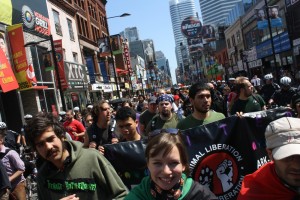
Protestors march down Toronto's Yonge Street as part of anti-G20 All Out In Defense of Rights Rally, Monday June 21 2010. Photo by Jesse Mintz.
The Toronto Community Mobilization Network kicked off its themed days of resistance to the G20 on Monday with activists converging around a mixed bag of issues including income equity, community control over resources, migrant justice, and an end to war and occupation. It’s an ambitious start for the week-long campaigns. On their own, each issue is complex. So wouldn’t combining them create one massively hopeless problem? Not necessarily.
Uniting the struggles sends a clear message: justice for one means justice for all. Organizing in solidarity weaves together the various conditions of oppression and injustice affecting populations around the world. It gives us a deeper understanding of these conditions, and how to act against them.
In effect, you can’t talk about income equity without addressing migrant justice. The fact is, so-called developed states have built their economies on the labour of underpaid and overworked “temporary” migrant labourers. A recent Stats Can report suggests that throughout the 31 countries that make up the Organization for Economic Co-operation and Development (compare these to the countries that have ratified or signed the UN Convention on the Protection of the Rights of All Migrant Workers and Their Families, or to the G20 roster for that matter), the “temporary migration of foreign workers has increased by 4 percent to 5 percent per year since 2000.”
The same report states that over 94,000 non-permanent residents worked in Canada full time (30 hours per week or more) in 2006. Many came to this country as part of temporary foreign worker programs, such as the Live-in Caregiver Program or the Seasonal Agricultural Workers Program. Activists, academics, journalists, filmmakers, politicians—pretty much everyone—have denounced the current state of both programs for their exploitative policies, racist legacies and harmful social effects. And it only seems to be getting worse for migrant workers as third-party recruiters become increasingly popular.
The fact that business is booming for recruiters means there’s a pool of people willing to put up whatever money they have for the promise of work abroad. And here’s where we connect the dots from migrant justice to ending war and occupation and restoring control of resources to the people—what has compelled, and continues to compel, the estimated 214 million migrants of the world to leave their home countries in the first place? That’s what migrant justice group No One Is Illegal wants us to think about:
Government and public discourse fails to address root causes of forced migration. On the one hand, because of free trade policies—including Canadian free trade agreements—and structural adjustment programs, governments throughout the global South have been forced to adopt neoliberal policies that have restructured and privatized their land and services, resulting in the displacement of urban and rural workers and farmers. On the other hand, capital mobility has led corporations to create millions of low-wage jobs and to seek vulnerable workers to fill them, both in sweatshops in the global South and exploitable labour sectors in the global North.
Sure, not all migrant workers are explicitly forced to come to Canada as a labourer, as one analyst with the Fraser Institute griped in an interview with The Dominion, but then again lots of people are. Forced migrants are refugees, asylum seekers, internally displaced and trafficked people, as well as survivors of developmental displacement, environmental and manufactured disasters.
Huge construction projects like dams, roads and airports squeeze people out of their homes. Stephen Castles, the former Director of the Refugee Studies Centre at Oxford University, writes that many of these initiatives are funded by the World Bank and displace as many as 10 million people annually. Though World Bank offers compensation for resettlement, Castles concludes:
Millions of development displacees experience permanent impoverishment, and end up in a situation of social and political marginalization.
People displaced by environmental change, by industrial accidents, and toxins generally face similar fates.
That’s why war and conflict, immigration and refugee flows, jobs and wages, and global economics are, together, a “focus” of protest. Far from being separate and unrelated problems, they’re inextricably entangled. And the solutions will be too.
]]>
People sporting the G(irls) 20 "Pangaea" T-shirt.
We’ve talked a lot about what’s going wrong so far with the G20 and G8 meetings taking place in Ontario this year. And lord knows there are plenty of problems: aside from the lack of discussion surrounding women’s health we’re now chopping down trees in an urban jungle and searching around for supposedly stolen police uniforms.
But for just a few minutes, let’s take a look at what has come out of these meetings. This week Toronto’s welcoming another delegation—a group of 21 young women who are setting out to discuss women’s rights. The G(irls) 20 Summit is going on from June 16- 25, and it’s sponsored by the Belinda Stronach Foundation. Yes, that Belinda Stronach.
According to a press release, the girls represent each of the G20 nations, as well as one member from the African Union. They’ll be discussing a number of issues that affect women around the world, but if you ask me, this is the perfect chance for these girls to tell their leaders what’s what.
Apparently it has become necessary for the world’s youngest citizens to educate their own governments on what’s important. These girls have the opportunity to speak out about adequate women’s health services and maternal rights. They have the power to talk about what they need and what they deserve. And I hope to God they’ve got megaphones.
Of course, women’s health isn’t the only important issue, but it’s one almost everyone can stand behind. It’s hard not to support a woman’s right to birth control, or abortion, or prenatal care, or even just regular pap smears. And hey, if you can’t, you’re probably invited to the big meetings anyway.
So sing it loud, girls. Now’s your chance.
]]>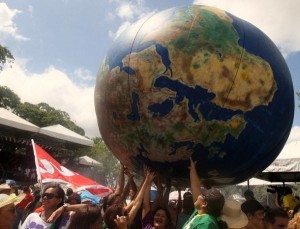
Participants at the 2009 World Social Forum in Brazil help keep the world safe. Copyright Vanderlei Almeida/Getty Images.
While the prime minister has been trying to do damage control for his G20 agenda, activists and organizers of all stripes have been busy building social justice movements. Sometimes movement-building involves bickering over listservs about who gets to the carry the banner, but sometimes it also involves holding massive, multi-day, multi-issue summits. Left Forum might be over, but there’s plenty more where that came from. Here is a rundown of summits happening this weekend and beyond.
The People’s Summit
June 18-20, Toronto
The People’s Summit is very similar in content to the US Social Forum (see below for details), but slightly different in structure. The People’s Summit is being held as an open, democratic alternative to the G8/G20 Summits taking place in Huntsville and Toronto next week, and has been put together by individuals, unions, student groups, NGOs, community groups, and others. The cost of participating in workshops and events is sliding scale, and there are events for children planned throughout the weekend as well. “Holding Canada Accountable” is going to be a hot topic, in addition to the usual suspects of Environmental Justice and Human Rights, among others. This weekend’s full schedule of musical events, rallies, marches, and panels kicks off tonight with a launch party – “Stories and Solutions from North and South”, featuring Maude Barlowe, Jessica Yee, and others. If you’re in Toronto, put on your combination party hat/thinking cap and head down to the Carlu to pay-what-you-can at 6:30.
Gender Justice Summit
June 18-20, Toronto
Oxfam is hosting the GJS alongside the People’s Summit, with the intention of putting a spotlight on the interrelatedness of women’s rights, climate change, and the economy, as well as fortifying the messages of hope and resistance with walk-the-walk proof that change is possible. Summit participants will “have the opportunity to hear Oxfam’s international program partners from Africa and Latin America discuss their work on the themes of gender based violence, humanitarian response, maternal health, climate change, and food security in plenary discussions, dialogue circles and workshops.” Topics include framing gender equality as a human rights issue and discussing the roles men can take to help achieve gender justice around the world.
Vancouver People’s Summit
June 20, Vancouver
The VPS is partnering with Vancouver’s Car Free Day and is trying to do something different, planning “live music, performance, art, food and a village of civil society groups, activists and independent media, because nothing builds community and strengthens networks better than a massive street party — without cars!” Two smaller summits focusing on women’s rights and climate justice will be held over “mini-eat-ins”, which I hope involves eating tiny vegan cookies and drinking tiny mugs of fair trade coffee. Events are free for all.
Reel Solutions Film Fest
June 21-24, Toronto
Ok so it’s not a summit. That doesn’t mean this scrappy four-day film fest being held at the Toronto Underground Cinema should be left off of this list. Scheduled to run after the People’s Summit and throughout the Themed Days of Resistance, the Reel Solutions Film Fest features documentaries about opposition to environmental disasters in Canada, Southern resistance to Canadian mining companies, and the hideous and long-ranging consequences of war. Heavy content, maybe, but your head and your heart will thank you later. 20$ will get you a series pass, and individual screenings are 8$, but no one will be turned away for lack of funds.
The U.S. Social Forum
June 22-26, Detroit
The 2nd USSF takes place in balmy downtown Detroit, three years after 12,000 people attended the first forum in Atlanta. Organizers say:
The purpose of the USSF is to effectively and affirmatively articulate the values and strategies of a growing and vibrant movement for justice in the United States. Those who build towards and participate in the USSF are no longer interested in simply stating what social justice movements “stand-against,” rather we see ourselves as part of new movements that reach beyond national borders, that practice democracy at all levels, and understand that neo-liberalism abroad and here in the US is not the solution.
Their ABC slogan (ABC stands for Assemblies, Brigades, and Caravans) brings an interesting element to the forum, stressing continued participation in the community after the forum, as well as encouraging a sprightly, bike-buoyed disbursement of ideas throughout the country in the days and weeks following.
Registration, which costs between 10$ and 100$ depending on one’s income, grants access to workshops, plenary discussions, and screenings. The forum focuses on tying local Detroit issues to those affecting the rest of the US. Detroit has been hit especially hard during the economic crisis, and many of the problems faced in other US cities are amplified there. That also means there is lots of room for positive change. Detroit isn’t too far away, so jump on your bike/car/train/bus so you’ll get there in time to learn about the ABCs of resistance.
The Children’s Social Forum
June 22-26, Detroit
Running alongside the USSF is the Children’s Social Forum, which includes teaching kids about unions, street theatre, and making connections between issues that affect them at home and issues that affect people throughout the world. Kids these days, getting their own forums! Here’s hoping that the lessons taught at the CSF lead to the creation of dozens of mini-Naomi Kleins armed with sharp pencils and crayons.
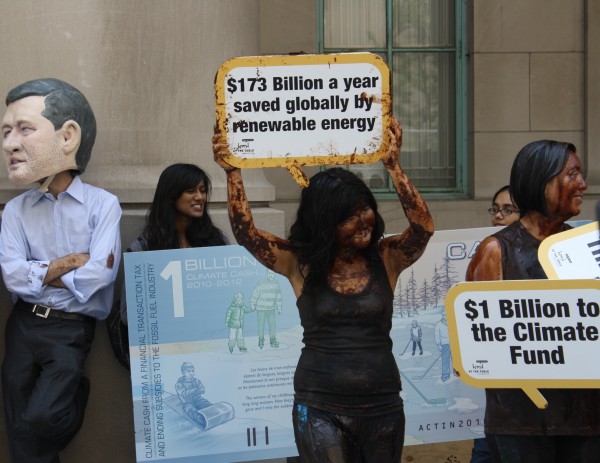
Protesters gather outside Union Station dressed as an oil spill in demonstration against Harper's environmental policy, June 17, 2010. Photo credit: Jesse Mintz
Unless you have been living under a fake rock beside a fake lake, chances are you’ve heard about this G8/G20 business in some way, shape, or form. The reasons why many people are protesting, however, may not be as clear. That’s probably because there isn’t any single issue uniting all protesters. And, despite what you may have heard, there is no one type of person who protests. Not all protesters are communists or socialists, not all are anarchists or against the government, and not all are ‘hapless hippies’, as one recent article stated.
You don’t have to be a feminist to believe that the Harper government’s paltry track record with domestic policies towards women has discredited any maternal health discussion led by our government. You don’t have to be a civil liberties advocate or an anarchist to oppose the spending of 1 billion dollars to turn Toronto into an military zone, complete with barricades, checkpoints and closed circuit security cameras monitoring our every move. And you certainly don’t have to be an environmentalist to doubt the Canadian government’s willingness to combat global warming and to turn a blind, or worse, defiant eye towards the Tar Sands issue.
While outrage over the price tag of the summits is pretty easy to understand, it’s the other issues on the table in front of us today in Canada, in our cities, and throughout the world, which are harder to untangle. It may require a lot of breath, but now is the perfect time to demand firm commitments instead of half measures and excuses on issues such as the environment, Indigenous rights, women’s and queer rights, the end of systematic economic injustice, justice for migrants and non-status people and an end to all wars and occupations. The interconnectedness of these issues shouldn’t be a problem–it should just provide more fuel for your fire.
Here are the reasons why everyone–not just the anarchists, hippies and commies–should give a damn and make yourselves seen, heard and understood in the week before the summits.
1. Gender justice: the Canadian government has pledged 1 billion dollars over 5 years for maternal health initiatives. This number stands in stark contrast with the 1 billion spent on security over the three days of the summit. The sad reality is that any initiative tabled by Harper will be a half-hearted one at best as he has refused to advocate the same rights for the women of the global south–specifically, the right to a safe abortion–as women enjoy in Canada. In addition, our government’s inability (or refusal) to understand the link between the health and status of women, children, the queer community, climate change and the failing global economy further, hinders any potential progress for these already marginalized communities.
2. Creating a just global economy: the road the current G8/G20 leaders in conjunction with the IMF and World Bank are taking us down will simply repeat the economic mistakes of the past. The economic crisis must impel leaders to implement a more sustainable development model worldwide. There are currently roughly 50 million people living below the poverty line–that is less then $1.25 U.S. a day–and this summit must be seen as an opportunity to push for fair economic trade regulations to help those in the global south.
3. Indigenous rights: The policies of the G8 have consistently marginalized indigenous populations around the world facilitating the transfer of wealth and power from the global south to the political elite. Domestically, indigenous populations have been dealing with the effects of globalization and neo-liberal economic policies that have ravaged their land and exploited their communities. Indigenous women and children are hit especially hard by ‘economic reform’ and budget cuts, and some Indigenous communities in Canada do not even have access to clean water.
4. Environmental justice: The summit presents the first opportunity since Copenhagen for world leaders to meet and reevaluate their commitments to reducing carbon emissions and aiding poorer nations in their attempts to adapt to climate change. Canada received the Fossil Award at Copenhagen as the nation that has done the most to impede global action on climate change. The summit must be used as an opportunity for us to ensure that our government knows that its environmental policy will not stand.
5. Imperialism: The G8 nations are responsible for roughly two-thirds of the world’s military spending. G8 nations are engaged in a self-serving global war on terror that militarizes the world. Domestically, Harper has increased our defense budget in the wake of massive cuts to public services, such as feminist-minded NGOs and arts programs.
These protests cannot be for the select few; they must be the voice of the many. There isn’t one issue that concerns and unites all people–but that’s okay. These issues fall under the same banner of demanding justice and rights from our government, for us and for others throughout the world, and that in and of itself, is quite a mandate.
We are no longer dealing with “Canada the good”; and we can no longer afford to be silent. So please, give a damn.
]]>You can also read the liveblog that I was furiously pecking out on an iPhone at the back of the room; of course, it was a little difficult to keep up with the pace of discussion on a three-inch keyboard.
Thanks to everyone who came out last night, to our partners at Rabble, the magazine’s board of directors and interns who did much of the organizing, and of course to the speakers: Robert Fox, Josephine Grey, Judy Rebick, and Antonia Zerbisias. The videos are below.
Judy Rebick:
Antonia Zerbisias
]]>
The G20 is less than two weeks away, and there’s a lot going on. You could just turn to the usual media suspects to get your news about the G20, but when it comes to the street-level collision of neoconservative colonialist plutocrats and anti-globalization activists (among many other blocs of interests), it pays to look off the beaten path for your news consumption. If previous G20 meetings and the demonstrations that accompanied them is any indication, you can’t trust big media to get beyond the usual hackneyed portrayals of anarchists in balaclavas and be-suited politicians doing photo-ops.
(We’ll be doing our very small part during the next two weeks by clipping and aggregating the best material we find on our G20 microblog — g20.this.org — and we welcome you to send us your photos, videos, blog posts, and links for sharing. Simply email [email protected] and we’ll take care of the rest.)
Here are the indie news sources we’ll be following in the next few weeks. Respond in the comments section if you have further sites that people should visit!
rabble.ca
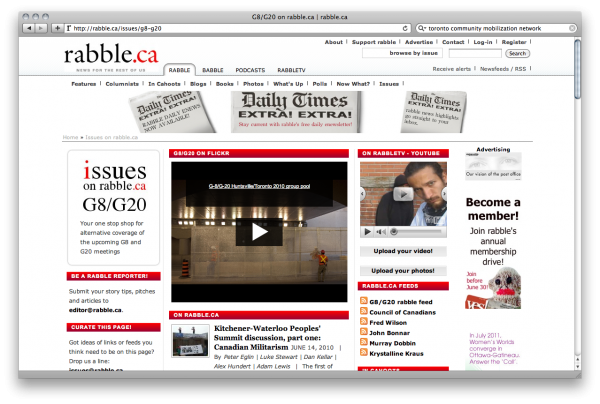
Our friends at Rabble have put together one of their “issues” pages that collects all of their G20 news and commentary in one easy-to-scan package. At a glance you can see any G20 related video on RabbleTV, submissions to the G20 Flickr group, what they’re tweeting and retweeting, and what their lively commentariat is saying on their message boards, Babble.
Toronto Media Co-op
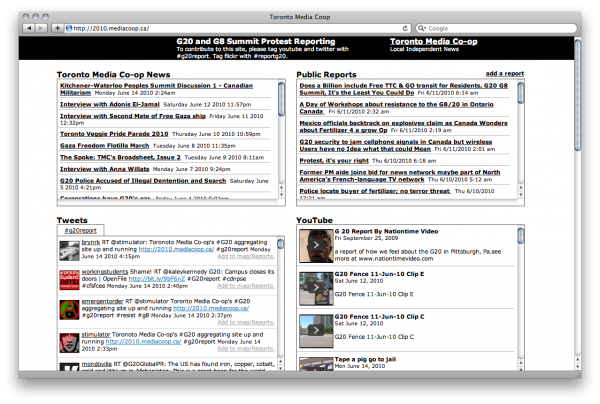
The Media Co-op is a grassroots network of independent news reporting collectives based in different cities coast to coast. Together, the co-op publishes The Dominion. The Toronto branch of the Media Co-op has set up a spartan but information-rich aggregation page for collecting photos, videos, tweets, news reports, and their own original reporting.
G20 Breakdown
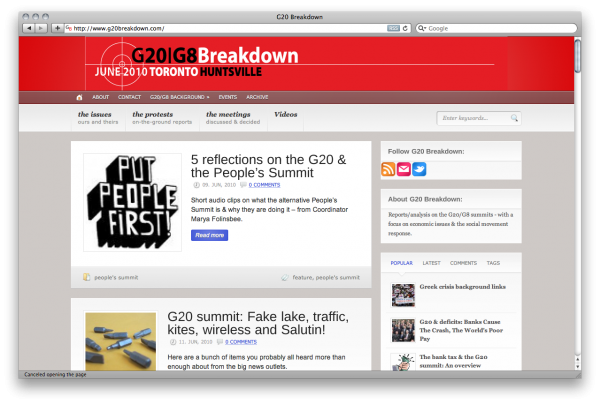
Darren Puscas started G20 Breakdown a few months ago and for a one-man operation, it features a lot of coverage. Puscas’ main areas of interest are economic and environmental issues, but he’s going to be on the ground in Toronto reporting directly on the People’s Summit this coming weekend, and the G20 itself the week after.
Toronto Community Mobilization
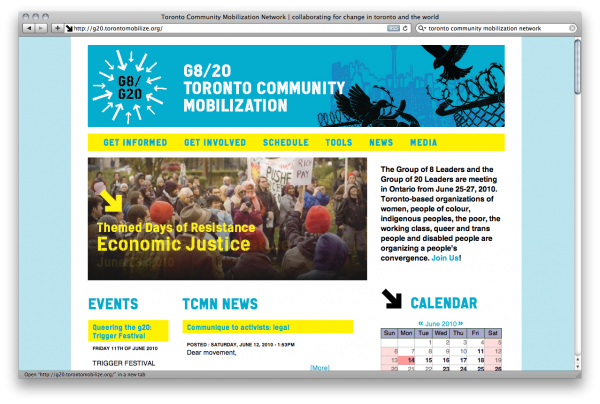
The Toronto Community Mobilization Network is the coalition of activist groups that is coordinating and publicizing the flood of social justice-themed events — demonstrations, concerts, panel discussions, parties, and more — in response to the G20. Their website won’t be so much a source of reporting as a place to keep on top of an ever-shifting schedule of stuff to do.
G20 Research Group
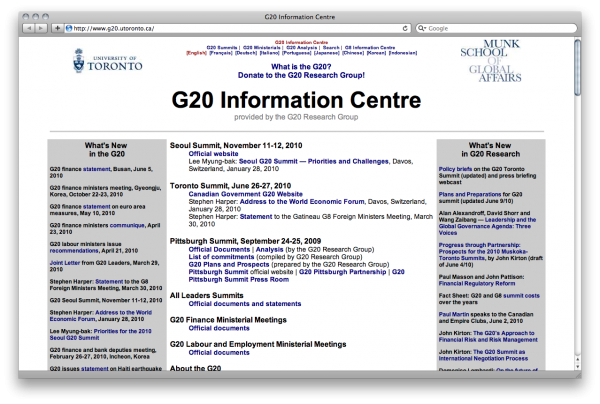
The G20 Research Group is an academic flying squad at the University of Toronto’s Munk School of Global Affairs, a largely student-run group that collects and sifts through the massive piles of information that the G20 produces. The emphasis here is on data, though there is some academic commentary (from across the political spectrum). The research group also sends students to the summit proper to report on individual meetings and press conferences. The academic analysis doesn’t always make for the most exciting reading, but when you’re the kind of reader who wants footnotes, this is your place.
]]>