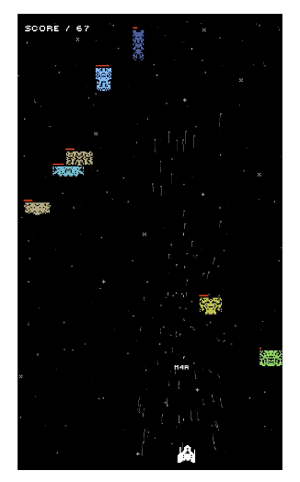
The current issue of This features Andrew Webster’s profile of Canada’s independent videogame scene, which came to mind recently when I stumbled across Lose/Lose, a video-game/conceptual-art-project that adds some real risk to the normally consequence-free world of blowing up aliens. When you play Lose/Lose, the alien attackers are stand-ins for actual files on your computer. When you blow them up, those files are deleted. If the aliens blow you up, the game deletes itself and you have to download it again. I didn’t play it, because, well, that’s not really the point. It’s a thought experiment.
The game’s creator, Zach Gage, explains the concept:
Although touching aliens will cause the player to lose the game, and killing aliens awards points, the aliens will never actually fire at the player. This calls into question the player’s mission, which is never explicitly stated, only hinted at through classic game mechanics. Is the player supposed to be an aggressor? Or merely an observer, traversing through a dangerous land?
Why do we assume that because we are given a weapon and awarded for using it, that doing so is right?
That’s a pretty explicit question, and a politically charged one—the kind that videogames have traditionally avoided.
As an art form, games seem to remain ideologically inert in comparison to other media. Partly that’s a function of the cost of developing them. When you spend millions building a blockbuster game, you can’t afford to turn it into a searing commentary on morality in pop culture; stuff just has to blow up real good. That’s true of film and music too, other high-capital undertakings that can’t afford to alienate the audience. But in those fields, independent, aggressively avant-garde projects still flourish on the margins. With video games, even the tiny indie producers seldom seem to venture into serious commentary on social, political, or economic issues. It’s all “dance dance” and no “revolution.” There’s the “serious games” genre, but those seem more like educational games, and less focused on commentary.
Does anyone have suggestions for video games (any platform) that have real political content? Who is the Brecht of X-Box? The Godard of GameBoy? The Breillat of Wii? Suggest them in the comments section below or email them to editor at this magazine dot ca.
]]>And narcissistic it is. A recent CBC documentary addresses those of us born after 1970 (myself very much included) by the not-so-subtle moniker “Generation Me.” The children of the Baby Boomers (more passively, “The Me Generation”), we’ve grown up being told just how special we are from the moment our heads crown from the birth canal. Our notion of self is defined not only by entitlement, but by an immense sense of self-importance brought upon by years of parental conditioning. We each fancy ourselves to be not only unique and special snowflakes, but the best possible unique and special snowflakes, and, while we may not have invented the quarter-life crisis, we have certainly perfected it.
While Facebook’s demographics are rapidly bridging generational boundaries, most of its users still fall within the 18-34 year-old range—Generation Me at full throttle. As both shameless exhibitionists and hopeless voyeurs (again, myself included), we relish in celebrity culture while simultaneously craving a slice of the fame for ourselves. Which is why, studies suggest, we are completely careless about the kind of personal information we are willing to disclose on our Facebook profiles.

courtesy of http://collegecandy.files.wordpress.com
“Youth are sharing a great deal of information on social networking sites such as Facebook and may not fully realize the consequences of this disclosure,” says Amy Muise, one of two University of Guelph Psychology PhD students recently awarded nearly $50,000 in government research funding. The research in question? Why, disclosure of personal information on Facebook, of course.
The grant, awarded by the Office of the Privacy Commissioner of Canada to Muise and fellow graduate student Emily Christofides, amounts to nearly the maximum allotted amount for the office’s Contributions Program, which is considered among the top privacy research funding programs in the world.
A June 9 University of Guelph press release quotes privacy commissioner Jennifer Stoddart: “I’m proud that our office is able to help encourage relevant and cutting-edge research. I am also glad that we can work with established organizations to spread knowledge about the importance of privacy.”
Whether or not this research is enough to knock some sense into our self-obsessed noggins is anyone’s guess, but this is at least a step in the right direction toward figuring out how to create boundaries between our lives and the meta-existences we forge online.
]]>Over the years, I’ve seen many creative, intelligent, rebellious teenage girls discouraged for being themselves and breaking the mould, and watched the subsequent damage to their self-esteems—not to mention the havoc wreaked on their academic performance, work, and relationships. I, too, was once trapped on that boat. It’s hard to be different, and we all would have benefited from a strong dose of shamelessness. Better yet, we could have used She’s Shameless.
An offshoot of the self-described, “fiercely independent” Shameless magazine, She’s Shameless is an anthology that boasts an array of autobiographical accounts taken from the lives of female writers, thinkers, and activists who have learned to be unashamed of themselves and the paths their lives have taken. Body image, teen pregnancy, sexual discovery and creative pursuits are all fair game for conversation in these poignantly honest firsthand narrations of PoMo coming-of-age. Among my favourites are Jowita Brydlowska’s jarring “Losing my Virginity,” and the cartoon advice guide “Things I Wish Someone Had Told Me as a Teenaged Girl,” penned by Zoe Whittall and inked by Suzy Malik; with such helpful teen life suggestions as “If you really hate your high school, leave” (an invocation to find an alternative school, not to drop out) and “Your poetry is probably awful, but keep writing it,” I wish someone had told me these things too.
Editors Stacey May Fowles and Megan Griffith-Greene—the publisher and editor of Shameless magazine, respectively—dedicate this lovingly assembled book “For all the shameless girls who know there’s got to be something more, and to all the shameless women who help them find it.” Clearly, these women have earned their feminist stripes.
(The book launch party for She’s Shameless: Women write about growing up, rocking out, and fighting back , is happening at the Gladstone Hotel Ballroom, 1214 Queen St West, Toronto
Tues June 23; 8pm (doors 7:30pm),$5 or Free with book purchase)
]]>
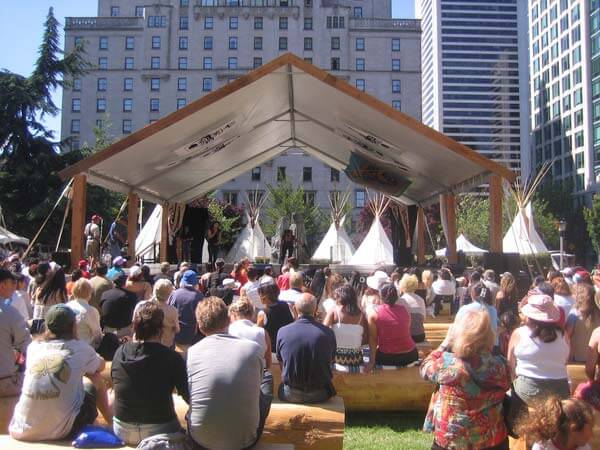
Vancouverites attending National Aboriginal Day events in 2006. Creative Commons photo by Flickr user Freedryk.
It’s only fair that the 11-day Celebrate Canada! festival should kick off with National Aboriginal Day. After all, what better way to commemorate this crazy multicultural mosaic of a country than by launching its celebration in honour of the first people to make it awesome?
We’ve compiled a list of things to see and do this weekend. Just click through after the jump to see the list.
The following is a sample of the weekend’s upcoming National Aboriginal Day celebrations, by region:
Atlantic Region:
Antigonish
National Aboriginal Day Celebrations
June 21, 2009
Paq’tnktk Powwow Ground
Antigonish, Nova Scotia
Contact: Rose Julian, 902-386-2781
Charlottetown
National Aboriginal Day Celebrations
June 21, 2009
Confederation Landing
Charlottetown, Prince Edward Island
Contact: Jamie Gallant, 902-892-5314
Fredericton
National Aboriginal Day Celebrations – Union with our Elders
June 21, 2009
St. Mary’s First Nation
Fredericton, New Brunswick
Contact: Allan Polchies Jr, 506-458-9511
St. John’s
National Aboriginal Day Celebrations
June 21, 2009
St. John’s Native Friendship Centre
St. John’s, Newfoundland/Labrador
Contact: David Penner, 709-726-5902
Ontario Region:
Toronto
Kahontake Kitikan Celebration- National Aboriginal Day Recognition
June 22, 2009, 12:00 – 3:00 PM
St George Campus, University of Toronto
(East side of Hart House)
Contact: [email protected]
Ottawa
Family Fun Day – National Aboriginal Day
Sunday, June 21, 2009, 11 a.m. to 4 p.m.
National Gallery of Canada
Ottawa-Gatineau (NCR)
Web: The National Gallery of Canada
Noongam Traditional Powwow
June 19-20-21, 2009
Dow’s Lake
Ottawa (Ontario)
Web: Noongam Traditional Powwow
Prairies Region:
Calgary
Celebrate Aboriginal Awareness at Heritage Park Historical Village
June 21, 10:00 a.m. – 5:00 p.m.
Heritage Park Historical Village
Calgary, Alberta
Contact: Jo Morris, 403-268-8556
Web: Heritage Park Historical Village
Edmonton
Weekend Festival – Day 1
June 20, 2009 (noon – 6 pm)
Alberta Legislature Grounds, 10800 – 97 Avenue
Edmonton, Alberta
Contact: [email protected], 780-495-6728
Web: City of Edmonton: National Aboriginal Day
Weekend Festival – Day 2
June 21, 2009, 1:00 p.m. to 5:00 p.m.
Alberta Legislature Grounds
Edmonton, Alberta
Contact: Mary Dion, 780-452-6100
Web: Metis Child & Family Services Society
Regina
Regina National Aboriginal Day Celebrations – Wascana Park
Sunday, June 21, 2009 10 a.m. – 10 p.m.
Wascana Park, near Royal Saskatchewan Museum
Regina, Saskatchewan
Contact: Orenda Yuzicapi, 306-596-5131
Web: Regina National Aboriginal Day Celebrations
Winnipeg
National Aboriginal Day – Time to Celebrate
June 21, 2009 10:00 a.m. – 3:30 p.m.
Indian and Metis Friendship Centre, 45 Robinson Street
Winnipeg, Manitoba
Contact: Clayton Sandy (Event Coordinator): 204-945-8319
Web: National Aboriginal Day – Time to Celebrate
British Columbia Region:
Vancouver
National Aboriginal Day Celebration
June 23, 2009, 9:00 a.m. to 5:00 p.m.
745 Clark Drive
Vancouver, British Columbia
Contact: 604-872-6723
Kamloops
National Aboriginal Day – Simon Fraser University (SFU)
June 21, 2009, 10:00 a.m. to 3:00 p.m.
McDonald Park, North Kamloops
Kamloops, British Columbia
Contact: 250-828-9799
Quebec Region:
Montreal
Solstice des Nations – Open to all
June 21, 2009, 10:00 a.m.
First Nations Garden, Montréal Botanical Gardens
Montréal, Quebec
Contact: Land InSights, 514-677-1377 (Info-festival line)
Web: First Peoples’ Festival 2009
Trois Rivières
Benefit day for the future Native Friendship Centre
June 21, 2009, 11:00 a.m.
Espace de créativité émergente l’App’Art, 45 St Antoine
Trois-Rivières, Quebec
Contact: 819-694-1843
Nunavut Region:
Arctic Bay
RCMP Barbeque
June 21, 2009
RCMP Detachment
Arctic Bay, Nunavut
Contact: S/Sgt Steve Wright, 867-975-4413
Iqaluit
Alianait Aboriginal Day Concert
June 21, 2009
Nakasuk School Parking Lot
Iqaluit, Nunavut
Contact: Heather Daley, 867-979-6468
Web: Alianait Arts Festival
A much more extensive list can be found here.
]]>Wind energy gets its hands dirty. Offshore oil rigs may provide the ideal spot for turbines.
Google buys a Finish paper mill and turns it into a data center. A sign of times to come?
Darwin turns 200!!!
SCIENCE IS FUN! ]]>
Part one (or two)
I’ve been lugging around the most recent, brick-heavy publication of the Journal of Aesthetics and Protest put together in LA. It has been worthwhile company for long streetcar rides. This book is divided into three portions, and I think I might offer a three-fold blog entry on the book instead of trying to gulp it all down and comment in one go.

As I said in my first blog post ever, the Journal is one of my favorite places to come and get thick ideas about activism and then come back and think about them. It offers a creative space for resistance thinking. I originally came upon the journal when I was writing a piece for Geez magazine about Neil Harrison‘s art. They self-describe as a “weirdo thinktank” but come across as a sincere but kind of tortured struggle for creative collaboration and resistance in a country that has been until recently crippled under the weight of fear and empire (a contentious label, i realize) and the frustration of embarrassment from a destructive leader. From the looks of it, this issue was less painful to produce than the first full-length book.
The book is also available online for free, so anyone can read it too and feel free to create a conversation.
Like a kid in front of the cake at their own birthday party, I’d like to take a chunk out of the middle to start: The Antiwar Survey, an attempt by the editors to give a picture of the cultural expressions of anti-war sentiment in California. The editors describe the journal as three books in one, so for fun let’s start with number two.
By way of an introduction, Robby Herbst describes what the Antiwar Survey section aims to do. He says that the anti-war sentiment in the States since 2003 can’t exactly be described as a movement. The anti-war struggle had and has pushed past being an activist thing to being the opinion of the majority of Americans, and certainly much of the rest of the world.
Much like many of the activists I’ve chatted with, Herbst agrees in his introduction to this section that the anti-war movement in the States is not so much a “movement” with leaders but a splintering of committed individuals and individual nodules of effort, spontaneous, creative eruptions against perceived injustice. Herbst concludes that maybe it was/is not so much a movement but a culture.
The Survey
The Antiwar survey simply documents the results of a survey that was sent out to groups in California. Each group answered the where and why of their anti-war action, and included what they learned from it, how they measured success, and what it would take for them to do it again. The actions include everything from pottery, postermaking, and dance to more traditional forms of “direct action.”
What I found striking about the survey is the question that asks “Are you connected to any other organization?” The number of respondants that said no is equally as moving as those who listed a host of other connections. It’s amazing to think of so many groups and lone individual artists needing to express their rejection of the unjust war, even if they did it alone.
Some of the projects included Hillary Mushkin’s “Far from War” video project where the artist interviewed folks about what their neighbourhood might look like if it was at war. The video was initially displayed in a barber shop in Eagle Rock, CA for a month. Other projects included improvised postering campaigns; “holding up” business at a Wells Fargo bank by keeping the lines jammed with volunteers; and a still dance collective that staged resistance theater in public space.
Another artist, Ehren Tool, made “war awareness art,” printing war imagery onto tea cups. Tool has distributed over 7,000 cups and sees it as a way to sneak war awareness literally into people’s hands and homes. It’s a way for the art to linger with them.
Another moving part of the survey is the way that artists and activists (also a contentious term) responded to the questions “What was the outcome of this activity?” and “How did you measure success?” Equally poignant was the answer of those who felt their action had made a significant difference, and those who answered “I don’t know.” Bringing these creative actions together in one volume gives them a place and a context within the broader anti-war culture.
Toronto finished off 2008 with three bank robberies and began 2009 with three new babies and the GTA’s first homicide, which, tragically, pales in comparison to the bloodbath that Calgary saw on New Year’s Day. Regarding the economy, the IMF is expecting 2009 to go from bad to worse, and the Globe and Mail’s Lawrence Martin predicts 2009 will see the end of Stephen Harper.
I would like to see 2009 bring some good news. A cure for cancer? Reasonable government? Baby kittens? Anything.
If, like me, you would prefer not to read about homicides and economic downturn on what is one of the precious last days before reality returns, here’s a bit of fun: Jeffrey Simpson of the Globe and Mail has made a quiz of the year’s top news items. See if you can beat my embarrassing score of just barely passing.
Instead of reflecting on the year that’s just passed (we’ve done enough of that already), it’s time to start thinking about the future. The Globe staff has made a few predictions of their own, but what do you predict for 2009? Maybe more importantly, what do you hope for 2009? ]]>
Little Adolf Hitler Campbell ran into trouble last week when a grocery store in his native Pennsylvania refused to print “Happy Birthday Adolf Hitler!” on a cake for his third birthday. His sister JoyceLynn Aryan Nation Campbell will likely face similar disappointment on her birthday.
His dad said he chose the name because he liked it and “no one else in the world would have the name.”
Well, almost no one. I hope little Adolf doesn’t discover Google and Wikipedia too quickly, or he may quickly be petitioning the court to allow him to change his name, as did a nine-year-old girl from New Zealand whose parents gave her the unfortunate name, Talula Does the Hula from Hawaii.
Both are considerably worse than Melissa Wilson.
However, I’m almost inclined to side with the Campbells on this one. Adolf Hitler is, after all, only a name, and it contains no profanity (though requesting a swastika on the cake is certainly crossing a line).
What do you think?
Are all the Jessicas and Jennifers of my generation thanking their lucky stars right now? ]]>

Two things that have come through my life recently have me thinking about problems and solutions. The first is an incredibly well-presented online video and website called The Story of Stuff. In it, activist Annie Leonard describes her years-long investigation of the lifetime of consumer goods: where they come from, how they get in our homes and what happens when we trash them. The video is about 20 minutes long and worth a look. Its design is simple and elegant and features clever animations and plain, urgent language.
But something about it makes me feel uncomfortable. It’s 19 minutes and 30 seconds about the problem at hand and roughly 30 seconds about hope for change. It appears to be aimed at the average consumer, but its educational tone comes across as a bit pedantic. It encourages viewers to stay on the site and click around for information and stories about positive change, and that’s probably where the real use of the site comes in, but I expect only a small percentage of viewers take the time to stick with it — especially if they approach the topic as skeptics.
Contrast this with a talk I went to last night by Chris Turner, journalist and author of the book The Geography of Hope: A Guided Tour of the World We Need. Through a photo slideshow and Q&A session, Turner outlined some of the amazing strides being made in sustainable living in places like Germany, Denmark, New Mexico and Thailand. Concrete examples of new ways to live, with an emphasis on renewable energy, reducing consumption and recycling. He mentioned a new wave of environmentalism, moving beyond doom-and-gloom predictions and concentrating on what is possible with the technology and willpower we already possess.
In my mind, this is the best way to reach the constituencies of people who remain doubtful about the urgency of climate change or the problems with the free market system. Enough warnings. Those who will listen to the warnings have already heard, and those who will not need a new kind of motivation for change. By getting the word out — and Turner mentioned an activist he knows who consults for Wal-Mart, and the importance of spreading our messages through the mainstream, commercial media — we are best positioned to inspire change in others.
IMAGE: STILL FROM THE STORY OF STUFF

(book image courtesy Amazon.ca)
I’m just back from a courtroom on University Avenue in Toronto where a judge in the Robert Baltovich re-pre-trial threw out a subpoena demanding a local writer hand over his research materials. It’s a very good day for a free press in Canada.
Derek Finkle, former editor of TORO Magazine, succeeded in protecting his background work for the book No Claim to Mercy, after months of pre-trial wrangling. No Claim to Mercy covered the 1990 Elizabeth Bain murder case, in which Bain’s boyfriend Robert Baltovich was convicted, only to be released from prison after eight years when new evidence threw speculation for the crime at Paul Bernardo. Bernardo was unknown at the time of Bain’s murder, but hindsight shows he was active as the Scarborough rapist when Bain disappeared from the University of Toronto’s Scarborough campus. Baltovich is being retried, and his prosecutors were very interested in seeing all of the confidential interviews and research materials Finkle collected to write his book. For more info on Bain, Baltovich and Bernardo see this CBC page.
At the press scrum after the hearing, one TV reporter asked this question:
“What’s so wrong with turning over this material to prosecutors anyway? I mean, they’re the prosecutors — the good guys, right? They’re trying to nail a murderer.”
I’m pretty sure the question was rhetorical, but in case it wasn’t and others out there wonder if it’s possible to always know who the good guys are in a court case, just ask one of these dudes:
Wrongfully Convicted in Canada
But the protection of a writer’s confidential work is less about good guys and bad guys and more about the public good, which is best served, I think, when police and courts do their own investigative work, rather than relying on the heavy lifting of writers.
Oh, and now seems like a good time to remind everyone that there’s more than one way for a press to lose its freedom and independence. ]]>