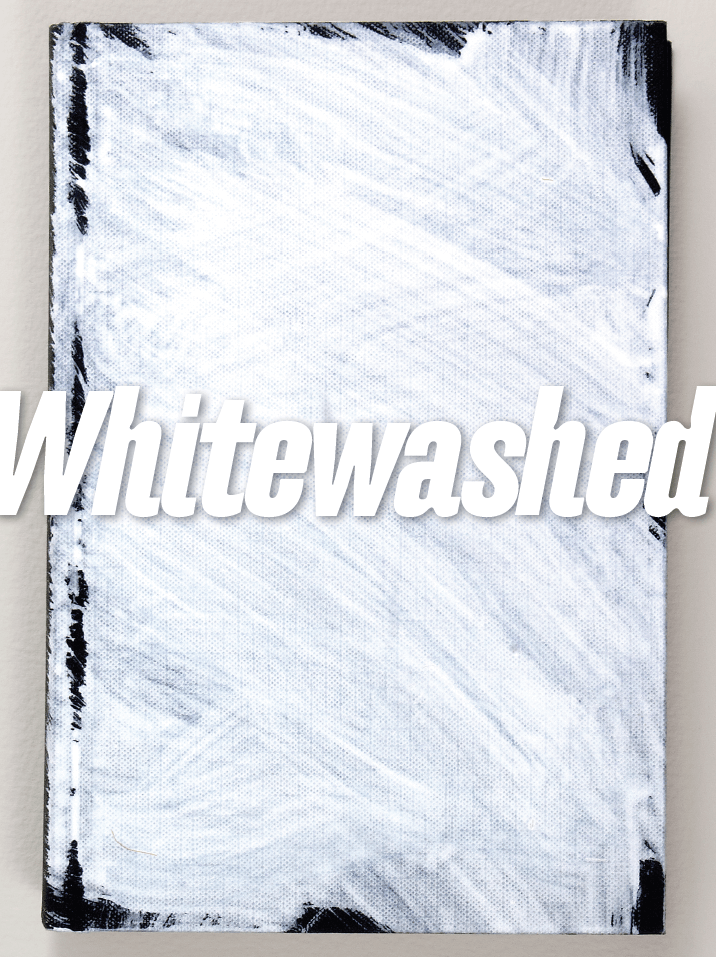
 From our education system to our literary community, why is CanLit so white? Nashwa Khan challenges the default narrative
JUNOT DÍAZ UNLEASHED A BOMBSHELL on the writing world when he published his essay “MFA vs. PoC” in the New Yorker last spring. The Dominican American author is a creative writing professor, a fiction editor for the Boston Review, and has won numerous awards for his writing—most notably the Pulitzer Prize for The Brief Wondrous Life of Oscar Wao. His New Yorker piece was about his own experiences as a racialized man in an MFA program he completed in 1995 at Cornell. Díaz’s take resonated with many who had lived through being racialized in the Ivory Tower, but it also unsettled some readers, predominantly white ones, who seemed shocked and outraged. Their reaction didn’t surprise me. Historically, academia at its foundation was built for white men, and not much has been done to rework the initial framework of how institutions are built—even if today’s student body is much more diverse.
I read hundreds of online comments. I read pieces analyzing Díaz’s essay. I read as much as I could digest. A lot of it made me cringe. Online comments seem to bring out people’s worst prejudices and even readers of the venerable New Yorker seemed no different. Commenters said people of colour were “not grateful;” they were told to “go back home.” Others praised his work. People wrote response pieces, both negative and positive.
Díaz’s essay was published at a time when I was at a crossroads with my own education. Reading it, I thought he was describing a racist experience, but one at a wealthy school that may have been less diverse. Plus, if he could, in the end, find like-minded people and support as a racialized man, I figured I could too. I was inspired to take the leap, and signed up for a creative writing program.
As a racialized Muslim woman, I grew up without my stories. I grew up reading about kids who weren’t like me, teenagers who weren’t like me, and now adults who aren’t me. I thought Díaz’s experience was anchored so long ago that mine would be better and I could foster his experience to build my own journey.
I found a program that had the flexibility and diversity I wanted. Díaz’s piece became a way for me to baptize myself in the world of creative writing courses, to learn how I could avoid the whiteness of the writing world. I told myself I would learn from his mistakes; he wrote that he slipped up because he was young. I was determined not to: I checked faculty, campus culture, and communities. I purposely chose faculty for my first set of classes who were queer or racialized, here in Toronto, the city Drake keeps trying to make happen, a city proud of its multiculturalism and cracksmoking ex-mayor.
I decided to do a certificate program, not a full MFA. I wanted to dip my toes in this world, not dive in unprepared. I wanted to avoid all the negatives situations Díaz recounted—things like workshops that were “too white” and a body of literature that similarly lacked diversity. I took all of the precautionary measures and, at first, it seemed to pay off.
On my first day, I was thrilled to walk into a classroom where a man of color was the instructor and the class was roughly 50 percent white and 50 percent people of color. I thought I had done my due diligence to find something close to a utopia in writing. I would soon learn, however, that I had walked into another sort of baptism, this one by fire. As much as I thought I had prepared for an MFA vs POC environment I called “Creative Writing vs. POC”, I should have expected, and have now amended it to, “Creative Writing vs. MOC vs. WOC:” Creative writing versus men of colour versus women of colour.
I’VE NOW READ DÍAZ’S PIECE at least a dozen times in full; I often pull up paragraphs that resonate with me most. I have a few sentences memorized. Tears well in my eyes every time I read it, but now they well in my eyes for Athena, the woman of color in his MFA program, the one who was gifted, but had enough, and left. Athena is not entirely fleshed out in his piece but Díaz does reminisce that the whiteness of the program exhausted her, and I feel that. About 20 years after Díaz and Athena felt the casual racism and microaggressions of being racialized while writing, I feel that.
To date in my life I have largely been “the other” but have not felt as hurt by microaggressions elsewhere as I have by those in the writing world. The writing world has made me feel more othered than any other space. Writing can expel so much.
Writing to expel shame.
Writing to cope.
Writing to tell stories.
Writing to riot.
Writing to right.
What writing cannot expel, however, is the anguish I leave the classroom with every time we workshop pieces. This kind of anguish is something hard to articulate. What I can identify is that my own experience is very different than the men of color with whom I write, and even more alien from my white classmates. Perhaps being a racialized female is an archipelago of an experience on its own. Perhaps it’s this belief that racialized people are their own category, and my female embodiment is one too distant for men to relate.
Every writing class I relive trauma.
I. I litmus tested Díaz’s mistakes, and failed.
I’ve realized that what I deduced from Díaz and others’ writing about classes being “too white” in numbers did not account for situations where the numbers may be in people of colour’s favour, but whiteness as a system and standard would dominate. White literature would be the default, white stories the skeleton of every piece, and white voices, even if outnumbered, would be the loudest even with a man of colour running sessions.
II. Minorities as a majority does not hold.
Hari Kondabolu’s skit “2042 and the White Minority,” about the census calculation that 2042 will be the year white people will be a minority in America, should be a primer for white people. When you really do the math in my workshops it doesn’t play out the way white women often thought it did when they mumbled things like “wow, so diverse.” But as Kandabalou makes light of in his skit, there is one big problem: as people of color, we aren’t all the same. This presumption of the white minority is heavily rooted in the belief that racialized people are a homogenous and united front.
Looking at the composition of certain classes, faculty, and program promotional material, both printed and on the web, you would think I found the utopia so many writers of color search for, including myself.
You would think people of color flourished and thrived as they wrote their vulnerabilities, shared their hearts on paper. You would think. When you look at my most diverse class, the composition is 50:50.
On days when one of their Ashley squad is missing, the white women will not let us forget how they are suddenly a “minority.” I don’t know whether our educational system hindered their basic math skills or if they just love surface level analysis, but in actuality women of color are still the “minority” on these days, and every other day in class. This particular class is comprised of 50 percent white women, versus five percent black women (i.e. one black women) and five percent non-black women of color (i.e. me). The rest is 40 percent men of color.
Bodies like mine and stories like mine remain foreign, uncomfortable, and on the margins. My stories become abstract even to the men of color who many classmates presume must relate to me. So when a white peer remarked during a workshopping of my piece, “well, you’re no longer a minority” and the class cackled, I still question their math.
III. Men of color don’t often support women of color in the same ways; #solidarityisforwhitewomen is real in the realm of writing.
White women in writing seem to have an easier time attacking women of color. This could be because of any variety of factors, but I want to say that it is a combination of intimidation and conditioning to believe that men are usually correct. I am still testing out my theory, but after conducting a few social experiments—such as using very WASP names in my writing or removing factors that potentially identify race, gender, and sexual orientation—my writing remains viewed as “foreign.” Maybe seeing me in the flesh is what constantly makes people fixate on what I can and cannot write. I am still conducting
experiments.
I say “white” but what I mean is women immersed in the very simplistic and classic ways literature is taught, those who uphold white feminism and let it seep into their writing and workshopping of pieces. I mean white women who would let myself and the other woman of color in my class know how to write about our bodies and existence, question our use of words from our mother tongues, and surveillance our truths. These white women were often cosigned by the silence of men of color I adamantly defended or agreed with in workshop sessions. These men were not part of my supposed “people of color majority.”
I still don’t know Maybe I feel bitter. But at the same time I understand that some have folded their bodies to fit into boxes that appease our white peers during
the workshops. I found their silence to be more comforting than their vocal approval with white women who said things like, “Why did you use that foreign word there?”
What I can say is having people of color does not equate to solidarity.
IV. Díaz was right in saying, “that shit was too white” about 1995 and I concur in 2015.
Díaz discusses how Athena and another friend often reflected on the shit their peers said to them. Feeling isolated, I kept a list that moved from a Post-It, to a sheet of paper, to pages in my notebook.
I try to slyly add to the chicken scratch list as people speak.
“Wow, since I was born here it’s fascinating for me to listen to your story.”
“You know I moved from England when I was six; I am an immigrant too!”
“I’m not racist but…” (Multiply this times infinity.)
“The names used in the story are really difficult, why can’t you pick …” (Insert any number of Anglo-Saxon names.)
“Oh, so, obviously English is not your first language.”
“Well this is obviously grossly exaggerated: Kids aren’t racist.” (Said during a memoir writing workshop.)
“I am a woman so I face oppression too.” (As if I am not a woman—very Patricia Arquette circa 2015 Oscars, if you ask me.)
The list that started as a page at the back of my notebook has now filled margins of my notes. It is blossoming like weeds throughout my pieces; a page can no longer contain the comments that my white and male peers will never face. These comments have also made me fold myself into a smaller version of myself, whittle down my stories to make them more palatable for a white liberal gaze.
Sometimes I want to scream, “Did you even read the words I wrote?” Tangential topics arise that are heavily laden with subtext. In fiction writing, if I wrote about any kind of conflict and the character had a name that seemed foreign or exotic, the same women would lament “this is cultural” and even once, a slip, “Is this from your experiences with your father?” Tropes saturated my existence—if only they believed my memoir writing the same way they believed my fiction.
Every week, they would explain how they did not understand my writing because they were “born here” and every week I would tell my white peers how I too was “born here,” on stolen land. I realized soon enough that they did not want to understand my writing. They couldn’t even humour reading my pieces: about immigrant parents crossing oceans and breaking their backs while being exploited by cheap labour for the American Dream.
They would not give me space to write about discovering myself as diaspora when I went to Morocco as a teenager. There was no space for my stories. This shit is still too white.
V. Memoir as fiction and fiction as memoir.
I discovered quickly that memoir writing classes should have beencalled something along the lines of “memoir; fiction for women of color, though.” No amount of reading on the MFA/workshop/writing retreat life would have prepared me for how much my truth would be interrogated along with the other woman of color in my program (who is actually the most educated person in the class, at least in the formal sense people seem to respect).
My stories had traces of flirty racism, racist iterations of sexism, and the pain of growing up racialized. That list in my notebook grew tenfold in memoir sessions. White women would use my workshop time to reflect on how my “gross exaggeration” made them cry. Once, the sole black woman in my memoir class wrote about herself, explicitly giving her character her name. A white peer asked why this white character was in Barbados. As if she did not realize it was memoir and the author right in front of her was a black woman. When I brought up how the default is white and that creates blind spots during workshopping and how egregious it was to suppose women of color wrote their memoir characters as white, the white women, joined by men of color, were up in arms.
Instead of letting me or other women of color receive feedback that was constructive, to requite the feedback they received, feedback I paid for, I got to hear about how they cried, how they “understood,” and how women of color memoirs made them “sad.” I wrote about my insecurities around women who looked like them as a child. I still cannot grasp how they “understood.”
I started to water down my writing like cheap coffee. I limited my memoir scenes to retellings of the awkward situations that not eating pepperoni caused me as a kid because if these women thrived off stories of drunk prom queens deserving to win, I could try writing about the tiny things in my life, close myself off from sharing anything more meaningful, more real.
VI. Social experiments don’t work on white people.
As much as I would remove markers of anything that was not white, straight, or middle class in my writing, my time in workshops became very specific. Regardless of how WASPY I made my pieces, white women still fixated on how I made them cry. They lamented that I was exotic and mysterious, despite having removed identifying markers from my writing. My body, the body I am trapped in, will never be able to write literature without having 21 questions unfold. My peers would say “I disagree with your memoir, but I learn so much from you.” Beyond the abhorrent notion that people can disagree with others’ memoirs, this labour I provided, vulnerability, and the display of my heart, only resulted in trauma for me and debating points, along with amusement, for them.
Once, I wrote a poem about the repetition of hearing the questions: Where are you from? What are you? Where are you really from? Where are your parents from? Three white women approached me after class to let me know these questions stem from genuine curiosity. They had good intentions, they told me; they weren’t racists. This all happened after a dedicated class discussion to my reverse racism. Throughout the term, this particular group kept relaying to me that they, too, were oppressed: they were oppressed by the yoga moms, the rich, the men—the list goes on, letting me know all I had was my identity oppression, whereas they had so much more.
VII. Pedagogy.
In the first five months of class, I read more white cis hetrosexual authors than I have in my entire life. Many don’t seem very special to me, but they are held to some kind of imaginary gold standard. Even in Canadian high schools, most of the literature taught is white, American, and male, as Michael LaPointe argues in his 2013 Literary Review of Canada essay “What’s Happened to CanLit?” The piece highlights truths that speak volumes. At the time, seven out of every 10 students in Toronto, for instance, were non-white. Of those surveyed, two-thirds expressed that learning about their own race would be more desirable. As well, unsurprisingly, half of the students surveyed believed that if that were the case, they’d do better in school. But whiteness will follow them into post-secondary education.
If we are what we read, will my writing become nuanced in the classic expectations of straight, white male writing?
I’ve read James Joyce, Ernest Hemingway, Paul Muldoon, Ted Kooser, Theodore Roethke, and Raymond Carver, all white men I’ve chased with the works of white women, such as Alice Munro, Amy Hempel, Eudora Welty, and more. This survey of whiteness is predominantly non-Canadian. Yet, it serves as Canadian literature, which I’d argue has morphed into ubiquity with white Anglo-Saxon protestant default writing.
White descriptions rooted in very colonial normative reality remain the default in writing programs today. This is witnessed in what we deem as “American Literature” and who is let into that elite group. The ahistorical erasure of methods of teaching writing in all forms is witnessed in what works we do close readings of and those we reference as authors to which we should aspire. I have navigated classrooms for most of my life and I want to reiterate that this is about white classrooms and not necessarily white people.
I say white classrooms to emphasize that it isn’t about the bodies occupying the room, the way we often think it is. Rather, it’s all taught to us within the pages of the syllabi and novels we treasure in these courses; the way we teach who to respect; the stories that are viewed as true; this the deep-seeded white normalcy.
It it is time to reevaluate the changing landscape of writers and adjust course curricula. Until then, the current set-up provides the ammo that weans out and exhausts women of color in these spaces. Until then, the framework for what is considered “respected literature” and what is not will remain the same. Until then, we will continue to see novels written by talented people of color used to fill diversity quotas, instead of just integrated as compelling works. Until then, we will we witness “diversity” writing integrated through the gaze of white authors. We will elevate novels like Harper Lee’s To Kill A Mockingbird. Until then, this is all that we will give racialized people: our stories retold through other mediums, selectively placed into marginalized classes.
VIII. Future.
I am weak and vulnerable; I feel too much, maybe. I like to think it could be a “me” problem but often realize it isn’t when I go online or to events. I find peers who look like me and I find a twisted comfort in finding out they have gone through similar experiences. I find ways to cope by ranting with them, listening to them, constantly being in solidarity with them. I’ve met people through the internet, which I always thought I would never do, just to find solace. I actively look for racialized writers forums and events now. Prior to being in this program I would go to any event, not wanting to be read as divisive. Now I know part of my survival is finding people like me in this struggle.
Will I finish any formal writing program?
Truthfully, I am not sure. There are days I feel great about a piece I’ve read or written that is creative non-fiction and get told I should be “realistic” about having a racialized person in fantasy, science fiction, or performing daily activities in a way that isn’t palatable to my workshop. I guess the same way dragons are more realistic than a man of color as a knight in medieval times.
Athena is only a tiny piece of Díaz’s essay, but to me she is everything. I’ve heard many racialized women feel the isolation, expressing similar sentiments that their alone is so alone that leaving any given writing program seems like the most appealing option. A future in writing looks bleak when this white default thrives in literature, a default that erases my being.
What real and dignified future is there for writers of color who make it?
Díaz has multiple awards to his name including, beyond the Pulitzer, a MacArthur Genius Grant. Yet, as an esteemed author honored by white dominated spaces, he still faces racism to serve as a punch line, even as a guest of honor. When Peter Sagal interviewed Díaz in October 2013 at the Chicago Humanities Festival, for instance, he riddled his introduction and questions with microaggressions and racial stereotypes. This exchange during the introduction made my skin crawl:
SAGAL: Welcome to this evening’s presentation of two bald guys from New Jersey. This is actually true. You’re from Perth Amboy, right?… And I’m from a town called Berkeley Heights …
DÍAZ: Yeah, I delivered three pool tables there.
SAGAL: What I like to imagine, well—We weren’t there quite the same time, and we never had a pool table, but I love the idea like a truck pulls up and in walks these Dominican guys—
DÍAZ: Nah, it was me and an African-American dude.
SAGAL: OK. And deliver to this, you know, suburban house where there’s this Jewish kid that’s going to Harvard and it’s like freeze it—Which of these is going to win a MacArthur Genius grant? [Points at Díaz.]
Similarly, Chimamanda Ngozi Adichie can author a New York Times’ 10 Best Books of 2013 but still be referred to as “Beyonce’s favorite feminist,” instead of as a talented author who has won numerous accolades.
In this system that has manifested, it may be that I could thrive— or I could perish a slow and painful demise within it, along with many other women of colour, along with Athena. Let me return to an earlier question: If everything we write is an extension of ourselves, what do women of color have in these workshop spaces? How can we flourish in male- and white-dominant spaces? Will I succumb to stories that are not my own, narratives of lives I cannot relate to?
I believe that writing, as an art, does not necessarily imitate life; it grows from it, roots itself in truth and blossoms with stories. But the roots cannot break through and take to the soil, they cannot sprawl and have their storied seeds planted when a system only values certain stories. I am a racialized woman writing in 2015. If I get rooted as a rare token writer, I may yet flower. Or, I will wilt at the margins of pages, my stories untold, my words unwritten. I know only that every workshop I walk into is like a battle, and my mental struggle in these spaces will determine my fate.
]]>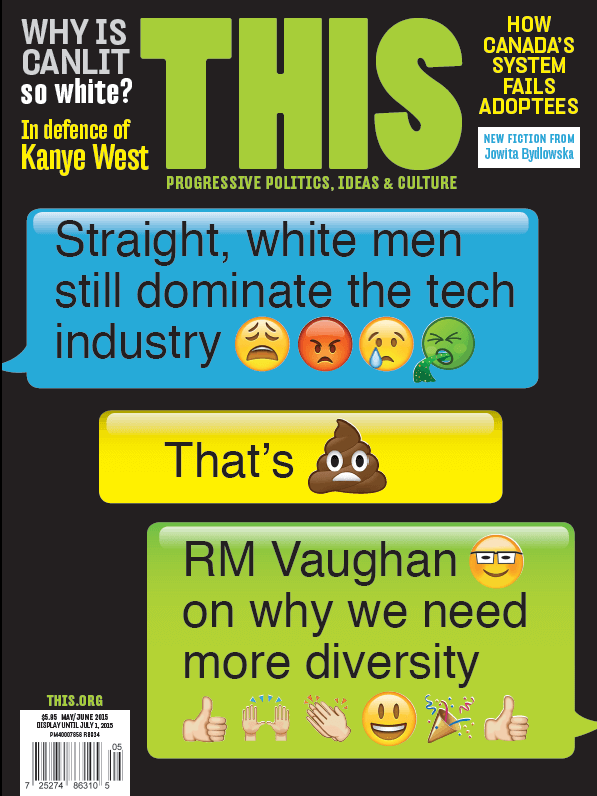
Straight, white, men still dominate the technology industry. In our May/June issue, This Magazine contributing editor RM Vaughan introduces us to LGBTQ activists around the world who are fighting for change. Also in this issue: Sam Juric tells us why we should stop painting foreign adoption as a Brangelina fairytale, and instead focus on the not-so-happily-ever-after of trauma, mental health crises, and isolation that many adoptees and their families face; Nashwa Khan asks “Why is CanLit so white?” and challenges the default narrative in our current education system and literary communities; plus new fiction from Jowita Bydlowska, an essay in defence of Kanye West, and much more!
If you’re having trouble finding This Magazine at your local newsstand or bookstore (so many copies of US Weekly! So very many!) email our publisher Lisa at [email protected] and she’ll help you find a store near you. Or better yet visit this.org/subscribe and get the magazine delivered right to your door.
]]>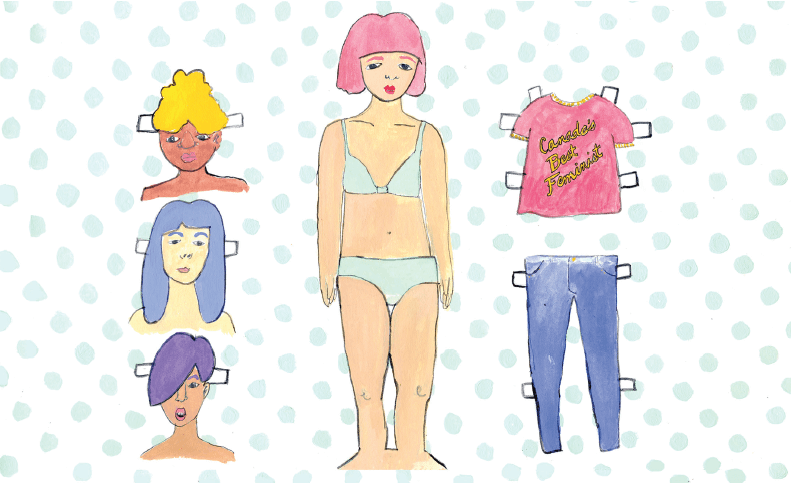
Illustration by Alisha Davidson
Because there’s more power in crowd-based, grassroots action—that’s why. Soraya Roberts challenges the cult of feminist celebrity
IF A FEMINIST FELLS CANADA’S PATRIARCHY and the media isn’t around to hear it, does it make a sound? Last year, Toronto Star columnist Heather Mallick was lambasted online for using the headline “Why Can’t Canada Build a Feminist?” to promote How to Build a Girl, the new book by renowned British feminist Caitlin Moran. A few days later, Maclean’s seemed to prove her point by publishing a cover story on the new faces of feminism—Malala Yousafzai, Tavi Gevinson, Emma Watson—most of which belonged to celebrities. The article’s sole Canadian, feminist video game critic Anita Sarkeesian, actually lives in the U.S. and only recently became a household name in the wake of Gamergate.
Though the Star changed its headline to “Why Can’t Canada Build a Famous Feminist?” Mallick’s original message stuck. Though fame underscored it, the takeaway seemed to be the mainstream invisibility of Canada’s feminists. What Mallick didn’t realize—unsurprisingly in an era in which feminism has been celebrified to the point that its non-celebrities are eclipsed—was that their invisibility is integral to their work. Canada’s feminists are invisible precisely because being visible limits what they can represent. And what the country’s current crop of feminists represents is everybody—you can’t be a so-called “somebody” and everybody else all at once.
“If there’s one trend I’m seeing among feminist activists, it’s that we generally do not want to be ‘the voice of our generation’ because one truth that we, as a movement, are plodding toward, is that whenever there is a woman considered the voice of her generation of feminists, she is generally white, generally middle or upper middle class, generally cis, often straight or straight-presenting,” says Stephanie Guthrie, founder of Women in Toronto Politics. “The reality is that her perspective will inevitably have blind spots as a result of those privileges.”
Canadian-based feminist organizations such as SlutWalk are conceived in crowd form. Even more recent campaigns, such as #AmINext, which raises awareness of murdered aboriginal women, only give the semblance of individuality—they are defined by a chorus. But dispersing Canada’s feminist mandate across the population—to all genders, races and age groups—can imply a dilution of the movement’s original intention. “I think sometimes the fact that the movement is generally more inclusive and more sex-positive than in the past can sometimes make second-wavers feel like we’ve gone ‘soft,’” says Anne Thériault, a feminist blogger from Toronto.
But today’s feminists aren’t soft—far from it.
A number of the Canadians who took issue with Mallick’s column argued that our country’s feminists are too busy working to vie for her attention. This is particularly true in Canada where, as feminist icon Lee Lakeman notes, funding is not as developed as it is in the U.S. “The swing to the right since 1995 has wiped out the last generation of more nationally- based women’s organizations,” she says, “and [the government] has not been forced to allow any new global waves to form.” Since conservative leader Stephen Harper came to power in 2006, the National Action Committee on the Status of Women, Canada’s largest national feminist organization, closed due to lack of funding (it now operates as an NGO). Canada’s Feminist Alliance for International Action and the Canadian Research Institute for the Advancement of Women also rely on donations. According to Lakeman, Canada’s desperation for funds causes its feminists to be “swamped” and “hidden from each other” at the grassroots level.
Canadian feminists are largely only visible to the people they help. They spend their days working directly with victims of domestic abuse, sexual assault, and various other forms of exigent exploitation—they are too preoccupied with the work to actually promote it. “They’re not celebrities, they’re not writers, they’re not famous people,” says Meghan Murphy, founder of the most-read feminist blog in Canada, Feminist Current. “That’s not the point of the work they’re doing.”
And their biggest workload comes in the form of Indigenous women’s rights. According to Statistics Canada, aboriginal women are three times more likely to face violence than non-aboriginal women, yet Harper slashed funding to the Sisters in Spirit initiative and the Aboriginal Healing Foundation and in August rejected a national inquiry into Canada’s murdered and missing aboriginal women, denying it was a “sociological phenomenon.” This compounds Canadian feminists’ invisibility—the fact that their biggest concern is women who are themselves invisible.
That these activists are still being ignored despite the increased awareness of feminism worldwide does not surprise Murphy. The issues they are addressing have been ignored for decades thanks to historical racism, not to mention abuse, addiction, and mental illness, all of which the government—and Canada as a whole—refuses to face. “The real issues of feminism are not very attractive issues,” Murphy says. “It’s not like Beyoncé.”
Canada does not have a Beyoncé. We don’t, in fact, have much of a celebrity culture in general—it’s not a natural fit for us to dress up feminism to make it more palatable or social media friendly even though that is what is currently being demanded of the movement. The internet has “democratized access to a platform,” says Guthrie. Authors of seminal feminist texts, such as Simone de Beauvoir and Gloria Steinem, the original thought leaders of feminism, have been replaced by bloggers, Tweeters, and YouTubers. “Increasingly,” Guthrie explains, “we are taking advantage of that access to a diversity of voices to listen, to learn, and to inform our activist approaches.”
But how do you get heard over the din? Increasingly individual feminists are branding themselves as distinct voices of the movement in order to stand out. It’s a culture that seems to agree less with Canadians than Americans, who come from a more individualistic society in which the self is favoured over the collective. “I don’t know that Canadian feminists would grow up thinking that they’re number one goal was to be Jessica Valenti or Gloria Steinem,” says Murphy. “Certainly when you start making feminism about personalities and individuals, it stops being representative of the work that’s being done.”
This skewed focus frustrates Cherry Smiley, a Thompson and Navajo Nations activist for Indigenous women and youth recipient of the 2013 Governor General’s Awards in Commemoration of the Persons Case. She thinks prioritizing individuals poses “a huge problem” for the movement. “I think my generation and younger have unfortunately embraced the idea of ‘feminisms’—that feminism can mean whatever you want it to be,” she says. “I think that idea has really watered-down feminism and has unfortunately embraced a very neoliberal ‘I’ as opposed to a collective ‘we,’ and it’s men and patriarchy that really benefit from these ‘me me me’ ideas.”
This misguided approach to feminism merely compounds the movement’s marginalisation by mainstream society, but that only makes Smiley work harder. “Feminism challenges patriarchy and colonialism, and it challenges racism and capitalism,” she says, “when we really begin ruffling feathers and pissing off the right people and truly challenging the status quo, that’s really when we’re on to something.” Hear that? That’s “we,” not “I.”
]]>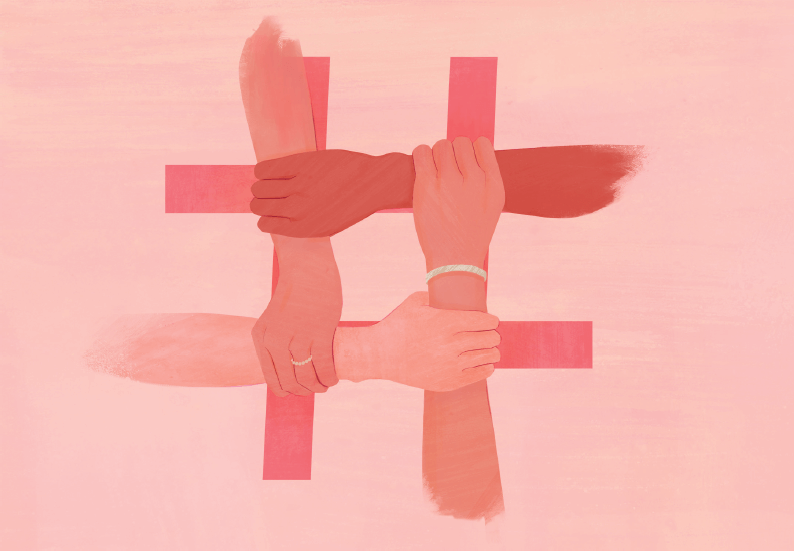
Illustration by Kris Noelle
Critics of social media say it’s nothing but white noise—but it can also amplify women’s voices
Antonia Zerbisias walks into the newsroom on what is her second last day before retirement. It’s early evening on October 30, 2014, and somewhere in between saying some of her last hellos and goodbyes to colleagues at One Yonge Street and attending to whatever final bits of business a columnist and writer has left after more than 25 years at the Toronto Star, she types out a tweet: “It was 1969 when, if you found you were the only girl in the rec room and no parents were home, it was your fault”
Period.
Then, “#BeenRapedNeverReported.” Send.
Minutes later, two more tweets, divulging memories that time couldn’t erase after 40 years.
“ … 1970: My friend’s friend from out of town ‘forgot his wallet’ in his hotel room …”
Period. “#BeenRapedNeverReported.” Send.
“ … 1974: A half-empty 747 to London. Traveling alone. Fell asleep…”
Period. “#BeenRapedNeverReported.” Send.
Hours before sending out these tweets, Zerbisias was messaging back and forth with longtime friend and Montreal Gazette justice reporter Sue Montgomery, together fuming over public reaction to the women who were then, for the first time, coming forward with their allegations of abuse against CBC’s former golden boy radio host, Jian Ghomeshi.
Zerbisias and Montgomery had watched, stunned, as the subsequent flood of questions on Twitter, Facebook, and the comment sections of online articles came in from coast-to-coast: Why didn’t the women report anything when it first happened? Why were they only coming out now?
The victim-blaming narrative infuriated both women, and Montgomery suggested they start a list with the names of women who had been raped but had never reported it—just to prove a point. She wanted to do something to “remove the fucking stigma” and get people to speak up and act up. Zerbisias agreed, suggesting they use social media to get their message out far and wide, landing on the hashtag: #BeenRapedNeverReported.
And so, at 2:55 p.m. she sent out her first tweet:
“#ibelievelucy #ibelievewomen And yes, I’ve been raped (more than once) and never reported it.”
Period. “#BeenRapedNeverReported.” Send.
“The rest is history as they say,” Zerbisias says with a laugh over the phone from her home in Toronto one evening in January. Three months after co-creating the hashtag that ignited a global conversation on why women don’t report rape, the describing word Zerbisias still uses over and over again is “overwhelmed.”
“I didn’t decide to start anything. It just happened. The time was right,” she says. “It seems to me that all we’ve been talking about on social media for the past two years is rape. That’s what focus of feminism is today. Much of the third wave, as it were, is about rape rage.”
“Social media is not just another way to connect feminist and activist voices—it amplifies our messages as well,” Jessica Valenti told Forbes magazine in 2012. Valenti is a columnist with the U.S Guardian and founder of Feministing, a feminist pop culture website, who, among other accolades, has been credited with bringing feminism online. Indeed, it seems today women’s voices are often heard loudest through our screens—a trend some are calling “hashtag feminism.” Although the term itself may be debatable, the phenomenon it points to is not: #Bringbackourgirls, #WhyIStayed, #WhyIleft, #YesAllWomen, #YouKnowHerName, and #BeenRapedNeverReported.
Odds are if you’re a Twitter user, or at all savvy to social media, you’ve come across these hashtags. Each was born out of public outcry in the wake of high-profile tragedies: The kidnapping of over 200 Nigerian girls by militant rebels Boko Haram; Janay Palmer’s decision to stand by hubby NFL running back Ray Rice after he knocked her unconscious in an elevator; the publication ban on Rehtaeh Parsons’ name; and the Elliot Rodger shooting rampage, in which six University of California, Santa Barbara students were killed. These hashtags were quickly taken up by millions around the world as outraged rallying cries for change—for women to raise their voices in unison and scream “enough is enough.”
Historically, feminists did this by marching and picket lines, staking out their causes with signs and speeches. Today many are turning their campaigning efforts toward the most public of public spheres: social media. But what’s the point of it all? When feminists grab their phones and type out an 140 character message, does it inspire positive change? Do these virtual mantras carry actual power?
Answering the questions surrounding the legitimacy of hashtag campaigns begins with a look back at the very roots of feminism, says Emily Lindin, founder of The UnSlut Project—a multimedia initiative working around cyberbullying and slut shaming. Social media most obviously lends itself to a spirit of solidarity between women, and speaks to the idea of a globalized sisterhood, hardly a new idea to the movement at all.
Lindin says the power of hashtag feminism lies not only in the content of a message, but the number of times that message is retweeted. Within the act of using a hashtag is a real sense of unity, or as Lindin so eloquently puts it: a way to “add your voice to a chorus.”
“It’s easy but impactful,” she explains to me one night in a phone call from California. “Feeling that you’re part of something, part of a movement; you’re not just feeling that way—you really become part of it.” Take the campaign she launched in the fall of 2014, #Okgirls. The hashtag originated from news that three high school girls from the city of Norman, Okla., alleged to have been raped by the same boy at their school, and, unfortunately to no one’s surprise, felt abandoned by the school and larger community once the word broke.
Lindin wanted her campaign to create solidarity for the three girls to connect with a globalized network of other sexual assault survivors—to reach out to the young women who had, unwillingly, opened themselves to bullying and potential triggers, just by being online. After all, as Lindin says, one of the hazards created by merging social media and feminism is the vulnerability of opening yourself to trolls, which at best means a slew of derogatory comments, slander, and hate speech. At its worst: death threats, which Lindin herself has experienced. “It works in the way that terrorism works,” she says. “If you speak out we attack you and we threaten you so just stop. Don’t speak up.”
Thinking of the Oklahoma girls, Lindin devised a plan. After contacting the mothers of the girls who had already began the hashtag #YesAllDaughters, Lindin created #Okgirls and asked people to use the hashtag to write direct messages of support and encouragement to the girls using Facebook and Twitter.
“For the #OKgirls: I was raped and then bullied in high school too. You are not alone. I stand with you. #survivor”
“#OKgirls: There is immutable, unmistakable power in your voices. Hear ours too: We believe you. It’s not your fault. Now, #NotOneMore.”
“#OKgirls: Your voices are strong, brave, clear. It’s okay to sometimes feel afraid, but know that there are so many in your corner now.”
Lindin then collected these, and hundreds of other similar tweets and curated them into a set of emails—partly to weed out the nasty comments, but also to allow the girls to remain offline and take a break from watching their own stories blown up in headlines and news stories. She emailed the girls’ mothers the lists of these tweets, which line after line, read as statements of commitment from survivors and allies to stand up and stand by the three girls as one unified community. “It was amazing,” says Lindin.
In January, 2014 Maisha Z. Johnson sends a tweet criticizing her former high school in California. The school had made headlines after spectators at a basketball game chanted, “USA, USA, USA,” to a Pakistani student while he stood at the free-throw line. Almost three hours later she’s calling out her online harassers with hashtags #OhYouMadHuh #WhyYouMadAboutJusticeTho. As evening rolls on, she switches her focus to a less serious subject matter: “The moon is gorgeous right now! I can’t stop staring at her.”
Twitter is all about expression; a space for free thought to abound, no matter how minuscule, seemingly insignificant, obxinious or profound. The phenomenon of status updates in social media offers a moment-by-moment transference of information from “real life” to whomever is behind a screen in a near instant. A point Johnson, a American-writer-activist-poet-turned-social-media-expert unintentionally proves through her own Twitter account, which is that the platform acts as a global space for women to express what she calls their “lived experience”—uncensored and unfiltered.
“I’m not asking for anyone else’s permission for what I tweet,” she says. “I’m not making sure I have the right terminology or anything like that, I’m just expressing myself.” That relationship between terminology and self-expression is pivotal and oftentimes problematic.
Too often, Johnson says, people, particularly women, are pre-occupied with finding the right wording to describe and define their own experiences and, as a result, remain silent. It’s easy for elitism and academia to dominate conversations about why a woman struggled to find an abortion clinic in her home province with vocabulary like “privilege” or “social transformation.” Twitter, says Johnson, brings us back to our “real selves”.
Real language can be used to connect with people, rather than being stuck in a bubble of academics—people who, says Johnson, may have all the vocabulary, but aren’t necessarily committed to communicating about the everyday.
Criticisms of hashtag feminism cover an array of understandably troubling aspects of digital culture that threaten to undermine the well-intentioned changes of social justice work: the temptation to make a hashtag go viral, for example, by picking a sensationalist message for the sake of garnering more attention, or even the inherent privilege associated with owning a smart phone, which raises questions of access and barriers to technology.
Freelance writer Meghan Murphy also writes on her own blog, Feminist Current, that hashtag campaigns give rise to the invention of the “feminist celebrity,” by invariably providing more visibility to certain perspectives on the grounds of popularity while silencing other more marginalized voices, which, in turn, she argues, erodes the very ideology of unity within the movement itself.
However, the most dangerous effect of hashtag feminism seen by Johnson today lays in the constraints of the 140 character limit. The threat: Over simplification. Take the issue of domestic violence, which Johnson herself advocates around in her own writings. On its own, the term, “domestic violence,” evokes images of a cis-man, presumably a husband, assaulting his wife, a cis-woman.
What happens to everyone else—LGTBQ folk—who do not fit into this normative understanding of a relationship? How can we communicate the dynamics of violence in an abusive same-sex or trans relationship, such as the fear of being “outed” by a threatening partner under a single blanket term, “domestic abuse”? And how do we do that surrounded by so many other social media campaigns against spousal abuse? The problem is we often can’t—well, at least not right away.
Johnson believes Twitter is an entry point for inevitably larger, more contextualized conversations. It is a tool designed to stay informed and get in the know about what’s happening, as well as to find the right language to talk about or express an issue.
Lindin agrees. Twitter should be recognized as a chance to jump aboard an idea, she says, not ignite any form of back-and-forth exchange. The 140 character limit is plenty to declare, “here I am,” and add your voice to a cause, but there is a deficiency to expound on the nuances of a topic.
“I told my boyfriend and he called me a whore. Broke up with me. #beenrapedneverreported.”
“The first question the police asked was, ‘what were you wearing?’ I was 10. #beenrapedneverreported <3”
“I’ve #BeenRapedNeverReported because I knew I would be blamed because I had been drinking.”
By the time Zerbisias went to sleep on the night of October 30, 2014, the hashtag was trending in the U.S. By morning she was receiving emails from American and European media asking for interviews. Four days later, the hashtag was translated into French—and who knows how many other languages since. “I was thrilled because it meant women were not allowing themselves to be re-victimized,” she says. “That they were saying ‘fuck you,’ I’m gonna say this.” The hashtag gave women and men the power, space and freedom to come out and reclaim their attack, declaring that they were indeed raped like so many, many others. It was exhilarating to watch, Zerbisias recalls.
Yet, she refused most of the interviews, and turned down offers from organizations and advocacy groups asking her to get involved with their projects. “That’s not my responsibility,” she says. “I’m a writer, I’m not a social worker, I’m not a jurist, I’m not a policy maker, I’m not a law maker, I’m not even an organizer.”
Headlines from around the world applauded Zerbisias and Montgomery for inventing the hashtag that ignited a global discussion into why 90 percent of women never report their sexual assaults to police. “The question,” says Zerbisias, “is, ‘What next?”
]]>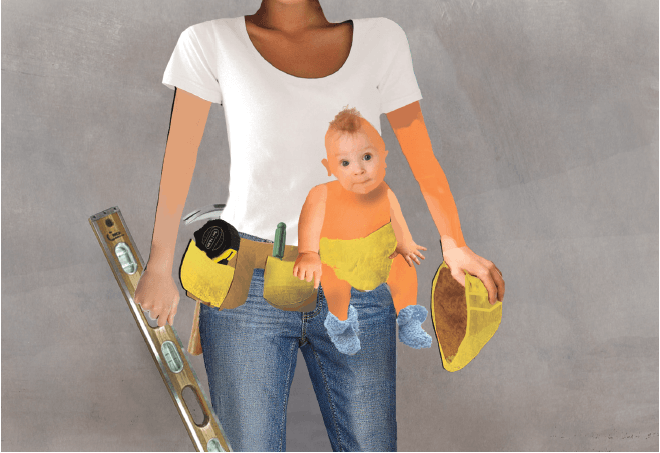
Illustration by Mariah Burton
Today’s skyrocketing daycare costs force many women to choose between work, children and poverty. Why Canada needs a national policy for affordable, accessible care
EMILY MLIECZKO HAS BEEN INVOLVED in the B.C.’s child care field since she was 19. Back then, she had no children of her own. “I just thought it would be a really nice thing to do,” she says. That was 22 years ago. Now, she has two sons, 19 and 16, both of whom grew up going to daycare. “I was a single parent who lived below the poverty level,” she says, “The support of my child care providers was one of the biggest assets I’ve ever had.”
Today, more than 75 percent of Canadian women with children under the age of six participate in the workforce—making child care an essential part of the labour puzzle. And yet, as Mlieczko says, Canada’s child care system is in crisis—and has been for the past four decades. High costs and few spaces in daycares across the country keep many mothers in poverty, at home or working several jobs, and federal and provincial governments have done little to address this. Affordable, accessible child care is a pressing feminist issue, but Canada is failing.
Mlieczko is now executive director of the Early Childhood Educators of B.C., and one of many fighting for more accessible child care. “Child care can cost more than post-secondary education,” she says. “There are some programs here in the lower mainland that charge close to $2,000 a month per child. That’s a lot of money.” Such fees aren’t unique to B.C. A recent report from the Canadian Centre for Policy Alternatives (CCPA) revealed some shocking facts about child care costs in Canada. The study, dubbed “The Parent Trap,” found that Toronto parents, for instance, spend an average of $1,324 per month on child care for their toddlers—often accounting for over a third of the mother’s income. This, too, is not uncommon. But think about it: that’s four months of labour to pay for a year of child care.
“The Parent Trap” is a stark on-paper reinforcement of something long known by child care advocates: the negative costs of child care mainly affect women. Child care costs are directly tied to women’s labour force participation, says David Macdonald, CCPA senior economist and co-author of the report. “The cost of child care has an impact on women’s labor force participation,” he adds, “but it doesn’t on men’s.” When child care costs are too high to afford, in other words, women, so much more often than men, stay home—even if they want to return to work. Others may be forced to work multiple jobs.
Even more simply put: child care costs keep women from working well. For example, 49 percent of women in Alberta cite child care as their reason for working parttime rather than full-time. These women, says Macdonald, are doing the same type of calculation he did in the report, which is: Does it make sense to go back to work? Would a woman pay more in child care fees than she would make working? Too often the answer to the latter question is “yes”—making the answer to the first a “no.”
Overwhelmingly, though, women want to work (a fact that should come to no surprise to anyone who isn’t living in the 1950s). The positive effects that affordable child care has on women in the workforce can be seen easily in Quebec. The province has been subsidizing early childhood education to $7 a day since 1997. As a result, child care costs are only six percent of a mother’s salary in Quebec City and Montreal, and only four percent of her salary in Gatineau. Women’s labour force participation in Quebec is eight to 12 percent higher than in provinces without affordable, accessible child care, according to a 2012 Université de Sherbrooke study. “It used to be that Quebec was significantly below the Canadian average in terms of labor force participation,” Macdonald says. “With the introduction of inexpensive child care, however, you see that Quebec has moved to slightly above the Canadian average.”
And yet, despite this success, few other provinces have broached subsidized child care. The federal government, for its part, has actually promoted policies that have the opposite effect. Take income splitting, for example. This allows families with children under 18 to split a household income of up to $50,000 for tax purposes, giving a tax benefit to the lower-earning spouse. Unfortunately, this is usually the mother—and, perhaps even more unfortunately, policies like this only reinforce the encouragement for her to stay home. As well, income splitting, a key part of 2014 Family Tax Cut, mostly helps higher income families. In fact, more than 85 percent of households won’t benefit from the plan, according to a 2014 report from the Caledon Institute of Social Policy. The CCPA calculated that the top five percent of families would gain more from this policy than the bottom 60 percent.
Feminists and child care advocates are not willing to accept such an outdated and unequal solution. Joined by progressives across the country, they are demanding a plan that will make child care more affordable and accessible for everyone. Mlieczko is one of those working to develop such a plan. With the Coalition of Child Care Advocates of B.C., she helped create the $10-a-day plan for B.C.—a concrete solution to tackle this growing problem. The proposal, first introduced in 2011, would subsidize child care in B.C. to $10 per day for full-time care, and $7 for part-time care. It would also make child care free for families with an annual income under $40,000.
While initial supporters were mainly other mothers and those in the progressive political sphere, the $10-a-day plan is now receiving increased support from the business community, whose members are finally starting to realize that not only is affordable child care good for women, it’s also good for the economy. “This will actually stimulate the growth of the economy,” says Mlieczko. When more parents are able to work, more jobs are created in the economy. It’s just basic math: Subsidized child care more than pays for itself in the aggregate, adds Macdonald, as the additional income tax gained is greater than the cost of the program.
Still, provincial governments are reticent. Under the current strategy of provincially-subsidized child care, provinces arguably don’t reap the benefits. Quebec, for example, spends most of the money to pay for child care, but the federal government sees most of the benefit in increased income tax. This weird balance can give provinces little incentive. To change this, argue advocates, Canada needs to treat child care like other social services; it needs a national child care plan. Just like with health care, say advocates, the federal government could work with the provinces and split the costs, leaving the provinces to implement the services.
Many hope the looming federal election will lead to more interest in a national child care policy. It certainly seems likely. The NDP has recently announced a $15-aday plan as part of its platform, though the Liberal plan remains unclear. Meanwhile, the Conservative government has increased the Universal Child Care Benefit. While this will provide parents with a few extra dollars, it won’t make child care more accessible or more affordable.
It’s now been 45 years since the Royal Commission on the Status of Women first recommended a national child-care program, and yet little has changed outside of Quebec. “It’s time for us to do this,” says Mlieczko. “We’ve seen other countries do this. We’ve seen other provinces do this. We’ve seen the success of Quebec and other provinces that are moving towards helping families, and I think every family in Canada deserves to have that kind of support.”
]]>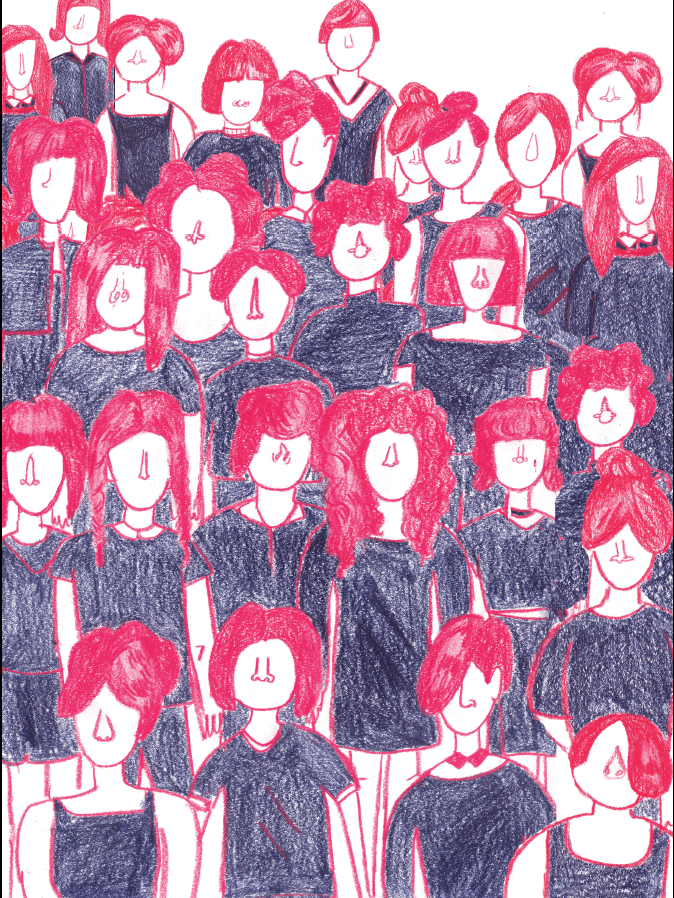
Illustration by Alisha Davidson
Mainstream white feminism preaches a privileged, exclusive, saviour-based model. And it’s time for it to go
MY FIRST INTRODUCTION TO FEMINISM was through Tumblr. At 17, I opened an account, and began the search for feminist blogs. As I tumbled through, I landed on the same images and topics: body hair growth, sexual liberation, pastel-coloured hair, flowers photoshopped onto women’s bodies—they all seemed to be at the forefront of feminism. Topless protests were the ultimate key to freedom. I was drawn in by the fierce vibrance of it. Yet, as I absorbed it all, I began to realize many of these women weren’t just interested in leg hair and periods. They were interested in saving a certain kind of woman: me.
It made me feel increasingly self-conscious: I wondered whether I did, indeed, need saving. Did I need to rely on white women for “real” freedom, as all those Tumblr posts seemed to suggest? After all, according to mainstream white feminism, I have all the hallmarks of an oppressed brown woman who needs saving. I’m a Middle Eastern and South Asian Muslim woman of colour who can, apparently, only find liberation through the West. I am part of a misunderstood, over-exotified culture, part of the mystical backwards Orient where women are subservient and trapped.
These ideas are both true and untrue. I am a woman facing oppression, from my own culture and from Western culture. But what saved me and liberated me wasn’t the topless protests of FEMEN, or white feminists in flower crowns, but rather other women of colour, who showed, despite all the ideas put forth by white feminism, that they did not need saving from the West. They had saved themselves.
This isn’t, on the whole, an idea that white feminism likes. Through social media sites, in particular Twitter, women of colour have pushed criticisms of white feminism to the forefront of public discourse. With stars such as Taylor Swift, Emma Watson, and Lena Dunham acting as the new faces of feminism, feminists of colour have become more and more aware that the mainstream form of feminism just doesn’t represent them—or any other marginalized groups for that matter. And white feminists have largely not taken this criticism well. Today, there is an obvious divide in feminism, and constant tensions within the movement of which feminism is “real” or “fake.”
The question, of course, is: What exactly is white feminism? Is it feminism practiced by exclusively white women? No. While many white women do subscribe to white feminism, they are not the only ones who do. White feminism, essentially, fails to acknowledge the intersections of race and gender. For example: it’s commonly lamented that women—as in all women—make about 77–82 cents for every dollar that a man makes. But that’s only white women. Black and Hispanic women make even less, 69 cents and 60 cents, respectively, for every dollar that a white man makes. While patriarchy is toxic to women, women of colour face the double burden of patriarchy and white supremacy, which have intrinsically throughout history gone hand-in-hand though processes of colonization. And, too often, that fact is ignored.
“White feminism works on the assumption that all women are equally oppressed,” says 23-year-old Kenyan-Canadian Truphena Matunda who is currently studying journalism at Sheridan. “The power structure within white feminism puts the concerns of Western white women before any other group,” Matunda adds, “often leaving issues concerning women of colour out of the conversation completely.”
Black women were the first to identify the idea of intersectional feminism, the term initially coined by academic Kimberlé Crenshaw. “Contemporary feminist and antiracist discourses have failed to consider intersectional identities such as women of colour,” says Crenshaw in her 1989 essay “Mapping the Margins: Intersectionality, Identity Politics, and Violence Against Women of Colour.” Intersectional feminism is a type of feminism that focuses on the multiple oppressions people face: gender, race, sexual orientation, gender identity, class, disability, and so on. While the mainstream feminism holds high the heroic actions of North American suffragists, for instance, many black feminists have accurately stressed suffragists were only fighting for the right for white women to vote.
“White feminism dehumanizes racialized women by ignoring and erasing the voice of women of colour,” says Matunda. “It passively reaffirms ideas that whiteness and white opinions are the only ideas that really matter.”
This makes me think not only of my ignored experiences, but also of the women in my family and their erased voices—one of my aunts in particular. She wears hijab and abaya. Conventionally-speaking, herimage could be used as that of the oppressed Muslim women, doomed to a life of subservience to men. But my aunt has been skydiving and has scaled Mount Kilimanjaro; she is an educated woman with a great job, who hiked for days through the English countryside alone. Does she sound oppressed to you?
I think also of my mother. She moved to Canada with no connections and two young children to raise. She was able to make the transition from full-time housewife to full-time managerial work without the network a first- or second- generation Canadian white woman would have. In an unfamiliar country and culture, my mother thrived—not from having a white saviour, but from her own relentless hard work. (And let’s just say that whenever I went to my father asking if I could go to a friend’s house, his first words were always “go ask your mother.”)
And the truth is, in white feminism’s attempt to save women of colour, they have done the opposite. Their pursuit to save women of colour oppresses us further; it erases our lived experiences of racist and sexist discrimination. By insinuating that women of colour need saving, white feminism has undermined our capability to liberate ourselves through our own means. Whenever I see white feminists looking to the Middle East, I wonder why they are forgetting to look at the sexism within communities here. Women here struggle with domestic violence, with rape culture, with discrimination in the job market, with daily microaggressions. Why are we looking across oceans to fight oppression, when oppression is alive and well in Canada?
As someone who comes from both worlds, I often feel torn in two. I have seen and experienced the repressive attitudes of the Middle East, but most of my life has been spent in here, in Canada, nestled within assumed superiority of the West. The sexism I experience on a day-to-day basis is here. I’m not the woman on the cover of your average Orientalist novel, shrouded in the black veil, silhouetted by the orange glow of the desert’s setting sun.
“Before becoming an intersectional feminist I was a white feminist despite my ethnicity,” says Tina Cody, a 22-year-old economics grad student at University of Toronto. Cody is Iranian, Irish, and French- Canadian. “It takes a lot more subtlety and nuance,” she adds, “to recognize the other intersections that impact one’s daily life, like race, sexuality, and ability.” Identifying those other intersections is in the subtleties; it requires looking beyond simplistic ideas of man versus woman.
Like Cody, I also once identified with white feminism. When I first entered the world of feminism, I did believe I was escaping the dangers of the Eastern world, into the more accepting, more vibrant realm of the West. It was like a fairytale; shedding Islamic verses to enter this North American utopia of full women’s equality, mini-skirts, and proud pink banners. The aesthetic itself makes it appealing, a feminism that seems lovely and uncomplicated: men are pushing us down, women must unite and rise up.
But this polarized Western feminist narrative is doomed by its own simplicity. Everywhere, women who face layered oppressions like racism and sexism, for example, realize that women’s equality is a highly complicated matter: one that must look internally within women themselves and ask difficult questions. Do some women have advantages in life that others don’t have? Are some women benefiting from the system that they outwardly seem to be against?
For 16-year-old New York high school student Tasmi Imlak, expressing criticism of white feminism has even resulted in backlash. “As a Twitter user, when voicing my opinions about intersectional feminism, I am often attacked by white feminists,” says Imlak. I know what she means: As much as Twitter has started conversations, it can also shut them down. These online spaces are conflicted with both external harassment from feminists who are not intersectional, as well as internal, personal conflicts.
I have been deeply let down by feminists that I once idolized, only to discover that they have contributed to the erasure of experiences of women of colour. White feminists donning Om earrings and bindis follow me, failing to realize that such cultural appropriation is offensive and utterly toxic to a woman of colour like myself. And when Imlak criticized Emma Watson’s speech on feminism, feeling that it was too male-orientated, she received backlash online from white feminists.
She says she feels her opinions are often undermined because she identifies as a Muslim and a feminist, an idea that many white feminists believe is not valid. “Women of colour have to make their own spaces,” Imlak says, “because we are not valued within white feminism.” When these spaces are formed, they can work well. Angry Women of Color United, a Tumblr blog, is one woman of colour centred space that has succeeded. As the name suggests, it’s meant to be entirely focused on the voices, questions, and concerns of women of colour. White users are welcome to follow the blog, but are asked to not engage in any tone-policing, or send repetitive questions seeking to be educated by the moderators of the blog.
Spaces with other women of colour have helped me progress my ideas of feminism. Intersectional feminists have helped me come to terms with my own conflicted identity, and opened my eyes to the struggles of women who do not have some of the privileges that I do. And, despite the backlash women of colour often face there, social media networks have become valuable. On Twitter, for example, intersectional feminists also form bonds with each other, creating a special cyber space where they can talk about their unique experiences. It shattered my initial unwavering trust in the movement to realize that feminism is a divided and complicated ideology. Internal strife within feminism is rampant, as white heterosexual, cisgender, ablebodied women remain the default of the movement, while women with marginalized identities find their efforts and voices driven to the back.
Yet in some ways, white feminism has its benefits. Like Cody and myself, Matunda also was introduced to feminist ideas through white feminism—an easy and non-threatening way to start immersing oneself in feminism ideology. “Although there is a lot of things I find wrong with white feminism, I do think it is a gateway to feminism,” says Matunda. “I will admit that I did prescribe to white feminism when I started my journey.” Matunda says she landed on her intersectional beliefs after she began to feel frustration with white feminism, and began the search for something better. “I did this because I’m black and I felt ignored.”
The catch is that you have to face the reality of white feminism’s downfalls, and the subsequent disappointment, in order to start branching out into a more intersectional ideology. Intersectional feminists have helped me relieve the inner conflict I faced when I first entered the world of white feminism. They have helped me understand that I don’t have to shed my entire identity to be a perfect feminist, or go against my own culture to be pro-women’s rights. I realize now that my liberation is not necessarily the same as a white woman’s liberation, and that I do not have to be a woman seeking a white saviour, but one who can find freedom for myself and other women of colour.
This is an immensely freeing idea. It is one that shatters default ideas of feminism, and allows me the freedom to practice a feminism that takes into consideration the intricacies of my identity and the particular oppressions I face. Feminism is not a one size fits all concept. White feminism robs women of the choice to tailor their feminism to their needs and lived struggles. Intersectional feminism gives us the opportunity to tweak our feminism to have a personal understanding of our stories. And that is the definition of true liberation and equality.
]]>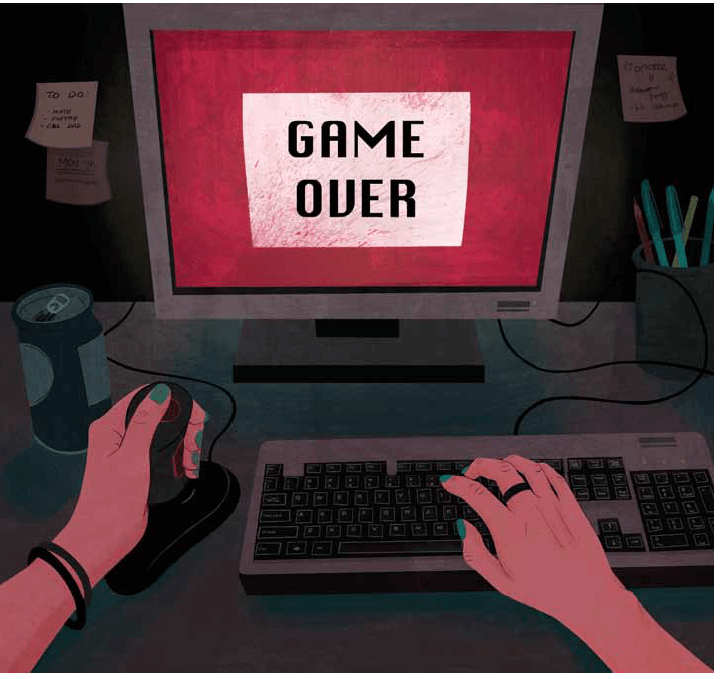
Illustration by Kris Noelle
The feminist battle for Gamergate victory isn’t done
When it comes to feminism and Gamergate, I want to say that feminism—unquestionably—won. But then I think: at what cost? Maybe it’s better to say: we know unequivocally we are on the right side of Gamergate.
There was a Mission Accomplished moment in October 2014, when the New York Times published an article that seemed confused about what Gamergate was and why it was happening—not in a fumbling, tech-illiterate sense, but more of a sense of incredulity. The writer, Nick Wingfield, appeared to be saying: “So you’re harassing women … for liking video games. Huh.” The article was published right after Anita Sarkeesian, a feminist critic best known for her YouTube series “Tropes vs. Women in Video Games,” cancelled an appearance at Utah State University after she received an anonymous threat of a shooting massacre were the talk to go ahead (as a concealed carry state, security at the event could not guarantee no one with a gun would be allowed in the building while Sarkeesian was speaking).
Sadly, Sarkeesian has long been the target of sexist attacks—ever since she first launched a Kickstarter campaign in 2012 to support the series. “The threats against Ms. Sarkeesian are the most noxious example of a weeks-long campaign to discredit or intimidate outspoken critics of the male-dominated gaming industry and its culture,” Wingfield wrote. New York Times may have been removed from the specifics and scope of the Gamergate conflict, yet it was clear the only response could be “this is baffling and terrible.” As an outsider’s perspective, it was invaluable and it illuminated something that was at once crucial and deeply disheartening: that it was even more terrible, and equally baffling, for the women caught up within Gamergate—we are on the wrong end, in the middle of something incomprehensible and horrific. And since October, Gamergate has only become more ridiculous.
Even former avowed Gamergaters have hung up their trilbies and abandoned their positions as everything became more extreme and untenable—or they suddenly found themselves on the opposing side of the harassment campaign. Those within the industry openly made statements against Gamergate, including: gaming companies such as Blizzard and the Entertainment Software Association (commonly know as the ESA and gaming’s top trade group); publications like Game Informer, Polygon, and Giant Bomb; and creative luminaries such as Tim Schafer and Damion Schubert. Some statements where measured, like the ESA’s assertion that “There is no place in the video game community—or our society—for personal attacks and threats.” But others weren’t. Schubert called it “an unprecedented catastrofuck,” which remains one of my favourite combinations of words ever. Even the vaguest of questions about the legitimacy of the movement seemed to evaporate.
And yet—and yet—it is still happening. On January 11, Zoe Quinn wrote a piece called “August Never Ends” on her blog Dispatches from The Quinnspiracy. It charted her struggles to get the legal system to do something about the avalanche of hate spewing her way. She talked about how demolished her life was and continued to be by the campaign. She wrote, in full: “The same wheels of abuse are still turning, five months later. I’ve been coming to terms that this is a part of my life now, trying to figure out what to do about it, and how to move forward with so many people trying to wrap themselves around my ankles. It’s been hard to accept that my old life is gone and that I can never get back to it. But I’ve found purpose in the trauma, in trying to stop it from happening again, to use my experience to show how these things are allowed to happen, and to further a dialog on how to actually stop it. If I can’t go home, maybe I can at least get out of this elevator shaft. Maybe I can help end August. Maybe you can, too.”
As much as there is hope here, and grim determination, and a strength of will that is barely fathomable, there is also so much pain and loss. Quinn’s piece is not the sort of thing that gets written looking back on a hard and well-fought victory—it’s the barest beginning, starting to see the light at the end of the darkest tunnel, the way out of the elevator shaft. Quinn has since gone on to found Crash Override Network, an anti-harassment network that attempts to help victims of Gamergate rebuild their lives and careers after the threats, doxing, and sabotage—a way to provide the support Quinn found lacking in the community. Today, she is taking the extra step to help others. That is victorious. That is what willpower is.
But the cost—my god, the cost. Crash Override Network and services like it are necessary. Certainly, people are going to be suffering the ramifications of this trauma for years, if not their entire lives and careers. In the games publication Giant Bomb’s discussion forums, game developer and tech writer Brianna Wu wrote “I was talking to Zoe Quinn this week, who told me about a folder on her computer called, ‘The ones we lost.’ And it was young girls that wrote her saying they were too scared to become game developers. I started crying because I have another folder just like it.” Wu went on to excoriate those who had not yet spoken out about Gamergate or who were not actively making policies to hire, support, and defend the women targeted, stating “I would suggest every man in this industry has a hell of a lot of soul-searching to do about the part they played in creating this situation.”
For every visible woman who has stepped away from their platform, how many less vocal or less well-known participants have we lost? In the wake of Gamergate, for instance, Kathy Sierra, a tech writer who was once the target of hacker and horrible person weev, walked away from the online persona she’d built as Serious Pony to insulate herself from further violence. Jenn Frank, who had built a nine-year career out of writing about games and was deluged with hatred for a Guardian piece about how women in the games industry are attacked, announced publicly that she was leaving the industry out of fear for her family’s safety. How many young women have chosen not to enter the industry at all? How many game developers have left the industry? How many journalists? How many women stopped participating in online communities and massively multiplayer online and co-op games? How can we possibly know the real numbers of the ones we lost?
The thing is, we can’t. It’s going to take years to sort out the impact on the industry, on the community, on the way games are made and played. Years before we figure out what games journalism can possibly look like in a post-Gamergate world. Years before we can even begin to get a grip on the personal trauma suffered by so many after such a massive campaign of harassment and violence. And before any of that work can be done, Gamergate has to end first. It’s an inevitable victory, perhaps, but one that’s going to leave deep, presently unfathomable scars.
]]>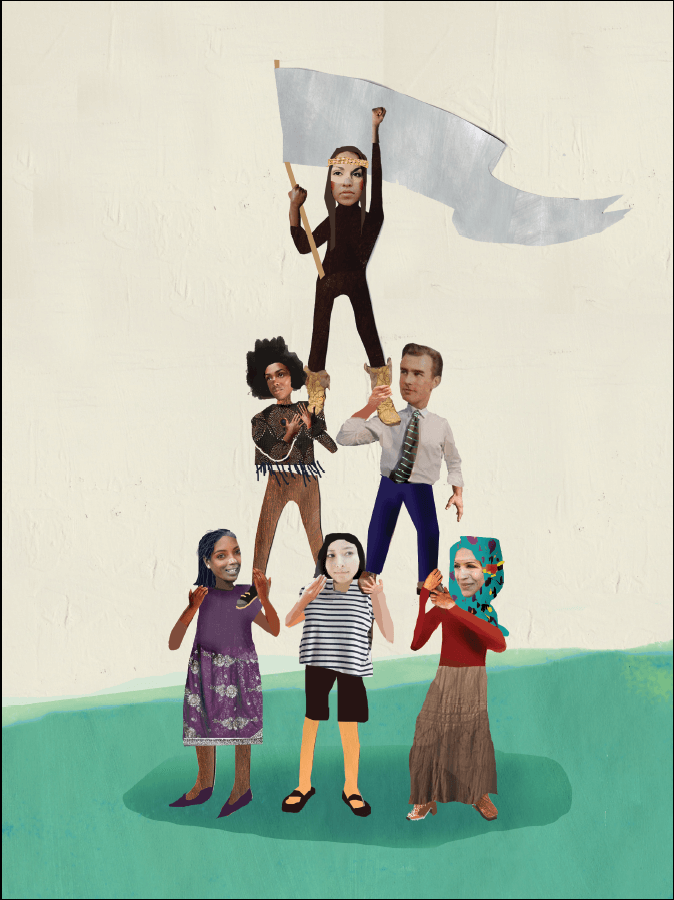
Illustration by Mariah Burton
Where do men belong in feminism? Hillary Di Menna tackles the thorny question of what it means to be a strong male ally—and whether women really need them
SOMETIMES I CAN’T DECIDE where men fit into feminism. On the surface, it seems like such a simple, yes-or-no question: they either belong or they don’t. But whenever I confront the question, I always end up surrounded by books with my feet propped up against the cat-scratched arm of my should-be-trash couch. This is what happens when my emotions get in the way of understanding feminism. Or, maybe understanding feminism is meant to be a journey. Something I know as fact one day is an enigma the next. On the subject of feminism, my brain is constantly turning, my thoughts are jumping all over, rushing ahead, sometimes so fast that I can’t keep up.
Recently, I wanted to post a quote by Michael Kimmel, author of Angry White Men, as a Facebook status. Kimmel is a sociologist and author who eloquently describes feminist concepts—even those unfamiliar with feminist jargon dig him. But I let my fingers pause, hovering over the keyboard. I just couldn’t shake the tiny, but persistent, voice inside me demanding to know why I was quoting a man. Was I trying to hush personal insecurities by proving men can be feminists too? Did I just want to prove we feminists aren’t man-haters? Or was I using a man’s words to appeal to other men? Why did I even want to appeal to men? And, if I did quote Kimmel, would I be furthering the awful belief that a man’s words have more validity?
In the end, my questions crushed me into inaction. I continue to read Kimmel’s work, but I’ve never shared his direct quotes. I can’t stand the knowledge that his words would be heard over a female feminist’s. But that’s not to say there isn’t a place for men in feminism. I mean. I think. Right?
It’s like this inside my head whenever I tackle this tough question: How do men and feminism fit together? Or do they? Can they? I was 24 when I went to school for journalism. At the time, I was in the court system fighting for custody of my daughter. I was also getting a restraining order against her father, as well as navigating the mental health system. I felt trapped in these institutions of a patriarchal system: I was victim blamed; I wasn’t taken seriously; people would suggest I was hysterical and incapable. I decided I’d use journalism to spread messages of social justice. I’d had enough. I figured if I was so shocked by how the system actually works, others would be too.
It was through my writing that I started to identify so strongly as a feminist. Financially, the year after graduation was hard. Single moms have a stigma attached to them that prevents them from finding something as important as an apartment to live in, and limited affordable child care resources can prevent finding steady employment—especially when those child care hours don’t mimic the same hours as the shift work women are prone to getting. In September 2014, I decided to go back to school and enrolled in the Gender and Women’s Studies program at York University. I wanted to better understand a system that seems to hate me, and all women, so much. I wanted the tools to change it—or at least something that would give me more information to share with others.
I quickly learned, though, that there is no clear answer—only more questions. I’m now thinking even more critically about what I’ve learned about gender in the first place. As a white cis-gendered woman in a certain place of privilege, there are things I knew about, but didn’t fully comprehend: the ways in which trans people can be doubly silenced, the complexities involved with socially-constructed races, the ways in which women of colour may not identify with the feminist movement I, as a white woman, have access to. As my list of questions grows, I find it even harder to pinpoint exactly where men fit into all of this.
I know there are, of course, feminist issues that people of all genders care about: national child care programs, legal protection for sex workers and their clients, addressing rape culture—I could go on. “Feminism doesn’t mean advocating only for women any more than the word ‘human’ only refers to men,” says Dr. Kristine Klement, one of my professors at York. “Feminism means recognizing that we live in a world where sexism and inequality exists and deciding to take responsibility for changing it.”
And, it’s not as if only women understand or experience oppression—this essential piece of humanity, I know, is what can make men good allies in the movement. It could even make them good leaders. “The different layers of who I am come into play,” says Jeff Perera, explaining how he strives to be a strong ally to women-identified people. Perera is the community engagement manager for the White Ribbon Campaign, a movement of men and boys that works to end violence against women and girls. “I am a man of colour, I grew up around domestic violence, I am someone who has always been more tuned into seeing what experiences are like that women have to deal with.”
Perera certainly possesses a quality that makes him empathize and listen. During one of our first conversations I mentioned how much harassment I face while taking public transportation (getting pushed around, cat-called, having my ass grabbed). He didn’t play the macho role, as so many men do when women relay these experiences (see: letting us know if they were there they would beat up our harassers). He didn’t try to avoid the potential awkwardness my revelations could lead to, nor did he make it obvious he was just waiting for his turn to speak. Instead, he asked me what I had to go through, and how it made me feel. He genuinely wanted to know. This can be such an uncommon experience, I was actually taken aback.
“Women are leaders in articulating their struggle, lived experiences, and empowering themselves,” Perera says. His campaign focuses on men, and the harmful ideas out there in regards to masculinity and how it can result in violence against women. This is how Perera is a good ally. “I feel for men and young men,” he adds. “It’s more about embracing the roles they can play to take on harmful masculinity in spaces we, as men, work, love, play, hang out, and worship in.”
In summer 2014, Perera spoke at SlutWalk Toronto. My best friend and I were holding the walk’s official banner behind the speakers as a backdrop. Already feeling emotional and empowered, I was elated to hear a man who “gets it.” I frequently cried “Yes!” and cheered as he spoke. After getting to know Perera, I know my feelings and enthusiasm for his words were genuine, because I know he is genuine with his intentions of being a strong male ally. Still, after the event, I asked myself: “Why did it matter so much to me that a man said those words, when so many woman have been screaming them for decades?”
SlutWalk co-founder Heather Jarvis says the event usually has one male speaker to acknowledge male victims of sexual abuse. In fact, the walk has always been gender inclusive and Jarvis believes there is room for male-identified people within the feminist movement. “With any form of oppression,” she says, “one side can’t do all the work.”
Certainly, I have male friends, family acquaintances, and colleagues who identify as feminists. One of those men is Matt, who lives in Toronto (and asked I not use his last name). As a gay man, Matt faced traumatic homophobic bullying throughout high school. “I was called a ‘faggot’ daily,” he says, “and this was especially true during PE class where I failed miserably.” Matt believes a fundamental component to feminism is recognizing that life is regulated by oppressive gender norms, but that oppression is not identical in all groups. At the same time, he says he still benefits from male privilege—in more ways than one. “So, when I call myself a feminist I am striving to understand gender oppression and challenge it,” he adds. “This is also why I am an ally.”
Wanting to learn more about feminism, Matt decided to sit on a committee focusing on feminist issues. In 2011 he joined the Feminist Action Committee of the Greater Toronto Worker’s Assembly, an anti-capitalist, worker-based organization. The committee primarily sought to apply a feminist analysis to the assembly’s organizing, but was open to all genders. Matt was the only man. “I had a vague identity as a feminist but was completely naïve to what that actually meant in practice,” he says. “The committee helped me to understand.” He—rightly—stood back from the spotlight, during meetings opting for tasks such as minute-taking, allowing the women in the committee to focus completely on what they wanted to accomplish. At a similar meeting I attended, a man provided child care for my six-year-old daughter. Both of these tasks, child care and minute-taking, have been traditionally assigned to women. When men alleviate the pressure to do this work, they are allowing us to have a distraction-free space to discuss issues and prepare solutions.
Tracy Ashenden, front woman of feminist punk band Cross Dog, agrees men can be productive allies, and uses the example of stepping in when seeing street harassment. “If you witness this, as a male, say something,” she says. “Put a stop to it. Do work by putting yourself in the position women are likely unsafe to put ourselves in.” Feminism is about equality, Ashenden adds, but it’s also important to remember social justice is about empowering the marginalized group—in this case women. When men speak for women or take the lead of feminist groups, they are enforcing their power and their dominant position; they are not providing any productive support. It is more important for a man to behave like a feminist than to identify as one. As Ashenden quips: “Hero cookies will not be given out here.”
If anything, we need men as allies, if only to promote feminism to other men. It is frustrating and emotionally draining for a member of any oppressed group to explain the oppression they feel to the dominant group. My own experiences never seem to be enough. It isn’t enough, for instance, when I share that I have been emotionally, physically, and sexually abused by men since childhood. I have to eloquently explain how these things affect my life (things I haven’t even fully figured out). I have to prove how, statistically, my experiences are actually common. And I often have to explain these experiences to people who often cannot fathom them as part of their own lives. A man may dismiss a cat-call—but he doesn’t know how many of us women have learned they can be signs of violence to come. Some men may not understand how the system fails, shames and blames us for our own sexual trauma. Feminist activism is already hard work, and I simply don’t have the stamina needed to prove injustice exists in the first place. When a man takes on the role to educate other men, it helps women conserve their energy to focus and progress on their own terms.
In many ways, it seems natural to be open to male allies and men who identify as feminists, whether they are marching side-by-side with us during the SlutWalk or respectfully staying to the side in solidarity at a Take Back the Night march. But I also have some worries. Some men have mansplained feminism to me. Others—men close to me who claimed to be feminists—have assaulted women. And, what about Hugo Schwyzer, a male feminist-identified writer who turned out to be abusive and racist toward women of colour? Ally is a wily word. It sounds friendly enough. It communicates the message efficiently enough: someone who is supporting an oppressed group. But like the title feminist, it can be abused. A male friend of mine won’t use the word. “I don’t like the term ‘ally’ because I think it implies an ability of those who are allies to wash their hands of their position of privilege,” he says. So he identifies as a feminist, “I see it as one way to hold men accountable,” he adds, “so they can’t just wash their hands of it once they get uncomfortable.” And as Perera says of privilege, we need to get comfortable with the discomfort: “We need to do that initial gut check, address the ugly things we find, and continue to own up to mistakes.”
That includes my privilege. As I examine how men fit into feminism, I feel compelled to confront my own cis-privilege and the dangers of binary thinking. There is a broad spectrum of gender —making it near impossible to look at the question of allyship in the simple terms of men versus women. And, to that point, if we’re talking about what makes a good ally, shouldn’t we also ask: What about women feminists? The white women who ignore women of colour? Or women-only groups that are not trans inclusive? Many female feminists don’t know how to be good allies either—and they aren’t feminists I want to align myself with.
In my feminist advocacy work, I’ve often heard that the word feminism should be pluralized. There are so many branches: social feminism, radical feminism, ecofeminism, and on. As Jarvis told me, no individual can own language, just as no singular group can claim feminism. Language can serve as a bridge and a barrier. If more people—men, women, and trans—identified openly as feminist, perhaps it wouldn’t be seen as such a dirty word. And, the pressing issues women face today won’t be solved with me running around making sure everyone identifies properly as a “feminist” or “ally.”
After all this is done—when a system that favours one gender over others is abolished—we won’t need to focus on whether men should be in the feminist movement. But until then, we all need to sit on our own versions of our should-be-trash couches, get out there, and constantly ask questions, continually evaluate our goals, and act toward progress in gender equality. What’s truly important is that women obtain not just a voice, but an influential one. I want us to be seen as people the way men are. And if men can help play a role in this, I want them on the women’s rights team—knowing it is a women’s team.
]]>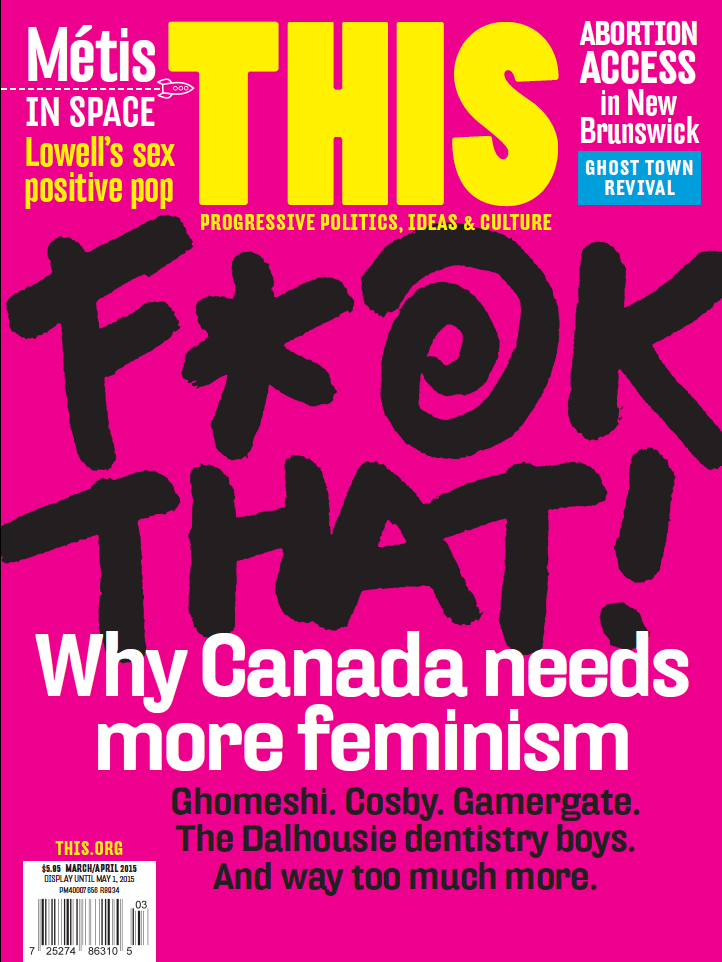 Our March/April issue is now on newsstands, and we’re super excited. Check out the editor’s note from Lauren McKeon, where she shares our motivations for publishing the issue, and also what you can expect to see inside its pages and online at this.org!
I cannot remember a time when I didn’t identify as a feminist. From the moment I first heard it, the word feminist fit me like the perfect pair of jeans. I learned it as if by osmosis, the way geese know to migrate south for the winter or dogs to bark at strangers. I know many people who feel the same way I do, and many who don’t. Some days, lately, I’m not sure which side has the higher tally.
Feminism has taken over our national conversation and the results are both encouraging and discouraging. As feminists get more ink and airtime, so too do anti-feminists—our current clickbait-centred media culture ensures it. We debate merits and viewpoints, all the while obscuring this pervasive attitude that women’s life experiences aren’t worth being taken at face value. It’s not enough to simply testify these things are happening to us, to say we are oppressed, abused, and disadvantaged: we must prove it. Again and again and again.
Well, f*@k that. Here at This Magazine, we believe Canada needs more feminism—now. In this issue, we also give a big f*@k that to the popular culture that fostered Jian Ghomeshi, Bill Cosby, and the boys at Dalhousie’s Dentistry school; the one that cultivated mansplaining, manspreading, and street harassment; and the one that encourages apathy toward threats to abortion access, the pay gap, and our country’s Indigenous murdered and missing women.
But it’s not all raised fists: We also explore what we need from feminism now, and ask the tough questions: Is feminism too middle-class and white? (Answer: Yes. “The trouble with (white) feminism” by Hana Shafi) Where do men fit into the movement? (“Allied forces” by Hillary Di Menna) Does hashtag activism work for feminism? (“#Feminism” by Stephanie Taylor) And more.
While we can’t cover all the myriad ways in which we need more feminism, we hope this issue can add to our great Canadian feminist conversation, as well as spark a few new conversations. Because now, perhaps more than ever, we need to examine the current state of—and need for—feminism. We need to look at what we can do better. So, please, pick up up a copy of This and stay tuned to this.org and, where you can join us in saying, “F*@k that.”
Can’t find This on newsstands? Contact publisher Lisa Whittington-Hill at [email protected]
]]>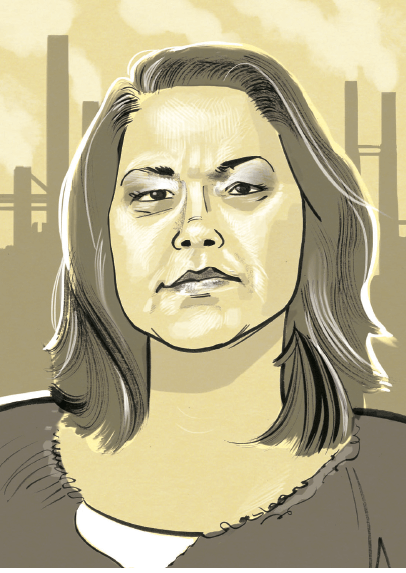
Illustration by Nick Craine
Fearless environmental activist Ada Lockridge leads her First Nation’s charge against oil giant Suncor
ENVIRONMENTAL ACTIVIST AND RABBLE-ROUSER Ada Lockridge is the recipient of many whispers. Through her work trying to stem the petrochemical pollution surrounding her home of Aamjiwnaang First Nation, she has become equal parts private detective and confessor. Whether it’s a plant worker letting her know about an industrial accident or an apology to Aamjiwnaang for bearing the brunt of the area’s pollution, Lockridge is frequently told things in a hushed voice.
Over the past decade, she has found ways to turn those whispers into a sustained campaign of environmental activism. Her history of getting things done has made her a fixture at community meetings and provided her insider access to CEOs and government officials alike. Whenever she meets someone important she likes to jokingly ask, “Are you sure you want to give me your number? Because I will call you.”
Her latest battle is with the Ontario Ministry of the Environment and oil giant Suncor—and it’s one that will take all of her dogged persistence to succeed. In southern Ontario, more than 60 petrochemical facilities are clustered along the St. Clair River south of Sarnia, earning it the nickname Chemical Valley. In the middle of this valley is Aamjiwnaang. The area around Lockridge’s home was one of the first in North America to have its oil reserves exploited. In the 1850s, companies such as Imperial Oil got their start in the new market. The neighbouring town of Sarnia became a hub for the fledgling industry thanks to its proximity to both oil reserves in towns like Petrolia and Oil Springs, and the Great Lakes waterway. With the concentration of facilities came pollution and new health problems for local residents. Lockridge describes the pervasiveness of illness in the community saying, “When someone around here is sick, we ask ‘What kind or cancer do you have? How much time do you have?’”
So when Lockridge and her fellow Aamjiwnaang community members heard in 2010 that the Ministry of the Environment had approved a 25 percent increase in production at Suncor’s desulphurization plant, they decided they’d had enough. It was time to do something. Together with her neighbour Ron Plain and the national non-profit Ecojustice, which mobilizes lawyers and scientists to defend Canadians’ right to a healthy environment, Lockridge decided to launch a legal challenge against Suncor and the ministry.
The case, often dubbed the Chemical Valley Charter Challenge, is part of Ecojustice’s right to a healthy community campaign. If successful, it could see a radical change to the permitting process for industry. Essentially, Ecojustice lawyers argue the ministry broke the law when it green-lighted Suncor’s increased production. The ministry, they add, failed to consider two main factors: the cumulative effect of the industry’s emissions, which they say violates both the “right to life, liberty and security of the person” enshrined in the Canadian Charter of Rights and Freedoms, and also the “right to the equal protection and equal benefit of the law without discrimination.”
The latter largely refers to Lockridge and Plain’s status as First Nations community members. As Kaitlyn Mitchell, an Ecojustice lawyer working on the case, says: “Ron and Ada have particular ties to their community, so it’s certainly not easy to just get up and move.” The ministry, she argues, is not recognizing the First Nations’ connection to the reserve lands—something she, and others, believes constitutes an act of discrimination.
To date the lawyers have submitted over 2,000 pages of supporting evidence (about everything related to environmental health, cumulative pollution, and the vulnerability of people living on reserve), as well as defended against Suncor’s attempt to have the case dismissed. Much of 2014 was spent cross-examining the 19 witnesses sighted.
While the Suncor case could prove monumental, it’s far from Lockridge’s first act of environmental activism. She harkens back to 2002, when Imperial Oil had a major “process-upset” that caused a sand-like catalyst to spew from their emissions stacks. The cloud of industrial pollution was blown south from the plant, across Aamjiwnaang, to the neighbouring town of Corunna. This was the first time Lockridge decided to do something. After the accident and the subsequent struggle to have Imperial Oil include Aamjiwnaang in their cleanup plan, Lockridge decided she could no longer be passive. She dedicated her evenings and weekends to fighting against the constant pollution around her.
In the first few years of her activism, Lockridge learned how to do air sampling using filters on plastic buckets, compiled data for researchers, and worked with biologists, such as Dr. Michael Gilbertson from the International Joint Commission (a Canada/U.S. government initiative that investigates issues related to the countries’ shared waterways). Together, she and Gilbertson re-examined a 1996 Ministry of the Environment study which was completed three years after Suncor had a large on-site accident. The ’96 study showed high levels of mercury in area plant and marine life—a startling discovery that caused Gilbertson to wonder how such things might affect the community’s birth ratio. Similar compounding questions arose as more studies were completed. Eventually, Lockridge began to wonder“My god, what did we start? I think there’s more to it than we realize.”
Although Aamjiwnaang has many forested areas, it’s the countless smoke stacks and flares that dominate the horizon. Among these stacks are warning sirens, which send the alert of an accident, usually resulting in an increased amount of pollution being released. Some of the factories are so close to Lockridge’s house that she hears their sirens and sees workers running to their cars—how can the danger possibly be contained within the company’s chain-link fences? Since 2004 Lockridge has been keeping a detailed calendar charting the “releases” and “upsets”, as the industry euphemistically calls them. In the decade since she started keeping track, she can count only two months without a notation; some months show as many as 15.
Even when the sirens are silent, government-approved emissions from many of the plants contain a host of toxic chemicals, the exact make-up of which is kept from the public (it’s considered a trade secret, and thus protected). Although the individual emissions of each of the 60-plus facilities are within the Ministry of Environment’s parameters, many, like Lockridge, believe the cumulative effect poses a serious problem.
High levels of mercury have been found in the blood, hair, and urine of some Aamjiwnaang members, and a community-led body mapping survey showed asthma levels in adults and children far exceeding that of the surrounding communities. In 2005, prompted by Gilbertson’s questioning on mercury effects, Lockridge co-authored a study of the on-reserve birth ratio. The result? Since the mid-’90s, two girls were born for every boy, helping to explain why there were so many girls’ softball teams in Aamjiwnaang. Many scientists believe that endocrine-disrupting chemicals such as toluene and benzene are the probable cause of the skewed ratio. These chemicals are frequently emitted by the area’s industrial neighbours. But it’s challenging to establish a baseline for air quality testing in the area, says Lockridge.
She once took a sample on what seemed like a clear day—one where there had been no recent sirens—but even that “good day” sample recorded low levels of carcinogens. Frequently, when studies are compiled and presented, little action is taken. Government and industry officials say the results need to be further tested. This frustrates Lockridge. In 2013, when yet another county-wide health study was proposed she asked “Will this be the scientific proof that is needed to say, ‘Yes, it is indeed the chemicals in the industry that are causing the health effects here?’” The representative from Health Canada, she says, responded, “‘No, it’s not.’” She sees the court case as a way to finally force the government into action.
Unfortunately, Suncor and the government have the resources to drag out the case—although Lockridge’s reputation and no-nonsense approach have helped counter the imbalance. She recounts one incident where both have helped. The Ministry of the Environment had been slow to cough-up an important document and when Lockridge found out she simply phoned the ministry and said, “It’s Ada Lockridge calling, I’d like a copy of the report and I’ll be there in 15 minutes. Can you have it ready at the front desk?” Sure enough, it was.
As of December 2014, it seemed likely that the hearing portion of the case wouldn’t start until spring 2015. A ruling could take many months more, and an appeal is likely if the decision is in favour of Lockridge and Plain. The slow pace of the judicial system works to the benefit of Suncor—the company is able to maintain its contentious operations for as long as it takes for a final decision to be heard and enacted. Meanwhile, Lockridge and many others in Aamjiwnaang will continue watching the smoke stacks, charting the releases, sampling air in plastic buckets and demanding their rights. And people will continue whispering tips and apologies to Lockridge.
]]>