If the part about having already fought for everybody else’s equal rights part leaves you a little confused, the actress clarifies what she means later in the press room: “So the truth is, even though we sort of feel like we have equal rights in America, right under the surface, there are huge issues that are applied that really do affect women. And it’s time for all the women in America and all the men that love women, and all the gay people, and all the people of color that we’ve all fought for to fight for us now.”
There are now questions circulating about. Did nerves leave the actress rambling and unguarded? Was she not really thinking? Or does she actually believe that gay and civil rights are segregated from feminism? It all sounds very second wave feminism, void of any thought regarding intersectional oppressions. And though it may be frustrating to hear privileged, rich, white women talk about oppression, actresses like Arquette and Emma Watson are celebrities who many look up to—whose words are taken to heart. Their words can lead others to take baby steps to feminism. Even fumbles like Arquette’s pressroom comments can be a jumping off point for discussions on gender equity and intersectionality.
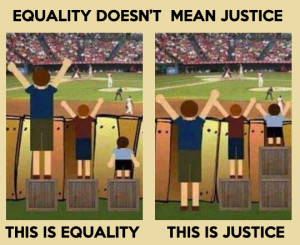
When talking about injustice, the word “equality” is often used in defining justice. Emma Watson used the term in her speech to the UN last September, and many other well-meaning folks do as well. But, equality operates on the idea that everyone is starting from the same place. That’s just not the case when it comes to gender discrimination and pay. Women of colour, Indigenous women and women with disabilities, for example, face barriers white able women do not—there is still a mainstream default ideal, which is based on whiteness, heterosexuality, middle-class status and having an able body.
It is well documented that women in higher-up positions, such as CEOs, make less than their male counterparts. It is also known that women are hired more for part-time work. Since the dominant gender norms dictate that women are the caregivers, mothers take the pay hit, whether it be in daycare fees or part-time work, as well as low maternity leave pay. Even for women without children, the mere possibility that they could get pregnant lessens their chances of being hired, among a list of other tired and sexist excuses. Equity would first create fairness for all people. Access to the same opportunities needs to be made before moving on to equality as the ideal. But there are so many overlapping factors regarding oppression. Race, class, religion, sexuality, ability, language, family, gender, and on and on.
White, heterosexual, rich women do not own feminism. Looking at Arquette’s comments, she seems to have forgotten that there are women of colour and gay women, or the fact that civil and gay rights have not yet been achieved.
I want to give the actress the benefit of the doubt; I want to be happy that feminism is being brought into the mainstream. Earlier today she Tweeted, “The working poor women of this country have been asking for help for decades. If I have “privilege”* or a voice I will shine light on them.” Hopefully those who were enlightened to feminism through Arquette’s speech will join the discussions about intersectionality so that these same mistakes won’t be made again.
*The reluctance of those with any privilege admitting that they have privilege is a whole other post.
A former This intern, Hillary Di Menna is in her first year of the gender and women’s studies program at York University. She also maintains an online feminist resource directory, FIRE- Feminist Internet Resource Exchange.
]]>
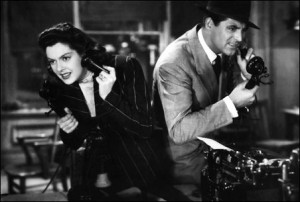
Rosalind Russell and Cary Grant in 'His Girl Friday'. Newsrooms still have a long way to go toward achieving gender equity.
[Editor’s note: On a semi-regular basis, we survey a sample of recent back issues of This to analyze the topics we cover, how truly national our scope is, and the makeup of our contributor roster. See the last survey here.]
The new documentary Page One focuses on the state of journalism, its new technologies and decreasing revenues. And if you look closely, the trailer also reveals the struggling industry’s sweeping bias. The reporters and editors interviewed at the New York Times are mostly men (and they’re all white):
It’s old news that American print media is running a deficit on female contributors. Last year Elissa Strauss conducted a survey of major magazines in the U.S. The New Yorker had 27 percent female bylines. The Atlantic, 26 percent. Harper’s Magazine, 21 percent. And that’s just to name a few. You can view a more extensive list by VIDA here. And last February, CBC Radio followed up on the story, interviewing Canadian magazine editors about the same problem north of the border.
So when my editor asked me to survey a year’s worth of This magazines, I jumped at the chance to uncover our biases. Where did our stories take place? What topics did we write about? How many of our writers, and their sources, were female versus male? The results surprised me.
Methodology
My survey may not be 100 percent replicable at home. You can view the whole spreadsheet on Google Docs here, or download it as a CSV file. And you can check out the previous year’s stats (which tracked geography and topics, but didn’t track gender).
I kept track of every article that had a byline. I assigned each of these a location (e.g. Vancouver) and a general topic (e.g. environment). I also noted each contributor’s name and gender*. Then I took note of every person who was quoted. I chose to do this because a direct quote conveys the person’s voice to the reader. I also took note of each source’s gender. Quoted sources are very often referred to as “him” or “her” in an article. When they weren’t, I asked the writer or Googled names to find out.
As I surveyed the first magazine, an unexpected trend emerged. There seemed to be far more male sources than female sources. So I retraced my steps and added each source’s profession, title or expertise. I kept it up, hoping this would give me more insight if the trend continued.
Results
We haven’t changed much since last year in terms of geographic distribution. Ontario, particularly Toronto, appeared frequently (though we haven’t determined yet whether it’s disproportionate to Canada’s population). British Columbia, with particular emphasis on Vancouver, was a close second. This year it was the Yukon, Nunavut and PEI that went unmentioned (last year, it was New Brunswick that was non-existent between our purportedly national pages).
When it comes to our favourite topic, the environment is still number one. We also love technology and politics, as per the usual. Freelancers take note: we didn’t have nearly as many stories about racism or homophobia in this sample as we do about women’s rights. Transphobia was invisible between our pages.
This Magazine is a lefty indie not-for-profit with a male editor and female publisher, and our bylines are also pretty egalitarian: 53 percent of bylines over the year were female (76 out of 142). Compared to the male byline bias in the mainstream media, This Magazine constitutes a fair counterpoint.
However, when it comes to sources we’re not doing so well. Only 72 out of 256 sources quoted were female. That’s 28 percent. Suddenly we look a whole lot like those other magazines I mentioned. Are our writers biased, or are the numbers reflective of the status of women?
Both. Male writers were less likely to quote female sources (22 percent of sources quoted in their articles were female). By contrast, sources quoted by women were 33 percent female. This disparity suggests that credible, accessible, female sources exist—but men aren’t quoting them. Another factor could be that men tended to write more for our technology issue (13 out of 23 bylines), which acknowledged a lack of women experts in the field. Conversely the most female bylines (17 out of 23) could be found in “Voting Reform is a Feminist Issue.”
If our journalists are quoting people of the same gender as themselves and over half our bylines are female, shouldn’t we have a more even split of sources? Sadly it doesn’t appear that personal bias plays a strong enough role to account for the disparity. I have to conclude that the lack of females quoted reflects the status of women in society.
Think about it. Journalists quote people who hold positions of authority. As I read down the list of sources’ titles, I can say pretty confidently that our reporters interviewed the right people. Some of their sources are politicians, CEOs, judges, police officers, people of high military rank. In Canada, these positions are occupied by men and women—but women are decidedly the minority in those cases. In 2007, according to the Status of Women in Canada, 35 percent of those employed in managerial positions were women. According to a one-week old worldwide survey by the new UN agency for women, 44 percent of Canadian judges are female. Only 18 percent of law enforcement workers are female, says a 2006 StatsCan report. According to StatsCan the Department of National Defense, only 15 percent of Canadian Military personnel were female. It’s no wonder that our feature on Canada’s involvement in Afghanistan quoted no female military sources, and that our reporters interviewed few females involved in law when researching our “Legalize Everything” issue.
Solutions
The best thing journalists can do to eradicate bias is to be aware of it, which is why we do this kind of analysis in the first place. Without this first step, we can’t ever hope to challenge our points of view. Acknowledging bias includes direct and indirect bias. The first type includes journalistic and editorial perspectives. The second type includes structures that perpetuate the unequal status of women, such as advertising bias, media ownership, and hiring practices in the wider world. So although it’s a great start, seeking out female sources in law enforcement, engineering, politics and technology is not going to cure the gender gap. Those in positions of power must attempt to correct gender, race, sexual orientation and class biases when they hire and promote workers. Voting reform would help, too.
Don’t lose heart — there are also positive signs in the numbers. The equality of male-to-female bylines and the greater female tendency to write without using as many direct quotes (often considered a sign of reportorial confidence among journalists) challenges Strauss’ guess that women may be meek or passionless about politics and critical journalism. For a magazine with the slogan “everything is political,” this is simply not true. It could, however, still be correct for the magazines Strauss surveyed. After reading a year’s worth of This, I can safely say our writers (female and male) are unapologetically critical in their approach — and nowhere near shy.
We want to do better in terms of bias, and we welcome any and all suggestions on how to improve our coverage of underrepresented topics, locations and communities.
*I don’t believe gender is necessarily fixed, but it certainly has a binary status in our language. Whether the sources actually identified as one of two genders or not, our magazine certainly identified them as male or female; no articles used “s/he” or mentioned any other gender. Due to the superficiality and time constraints of this survey, it’s not possible to tackle the language problem right now. However, I would love to hear your thoughts on how this might be possible in the future. Email [email protected].
The SlutWalks are challenging that vocabulary of oppression. On April 3, hundreds of women took pride in their pleasure and walked through the streets of Toronto (note that they walked for all kinds of different reasons). Inspired by them, a march followed in Boston on May 7. Now self-proclaimed “sluts” and their allies are taking to the streets all over the world in response to the falsehood that sexual assault is linked with promiscuous attire.
It’s an old idea, and one we should be long rid of. There may be other definitions involving a woman’s barely-there clothing or willingness to cheat, but “slut” in its most powerful and oppressive form is inextricably linked with rape.
Patricia Douglas
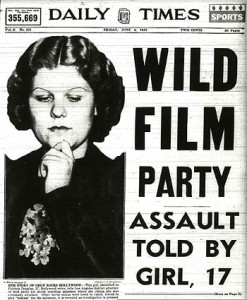
Patricia Douglas made headlines after she was raped by an MGM director.
Who exactly is Patricia Douglas?
In 1937, she was a 19-year-old dancer for Metro-Goldwyn-Mayer – you know, the film company with the iconic roaring lion. On May 5 of that year, she answered a call to a “film set” at an isolated ranch outside of Los Angeles. She and 119 other girls were required to wear cowgirl outfits. Patricia didn’t notice there were no movie cameras at the ranch. Present at what turned out to be an MGM sales convention party were nearly 300 salesmen, directors and producers. Throughout the night a film director pursued her, as they often did, asking her to teach him a popular dance. The director, David Ross, offered her champagne and whiskey, but Patricia had never tasted liquor so she refused. He and another patron forced the alcohol down her throat. When she ran outside to vomit, Ross followed her. He then violently raped her in a field near the barn.
Today we would hope such an act would be condemned and such a man would be brought to justice. But the 1930s were different. The word “rape” was rarely used. Instead the newspapers printed the word “ravished.” Women who were sexually assaulted didn’t often press charges. If they did, it was likely they would be publicly shamed. Only “sluts” had sex before marriage, whether or not they willed it.
As former MGM extra Peggy Montgomery said in a documentary I just watched about Patricia:
“I remember two words that I learned — one was ‘rape,’ which was an extreme disaster, and the other one that usually was in the same conversation was ‘tart’ – ‘well she’s a tart.’ … The whole vocabulary of ‘ bad woman’ – slut, tart, tramp – came up immediately if anybody mentioned, ‘she was raped.’”
It’s still a pervasive idea. If a girl sleeps around, she must have wanted it. If a girl is wearing suggestive clothes or makeup, as a Manitoba judge recently said, she must be asking for it. If on the other hand she doesn’t dress like a slut, as a Toronto police officer recently recommended, then she will prevent rape.
Patricia pressed charges against Ross. It was a brave move. Even today, attacking the credibility of a rape survivor is a valid means of undermining his or her testimony. Patricia was up against a financially powerful spin-machine. If MGM could show she had questionable morals – if she had casual sex, for example – the movie giant stood a better chance of winning the case. The movie studio circulated a form asking about the girl’s morals and whether she had been drinking on the night of the party. It aimed to establish that Patricia was a slut. If she was a slut, she couldn’t have been raped. But Douglas had been a virgin at the time, so MGM used another defense. “Look at her,” the prosecutor commanded: “who would want her?”
Rape was and still is linked with desire according to folk psychology. But this is an oppressive idea. Rape is all about power. Rapists perceive their “victims” as weak, which is why many sexual assault centres have shifted to calling them “survivors.” In a linguistic sense, this new word takes some semantic power away from rapists.
And what would happen if the word “slut” lost its power too? What if it bestowed strength rather than shame upon its subjects? Thanks in part to the SlutWalks and the debate they have launched, we may at last find out.
]]>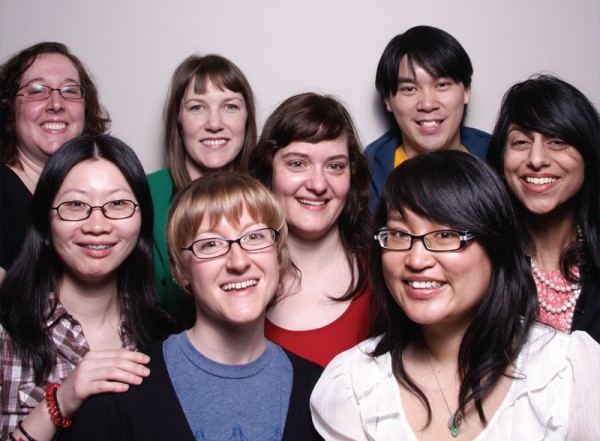
The Shameless editorial collective. Photo by Robin Hart Hiltz.
Flip through the pages of Shameless, a feminist magazine for teen girls, and you’ll find a debate about the value of corporate social responsibility titled “When Oppressive Corporations Do Progressive Things” alongside a first-person call for self-acceptance, “Shame, Beauty and Women of Colour.”
It’s not exactly Seventeen, and that’s the whole point — or at least it was. “When we started, we defined ourselves as what we aren’t,” explains Sheila Sampath, the magazine’s editorial director. “Now, we no longer have to do that. It’s more about what we are.”
Shameless was born out of a Ryerson University classroom seven years ago, founded by students Nicole Cohen and Melinda Mattos to redress the deficiencies in mainstream teen magazines. Sampath, who joined the team as art director early on, is now running the show — and providing day-to-day continuity within the all-volunteer team. The magazine’s 10 or so editors are joined by outreach volunteers, including those who run the Wire, a journalism training program for high-school girls.
“I wish I’d had Shameless when I was a teen,” says Sampath, pointing out that, refreshingly, it doesn’t assume its audience to be straight, white, and middle class.
Shameless is overtly activist, with a mission statement that reads, in part, “We understand that many of the obstacles faced by young women lie at the intersection of different forms of oppression, based on race, class, ability, immigration status, sexual orientation, and gender identity.”
Its target demographic — vocal in its appreciation — usually finds the mag in school libraries, but Shameless is also available on newsstands and finds many fans in older age groups, too.
The indie title aims to provide a sense of community for those who are “different”—in viewpoint or ethnicity. “It really is validating to see yourself reflected in print,” Sampath says. “We’re trying to redefine what’s normal.”

On February 8, roughly 1,500 Quebec crown prosecutors and lawyers went on strike in frustration over being the country’s most overworked and underpaid public lawyers.
The strike is believed to be the first in Canada. Prosecutors were given the right to strike in 2003 by the provincial government, who opted for contracts and incremental raises instead of binding arbitration. The aim of the strike was to close a 40 percent income gap separating Quebec from the national average.
An episode of CBC’s The Current examined the pay discrepancy and resulting backlog of cases. Lawyers discussed the low morale that comes with insufficient time to do justice. Decrying an understaffed system, one guest spoke of rape victims only getting 90 seconds to speak with a prosecutor.
A group representing the striking prosecutors says low salaries prevent the province from retaining the most competent lawyers, who must challenge the arguments of well-paid defence lawyers. Lawyers have left the provincial system, lured by competitive salaries in the private sector and other provinces. The result is a high rate of turnaround, with younger, less experienced prosecutors filling spaces left by those seeking greener pastures.
After the two weeks of picket lines, Quebec Premier Jean Charest legislated provincial prosecutors and lawyers back to work. The strike threatened provincial legislation, as state lawyers write the laws passed by the National Assembly.
As part of its back-to-work legislation, the province implemented a pay rise of 6 per cent over five years. It also announced plans to hire 80 new prosecutors and 65 related staff. The group that mobilized the strike estimates that Quebec lacks 200 crown prosecutors — 45 percent of its current workforce.
The resulting outcry is affecting the provincial government on multiple fronts. Not enough prosecutors have stepped forward for an upcoming biker-gang trial implicating 155 Hell’s Angels members. The government created an anti-corruption unit to prosecute those allegedly involved in organized crime in Quebec’s construction industry; crown prosecutors have boycotted the project. Last week, half the province’s top prosecutors asked to be reassigned, citing precarious working conditions.
Quebec’s current predicament is similar to the 2009 Legal Aid Ontario lawyers’ boycott. Legal aid lawyers refused to participate in long-term trials involving violent crime, saying they lacked sufficient pay and resources to provide a fair defence. Yet again, provincial lawyers were underfunded, threatening the pursuit of justice.
With a federal election looming, Stephen Harper is pursuing a tough-on-crime agenda, with stiffer penalties for young offenders, more prisons and fewer programs like prison farms. Toronto mayor Rob Ford wants more cops — something even the police union disagrees with — in an effort to grab the public safety vote.
All these proposals are empty hypocrisy without more crown prosecutors and lawyers, and adequate funding to pay them. They’d have to be well-paid to avoid the precarious conditions now experienced in Quebec. Otherwise, we risk undermining one of society’s most crucial institutions.
]]>Consider this: the population growth of racialized or non-white groups continues to outpace that of white Canadians. This has created a shift in the demographic balance of the Canadian mosaic, with our population on its way to becoming a “minority majority.”
According to Statistics Canada, by 2031, over 70 percent of Canadians living in Toronto, Montreal, and Vancouver will be from a visible minority or racialized group. Already, almost half the population in the Greater Toronto Area is a visible minority. Yet we are not seeing an equivalent shift in the halls of power: in business and in government, visible minorities—particularly African-Canadians—still represent a small fraction of the decision-makers relative to their overall population.
In April, a report by the Law Society of Upper Canada looked at the legal profession relative to others and made the following observations: “In Ontario in 2006, members of a visible minority accounted for 30.7 percent of all physicians, 31.7 percent of engineers, 17.6 percent of academics and 11.8 percent of high-level managers, compared to 11.5 percent of lawyers.”
A recently released study, entitled “DiverseCity Counts: A Snapshot of Diverse Leadership in the Greater Toronto Area,” showed that while some sectors are doing better at reflecting the general makeup of the population, visible minorities are underrepresented in leadership positions. Today, visible minorities comprise 49.5 percent of the population, but only 14 percent of senior-level leaders.
The implications of this imbalance will only become more significant as the population continues to shift. Canada must demonstrate the potential of harnessing the best of all of our peoples. Diversity in the leadership of our institutions matters. Far from being a form of tokenism, a significant increase in the number and diversity of visible minorities at all levels of leadership is essential to Canada’s competitiveness.
In May, Governor General Michaëlle Jean addressed business, academic, and socialsector leaders in a speech to the Canadian Club. She told the audience that “saying yes to diversity is saying yes to modernity, to opportunity, and to the very future of our country.” There is an economic case for embracing diversity: to create a “brain gain” by recruiting, hiring, mentoring, developing, and retaining a qualified and diverse workforce. Imagine the dividends for Canada’s global competitiveness when all its citizens have an equal opportunity to lead, to innovate, and to contribute to our social, economic, cultural, and political landscape.
The DiverseCity study also found that visible minorities are underrepresented in the media, accounting for only 19 percent of appearances by broadcasters, reporters, print columnists, subject experts, and commentators. Diversity in media leadership and representation of visible minorities is improving incrementally, but larger gains are needed. Why do we not see or hear from more visible minorities in daily coverage? How long must we wait for media outlets to do the research and start assigning these stories?
One initiative to improve the coverage of racialized minorities is DiverseCity Voices, a new electronic database of experts who are also visible minorities. Journalists can turn to the website to find underrepresented leaders who are able to provide commentary and opinion on current affairs.
Since joining the website, I have appeared in a variety of local and national print and radio, television, broadcast, and social media outlets, providing my opinions on subjects ranging from the Olympic Games, the G20 summit, and Africentric Schools. I’ve received more calls from journalists looking for comment, and that’s important to me. Young people become what they see, and role models of all backgrounds need to be seen and heard.
Sociologist John Porter’s Vertical Mosaic, published in 1965, remains the touchstone for a deeper understanding of the structure of Canadian society. Porter’s findings portrayed Canada as a hierarchical racial pecking order, with attendant consequences for social mobility, access to power, and economic success. In the Canadian mosaic, whites were (and still are) the dominant culture at the top of the heap. Fifty years on, Porter’s study still rings depressingly true. But there is reason to be optimistic.
With a conscious effort to create and sustain diversity in all our institutions, it is possible that Canada’s vertical mosaic will be replaced by one that is inclusive, linear, and beneficial to us all—no matter where we come from or the colour of our skin.
]]>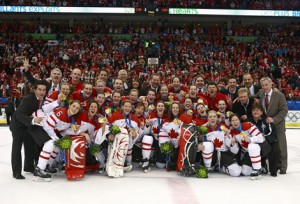
Canada's women's Olympic hockey team pose with their gold medals after the winning game.
Guest blogger Canice Leung recently wrote in this space that Canada’s “national sport,” our beloved ice hockey, has became too elitist, too expensive and too inaccessible to maintain its position near to the top of the Canadian cultural hierarchy. Sparked by a fiery debate on Twitter the day before, her words were thought-provoking and insightful and her column provided an valuable perspective—one that those of us closely connected with the game often forget. And though I agree with the spirit of Leung’s argument, I have have to take issue with her conclusion, that hockey does not and should not represent this country.
She is right to point out that sport in Canada is a multimillion-dollar industry and that in certain respects it has become increasingly elitist and inaccessible. As Leung notes, higher-end ice skates alone can cost upwards of $600 and that’s just one piece of the bounty of expensive gear required to the play the sport at any level. Also, rinks are expensive to maintain, so ice-time is scarce and registration fees for youth hockey leagues are exorbitant. Just last week, the Greater Toronto Hockey League, the minor hockey association for the city that is supposed to the most diverse on earth, announced it would be doubling its fees next year. All the GTHL’s 512 teams will now pay $2000 to register a 16-player squad in order to cover the $500,000 hit the league expects to take with the introduction of the Harmonized Sales Tax in Ontario in July.
As Leung argued, circumstances like these make any sport—or any endeavour, for that matter—self-stratifying. Sure, there are bursaries, hand-me-downs and other equalizing measures out there. But with decreased accessibility comes increased elitism. More immigrants and second-generation Canadians may be filling roster spots in the game’s professional ranks. Yet there are also fewer opportunities for the less affluent to have a shot at playing the game at its highest level. For Leung, that means that when hockey is “put on a cultural pedestal, it demands a fairness and accessibility that befits the morals of the country it represents.”
But, for me, it’s still the national game.
The reason hockey needs to be more a more accessible and more equitable sport is precisely because it’s so deeply interwoven in our collective identity. Opening the sport to a wider, more diverse sample of Canadians will not only increase its already massive audience—10.3 million Canadians tuned in to the Olympic quarter-final against Russia; 21.5 million, nearly two-thirds of the country, for the gold medal match-up with the United States—and support other values we hold close, but also deepen the talent pool and make us that much better at, that much more connected, to our cherished national pastime.
When Leung writes that “in modern-day Canada, the idea that the sport represents us all seems anachronistic,” I think she may be missing the point. In today’s world, there is nothing that is going to perfectly represent us all. Hockey is for some, not for others. But the shared experience of sport can unite us and hockey is that shared experience for Canadians. The beauty of sport is that you don’t have to play it to take part in it—the Olympics final the perfect example of just that. It’s the overwhelming emotion and excitement coupled with hockey’s rich folklore that brings people together in one collective act. The fact that so many of us tune it on a nightly basis is what makes it ours.
Granted, it’s a shame the women’s game doesn’t get the attention it deserves—but that is true of all female sports and Canadian women’s hockey is probably in a better state than most. Plus, that culture is rapidly changing, particularly at the amateur level where more young and talented female athletes are playing competitive sports than ever before. They, too, share in the collective hockey experience and are increasingly becoming an active part in shaping it.
Of course, that doesn’t mean we shouldn’t apply a critical lens to our national game, giving it a free pass simply because we love it. More access and more representation will only make our game bigger, better and more of a positive force in shaping Canada’s culture. Leung’s point is an important one and very well taken. But there’s still something distinctly Canadian about that good ol’ hockey game.
]]>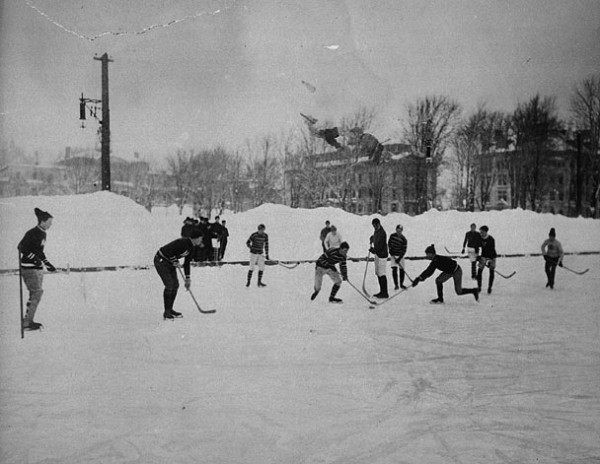
Hockey players at McGill University, Montreal, 1901.
I grew up in the Greater Toronto Area, home to the most diverse region in all of Canada, perhaps the world, in a Hong Kong immigrant household (caveat: my Man U-loving dad raised me on soccer). I’m intensely proud of that fact. So it ruffles my feathers that, hockey so often precludes all other events — a men’s hockey semi-final quarter-final win over Russia (at that big sporting event that shall not be named) garnered more media and spectator attention on a day in which four medals were won in non-hockey events.
Hockey, Wikipedia tells me, is the national winter sport of Canada and has a well-known history that predates European arrival. But in modern-day Canada, the idea that the sport represents us all seems anachronistic.
I tweeted as much yesterday, saying “Heres the thing about hockey: its a rich cdn’s sport. It irks me to no end one of the least accessible games somehow represents my nat’l ID. … That, and up until recently, it was (and arguably still is) a boy’s game. It just doesn’t represent us all.” The debate that ensued seemed to strike a nerve, which you can read in its entirety here and here.
The Canada-Russia game averaged 10.3 million viewers—a third of Canada’s population. I don’t doubt the popularity of hockey, but it’s the modern incarnation of the sport that irks me.
As I tweeted earlier, it doesn’t take much to figure out that hockey runs hundreds, maybe even thousands, beyond what more “democratic” sports cost: high-performing soccer cleats run about $200, plus another $100 for jersey, shorts, socks, shin guards. Basketball: $40 ball, $150 shoes. Hockey: high-end skates can run $600 — never mind the cost of pads, sticks, helmets, pants, jerseys, neck guards and everything else.
My boyfriend, a lifelong hockey fanatic and a player in his adolescence, took umbrage with my assessment. He says in his small town in New Brunswick, almost every kid, boy or girl, played the game. If they couldn’t afford it, coaches supplied hand-me-downs, freebies or communal team gear.
True, you can still enjoy a game of outdoor shinny on hand-me-down skates and sticks. And the game itself is still a rush to watch. But we don’t live in a Tim Hortons commercial — even a rec league requires all that equipment, and from it, the hockey industry — from the $300 Leafs tickets to Bauer and Nike — generates billions of dollars from it.
For a disadvantaged Toronto kid, charity, waived fees and mentoring seems to be the only way into the game these days, the Toronto Star found, quoting NHL goaltender Kevin Weekes: “The pricing is such that our sport is becoming an elitist sport.”
Playing at a rep level and up requires several thousand in registration fees, cost for travel, and that’s not even counting the gear. All totalled? $10,000 a kid. As the Star pointed out, this leads to kids—talented ones—dropping out because of the financial burden.
Any sport that requires such a money sink is self-stratifying. It’s a terrible social phenomenon happening not just in amateur sports, but also in skyrocketing university tuition, extra fees required even in public school, laptops and other technological gadgets that are now virtually mandatory in academic and professional spheres. It also means at the highest level, the NHL, as in many other places in life, those that succeed are the ones that can afford it. It’s disheartening that all these opportunities are moving further and further out of reach of low-earning Canadians families.
In recent years, more leagues, presumably aware of this problem, have started offering bursaries to players—but I’m sure the effects are analogous to university bursaries vs. tuition freezes and reductions.
@bmo, a gentleman I was talking with on Twitter, mentioned how sports such as football institutionalize the outfitting of players—high schools supply all the equipment. An online search turned up nothing on socioeconomic statistics of incoming players in any major leagues, but I’d be interested to see if there’s any correlation between how sports are funded and who ends up succeeding. For a country whose diversity will only increase, not to mention an NHL looking for a wider audience, this isn’t a passing concern.
The costs associated with modern youth activity isn’t just hockey, obviously. It’s just as wrong that serious coin must be spent for extracurriculars such as soccer, basketball, dance, gymnastics, horseriding, ballet, skiing or swimming.
The difference is, no one’s calling these the national sports of Canada. When it’s put on a cultural pedestal, it demands a fairness and accessibility that befits the morals of the country it represents. I think most Canadians believe we are a fair, free and equal country. Hockey, if it ever did represent that, doesn’t anymore.
The spirit of a nation comes from its people, emblematic of their shared experience, ethnicity, history or culture. Our spirit is that we lack all these, and instead take polite pride in them all. We are not one dish, one national dress, one language, one music (I would defect if Anne Murray or Celine Dion were our national chanteuses). How, then, can Canada reduce its sport to just one?
]]>The Legal Aid Ontario boycott: Is it just about money?
The Ontario Government is using single mothers to sell a proposed funding increase to legal aid the public, but lawyers aren’t buying it.
“Almost 70 per cent of family legal aid cases involve women making $22,000 or less per year. Nearly all of these cases involve children. This significant investment is critical to ensuring the safety of women and children in Ontario.”
– Pamela Cross, Legal Consultant and advocate for female victims of violence
But the Canadian Legal Association Criminal Lawyers’ Association members and supporters aren’t boycotting cases involving women and children. The scope of the boycott clearly states only criminal cases, homicides and those under investigation by “Gangs and Guns” squads will be boycotted. These types of cases are what Legal Aid Ontario calls Big Case Management. The sheer number of BCMs tells the story of the boycott.
There are currently about 1230 active BCMs, 96 per cent were carried over from 2007-2008. In the first 6 months of 2009, 318 news cases were added and only 273 were resolved. The average length of a BCM is 3 to 4 years, and the average cost per defence lawyer in these cases is almost $30,000.
But how much of that money do the lawyers actually see? Not much, when you consider that the average hourly wage for a LAO lawyer in southern Ontario is about $87 per hour. That’s a lot more than many of us make, but after subtracting the cost of offices, support staff, equipment, and other overhead—not to mention the hefty student loans that financed their (deregulated) law school tuition in the first place—there’s seldom much left over.
LAO lawyers say they receive less funding for expert witnesses than prosecuting attorneys, who also have government funded offices, supplies and support staff. The CLA says the $150 million dollar funding increase by the McGuinty government barely covers the cuts and rate freezes of the past. In the last 22 years, compensation to LAO lawyers has risen only 15 per cent, and hasn’t factored in increases in population, support staff wages, or office rental. Crown lawyers received an 57 per cent wage increase between 1997 and 2007.
If our legal system is to remain fair, then the defence counsel (especially in the case of legal aid counsel) and prosecution must be equally up to the task of preparing and presenting their respective cases, regardless of who is paying the bill.
]]>