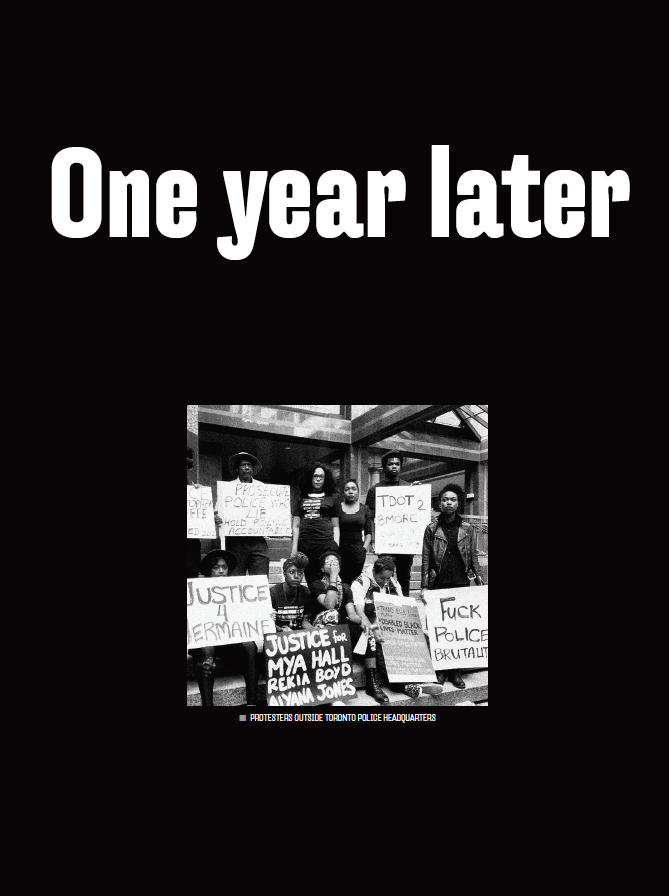
 Denise Hansen examines the Black Lives Matter movement in Canada—and why there’s cause for anger and hope here, too
PROTESTS AND MARCHES AND SIT-INS have never really been my chosen course of social action. I can remember my dear family friend Kathy, a valiant social justice advocate, trying over the years to introduce my tender, elementary-aged sister and me to the world of social action. She’d drag us to women’s marches and tuition rallies but somehow, we always became so besieged by the noise and the cold (this is Canada, after all) that after a mere hour we’d end up at the nearest Tim Horton’s, clutching hot chocolates and talking through alternative ways we could create social change. Still today, I deeply admire the committed and resilient spirit of protestors (and my dear family friend for fearlessly trying to involve us in that world!) but have decided that for me, social justice is best pursued in other ways. So I write.
But that was before Michael Brown.
The night it was announced that a St. Louis County grand jury had decided not to indict police officer Darren Wilson in the shooting death of unarmed black teenager Michael Brown, I was in bed under the covers, glued to the light of my phone, slowly scrolling through news report upon news report, tears falling down my face at the same pace. I fell asleep that night feeling emotionally shattered, and like nothing mattered. It was an indescribable feeling of despair with society that I had never experienced before.
The same week I, along with hundreds of other Torontonians, converged at the U.S. Consulate General in downtown Toronto to express anger and frustration with the non-indictment decision and to protest the systemic oppression black communities both in America and here at home continue to face at the hands of police and the state. At the end of the rally, organizers asked us to turn to the person next to us, take our hand, place it on their back, and say the words “I got your back.” I biked home that cold November night feeling everything but what I had felt earlier that week. The protest made me feel that I, my community: we mattered.
I think there comes a time in every black person’s life where the straw simply breaks. You take it and you take it, and you take it and you see your family take it and your friends take it, and people you don’t even know take it, until one day the load becomes too much. For millions of people, that day came with the events surrounding Michael Brown and Ferguson. A year after Brown’s death and the #BlackLivesMatter protests (unofficially) began, I wanted to find out how far the Black Lives Matter movement had come in turning hearts and minds—in America and here at home—to the supposedly revolutionary idea that black life does, in fact, matter.
Does my black life matter more now, one year later?
PEOPLE OFTEN QUESTION what it was about the Michael Brown shooting that spurred millions of people around the world, black and otherwise, to pay heed to the unjust policing practises afforded to black communities in America. After all, since Trayvon Martin’s death in February 2012 and before Michael Brown’s death in August 2014,countless unarmed people of colour have been killed by police in the
U.S. These are just some of the names of black individuals that were killed by police or vigilantes only one month after Trayvon Martin died: Raymond Allen (age 34), Dante Prince (age 25), Nehemiah Dillard (age 29), Wendall Allen (age 20), Shereese Francis (age 30), Rekia Boyd (age 22), Kendrec McDade (age 19), and Ervin Jefferson (age 18).
“The community response set things off, the way people in Ferguson decided to rise up and come together as a community,” says 25-year-old Tiffany Smith, explaining what galvanized America around Michael Brown. “That really showed all of us that we could do the same.” Seeing the courage of the Ferguson community to come together and revolt spread action like wildfire across the U.S., she adds. She herself has been part of the Black Lives Matter movement since it began last year, protesting and organizing in Atlanta, Georgia.
After Brown’s death, protestors flooded the streets of Ferguson and other cities across America. When the first report came out of Ferguson that police tear-gassed peaceful protestors, the community, understandably, retaliated. In response, President Barack Obama addressed the nation and urged an “open and transparent investigation” into Brown’s death while calling for calm and restraint. But then Officer Darren Wilson’s name was released. National protests intensified, calling for police reform and the immediate arrest of Wilson. A state of emergency was declared in Ferguson. Every night as I turned on the news, I knew I was watching a revolution unfold before me.
As protests strengthened, the Black Lives Freedom Rides—organized by the same three women who began the #BlackLivesMatter hashtag—reportedly brought more than 500 activists from around the country and Canada to Ferguson to join thousands others for Labour Day actions and protests. Highways were stopped, football and baseball games and symphonies were disrupted, Walmarts were shut down, and hundreds of protestors staged die-ins in cities across the country. Black Lives Matter made its way into my conversation circles with friends, colleagues, and people on the street. I felt like a kid in a candy store when the subject came up. For the first time, I was discussing race relations—no! I was discussing anti-black racism!—with people I had known for years. Please, please, please let us hold on to this moment a little while longer, I thought.
In November, with the nation bracing for the Michael Brown grand jury decision, the city of Ferguson became a military war zone with police outfitted in riot gear, body armour, tear gas, and other militarized crowd control items. When the devastatingly predictable nonindictment decision was announced, thousands of people rallied to protest the verdict in more than 170 cities across America and massive protests were launched, shutting down malls and highways to boycott Black Friday.
“But what does asking poor, black families to stop shopping on Black Friday do?” my American friend asked me one day, referring to the Black Friday shopping boycotts. “These are the same families that, because of generations of systemic racism and oppression and as a result, limited financial means and economic wealth, are just trying to save a couple of dollars on their kids’ Christmas presents.” She made a good point. We talked for hours more about protest, boycott, and its place in revolution.
Then in December, another injustice made it to news broadcast. It was announced that a New York grand jury would not indict police officer Daniel Pantaleo for the death of Eric Garner, a 350-or-sopound, asthmatic, married father of six, who was harassed, mobbed, and eventually died at the hands of police via chokehold for selling cigarettes. I was getting ready for work the morning I heard the news. Listening to the audio of Garner desperately plead for his life is something that will stay with me forever. Shaken, I turned the radio off halfway through the audio, only able to muster up the courage to watch the full video a couple of days later.
The Garner non-indictment announcement incited a surge of protests in New York City and across the nation. Basketball teams donned “I Can’t Breathe” T-shirts at games; a Black Lives Matter protest filled the Mall of America; and black congressional staffers walked out of Congress staging a powerful “Hands Up, Don’t Shoot” protest. I felt a strange sense of relief when incidents of police violence were still making the evening news and daily newspapers. How strange it is to feel relief when black people—my community—were still the victims of violence and death at the hands of police. But I guess I was just relieved that the struggle still mattered enough to popular media.
With the start of 2015, the most powerful image: a diverse crowd of over 50,000 people marched through New York City. Titled the Millions March NYC, it brought together people of all races, ages, and backgrounds to protest ongoing state-sanctioned violence against black communities. Thousands upon thousands of people protesting anti-black racism; these were images I had never seen in Canada, outside of school textbooks during Black History Month. Then in Baltimore this spring, more outrage as people poured into the streets after 25-year-old Freddie Gray died in police custody after being illegally arrested and detained.
In so many ways, it has been a defining and transformative movement highlighting North America’s fractured race relations and broken criminal justice system. In just one year, the movement has been able to bring international awareness to the systemic dehumanization of blackness that occurs at the hands of the state, most visibly by the police, every day, every hour, and every minute. Similar in size and scope to the civil rights movement of the 1960s, Black Lives Matter has brought race relations and the heartbreaking understanding of how disposable black life is in America to the fore.
Even in places as far away as Australia, Japan, Palestine, the U.K., Cuba, and the West Indies, Black Lives Matter has mobilized people not just to take to the streets in solidarity but also, and more importantly, has mobilized international communities to examine their own practises of policing, race relations, and anti-black racism. Outside of the important conversations it has sparked, Black Lives Matter has seen successes in the policy arena too. In less than one year the movement has seen seven bills aimed at police regulation and accountability introduced to Congress including the Jury Reform Act, the Stop Militarizing Law Enforcement Act, the Right to Know Act, and the End Racial Profiling Act. A federal civil rights investigation has been launched in the death of Eric Garner and its subsequent grand jury decision. The U.S. Department of Justice opened an investigation into the conduct of the Ferguson Police Department and found that the force regularly engaged in conduct that violated the constitutional rights of its black residents (the Department of Justice is now investigating police conduct in other U.S. cities including Baltimore, North Charleston, Cleveland, Albuquerque, and St. Louis).
In August 2014, a petition to create the Michael Brown law, which requires all state, county, and local police to wear a body camera, received well over 100,000 signatures (the threshold required for the Obama administration to respond). The petition also spurred the NYPD to equip police officers with body cameras for a three-month pilot program, have 7,000 body cameras supplied to the LAPD over a two-year period, and have President Obama propose a plan that includes funding over 50,000 body cameras for American law enforcement. The Death in Custody Reporting Act was signed into law and we saw rightful police indictments retained in the deaths of Rekia Boyd, Levar Jones, Bernard Bailey, as well as six police officers indicted in the death of Freddie Gray.
On the grassroots level too, Black Lives Matter has triumphed. Protestors have been able to create and distribute resource toolkits for organizing protests and other actions; nationwide, conferences have been hosted; conference calls regularly occur between groups across the country to share actions and next steps; and Black Lives Matter organizers named 2015 the Year of Resistance. Taken together, we are seeing how, in just one year, grassroots community work can directly shape and inform public policy work.
“That report that came out about Ferguson of how black folks are over-policed,” says Smith, who believes that Black Lives Matter has highlighted the importance of data and the power of information. “That report would have never come out if people weren’t in the streets.”
Rick Jones is lawyer and a founding member of the Neighbourhood Defender Service of Harlem. The NDS is a community-based public defence practice which provides legal representation to residents of Harlem and other historically underserved and over-policed communities in north Manhattan where it’s not uncommon for some of his clients to be stopped by police two to three times a week. Jones agrees that what Black Lives Matter has done best is bridge the worlds of policy and protest (although he’s not sure it’s yet been successful). In his own work, he notes that the action that Black Lives Matter in New York City did to protest Stop-and-Frisk on the streets concretely helped in highlighting the work NDS and other practices did around
Stop-and-Frisk litigation at the policy level.
When I ask Jones how the Black Lives Matter movement has impacted the work NDS does, he tells me, “We’ve been able to help our clients understand that the constitution applies to them, to help them understand that it’s not okay for the police to just throw you up against the wall and go through your pockets for no reason.” This is important work, he stresses, adding that when generational oppression is present—“granddad was oppressed and dad was oppressed and now son is oppressed”—this education becomes a lot more difficult. Even in a country like America where race is talked about often, making the connection between people’s personal struggles to systemic injustices becomes hard because racism has been the status quo for so many generations.
Even harder is asking these same communities to act and expose themselves to a system (police, etc.) that has wronged them in the first place. Black Lives Matter is so remarkable because it has done both: made the link between individual disenfranchisement and systemic oppression and convinced affected communities the fight is worth it. Yet, then, what happens in a place like Canada where race and anti-black racism is almost never talked about? How has Black Lives Matter permeated the Canadian landscape? Has it at all?
ONE YEAR POST-FERGUSON Black Lives Matter has been instrumental in providing Canadian justice organizations and black groups legitimacy when speaking out about how our own black communities are treated by law enforcement. The protests and marches and sit-ins we saw planned by Black Lives Matter organizers across Canada came about not just to show solidarity for black men and women in America who contend with a racist criminal justice system, but also to protest and rally around the racial profiling, suspicion, and institutional anti-blackness that is present in Canadian policing practices.
“In Canada, we maintain a kind of smugness so that when we talk about police and black communities, often we revert to experiences going on in the States,” says Anthony Morgan, a lawyer at the African Canadian Legal Clinic, a not-for-profit organization that advocates for and represents African-Canadians in a number of legal forums. Morgan asserts that the movement has created space to acknowledge how Canada’s black communities experience policing institutions and practises. To him, Black Lives Matter has allowed Canada to critically assess the Special Investigator’s Unit (SIU.), a civilian law enforcement agency that conducts independent investigations to determine whether a criminal offence took place whenever police officers become involved in incidents when someone has been seriously injured, dies, or alleges sexual assault.
Morgan says Black Lives Matter has also allowed us to critically assess the Office of the Independent Police Review Director (OIPRD), an independent civilian oversight agency that receives, manages, and oversees all complaints about police in Ontario. And it has especially engaged people in critically assessing the issue of carding, the practise whereby Toronto police officers stop, question, and collect information on people without arresting them.
While black communities make up only 8.3 percent of Toronto’s population, they accounted for 25 percent of the cards filled out between 2008 and mid-2011. Research shows that in each of Toronto’s 72 patrol zones, blacks are more likely than whites to be stopped and carded and the likelihood increases in areas that are predominantly white. This in Canada’s most multicultural city and a global beacon of what a post-racial society looks like.
Morgan adds that the Black Lives Matter movement has also been effective in raising awareness about the SIU and how many times it has exonerated a police officer who has killed a civilian. Black people are overrepresented in these encounters as well. Jermaine Carby, a black Toronto man, was shot and killed by police last year after being pulled over by police for unknown reasons. Rather than providing answers and support to the Carby family, the SIU is still withholding the suspect officer’s name and details of the incident. “What systems do we have here in Canada that try and justify or explain the killing, harassment, and violence black civilians experience at the hands of police?” asks Morgan. “These are important questions that we’ve finally been able to get at.”
THE SUCCESS OF BLACK LIVES MATTER has had as much to do with its origins as its message. Here is a movement that began as grassroots in nature, had its origins in female leaders and youth, lacked centralized leadership, and used social media as an organizing tool. By virtue of all these characteristics, the movement has wildly succeeded. Black Lives Matter has also wildly succeeded because of its universal message— Black Lives Matter. It’s not only a powerful message, but one that is easily understandable and irrefutably cannot be denied. “One of the realities of protest movements is that unless those who are protesting frame their protest in a way that is not threatening and that is easily understood by the very society that is oppressing them, the protests don’t go anywhere,” explains Ken Coates, Canada Research Chair of Regional Innovation and author of #IdleNoMore: And the Remaking of Canada. In his book, Coates argues that the basic assertion of #IdleNoMore as aboriginal people engaging with their identity and feeling empowered to be a part of the future of Canada was a success in its own right.
“It’s hard for governments and the public at large,” he adds, “to ignore movements that start off with an assertion that cannot be rejected.”
The Black Lives Matter movement has worked in much the same way. Protestors have found a concept that no sensible person can reject. In this way, when government or policing institutions don’t deny that black lives matter, they at the same time are forced to question why then they continue to over-police and over-criminalize black communities; or why they continue to use poor, black populations as revenue tools; or in Toronto, why they continue to unduly target young black men in carding stops (though the city’s mayor recently vowed to end the practice). If black lives matter, why continue to apply these unjust practises to black communities? With three simple words, the Black Lives Matter movement has exposed the hypocrisies and, thus, has been able to rally for change.
“The protestors won as soon as they started organizing,” explains Coates who says that Black Lives Matter protests have spurred a similar paradigm of revolution to Idle No More, where people were equally as excited about being aboriginal and showing their country that aboriginal people were alive, engaged, vibrant as they were ready to assert their presence. “In the same way, Black Lives Matter is as much a conversation among African Americans as it is with African- Americans and the rest of the American population,” he adds. “And that part is really powerful.”
Arguably, the greatest success of the Black Lives Matter movement is that it has made people excited about being black again—a feeling we haven’t seen since the 1960s in America, or in Canada, ever. One year later, Black Lives Matter is and continues to be a powerful assertion of black identity and confidence whereby black communities, especially young black people, have found their voice, realized the future of their communities lay in their hands, and have demanded public attention in this regard. “Black folks who may have not thought about their lives as something that mattered are now reminded,” says Smith, who adds that when Michael Brown was killed, it opened up a new space for young, black activists who saw their involvement in the movement as an act of necessity. “For me being a part of this movement is about my livelihood. I felt like how can I not be a part of this? Black Lives Matter encompasses all of my lived experience: as a black person, as a woman, as a queer person. For me, Black Lives Matter has been this constant reminder that I do matter.”
Popular media feeds us so much bad news coming out of the black community: our crime rates, our lack of involvement in the economic, social, or political dimensions of the wider (whiter) society. In the face of one of these bad news pieces —the excessive violence and death of black individuals at the hands of police—Black Lives Matter has, in Lauryn Hill’s words, turned a negative into a positive picture. It has reminded black people of the simple notion that we do matter. In just one year, the movement has turned the tragic and violent death of Michael Brown into a sense of shared identity and purpose for millions of black people across America, here at home, and across the world.
I remember that cold, November night biking home from a Black Lives Matter protest feeling like I, my community: we mattered. Many gains have been made by Black Lives Matter, but even if the movement does have a long way to go in reforming policy, transforming the school-to-prison pipeline and creating equal opportunities for black populations across social, economic, and political dimensions, thanks to Black Lives Matter, I know my life matters. More than I did last year. And millions more do too.
I matter. A simple and most powerful revolution. If this is just one year in, the Black Lives Matter revolution has only just begun.
]]>The magazine’s cover story devotes significant column inches to talking about how historic OITNB is. It’s a show about women and, more importantly, women doing something other than being the token girlfriend or token best friend to some lame leading man. Not only are the show’s female characters great, but they’re played by traditionally marginalized and underrepresented actresses—the cast includes plenty of women of colour, Latina women and queer women, as well as transgender actress Laverne Cox playing a transgender woman.
Rolling Stone was so blown away by how ground breaking OITNB is that they decided to celebrate with this revolutionary cover treatment.
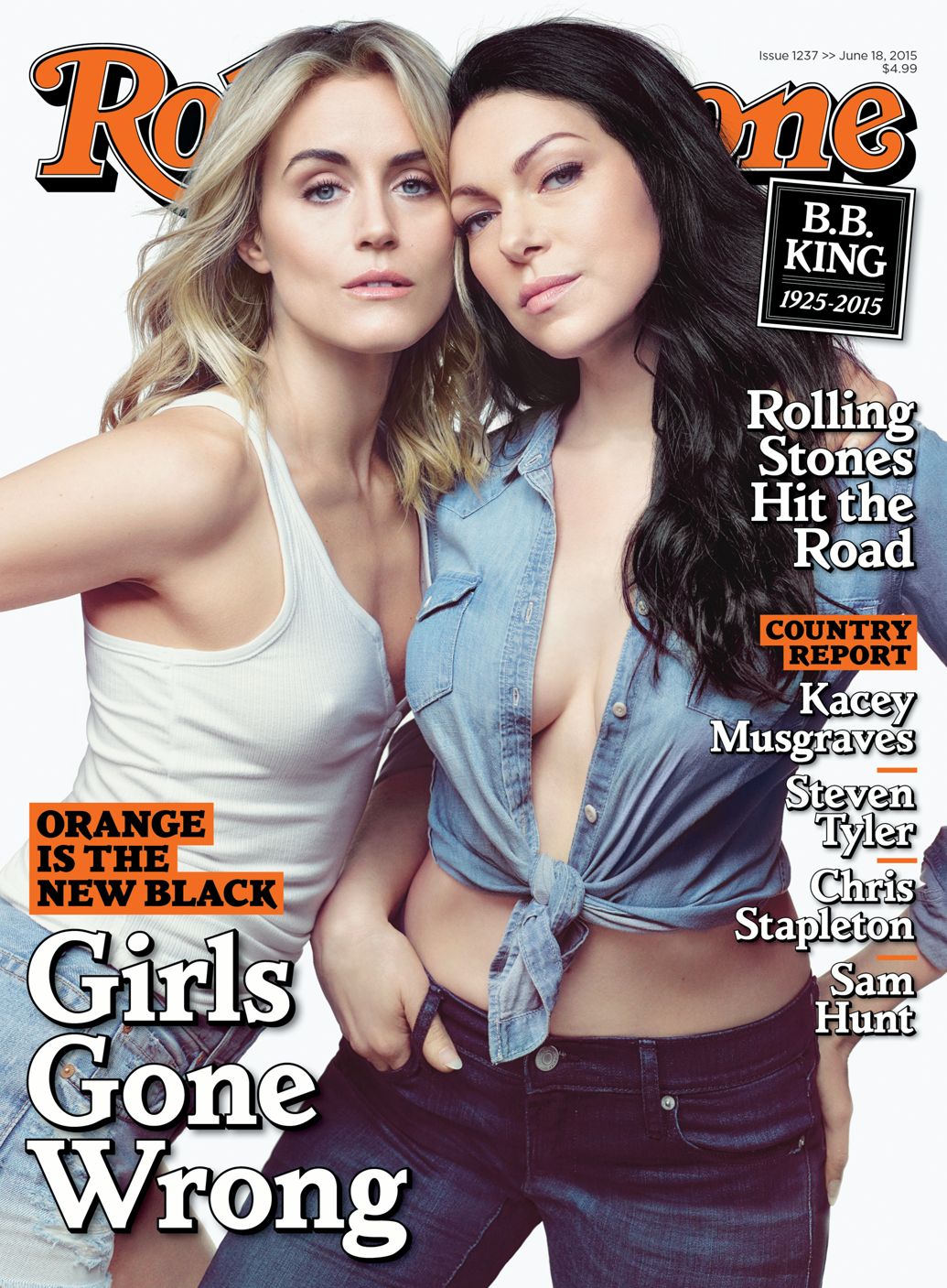
Seriously, Rolling Stone? While the article features interviews with several of the show’s diverse cast members, it’s the hot white lesbian characters that get the cover. Not only that, but the show’s hot white lesbian characters—played by Schilling and Prepon—received the predictable no bra, super sexualized, male fantasy Rolling Stone cover treatment. A white tank top, preferably with no bra, is the magazine’s go to look for women. I hope the company that manufactures women’s white tank tops has sent Rolling Stone an edible arrangement for keeping them in business all these years.
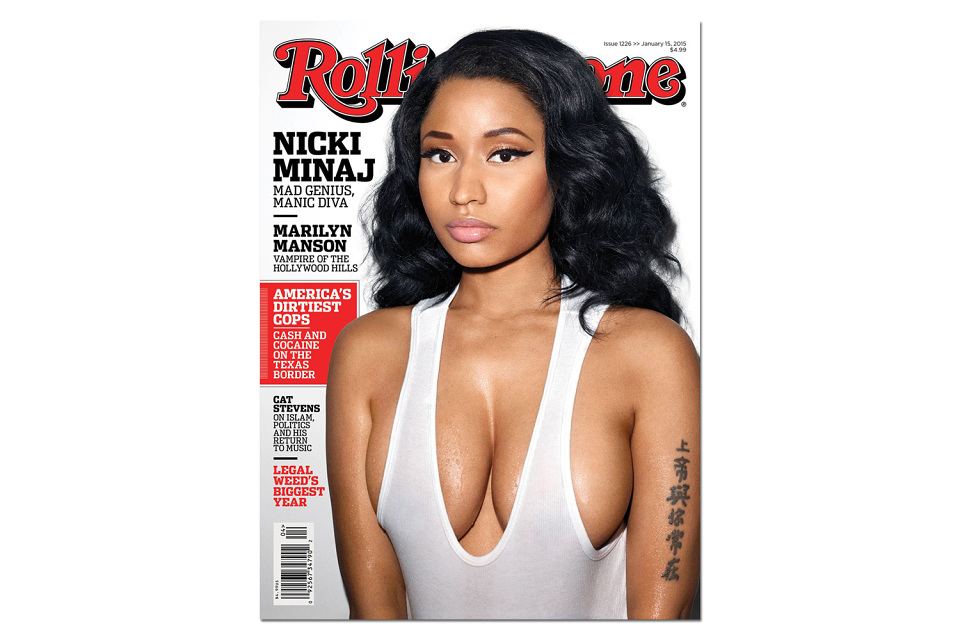
At least Schilling got to keep her nipples (maybe it’s a prison thing). Cover star Nicki Minaj was not so lucky. Minaj appeared on a January 2015 cover where she was given the Barbie boob treatment: her breasts smoothed out and not a nip in sight. “Mad Genius. Manic Diva,” reads the cover copy. Is she manic ’cause Rolling Stone stole her nipples? She should be.
Rolling Stone’s horrible treatment of women is certainly nothing new and, sadly, it only seems to be getting worse. A look at Rolling Stone covers for the five year period from 2013–2009 (the magazine’s online cover archive ends at 2013—maybe because someone became too depressed by the covers to update it), shows that men graced 94 covers while women were featured solo on just 20 covers and were part of six group covers (the cast of 30 Rock, the stars of Mad Men, The Black Eyed Peas).
Rolling Stone is more comfortable putting the Boston Marathon bomber on the cover than it is a woman. In 2013, only three of the magazine’s 24 issues featured women cover subjects; including Lena Dunham, Rihanna, and Miley Cyrus. Tina Fey also got a cover, but was featured alongside two male members of the 30 Rock cast. The magazine also tends to recycle their women cover subjects, suggesting that Lady Gaga and Katy Perry are the only women out there making music—or, at least, the only women making music with enough cover-friendly appeal.
It’s as if we’ve given up altogether on music magazines doing better when it comes to female representation. Well, maybe not all of us. The Stranger, a Seattle alternative weekly, recently published its second annual “Men Who Rock” parody issue designed to highlight the sexism and double standard female musicians face. The “Men Who Rock” issue mocks plenty of the tropes in music coverage, including: the idea that women making music is a trend; the ridiculous way women are posed on covers; interview questions for women musicians, and especially those that tend to focus on tabloid over talent.
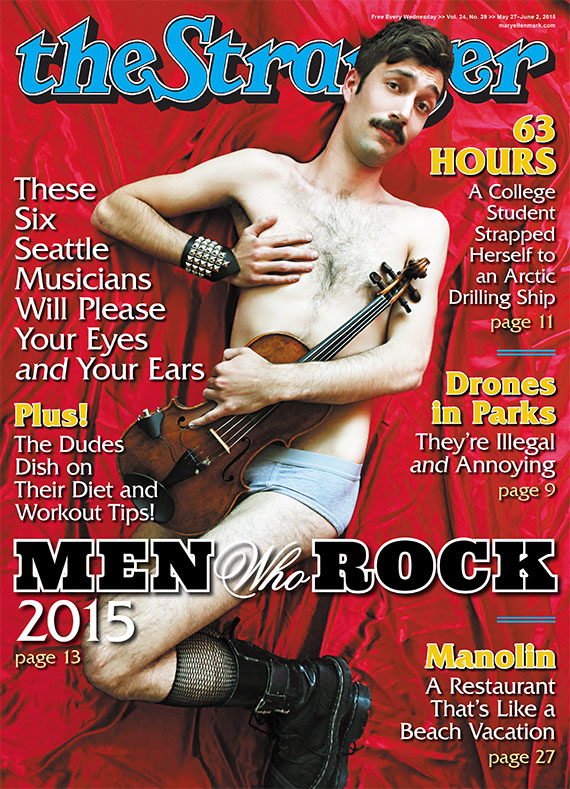
So if you’re looking to follow The Stranger’s lead and do your own “Men Who Rock” parody issue (please do and send it to me) or simply want to publish a magazine that treats women as badly as Rolling Stone does, here are the top 10 tips for dealing with female cover subjects.
1. Putting an actual dick on the cover would be in poor taste (the closest Rolling Stone has come to a dick on the cover is Sean Penn). Instead you should use a series of dick stand-ins. These can include: a rocket, the neck of a guitar, Tasti D-Lite or a ball park frank (bonus points for squirting condiments).
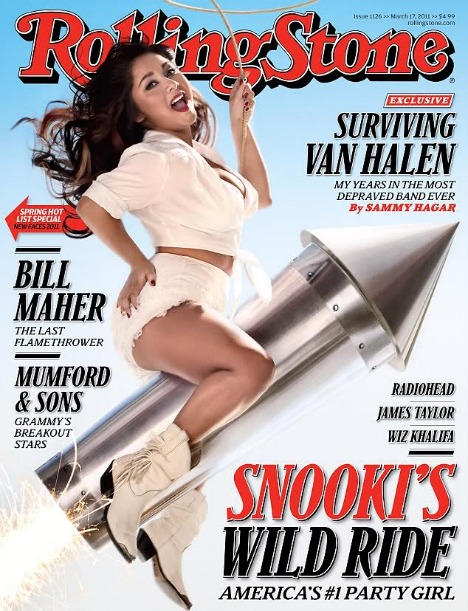
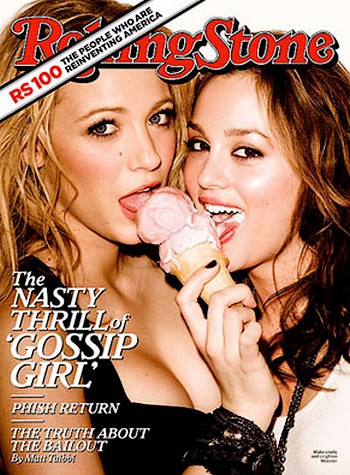
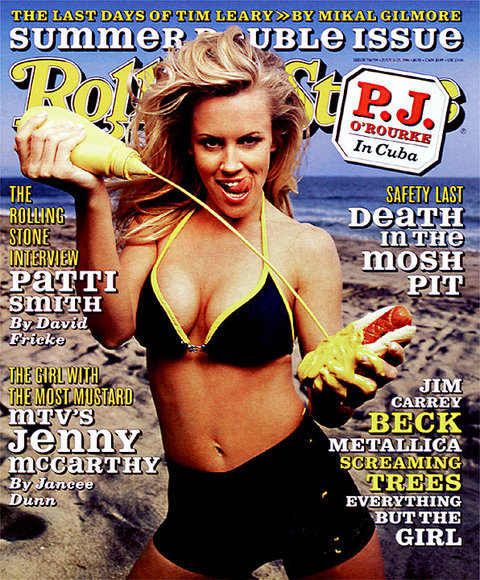
2. If the female cover subject is over a certain age (25) or over a certain size (two), face only please. The tighter the photo crop the better. You don’t want viewers to have to imagine Adele as a sexual being with an actual body. Floating head is best.
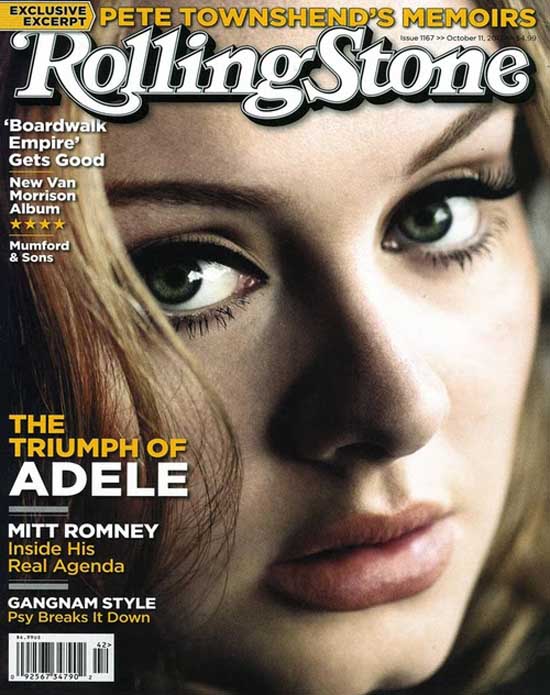
3. Use woman of colour on as few covers as possible. In the five year period from 2013-2009 only three covers featured women of colour. Rihanna graced two of these covers. If a woman of colour wants to be on the cover she should be prepared to die for it. Whitney Houston got the third cover spot when she died in 2012.
4. The less clothing the better. If your subject does have to wear “lots” of clothing it should look like the clothing is just about to come off, or could easily be ripped off in under a minute. I am not sure why they’ve even bothered putting a skirt on Christina Aguilera. Maybe she’s layering up for a post photo shoot game of strip poker? Sadly, there’s not enough word count left for me to get into the “What Christina Wants” cover line. And then there’s Rihanna in a pair of shorts that look like they’re made of partially eaten Fruit Roll-Ups that are ready to dissolve at any moment.
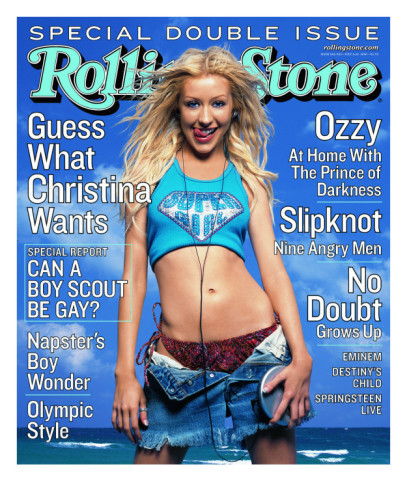
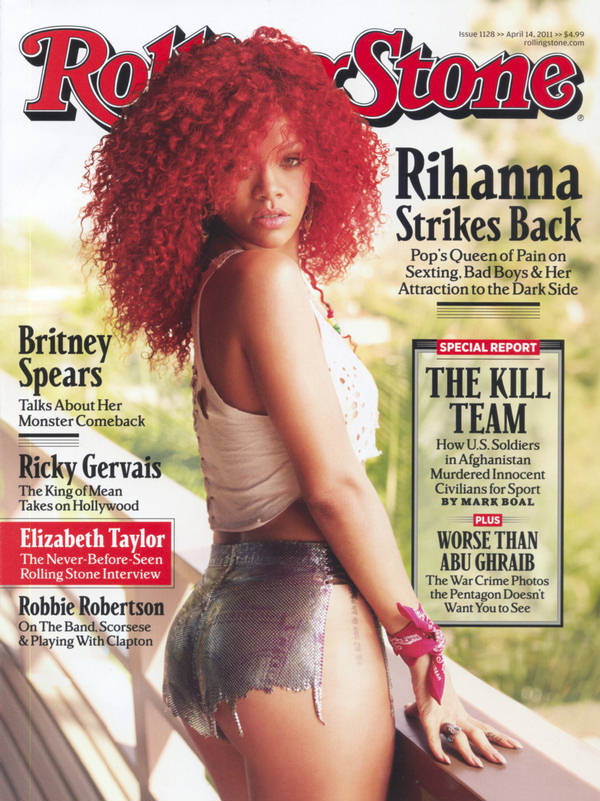
5. No clothing is really the best option. If you are worried about that poor taste thing (see rule #1) just throw on a string of bullets. You’re welcome, NRA.
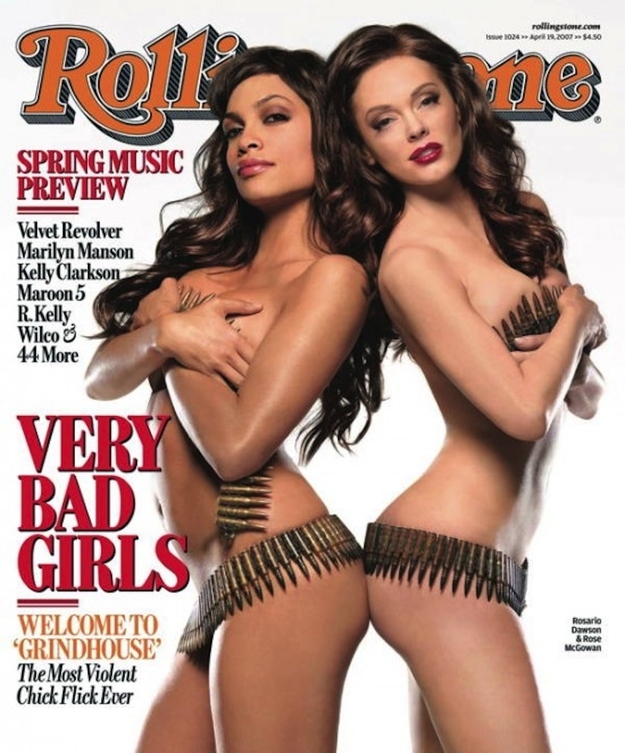
6. Ban the bra? Keep only the bra? Rolling Stone has a very conflicted relationship with the bra and watching them work out their feelings about this undergarment has become extremely tiresome. So very tiresome.
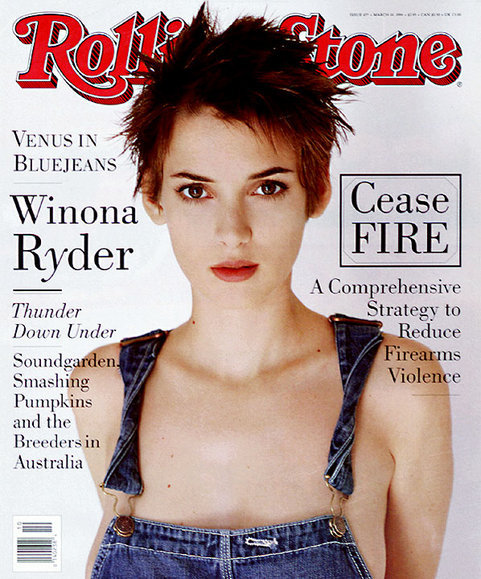
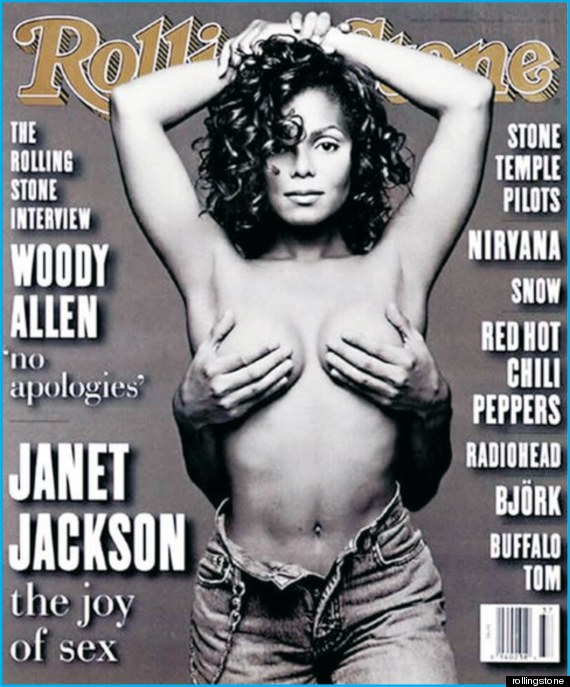
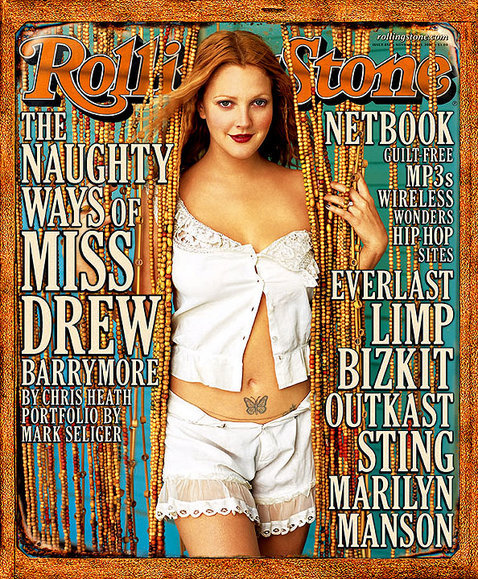
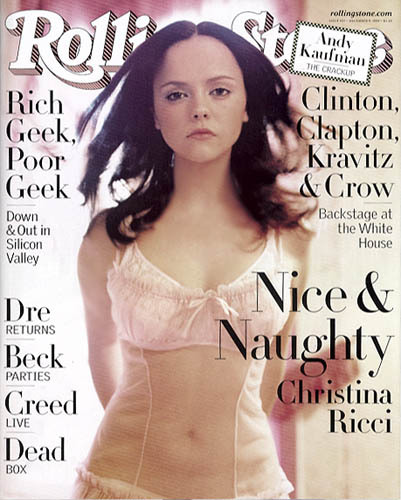
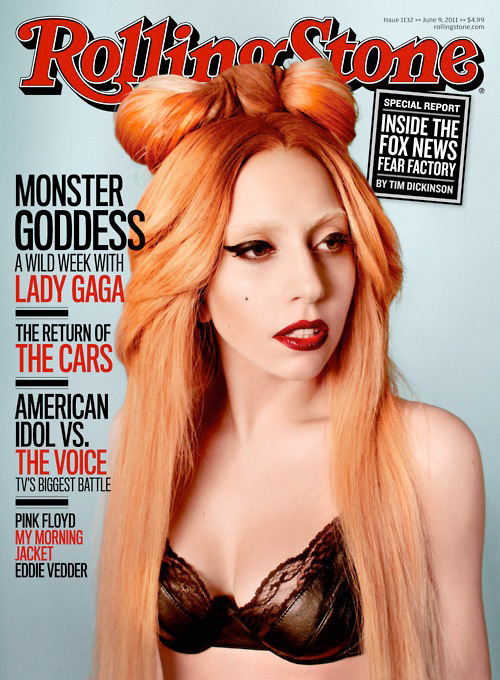
7. Jailbait is A-okay. I’m all for women appearing on the cover of music magazines on their own terms to announce they’re an adult and no longer a tween slave to the cult of Disney, but that’s rarely the Rolling Stone way. Britney Spears was only 17 (Teletubbie age: unknown) when she shot this famous cover—one with which she was reportedly uncomfortable. Rolling Stone didn’t super sexualize Lindsay Lohan or the Olsen twins with their cover image; they let the display copy do that job for them. “Hot, ready and legal!” reads Lohan’s cover while “America’s Favourite Fantasy” accompanies the Olsen twins. Let’s take a moment to remember this is supposed to be a respected music magazine.
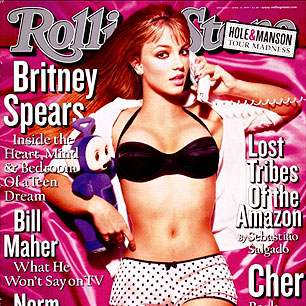
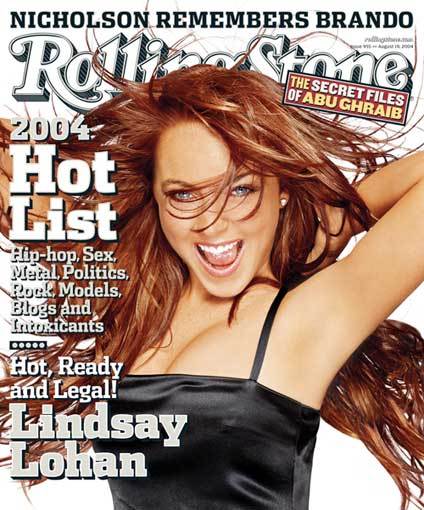
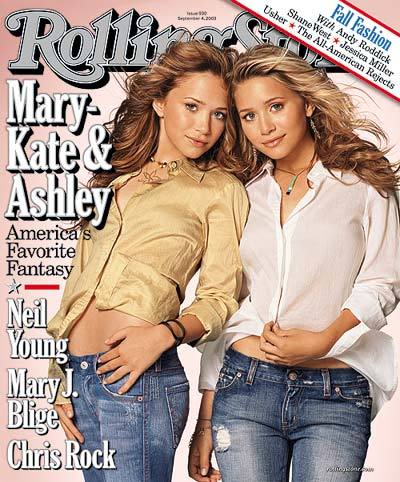
8. Make sure you sex up those cover lines! The Go-Go’s put out! Shania Twain knows what you want! Nicole Kidman uncensored! SEX SELLS! SUBTLETY DOESN’T!
9. Make sure to pose women in ways you would never pose a man. Rolling Stone tends to pose male cover subjects in the exact same way. There’s the familiar head-on face shot. Dave Grohl, Dave Letterman, Dave Matthews—they all blur into one white male face on the cover. Not so for women. Poses should suggest sex and look as uncomfortable as possible. Megan Fox looks like the only thing missing is a sign between her legs that says “insert penis here” Bonus points if the pose is just “hot woman as prop.”
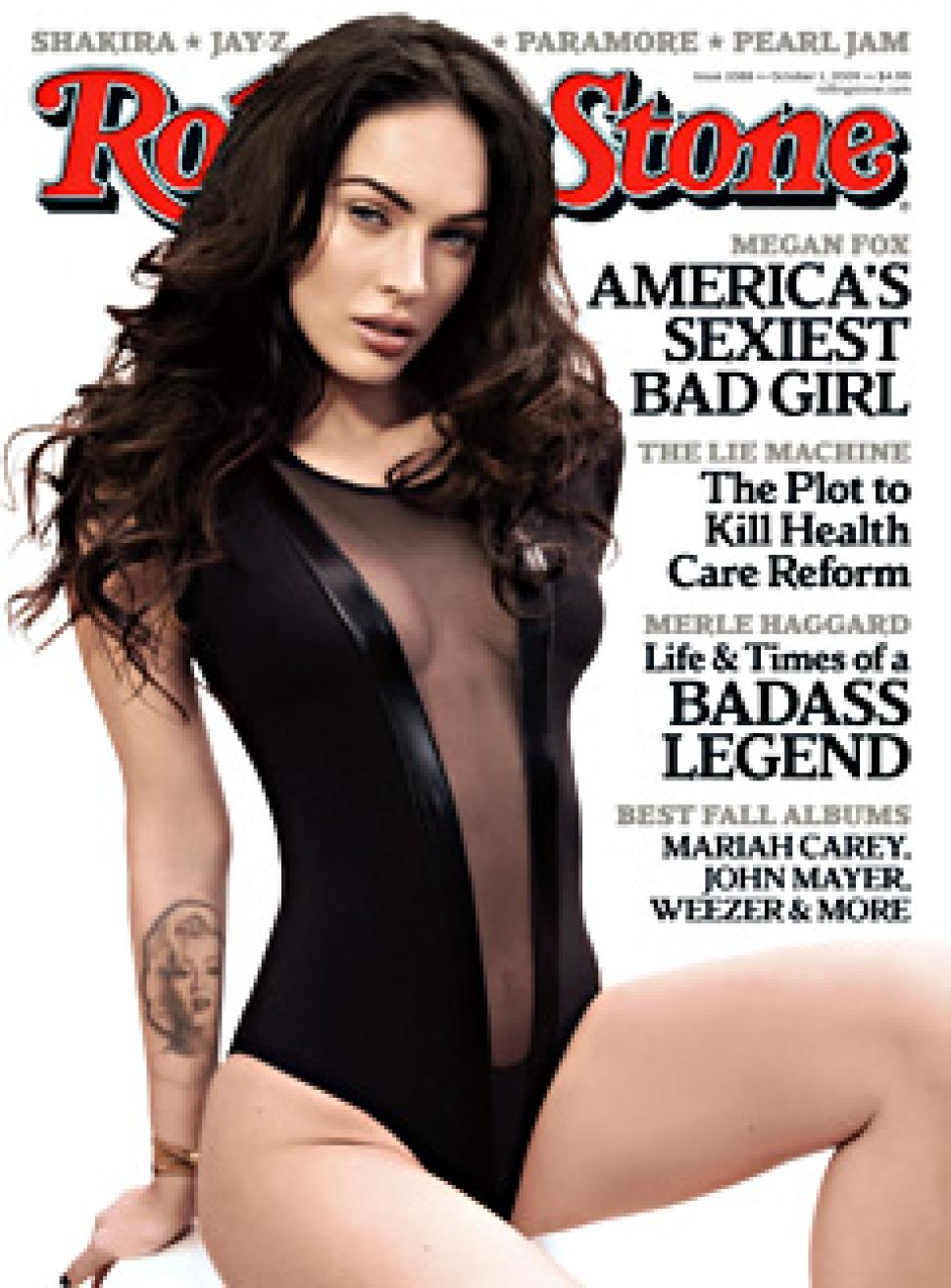

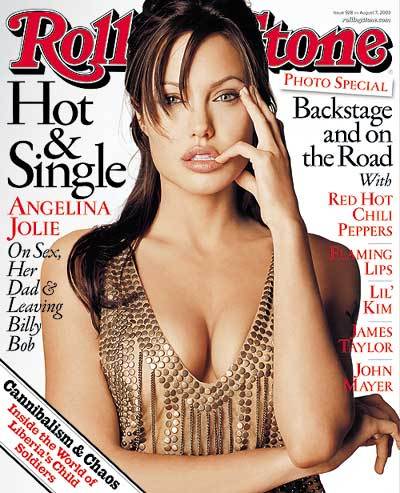
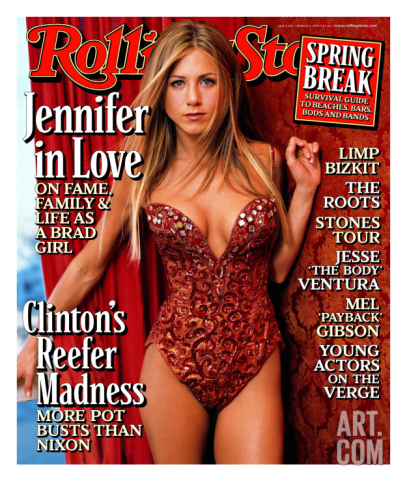
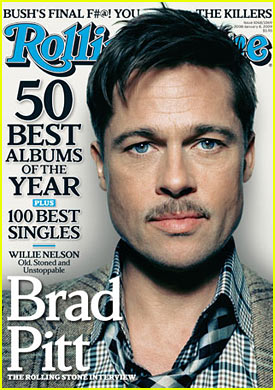
10. Keep the cover conversation light with women. Highlight male cover subjects’ accomplishments, success or stick to “the Rolling Stone interview,”—a standard cover line for men from Barack Obama to Bruce Springsteen. For the ladies focus on their love life, their sex life or their looks. What’s Angelina accomplished? She’s “hot & single.” Jennifer Aniston’s latest project? Her “love life.” What’s Brad Pitt got going for him? He’s got the serious, professional and intelligent sounding “Rolling Stone interview.”
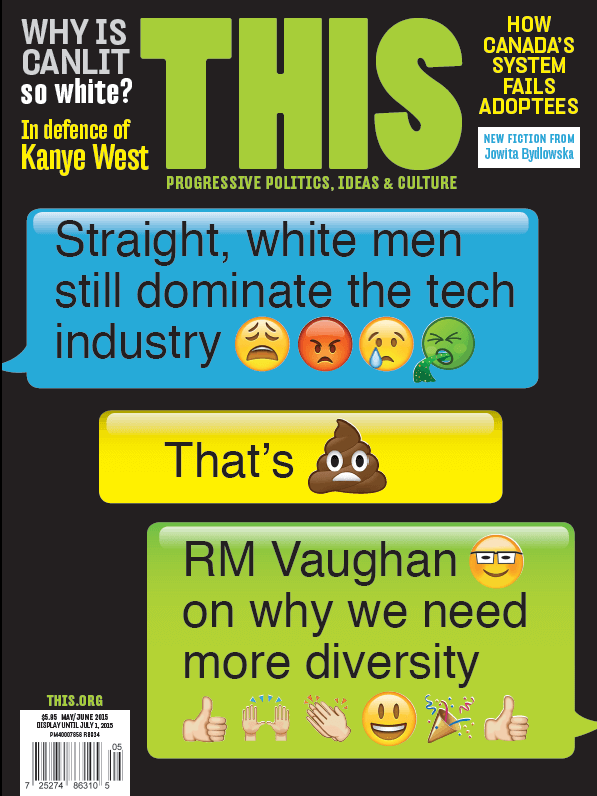
Straight, white, men still dominate the technology industry. In our May/June issue, This Magazine contributing editor RM Vaughan introduces us to LGBTQ activists around the world who are fighting for change. Also in this issue: Sam Juric tells us why we should stop painting foreign adoption as a Brangelina fairytale, and instead focus on the not-so-happily-ever-after of trauma, mental health crises, and isolation that many adoptees and their families face; Nashwa Khan asks “Why is CanLit so white?” and challenges the default narrative in our current education system and literary communities; plus new fiction from Jowita Bydlowska, an essay in defence of Kanye West, and much more!
If you’re having trouble finding This Magazine at your local newsstand or bookstore (so many copies of US Weekly! So very many!) email our publisher Lisa at [email protected] and she’ll help you find a store near you. Or better yet visit this.org/subscribe and get the magazine delivered right to your door.
]]> In early March, the College of Physicians and Surgeons of Ontario released a draft policy paper saying doctors could no longer deny patient care based on moral or religious grounds. The Professional Obligations and Human Rights policy requires doctors who limit the care they provide based on beliefs—such as refusing to prescribe birth control or provide abortion services—must refer the patient elsewhere, without interference.
This policy will prevent doctors from providing or denying health care, “on the on the grounds of race, ancestry, place of origin, colour, ethnic origin, citizenship, creed, sex, sexual orientation, gender identity, gender expression, age, marital status, family status or disability.” (In further it’s-about-time-news, gender identity and gender expression are newly protected grounds of discrimination under the Ontario Human Rights Code.)
In addition to having to refer patients elsewhere (in other words, to doctors who don’t decide who is and isn’t morally worthy of care), doctors will have to explain to their patients, directly and with sensitivity, why they are not willing to recognize things like women’s reproductive rights.
The policy reads: “While the Charter entitles physicians to limit the health services they provide on moral or religious grounds, this cannot impede, either directly or indirectly, access to care for existing patients, or those seeking to become patients.”
Um, how has this not happened yet? How is this even a thing?
I was naive enough to think the primary concern of health care professionals was the health of their patients. But this is clearly not the case—and some medical professionals appear upset their personal beliefs can no longer trump proper care.
Take, for instance, the Christian Medical and Dental Society of Canada. The organization, whose members take pride in what they believe to be moral integrity, held a press conference on the March 25 to announce it has filed an application asking the court to realize this new policy breaches sections of the Canadian Charter of Rights and Freedoms. As reported by the Toronto Star, Health Minister Eric Hoskins recently told reporters: “They’ve been given an alternative. None of this is forcing anything . . . all that’s required of them is providing timely access to another health care professional.”
But to provide such access would be to value reproductive rights—and that’s always been a scary thing for some people, and too often it’s those same people who are in power.
A former This intern, Hillary Di Menna is in her first year of the gender and women’s studies program at York University. She also maintains an online feminist resource directory, FIRE- Feminist Internet Resource Exchange.
]]>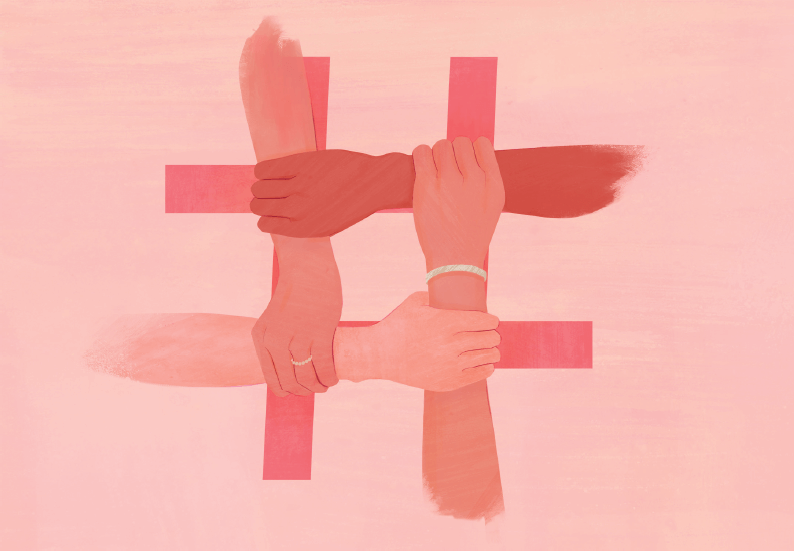
Illustration by Kris Noelle
Critics of social media say it’s nothing but white noise—but it can also amplify women’s voices
Antonia Zerbisias walks into the newsroom on what is her second last day before retirement. It’s early evening on October 30, 2014, and somewhere in between saying some of her last hellos and goodbyes to colleagues at One Yonge Street and attending to whatever final bits of business a columnist and writer has left after more than 25 years at the Toronto Star, she types out a tweet: “It was 1969 when, if you found you were the only girl in the rec room and no parents were home, it was your fault”
Period.
Then, “#BeenRapedNeverReported.” Send.
Minutes later, two more tweets, divulging memories that time couldn’t erase after 40 years.
“ … 1970: My friend’s friend from out of town ‘forgot his wallet’ in his hotel room …”
Period. “#BeenRapedNeverReported.” Send.
“ … 1974: A half-empty 747 to London. Traveling alone. Fell asleep…”
Period. “#BeenRapedNeverReported.” Send.
Hours before sending out these tweets, Zerbisias was messaging back and forth with longtime friend and Montreal Gazette justice reporter Sue Montgomery, together fuming over public reaction to the women who were then, for the first time, coming forward with their allegations of abuse against CBC’s former golden boy radio host, Jian Ghomeshi.
Zerbisias and Montgomery had watched, stunned, as the subsequent flood of questions on Twitter, Facebook, and the comment sections of online articles came in from coast-to-coast: Why didn’t the women report anything when it first happened? Why were they only coming out now?
The victim-blaming narrative infuriated both women, and Montgomery suggested they start a list with the names of women who had been raped but had never reported it—just to prove a point. She wanted to do something to “remove the fucking stigma” and get people to speak up and act up. Zerbisias agreed, suggesting they use social media to get their message out far and wide, landing on the hashtag: #BeenRapedNeverReported.
And so, at 2:55 p.m. she sent out her first tweet:
“#ibelievelucy #ibelievewomen And yes, I’ve been raped (more than once) and never reported it.”
Period. “#BeenRapedNeverReported.” Send.
“The rest is history as they say,” Zerbisias says with a laugh over the phone from her home in Toronto one evening in January. Three months after co-creating the hashtag that ignited a global conversation on why women don’t report rape, the describing word Zerbisias still uses over and over again is “overwhelmed.”
“I didn’t decide to start anything. It just happened. The time was right,” she says. “It seems to me that all we’ve been talking about on social media for the past two years is rape. That’s what focus of feminism is today. Much of the third wave, as it were, is about rape rage.”
“Social media is not just another way to connect feminist and activist voices—it amplifies our messages as well,” Jessica Valenti told Forbes magazine in 2012. Valenti is a columnist with the U.S Guardian and founder of Feministing, a feminist pop culture website, who, among other accolades, has been credited with bringing feminism online. Indeed, it seems today women’s voices are often heard loudest through our screens—a trend some are calling “hashtag feminism.” Although the term itself may be debatable, the phenomenon it points to is not: #Bringbackourgirls, #WhyIStayed, #WhyIleft, #YesAllWomen, #YouKnowHerName, and #BeenRapedNeverReported.
Odds are if you’re a Twitter user, or at all savvy to social media, you’ve come across these hashtags. Each was born out of public outcry in the wake of high-profile tragedies: The kidnapping of over 200 Nigerian girls by militant rebels Boko Haram; Janay Palmer’s decision to stand by hubby NFL running back Ray Rice after he knocked her unconscious in an elevator; the publication ban on Rehtaeh Parsons’ name; and the Elliot Rodger shooting rampage, in which six University of California, Santa Barbara students were killed. These hashtags were quickly taken up by millions around the world as outraged rallying cries for change—for women to raise their voices in unison and scream “enough is enough.”
Historically, feminists did this by marching and picket lines, staking out their causes with signs and speeches. Today many are turning their campaigning efforts toward the most public of public spheres: social media. But what’s the point of it all? When feminists grab their phones and type out an 140 character message, does it inspire positive change? Do these virtual mantras carry actual power?
Answering the questions surrounding the legitimacy of hashtag campaigns begins with a look back at the very roots of feminism, says Emily Lindin, founder of The UnSlut Project—a multimedia initiative working around cyberbullying and slut shaming. Social media most obviously lends itself to a spirit of solidarity between women, and speaks to the idea of a globalized sisterhood, hardly a new idea to the movement at all.
Lindin says the power of hashtag feminism lies not only in the content of a message, but the number of times that message is retweeted. Within the act of using a hashtag is a real sense of unity, or as Lindin so eloquently puts it: a way to “add your voice to a chorus.”
“It’s easy but impactful,” she explains to me one night in a phone call from California. “Feeling that you’re part of something, part of a movement; you’re not just feeling that way—you really become part of it.” Take the campaign she launched in the fall of 2014, #Okgirls. The hashtag originated from news that three high school girls from the city of Norman, Okla., alleged to have been raped by the same boy at their school, and, unfortunately to no one’s surprise, felt abandoned by the school and larger community once the word broke.
Lindin wanted her campaign to create solidarity for the three girls to connect with a globalized network of other sexual assault survivors—to reach out to the young women who had, unwillingly, opened themselves to bullying and potential triggers, just by being online. After all, as Lindin says, one of the hazards created by merging social media and feminism is the vulnerability of opening yourself to trolls, which at best means a slew of derogatory comments, slander, and hate speech. At its worst: death threats, which Lindin herself has experienced. “It works in the way that terrorism works,” she says. “If you speak out we attack you and we threaten you so just stop. Don’t speak up.”
Thinking of the Oklahoma girls, Lindin devised a plan. After contacting the mothers of the girls who had already began the hashtag #YesAllDaughters, Lindin created #Okgirls and asked people to use the hashtag to write direct messages of support and encouragement to the girls using Facebook and Twitter.
“For the #OKgirls: I was raped and then bullied in high school too. You are not alone. I stand with you. #survivor”
“#OKgirls: There is immutable, unmistakable power in your voices. Hear ours too: We believe you. It’s not your fault. Now, #NotOneMore.”
“#OKgirls: Your voices are strong, brave, clear. It’s okay to sometimes feel afraid, but know that there are so many in your corner now.”
Lindin then collected these, and hundreds of other similar tweets and curated them into a set of emails—partly to weed out the nasty comments, but also to allow the girls to remain offline and take a break from watching their own stories blown up in headlines and news stories. She emailed the girls’ mothers the lists of these tweets, which line after line, read as statements of commitment from survivors and allies to stand up and stand by the three girls as one unified community. “It was amazing,” says Lindin.
In January, 2014 Maisha Z. Johnson sends a tweet criticizing her former high school in California. The school had made headlines after spectators at a basketball game chanted, “USA, USA, USA,” to a Pakistani student while he stood at the free-throw line. Almost three hours later she’s calling out her online harassers with hashtags #OhYouMadHuh #WhyYouMadAboutJusticeTho. As evening rolls on, she switches her focus to a less serious subject matter: “The moon is gorgeous right now! I can’t stop staring at her.”
Twitter is all about expression; a space for free thought to abound, no matter how minuscule, seemingly insignificant, obxinious or profound. The phenomenon of status updates in social media offers a moment-by-moment transference of information from “real life” to whomever is behind a screen in a near instant. A point Johnson, a American-writer-activist-poet-turned-social-media-expert unintentionally proves through her own Twitter account, which is that the platform acts as a global space for women to express what she calls their “lived experience”—uncensored and unfiltered.
“I’m not asking for anyone else’s permission for what I tweet,” she says. “I’m not making sure I have the right terminology or anything like that, I’m just expressing myself.” That relationship between terminology and self-expression is pivotal and oftentimes problematic.
Too often, Johnson says, people, particularly women, are pre-occupied with finding the right wording to describe and define their own experiences and, as a result, remain silent. It’s easy for elitism and academia to dominate conversations about why a woman struggled to find an abortion clinic in her home province with vocabulary like “privilege” or “social transformation.” Twitter, says Johnson, brings us back to our “real selves”.
Real language can be used to connect with people, rather than being stuck in a bubble of academics—people who, says Johnson, may have all the vocabulary, but aren’t necessarily committed to communicating about the everyday.
Criticisms of hashtag feminism cover an array of understandably troubling aspects of digital culture that threaten to undermine the well-intentioned changes of social justice work: the temptation to make a hashtag go viral, for example, by picking a sensationalist message for the sake of garnering more attention, or even the inherent privilege associated with owning a smart phone, which raises questions of access and barriers to technology.
Freelance writer Meghan Murphy also writes on her own blog, Feminist Current, that hashtag campaigns give rise to the invention of the “feminist celebrity,” by invariably providing more visibility to certain perspectives on the grounds of popularity while silencing other more marginalized voices, which, in turn, she argues, erodes the very ideology of unity within the movement itself.
However, the most dangerous effect of hashtag feminism seen by Johnson today lays in the constraints of the 140 character limit. The threat: Over simplification. Take the issue of domestic violence, which Johnson herself advocates around in her own writings. On its own, the term, “domestic violence,” evokes images of a cis-man, presumably a husband, assaulting his wife, a cis-woman.
What happens to everyone else—LGTBQ folk—who do not fit into this normative understanding of a relationship? How can we communicate the dynamics of violence in an abusive same-sex or trans relationship, such as the fear of being “outed” by a threatening partner under a single blanket term, “domestic abuse”? And how do we do that surrounded by so many other social media campaigns against spousal abuse? The problem is we often can’t—well, at least not right away.
Johnson believes Twitter is an entry point for inevitably larger, more contextualized conversations. It is a tool designed to stay informed and get in the know about what’s happening, as well as to find the right language to talk about or express an issue.
Lindin agrees. Twitter should be recognized as a chance to jump aboard an idea, she says, not ignite any form of back-and-forth exchange. The 140 character limit is plenty to declare, “here I am,” and add your voice to a cause, but there is a deficiency to expound on the nuances of a topic.
“I told my boyfriend and he called me a whore. Broke up with me. #beenrapedneverreported.”
“The first question the police asked was, ‘what were you wearing?’ I was 10. #beenrapedneverreported <3”
“I’ve #BeenRapedNeverReported because I knew I would be blamed because I had been drinking.”
By the time Zerbisias went to sleep on the night of October 30, 2014, the hashtag was trending in the U.S. By morning she was receiving emails from American and European media asking for interviews. Four days later, the hashtag was translated into French—and who knows how many other languages since. “I was thrilled because it meant women were not allowing themselves to be re-victimized,” she says. “That they were saying ‘fuck you,’ I’m gonna say this.” The hashtag gave women and men the power, space and freedom to come out and reclaim their attack, declaring that they were indeed raped like so many, many others. It was exhilarating to watch, Zerbisias recalls.
Yet, she refused most of the interviews, and turned down offers from organizations and advocacy groups asking her to get involved with their projects. “That’s not my responsibility,” she says. “I’m a writer, I’m not a social worker, I’m not a jurist, I’m not a policy maker, I’m not a law maker, I’m not even an organizer.”
Headlines from around the world applauded Zerbisias and Montgomery for inventing the hashtag that ignited a global discussion into why 90 percent of women never report their sexual assaults to police. “The question,” says Zerbisias, “is, ‘What next?”
]]>If the part about having already fought for everybody else’s equal rights part leaves you a little confused, the actress clarifies what she means later in the press room: “So the truth is, even though we sort of feel like we have equal rights in America, right under the surface, there are huge issues that are applied that really do affect women. And it’s time for all the women in America and all the men that love women, and all the gay people, and all the people of color that we’ve all fought for to fight for us now.”
There are now questions circulating about. Did nerves leave the actress rambling and unguarded? Was she not really thinking? Or does she actually believe that gay and civil rights are segregated from feminism? It all sounds very second wave feminism, void of any thought regarding intersectional oppressions. And though it may be frustrating to hear privileged, rich, white women talk about oppression, actresses like Arquette and Emma Watson are celebrities who many look up to—whose words are taken to heart. Their words can lead others to take baby steps to feminism. Even fumbles like Arquette’s pressroom comments can be a jumping off point for discussions on gender equity and intersectionality.
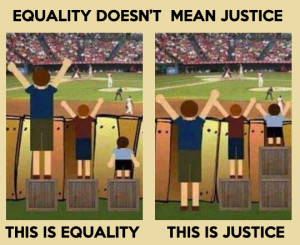
When talking about injustice, the word “equality” is often used in defining justice. Emma Watson used the term in her speech to the UN last September, and many other well-meaning folks do as well. But, equality operates on the idea that everyone is starting from the same place. That’s just not the case when it comes to gender discrimination and pay. Women of colour, Indigenous women and women with disabilities, for example, face barriers white able women do not—there is still a mainstream default ideal, which is based on whiteness, heterosexuality, middle-class status and having an able body.
It is well documented that women in higher-up positions, such as CEOs, make less than their male counterparts. It is also known that women are hired more for part-time work. Since the dominant gender norms dictate that women are the caregivers, mothers take the pay hit, whether it be in daycare fees or part-time work, as well as low maternity leave pay. Even for women without children, the mere possibility that they could get pregnant lessens their chances of being hired, among a list of other tired and sexist excuses. Equity would first create fairness for all people. Access to the same opportunities needs to be made before moving on to equality as the ideal. But there are so many overlapping factors regarding oppression. Race, class, religion, sexuality, ability, language, family, gender, and on and on.
White, heterosexual, rich women do not own feminism. Looking at Arquette’s comments, she seems to have forgotten that there are women of colour and gay women, or the fact that civil and gay rights have not yet been achieved.
I want to give the actress the benefit of the doubt; I want to be happy that feminism is being brought into the mainstream. Earlier today she Tweeted, “The working poor women of this country have been asking for help for decades. If I have “privilege”* or a voice I will shine light on them.” Hopefully those who were enlightened to feminism through Arquette’s speech will join the discussions about intersectionality so that these same mistakes won’t be made again.
*The reluctance of those with any privilege admitting that they have privilege is a whole other post.
A former This intern, Hillary Di Menna is in her first year of the gender and women’s studies program at York University. She also maintains an online feminist resource directory, FIRE- Feminist Internet Resource Exchange.
]]>
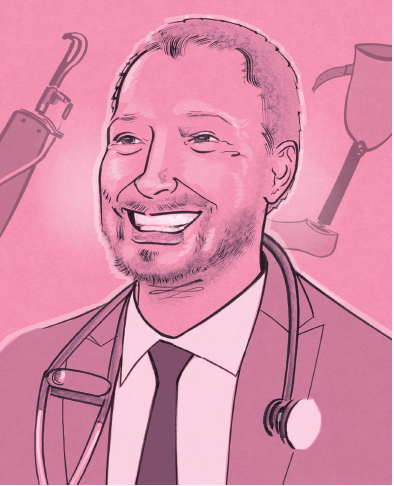
Illustration by Nick Craine
Dedicated anti-poverty activist and doctor Ryan Meili tackles the root causes of illness and addiction
IN 2010, RYAN MEILI STOOD in the medical clinic where he worked, on the west side of Saskatoon. A girl named Maxine walked in. She was a 20-year-old from the streets who moved as if she were 91. She wanted antibiotics, but really needed a hospital. With a case of full-blown AIDS and a drug addiction, she was getting weaker. Meili remembers the sound of her lungs through his stethoscope, like a rubber boot being pulled from the mud. There was only so much he could do—the damage was done. Maxine’s life had been tragic, full of poverty, dysfunction, and abuse of all sorts. He finally got her to a hospital, where he visited twice a day, but she came and went, often scoring drugs in between.
Meili says stories like Maxine’s are much too common in Canada, and the 39-year-old Saskatchewan-based family doctor is fiercely determined to break the pattern. “What we can do in response as health care providers is really limited,” he says, “because we’re not really able to impact the root cause of illness.” But Meili decided to try anyway and in 2013, he created Upstream, an organization that seeks to address the social determinants of health, such as poverty, nutrition, education, and housing.
In just a few short years, the movement is already making strides: sparking conversations on social media via Facebook, writing blogs and articles for national news outlets, and creating partnerships to deliver awareness on determinants in powerful ways. In 2013, Meili learned that Saskatchewan and B.C. were the only two provinces in Canada without a poverty reduction strategy, so Upstream helped spearhead the recent Poverty Costs campaign, working with the Saskatoon Anti-Poverty Coalition, Saskatoon Food Bank, Saskatoon Health Region and other groups keen to implement a plan.
Through sharing hard facts (the economic cost of poverty in Saskatchewan is $3.8 billion due to increased health and social services), a fierce letter-writing campaign, and asking disadvantaged men and women to share their stories online, Poverty Costs turned out to be a big win, with the Saskatchewan government committing to a poverty reduction strategy in October 2014.
“It’s about taking what we know, getting people aware of it, turning that awareness into real policy change and, ultimately, improving the health of Canadians,” says Meili, who realized he wanted to work with under-served communities when he started practicing medicine. He felt it mattered more to service patients most in need. Then, during his first year of medical school in 2002, he met Dr. William Albritton, professor of pediatrics and then dean of the College of Medicine at the University of Saskatchewan, who further inspired him with the idea of social accountability—that doctors should be mindful of growing social concerns.
The following year, Meili and two friends approached Albritton with the idea to start a student-run clinic in Saskatoon’s inner city. “When he first got started, I told him the problem is not going to be setting up the clinic, because you’re committed and have that ambition,” remembers Albritton. “The success of the clinic will depend upon attracting people who will follow you, who will maintain that same degree of commitment. And he’s tenacious; he’s done a very good job of finding
people with those same world views.”
Eleven years later, Meili is now a supervisor at the Student Wellness Initiative Towards Community Health (SWITCH) clinic that sees about 50-plus clients every shift, three times per week. “Some days are tougher than others. Some days you take a story home, you get touched by people. It’s really hard,” he says. “But it’s even tougher to not be there. It’s tougher to walk away. Once you’re aware that there are these injustices and people who are struggling, you want to be there to help.”
Meili would surprise a lot of people if he ever did walk away. “He’s always had this intense, clear vision of the world that he believes we could have, with no sense of exhaustion in pursuing that,” says Liz James, a longtime friend who met Meili while the two were involved with the student activist network at the University of Saskatchewan. “Things seem possible to Ryan that not everybody believes are possible.”
Take, for instance, the time he was living in Halifax in 1999. He was working at the Big Life Café as a cook and server and heard about an initiative out of the Falls Brook Centre, a local community hub. People were casually tossing around the idea of delivering prosthetic limbs to poor communities in Central America as part of the Limbs to Light campaign. That summer, Meili tore out the seats of an old yellow school bus he rented, strapped himself in and drove from Saskatoon to Halifax, collecting unwanted limbs along the way. Loaded to the roof with arms and legs, he drove down the east coast of the U.S., until he reached Nicaragua. In local villages, victims of landmines had been fashioning scraps of homemade material into limbs. Meili dropped off his stash to the Red Cross and, one month later, headed back home.
Travelling back and forth between run-down areas of Central America, and disadvantaged communities in Saskatchewan, Meili witnessed the same kinds of injustice, gaps between rich and poor. So began the shift from a direct hands-on, people-helping person (which he still is) to thinking more in terms of the system as a whole, rethinking not only about health care, but how we make decisions as a society.
In his early days with the SWITCH clinic, in 2006, Meili was invited to speak at a New Democratic Party (NDP) Convention where he challenged the ruling government to do a better job of balancing resources. “I think from that experience, I realized if I wanted politics to work that way, I needed to get more involved.”
So he did. He ran twice for leadership of the Saskatchewan NDP, first in 2009 when he finished a close second, and then in 2013 when he lost by 44 votes. He’s not sure he’ll run again, but it’s possible. “It would have been an excellent place to bring these ideas forward, but right now, what I’m able to do with Upstream in practice and research is valuable,” he says. “The challenge now is to try and accomplish something dramatic. What we’re really trying to do is apply a new lens to our political decision-making and to do that is pretty ambitious.”
Meili hopes to steer what he calls “an issue that cuts across political lines” and move away from a system that “flounders from crisis to crisis” to one that presses societal concerns—such as the life circumstances of young girls like Maxine.
Maxine never had chances, and her fate isn’t difficult to predict; it’s right there in the first chapter of Meili’s book, A Healthy Society, published prior to his second political run. Meili had been working with a First Nations community in rural Saskatchewan when he got the news. Maxine ran back to the streets she’d known since she was 13 and was hit by a car that shattered her pelvis. Back in the hospital, she contracted pneumonia. She never recovered and died just before her 22nd birthday.
“What often escapes our attention when considering the tragic story of one individual is how intimately it is connected to all of us, to the collective decision-making process that is electoral politics,” says Meili. “It is politics that decides whether young women like Maxine live or die.”
]]>“Studies show that men interrupt women during meetings, while in groups with friends, and while speaking one-on-one,” writes Lucy Vernasco in Seven Studies That Prove Mansplaining Exists published by Bitch Media July 14, 2014. Rebecca Solnit, author of Men Explain Things to Me, coined the term “Mansplaining.” In her essay, titled the same as the aforementioned book, she shares her experiences with mansplaining, including that of one man who interrupted her to tell her about a book—one that he hadn’t realized she’d written. “The battle with Men Who Explain Things has trampled down many women,” she pens. “Of my generation, of the up-and-coming generation we need so badly, here and in Pakistan and Bolivia and Java, not to speak of the countless women who came before me and were not allowed into the laboratory, or the library, or the conversation, or the revolution, or even the category called human.”

Image from Men Taking Up Too Much Space on the Train
Then there’s the physical space. The perfect example of “public assertions of privilege,” is the blog, Men Taking Up Too Much Space on the Train, a collection of guys enjoying extra space, despite packed public transportation vehicles.
Women are supposed to take up so little space, that even our bodies must be thin. Lily Myers speaks of her parents and grandparents in her spoken word poem, Shrinking Women. While her father and grandfather grow fatter, the women in her family shrink, to take up less space; “Maybe this is why my house feels bigger each time I return; it’s proportional.”
Gender roles tell us that women must be small and quiet, while men must be large and commanding. We aren’t supposed to take up space but men are expected to have, and take, it all. Last summer, during Slut Walk Toronto, it was requested those walking take up as much space as possible. I make this same request to all women.
A former This intern, Hillary Di Menna is in her first year of the gender and women’s studies program at York University. She also maintains an online feminist resource directory, FIRE- Feminist Internet Resource Exchange.
]]>
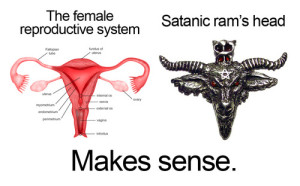
Now but a meme, this was originally seen as fact
So long ago it was proven that women are evil because, duh, uteruses have horns.
This week, I am reading An Introduction to Women’s Studies Gender In A Transnational World by Inderpal Grewal and Caren Kaplan for Dr. Kristine Klement’s Introduction to Gender and Women’s Studies class at York University. We are focusing on how science may just be as culturally affected as the rest of us, especially when it comes to gender: “Many people think that biology answers [what counts as difference] once and for all,” reads the first essay, “Social and Historical Constructions of Gender.” “But science (including biology) has a history.”
These influences affect different aspects of gender and sexuality. As Dr. Klement points out, “Binary thinking affects science.” Because we are so dead set on sticking with this male/female gender dichotomy we are able to use science to justify prejudice against trans* people, or decide what gender role a child will be expected to live up to—something many people and organizations, including the Intersex Society of North America would like to see stop. “Intersexuality is primarily a problem of stigma and trauma, not gender,” reads the society’s website, for example. “Parents’ distress must not be treated by surgery on the child.”
I’m not saying all science is terrible—it’s a pretty broad profession and, of course, used toward wonderful advancements. But scientists are still people coming from an oppressive culture, with their own ideas and—even though some may be subconscious—their own prejudices. And there’s quite the history of how it has been used to justify the dehumanization of women, especially working class women. Take, for instance, the early 1900s case of Margaret Sanger.
Sanger, is considered the mother of the birth control movement. Earlier this summer, The Washington Times published an article about Sanger’s pushing of the eugenics movement. Sanger wanted birth control to be used for “respectable” married women, not working class women—despite her own working class background. “Her views and those of her peers in the movement contributed to compulsory sterilization laws in 30 U.S. states,” writes Arina Grossu in The Washington Times. “That resulted in more than 60,000 sterilizations of vulnerable people, including people she considered ‘feeble-minded,’ ‘idiots’ and ‘morons.’”
Almost a hundred years before Sanger was Paul Broca, known for measuring skulls, or, crainometry. Broca also thought we were a bunch of idiots, and wanted science to prove this. He determined women’s heads were smaller than men’s, and thus women were more stupid. Stephen Law writes about it in “Women’s Brains,” quoting who he referred to as “a black sheep in Broca’s fold,” L. Manouvrier: “Women displayed their talents and their diplomas. The also invoked philosophical authorities. But they were opposed by numbers … The theologians had asked if women had a soul. Several centuries later, some scientists were ready to refuse them a human intelligence.”
Also, on the list of “bad” things women’s bodies do: shedding unnecessary garbage during menstruation while men are being awesome producing all sorts of sperm (“The Egg and the Sperm” by Emily Martin.) “In analyzing male/female differences these scientists peer through the prism of everyday culture, using the colours so separated to highlight their questions, design their experiments, and interpret their results,” writes Anne Fausto-Sterling in ‘The Biological Connect.’ “More often than not their hidden agendas, non-conscious and thus unarticulated, bear strong resemblances to broader social agendas.”
Interestingly enough, at my last science lab, part of my assignment was to help a fictional lady, Jezebel (named after the Bible’s bad girl), figure out the father of her baby.
A former This intern, Hillary Di Menna is in her first year of the gender and women’s studies program at York University. She also maintains an online feminist resource directory, FIRE- Feminist Internet Resource Exchange.
]]>Two days later, Joseph Gordon-Levitt sent a video request through the internet to collect viewer’s thoughts on the word feminism and what it means to them: “To me it just means that your gender doesn’t have to define who you are; that you can be whatever you want to be, whoever you want to be, regardless of your gender,” says the actor. Responses will be used to make an episode for Gordon-Levitt’s company Hit Record for an episode called “RE: Your Mom.” It’s perfect for Gordon-Levitt, whose mom taught him about feminism and was active in feminism’s second wave.
“I decided that I was a feminist. This seemed uncomplicated to me,” says Watson. “Apparently, [women’s expression is] seen as too strong, too aggressive, isolating, and anti-men, unattractive even.”
Whether we’re into pop culture or not, it is important that these celebs are speaking out about the importance of feminism. Because of their position of cultural power and a voice that people will listen to, their messages will be heard, and then shared, re-blogged, and talked about. “Cultural domination has real effects,” writes Stuart Hall in his essay Notes on Deconstructing ‘The ‘Popular.’ “If we were to argue that these imposed forms have no influence, it would be tantamount to arguing that the culture of people can exist as a separate enclave, outside the distribution of cultural power and the relations of cultural force.”
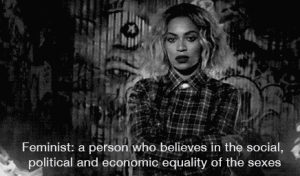
Beyonce knows.
A friend of mine compares it to a person who has a megaphone at a demonstration and how they appear to have authority over the chants at a demonstration. Yet, if people are listening to celebrities no matter what, why can’t it be for the good of feminism?
“Feminism and pop culture will always be uneasy bedfellows in a larger culture that remains conflicted,” writes Andi Zeisler in her essay Pop and Circumstance, as part of Feminsim and Pop Culture. “About how much power, agency, and autonomy women should have.”
A former This intern, Hillary Di Menna is in her first year of the gender and women’s studies program at York University. She also maintains an online feminist resource directory, FIRE- Feminist Internet Resource Exchange.
]]>