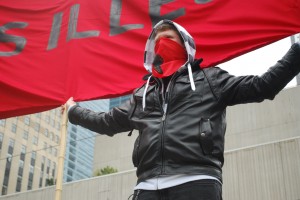
A young protester helps to hold the banner for No One Is Illegal
More than 1,500 people gathered at Nathan Phillips Square yesterday to rally and march down Queen Street for May Day—and to rejuvenate the Occupy movement . The co-event was organized as part of International Workers’ Day, in a joint effort between No One Is Illegal, Occupy Toronto and the May 1 movement, which is a coalition of organizations from around the city.
I arrive at the predetermined location at 3:30 p.m., about a half hour before the event was slated to start. (I am habitually early to just about everything.) When I get there, there are only a few small clusters of yellow clad police officers standing and waiting; others circle the premises on their bikes. Major news networks are parked out front. Camera crews wander aimlessly around the vacant demonstration area. A women who appears to be a regular tourist, snaps pictures while other pedestrians carry on with their own business.
As it turns out, the tranquil and quite nature of the square is really the calm before the storm.
Patiently waiting for things to kick start, I find myself seated next to a woman and her young child. The young mother, named Angie, is holding a small homemade sign: WE ARE WORKERS, NOT COMMODITIES. “As workers we are people and we should be compassionate towards each other,” says Angie. “People should care about making sure everyone has enough to eat, everyone has enough resources, where as commodities are just things. I mean when you are just a little number on the balance sheet in the cost section, who cares about that?”
As the minutes slipped toward 4 p.m., more and more people began to gather in the front of the square. These ever growing factions, I think, may be a sign of the growing awareness of the issues at hand. I begin to notice more flags, and a growth in the number of signs poking out of the crowd. There is a young man moving along the walking bridge writing “CAPITALISM WORKS FOR THE RICH”, with chalk.
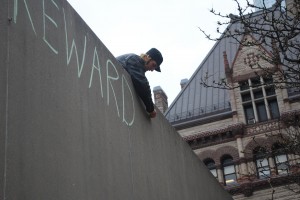
A man writes out a message in chalk for the entire crowd.
I hear a faint drumming off in the distance. This sparks a kind of energy within the growing crowd: Something is about to take off.
Not long after the arrival of the drummers, No One Is Illegal sweeps in with a sea of black and red. A massive roar rips through the square. It has begun.
The goal of the event is to join in solidarity with people throughout the world in a fight to draw attention to the problems within our society. Workers rights for undocumented workers, documented workers, migrant labours, for refugees, for people who are out of work and looking for work, and those who are under employed—to name a few.
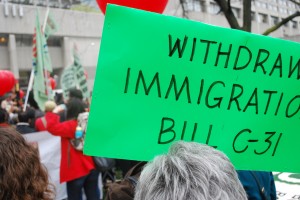
One of the many signs seen throughout the square.
At about 4:30 p.m, people begin to step up to the generated powered mike to address the crowd. Each speaker represents a different group involved with the movement, but every message centres on the same demand: a need for change. The engaged crowd listens contently, then joins in with various, rotating chants including, “Harper is a criminal, Kenney is a criminal and Ford is a criminal.”
A middle aged man named Armando makes his way through the crowd with his bike in order to gain a better vantage point of the speakers. He wears a red bandana around his neck in support of No One Is Illegal. “This is a very important historic day,” says Armando. “So it’s good to share in the movement that started last year and today maybe is going to restart Occupy Toronto.”
A similar sentiment is prevalent with many of the demonstrators. Katie Berger, who works with Occupy Toronto, is excited about the group’s direction. “We’ve been super active over the winter. Just not so much visible.” Since the group ended their occupation of St. James Park in late November of last year, a great deal of planning and education has been taking place. “This was part of the direction we wanted to take,” says Berger. “A lot of people involved in the occupy movement are very new to activism and one of our goals is to unite and learn from the people who have been doing this and working for these struggles for years.”
Berger was not involved in the planning around the initial occupation. She believes this time around they are better prepared. “We really took this time to regroup and try to outreach to more people and look within our own group and figure things out.”
With the closing of the rally the hundreds strong crowd took to Queen Street for a march to Alexandria Park for a cultural celebration led by a small group of indigenous peoples. Police lined the middle of the street separating the crowd from the disrupted rush hour traffic. Onlookers stood in awe of the massive crowd flowing through the downtown, chanting dozens of different messages.
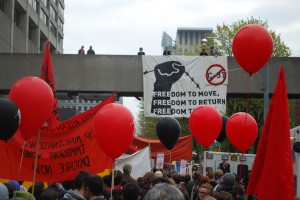
Demonstrators begin their march down Queen St.
Following the cultural celebration, Occupy Toronto set out to their final location for a 24-hour reoccupation of Simcoe Park. Occupy intends to start 24-hour occupation at various locations throughout the city.
Prior to heading to the demonstration yesterday I was reading “Among the Rebels”, by Lia Grainger in the most recent issue of This Magazine. I came across a quote that made sense when looking back at the event yesterday and where this movement is going. The quote read,“Action. Reflection. Action.”
We have now reached the point of action. Like most movements everything takes time, nothing happens over night. We learn from history and therefore we can engage the future better prepared. I think that is where we are headed this summer. People are taking the lessons they acquired and implementing better tactics with a more focused cause. The cause is still not perfectly drawn out yet, but I’m sure it’s waiting to erupt and when it does, more people will grab hold, not because they are band wagon jumpers, but because they finally see themselves in the movement. A cause, a concise cause can bring more people together.
This should be the focus. In order to gain public support, I think, you need to appeal to them, find the common link. If they can see the direct impact on their own lives it’s only a matter of time before the movement is full blown and the governments, banks, or whoever it may be, will have no choice but to listen.
]]>
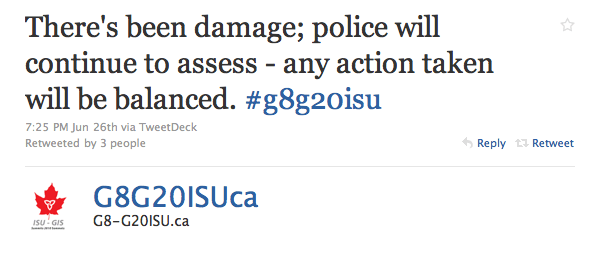
The police knew that social media was going to play a prominent role in the protests, and so they had a presence on Twitter, Facebook, and YouTube, to communicate and to try to exert some measure of spin control. On Saturday, after protesters engaging in Black Bloc tactics broke windows and set fire to several damaged police cars, the Integrated Security Unit tweeted their awareness and reassured followers that the police reaction would be “balanced”:
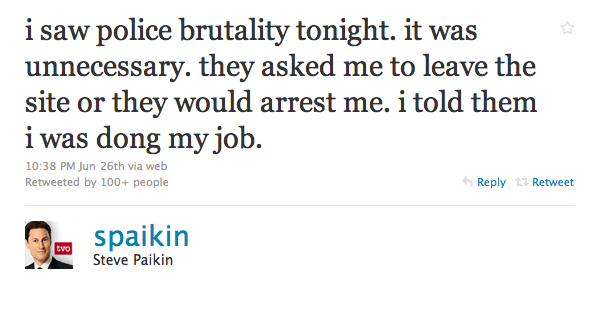
But it was not to be. Police actions just a few hours later got wildly out of hand. Steve Paikin, host of The Agenda on TVO, was at the Novotel demonstration on Saturday night and his tweets showed that you can still shock a veteran news reporter who’s seen it all. After his experience, he wrote a now-widely-cited blog post that pulled no punches with its blunt headline, “An Awful Night for Democracy in Toronto“:
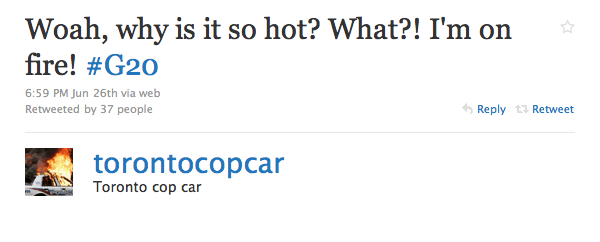
You don’t have a social media news revolution, of course, without some social media internet-meme jokesters coming along for the ride. Riding the coattails of @MontrealCopCar—the Twitter account that instantly popped up after spectators burned 16 Montreal police cars in April 2008 to celebrate a hockey victory—@Torontocopcar was online before the flames were extinguished.
The mood was considerably darker Sunday afternoon when security forces cordoned off the corner of Queen and Spadina, saying they had evidence there were people within a small group of marchers along Queen West intent on committing more vandalism. As storm clouds loomed, ranks of riot police “kettled” everyone in the intersection, including several tourists, passers-by, people waiting for the streetcar, and more. Among the crowd was Globe and Mail writer Lisan Jutras, who quickly felt the vibe change…
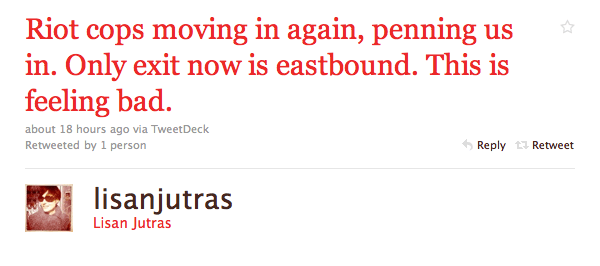
…While Justin Stayshyn also tweeted from inside the kettle that many of the people being detained were curious onlookers, not troublemakers:
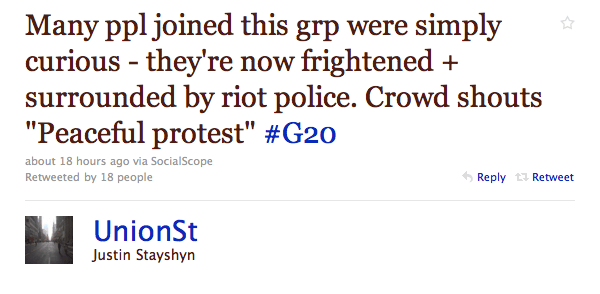
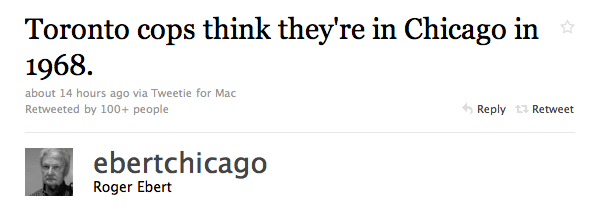
Not that it mattered. Police ultimately kept the majority of people inside the cordon, in a torrential downpour, for roughly five hours. News of the baffling police action travelled fast and far, prompting Roger Ebert to make the historical connection that the kids and their iPhones couldn’t:
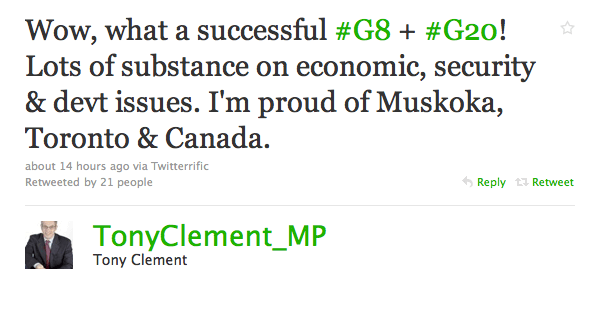
Shortly after, Tony Clement, Canada’s minister of industry, merrily chirped what a grand and successful affair the whole thing had been, taking the prize for Most Fatuous Public Statement Of The Evening:

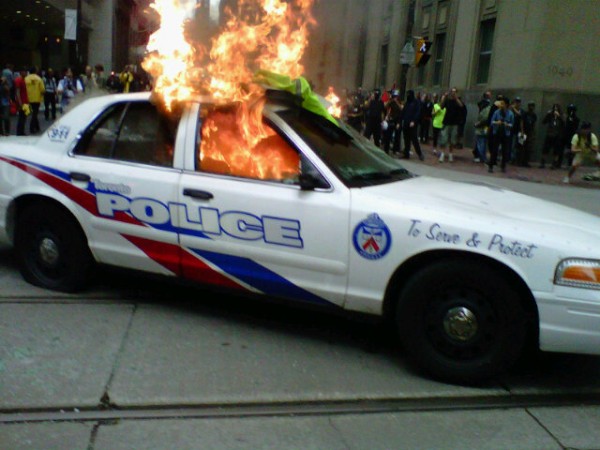
One of the most notorious images from Saturday was a Twitpic of a burning police cruiser, snapped by Alex Posadzki, which as of this morning had been viewed more than 18,000 times. As many commentators pointed out, the G20 saw four police cruisers burnt, compared to the 16 destroyed in Montreal by celebratory rioters after the Montreal Canadiens won a hockey game in April. But this has still become an indelible image, and footage of burning police cars quickly became a recurring motif of the television coverage over the weekend.
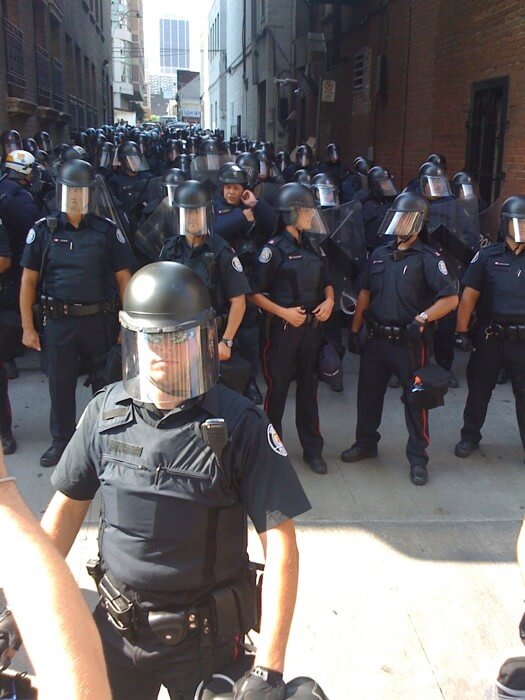
The sense of creeping anxiety didn’t start for most of us until Friday afternoon when Jeff Robson tweeted this photo of riot police crammed dozens deep in an alleyway as peaceful protesters went past on College Street. In hindsight, it was a harbinger of things to come:
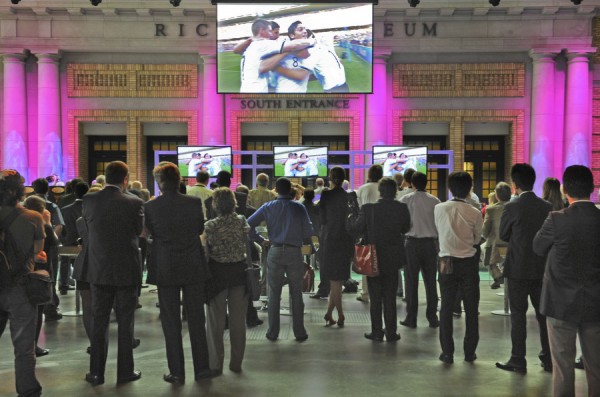
The strange juxtapositions came hard and fast this weekend; while protests and a record 900 police arrests continued outside, reporters from the foreign press were a the international media centre at the CNE, where the Toronto Star‘s Richard Lautens found them watching the Germany-England match at the World Cup. For big-media skeptics (like us!) this photo says a lot about the failings of the mainstream media covering the G20.
And lastly, from the Department of Grimly Hilarious Symbolism came this Torontoist photo of the “eternal flame” at Metro Hall—a symbol of the “hopes, aspirations and triumphal achievements burning within the human spirit,” says its commemorative plaque—extinguished and encased in a plywood cover. It’s been lit since May 1996, but the G20 was enough to snuff it out:
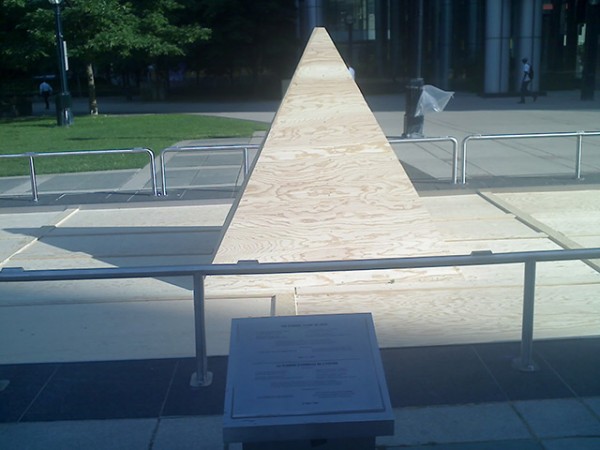
Ryan Walker of Torontoist captured the same event from ground level:
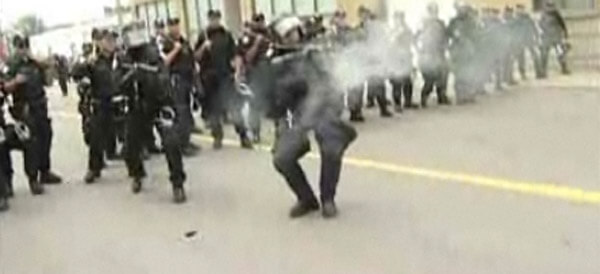
In a separate incident on Sunday, outside the detention centre, Global TV recorded this scene, in which an officer fires what appears to be a tear-gas pellet into a loud but peaceful demonstration, striking a young woman:
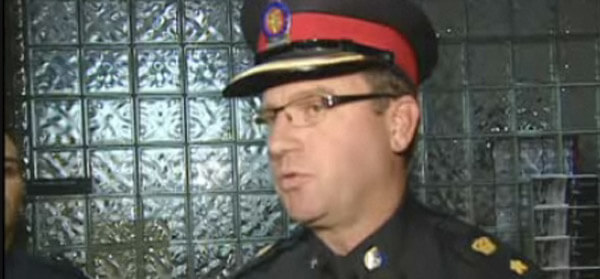
Late on Sunday, Toronto Police Services Superintendent Jeff McGuire held a press conference outside police headquarters to talk about police activities on Sunday, including an incident in which hundreds of individuals—some protesters but also many journalists, bystanders, and tourists—were boxed in by a police cordon at the corner of Queen and Spadina for hours in torrential rain. McGuire defends police actions, but is unconvincing and evasive, invokes vague “threats” that he cannot enumerate, and repeats the same talking points ad nauseam. While it’s not in the linked video, during the Q&A McGuire was asked whether the statement constituted an apology to those people; he responded with: “I cannot apologize to them and I won’t.”
Then, of course, there was the video of choice for large media outlets, the burning police car. These are the images that many outside Canada will see in relation to this weekend’s events—if they see any news coverage of it at all:
]]>Monday‘s events were focused on Migrant Justice and Economic Justice, but the message that came out of the day was a mixed bag. A rally at Allen Gardens featured United Food and Commercial Workers (UFCW) and anti-poverty activists speaking on behalf of workers affected by G8/G20 policies in the global south. They also spoke about the failure of all levels of government in Canada to provide meaningful support to low-income people during the current economic crisis. 50-100 demonstrators made their way along Dundas, where an Esso station was briefly occupied to show disdain for government bailouts (Esso was one of the 70 corporations that received money from the US government). The march progressed up Yonge Street and ended at Children’s Aid Society headquarters to emphasize that the well-being of children is being threatened by all levels of government in Canada, due to unfriendly policies and funding structures for women’s organizations and organizations that deal with maternal health.
Things got steamy on Tuesday when the crushing humidity and the political sexiness of the Gender and Queer Justice march collided at Queen and Yonge. A crowd of 100-200 people took up all lanes on Queen street and stopped at various points to engage in a kiss-in, a declaration from lesbian bankers about Pride funding, and a little bit of good old fashioned street theatre—”Harper Don’t Preach,” sung and danced to Madonna’s “Papa Don’t Preach.” Even Perez Hilton took note.
The atmosphere on Wednesday morning was tense, but resistance was fertile. The unusual 5.0 earthquake literally underscored the theme of Environmental and Climate Justice. Groups including the Council of Canadians, the Rainforest Action Network (RAN) and the Canadian Youth Climate Coalition (CYCC) led a toxic tour of the city.
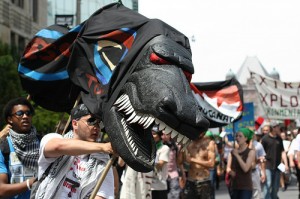
Oil dragon at toxic tour in Toronto. Copyright flickr user onlyandrewn 2010.
300-400 people marched with the tour, which was filled with floats, rebel clowns, smiling banner-toters, and others who simply got swept into the crowd as it progressed throughout the city. The crowd stopped first at a Royal Bank branch, where speakers noted that RBC is the biggest funder of the poisonous and destructive Tar Sands project.
The route continued along until the tour arrived at the doorstep of the U of T mining building, which had recently been given a gift from Gold Corp, the second-largest gold producing company in the world. Gold Corp routinely engages in mining operations that create environmental destruction and human rights abuses—in fact, they were just told by Guatemala to stop operating the Marlin mine because of such issues. Speakers from communities affected by mining companies took a moment to call out the corporation and the government of Canada, which has little or no regulations in place to prevent Canadian companies from causing such damage.
The toxic tour ended in front of the courthouse at University and Armory, where progressive lawyers spoke about suits brought against the TSX and the Copper Mesa mining company by three Ecuadorean villagers.
Huge banner and hundreds of protestors block road on Thursday. Copyright Oren Ziv/Activestills 2010
Thursday saw the biggest turnout yet. Indigenous Sovereignty was the theme of the day, and groups from across the country converged in the city to bring a firm message to the leaders of the G20. Two thousand people marched in the event, which was planned by Defenders of the Land, to protest Canada’s record on the treatment of Indigenous people. One purpose of the march was to call attention to Canada’s refusal to sign on to the United Nations Declaration on the Rights of Indigenous Peoples.
Today, the Themed Days of Resistance have ended, and the days of action have begun. A rally and march held by several groups including Ontario Coalition Against Poverty and No One Is Illegal started at 2:30 pm at Allen Gardens. “Justice for Our Communities” is the concept, and the march will culminate in a tent city and night-long party. More to come over the weekend!
]]>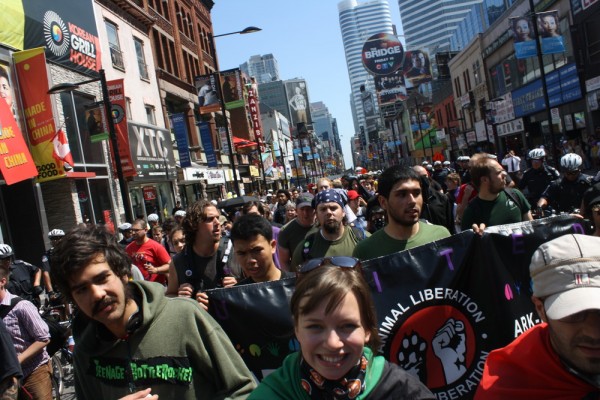
Protesters against the G20 in Toronto. Photo by Jesse Mintz.
From June 25–27, the world’s most influential political and economic leaders will descend upon Muskoka and Toronto for the G8 and G20 summits. Joining them will be thousands of protesters advocating everything from anti-globalization to climate justice.
If you want to get in on the dissent, check out this advice for emerging activists from Mike Hudema, the man behind Greenpeace’s “Stop the Tar Sands” campaign and someone who’s no stranger to direct action.
Connect…with people you trust. Attend activist training camps, join a Facebook group, and talk to local and indigenous communities to discover how you can support them. Good places to start are the Toronto Community Mobilization Network and No One is Illegal.
Arm Yourself…with knowledge. Educate yourself about the rich history of civil disobedience and all the rights we enjoy today because of it. Read classics like Henry David Thoreau’s Civil Disobedience or books by AK Press, an anarchist publisher with a great alternative bookstore.
Pack…protective shoes you can run in; heavy-duty gloves; shatter-resistant eye protection; clothing that covers most of your skin; a gas mask or goggles with a vinegar-soaked bandana for protection from chemicals; and noisemakers. Optional: rollerblades and a hockey stick to shoot back tear gas canisters—Canadian-style.
Be Aware...of the variety of tactics employed by diverse groups of activists. Some may feel that vandalism is warranted, whereas you may not. Decide beforehand what tactics fit with your personal convictions. And watch for police provocateurs who may show up undercover to incite violence and discredit activists.
Prepare…to be arrested. If you decide that you are willing to risk arrest, speak to a lawyer or civil liberties association beforehand so you know your rights and what to expect. Get a jail support person off-site who knows of your personal needs (e.g. if you need regular medication) and will be able to communicate with your lawyer and advocate for you.
Reconnect…once it’s over. Travelling to the summits is great, but make sure to also support causes in your own community. The old adage still stands: act locally!
]]>
We’ve marched, oh how we have marched.
The “get back to work” signs now find their place in the closet where dust has begun to flirt with the climate-themed “350” signs of October and December. The proroguing of Parliament has left the country with no ability to act on any sort of climate legislation (though that’s not so different than when it’s in session). We also now have the launch of a popular movement for democracy, based partly on a collective desire to deal with a whole raft of issues, the climate crisis being one.
A failure of international politics in Copenhagen and of democracy domestically has left a situation that is indeed bleak, though also provides time for activists, and all active citizens, to regroup. Journalist Murray Dobbin wrote last week: “These politically opportune moments do not arrive very often and it is incumbent upon existing organizations to rise to the occasion, support the nascent movement and begin gearing up their own machinery to take the fight to Stephen Harper and his government.”
We now have an election coming up—if not April, then at some point soon. But are we really that serious about firing Steve, as many rally signs had proclaimed?
Dobbin continues to ask if this democracy movement is about reform in itself or will it include the specific goal of ridding Canada of its current Prime Minister?
The big elephant in the movement is the political siloing of the non-Conservative activists. Diversity of voice often brings strength, but a split of support because of the partisanship of most of us in the movement continues to pose a problem within Canada’s electoral system.
The Conservatives’ drop in the polls due to shutting down Parliament and the prisoner abuse scandal has been sharp and pronounced. While without much in the way of advertised policy, the Liberals have managed an upswing in support, with the NDP, Greens and Bloc all down slightly in the New Year. The now two-party race for government is something to keep more than an eye on.
While progressives are split within many parties, the weakness in civil society institutions and movement organizations is also harming the cause. The environmental movement itself within Canada seems to have more and more organizations working on similar climate ends, and there even exists more than one coalition/umbrella type group that focuses on federal climate lobbying: Power Up Canada, Climate Action Network, Power Shift, and so on.
Perhaps this can be used to advantage. Three main strategies present themselves to guide us to the ultimate aim of reducing climate change emissions immediately and in the long-run.
- Some organizations may wish to stick it out, putting continued pressure and policy work on the international negotiating system leading to Copenhagen 2: Mexico City.
- Others must work on focused action that directs the removal of high-carbon sources to our atmosphere like coal plants, tar sands projects and industrial projects, which could reduce emissions quickly and may influence positive actions in other countries.
- The remaining organizations can concentrate on lobbying and coalition-building that focuses MPs and political parties to bring the climate agenda far forward in preparation for legislative debate and the next election.
Organizations working on these three objectives should be ready to support each others’ goals, each with a focus that could bring results – a multi-pronged strategy that may well bring success in at least one area.
We have a unique opportunity.It is largely up to the size and tact of citizens movements whether we let the government keep pushing the climate around or we push the agenda over the top.
Follow Stop Everything’s climate, political and action updates at: http://twitter.com/stop_everything
]]>Tomorrow is the big day all across Canada, as thousands of Canadians will be gathering to protest Prime Minister Stephen Harper’s decision to prorogue parliament until March 3. There are going to be many ways to participate in this peaceful, non-partisan event, both on the street and online.
This Magazine intern Luke Champion made this helpful Google map, above, which pinpoints the location of all the rallies we could find across the country (and in fact there are several happening outside Canada, too). Click any pin on the map to see the basic details of that event. Details for these are also available through this Facebook event page, and the Facebook group that started this whole ball rolling is here.
We intend to have boots on the ground at several of the rallies to photograph the events and talk to some participants, but we’re a teensy operation. That’s why we’d like your help. Because we just lurve screwing around with new web toys, and ripping off inspired by the pioneering work of our micro-media brethren (ahem), we’ve set up a sweet new Posterous account to aggregate photos, videos, and assorted other media flotsam generated during Saturday’s proceedings. It’s online here: post.this.org
You can easily contribute a photo or a YouTube video or a news link — just email it to:
[email protected]
…and we’ll do the rest (i.e., weeding out the libel and/or porn).
There are 200,000 members of the Facebook group, and buzz for Saturday is promising. But big media outlets have shied away from the anti-prorogue sentiment that has blossomed in the last few weeks, covering it from a distance, running their critical editorials, but always minimizing and hedging the power of digital media — not to mention good old-fashioned pavement-pounding street activism — to drive real change. We hope by collecting, aggregating, and distributing information in this low-friction way, we can prove them wrong. Hope you’ll help us out.
]]>