 For our special 50th anniversary issue, Canada’s brightest, boldest, and most rebellious thinkers, doers, and creators share their best big ideas. Through ideas macro and micro, radical and everyday, we present 50 essays, think pieces, and calls to action. Picture: plans for sustainable food systems, radical legislation, revolutionary health care, a greener planet, Indigenous self-government, vibrant cities, safe spaces, peaceful collaboration, and more—we encouraged our writers to dream big, to hope, and to courageously share their ideas and wish lists for our collective better future. Here’s to another 50 years!
When I started documenting the invisible animals in our world about 15 years ago, I didn’t know I was doing historical work. But I see that now and am so happy that I am not alone in bearing witness through photos and film so that others may see, know, care, and change. Animals desperately, urgently need this change.
Invisible animals are those we eat, wear, and whose bodies were used in research for the (often purported) advancement of science and medicine. I say that they are invisible because they aren’t the dogs and cats we so cherish. They aren’t the charismatic megafauna we revere from afar. We actually have the closest relationship with these invisible animals, these ghosts, but we never give them any thought. And if we do, we think of them as parts, not as sentient individuals. We call them spare ribs, instead of a pig. Wings, instead of a chicken. Leather, instead of a cow. Fur trim, instead of a mink or fox.
I’ve been to more than 50 countries to bear witness and document, but sadly it’s also very easy for me to do this work in my own backyard. I know that you, too, have seen the transport trucks carrying pigs, chickens, and cows along our Canadian highways, even in the height of heat waves or the freezing depths of winter, where animals commonly arrive at their destination dead or dying. I don’t believe that people are bad but we make poor choices when we’re uninformed about where the products (“products” being animals) we buy come from, or how they were raised and killed. I’ve spent months of my life on fur farms now. My pictures and films tell their story. I can tell you that when people look, and really take the time to see and think, they don’t continue to support these horrific practices.
The good news is that there is an awakening afoot. The lives of these ghosts are being brought to light. Factory farms can no longer hide the deprivation and insanity that goes on behind closed doors. Animal industries are being exposed and being called upon to change.
Everywhere now, these previously invisible animals are being discussed and are being given consideration. We are acknowledging that they are sentient, and admitting that how we treat them is wrong.
There’s never been a more pressing time to take part in making the world a better, kinder, more just place for animals. Frankly, it’s an emergency. One way to change our point of view about the animals we use each year, who number well over 500 million in Canada each year alone (and that doesn’t include sea life) is to think of them as individuals, just as our beloved companion animals are. We can’t feel a number like 500 million. Our brains can’t process having empathy for a large number of individuals like that. But a million isn’t a million. A million is made up of one, plus one, plus one, plus one.
More good news: there are now more ways than ever to help animals in Canada and worldwide. If you enjoy taking photos, or are a journalist, take to your camera and pen and document their stories. Share. Show. We need to see what’s going on.
If you want to see things for yourself, please do, and encourage others to join you. Facing cruelty is difficult because we’re compassionate; seeing it hurts. But it’s also difficult because we’re then faced with our own complicity in these cruelties. But we must be courageous. For them. For a kinder world. If we care about animals, as I know so many of us do, we have to be courageous and take a stand for them.
]]>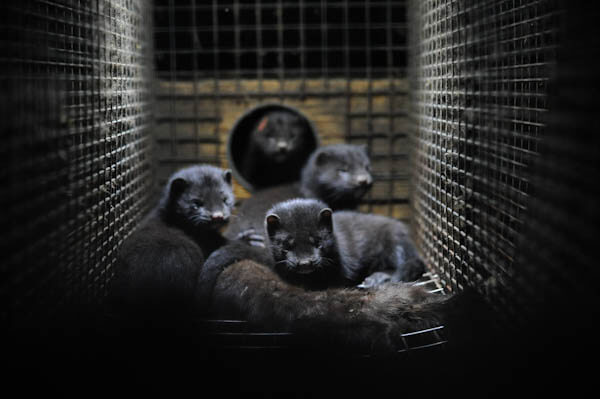
Photo cred: Jo-Anne McArthur / Djurattsallianssen
Award-winning photojournalist, author, and animal rights activist Jo-Anne McArthur is second in our new online-only Social Justice All-Stars series. Know a social justice all-star who deserves recognition? Email editor Lauren McKeon at [email protected]
With a camera in hand, Jo-Anne McArthur travels across the globe with a mission: to advocate for the rights of non-human animals, one photograph at a time. For over close to 15 years, the 38-year-old has photographed animals in a wide-range of situations—many of them dire. While some of her pictures are of rescued animals being nursed back to health and safety, McArthur’s images also capture animals moments before execution, struggling to survive under harsh conditions in farms, factories, aquariums, zoos, and auctions. “The animals that we physically abuse and psychologically abuse by the billions are the animals that are totally ignored by everyone,” she says. “No one wants to look at it because it’s painful.”
McArthur is an award-winning photojournalist, author, and animal rights activist who often contributes to undercover investigations for animal rights organizations. It’s not an easy job. In 2010, McArthur was officially diagnosed with post-traumatic stress disorder (PTSD). She first knew something was wrong when she realized her first thought upon waking up every morning was about a pig gestation crate. Though she has since recovered, McArthur realizes she wasn’t giving herself enough time to recuperate between documenting each awful scene of animal cruelty.
Although McArthur’s photographs may be difficult to look at, they’ve received awards for demonstrating compassion and advocacy, including the 2014 Media Award, given by the Institute for Critical Animal Studies, and the 2013 Compassion for Animals Award. The Ottawa-raised photographer even caught the attention of Canadian director, Liz Marshall, who profiled McArthur in the critically-successful 2013 documentary, The Ghosts in Our Machine.
McArthur, however, is used to being the one behind the camera. She fell in love with photography almost by mistake. At University of Ottawa, McArthur majored in geography and English, but happened to take a black and white photography elective. She instantly fell in love with the process and has been taking pictures since. McArthur’s photographs are substantially different than other animal advocacy images: a lot of photographers tend to focus on wildlife and pets, whereas McArthur’s lens has no limits. From insects, mink, rabbits, and bears, to pigs, cows, and penguins, McArthur’s photographs portray animals with a professional quality.
McArthur’s photographs will be regarded by future generations as important documents, says Alanna Devine, the director of animal advocacy for the Society for the Prevention of Cruelty to Animals, an organization that has collaborated with McArthur on projects since 2008. Devine believes McArthur is the “most trusted” person to tell a story about animals through photography, adding she genuinely feels there’s something special about McArthur.
“She has an incredible understanding of what animals needs are and what their lives should be like,” Devine says. “[The animals] sense that she’s doing anything she can. When she’s working, she approaches subject matter with compassion and objectivity.”
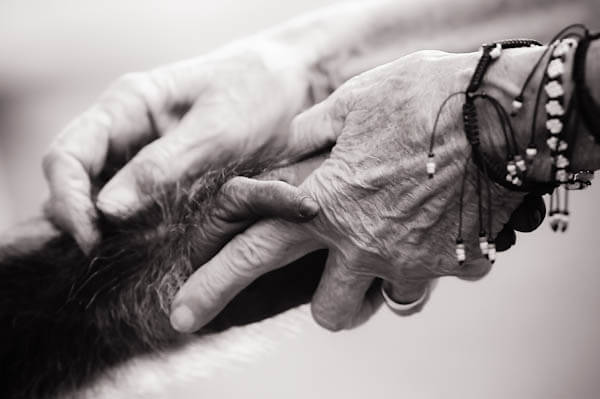
Photo credit: Jo-Anne McArthur / We Animals
She also has a bit of a rebel streak. It’s next to impossible to do what McArthur does without breaking the law—the photojournalist contributes to several secret investigations across the world with animal rights organizations, risking her safety and freedom to document the cruelty that happens behind farm and factory doors. McArthur and an investigation team were once chased off property by a truck, which hit a team member. Though McArthur’s team member wasn’t seriously injured, she says humans are the most dangerous part of the life-risking job.
Although there’s a dark side to animal advocacy, McArthur recognizes that some people in the industry just need to put food on the table for their families. Factory and farm workers, for the most part, don’t want to be there, McArthur says, adding that the cruelty suffered by animals is extended to the people working undesirable, low-paying, and dangerous jobs at factories and slaughterhouses. But, at the same time, if the industry is trying to hide something behind factory doors, it needs to be exposed.
And in huge part thanks to McArthur, industry secrets are starting to corrode—McArthur has exposed animal cruelty through her photographs and her book, We Animals, a collection of McArthur’s photographs from the past 15 years. Published in 2013, the book captures animals in human-made circumstances, whether they’re being used for fashion, entertainment, food, or research.
And though the book cover boldly shows McArthur’s name, she doesn’t always get the credit she deserves. In the past few years, her investigative photography was published more than ever—but some people thought she had gone off the grid. McArthur often cannot publish her photographs under her name without the risk of getting banned from a country or being sued. McArthur says that as We Animals becomes more visible, it’s a possibility that countries may put two-and-two together and ban her from entering. It’s frustrating that she sometimes can’t show her name, she says, but there’s something more important to animal rights activism than getting credit for it. “I will continue doing investigations as long as I can, because I need to,” she says. “It’s my skill and there aren’t enough people doing it. It’s like I don’t have a choice. It’s what I have to do.”
]]>It’s nearly sunrise, and Justin Stephenson is about 20 feet above the forest floor on a 32-square-foot tree stand. The November weather in Ontario cottage country is frigid. Stephenson’s bundled up in up in heavyweight camouflage, hunter orange vest, and hunter orange toque. His 870 12-gauge shotgun with a rifled barrel rests, butt on the wooden floor. He has been out here for an hour and 15 minutes, and the sun has started to rise. By now, he’s trying not to fall asleep. He thinks: Maybe it’s useless getting out here this early. He made too much noise climbing up to his perch on the stand. He is never going to get a deer.
He barely finishes this last thought, though, when he hears a noise so loud that he later describes it as “a drunk horse stomping through the woods.” At first, when the deer walks into the clearing, he thinks it’s a fawn. But that’s not it: as the deer gets closer, it gets bigger. And bigger. At 100 yards away and Stephenson can finally see the deer is a massive eight-point buck. One of its antler tines looks broken, possibly from fighting. “It was just,” says Stephenson, “this gnarly beast.”
He gets lined up for the shot, but the buck is at him head on—not a shot he wants to take. The bullet could shoot through the deer’s stomach and intestines. Stephenson’s entire body is ringing with adrenaline, but he waits and thinks: “Am I really going to do this?” By the time he resolves to shoot, two minutes have passed. Forty yards from the stand now, the deer sees Stephenson in the tree, and turns and runs toward the other side of the clearing. Stephenson shoots once, but it’s too late; the buck’s gone. “The next time this goes down,” Stephenson promises himself, “I won’t think twice about it.”
Stephenson has been hunting as an adult for the past eight years. Every fall, the 41-year-old drives out to a hunting camp with a group of his friends from the city to hunt deer. He also hunts ducks and geese north of Toronto, a few times each season. He’s also a self-described city guy. Stephenson lives in Toronto’s Corso Italia neighbourhood and is a fulltime video director/designer, perhaps most well known for designing and animating the title sequences to feature films like David Cronenberg’s Cosmopolis and A Dangerous Method. That big buck wasn’t the first animal he’d ever shot, but it was so big and so big and so impressive, it made him think twice before pulling the trigger.
Thanks to the popularity of books such as Michael Pollan’s The Omnivore’s Dilemma and Vancouverites Alisa Smith and J.B. MacKinnon’s The 100-Mile Diet, hyper-local has become cutting-edge eating. Killing for your own meat is as local, and visceral, as it gets. And books about hunting such as Call of the Mild, The Mindful Carnivore and The Beginner’s Guide to Hunting Deer for Food are gaining popularity.
Not to mention, we also live in a throw-back era when everything old is new again; hunting’s increase in popularity among the “cool” crowd really isn’t that surprising. It’s cool to have a garden, wear your grandfather’s clothes, and grow your beard out. This atavistic aesthetic is visible in art, music, fashion, and even dining culture: put on some plaid and grab a drink at the Farmhouse Tavern (an actual restaurant in Toronto), or pick up a maple syrup candle at Toronto’s upscale gift shop, the Drake Hotel General Store.
Hunting, however, is a commitment that transcends foodie trends—it’s not like growing a garden or eating seasonally. A would-be hunter must learn how to use a gun, and actually go out into the wild to kill animals. So why do it? For self-described unlikely hunters such as Stephenson, hunting is about exploring something that was lost—a human instinct and method of survival many urbanites have long forgotten. It’s also about knowing where the meat on their plates came from, and being comfortable with the way that animal lived and died. When you talk to hunters, even those who might have once balked at the thought of killing an animal, you’ll hear something else as well: hunting is fun.
The number of hunters in North America has dropped significantly since the ’90s. In the U.S., the number of hunters (over the age of 16) fell to 12.5-million in 2006 from 14.1-million in 1991, according to the National Survey of Fishing, Hunting, and Wildlife-Associated Recreation. In the past few years, however, those numbers have started to climb again. The most recent survey shows hunting increased by nine percent, in total, between 2006 to 2011; about 13.7 million Americans now hunt. In Canada, national numbers are difficult to acquire because each provincial hunting and angling association measures data differently. At least one hunting organization, Edmonton-based Hunting for Tomorrow, claims they’ve seen an increase here too.
Hunting for Tomorrow has even seen vegetarians walk through its doors. One in particular stands out in executive director Kelly Semple’s mind. Shortly after The 100-Mile Diet was published in 2007, a vegetarian turned aspiring-hunter registered for a women’s outdoors weekend. The woman was a university student who liked to eat meat, but didn’t like the commercial processing aspect, Semple says. If she was going to eat meat, the student told Semple, she wanted to learn how to properly harvest it and prepare it, and be responsible for taking the animal’s life. That fall, following the outdoors weekend, the woman took a hunting mentorship program through the foundation and shot her first deer, Semple says. “She’s never looked back.”
Vegetarians aside, there’s enough newbie, urbanite interest in hunting for people like Virginia-based Jackson Landers, who grew up in a vegetarian home, to write The Beginner’s Guide to Hunting Deer for Food. And the Bull Moose Hunting Society (BMHS), founded by 20-something urbanite hunters Nick Zigelbaum and Nick Chaset in San Francisco, recruits and mentors city-dwelling novice adult hunters.
The influx of hunting and fishing stores in urban areas is another indicator that hunting is on the rise with city dwellers, says Patrick Walsh, editor of hunting and fishing magazine Outdoor Canada. “You have these big box fishing and hunting stores, and you think, ‘Who the hell is buying all this stuff?’” he says. “It can’t be some dying demographic.”
Stephenson started hunting as an adult to reconnect with the past. Growing up in Whitehorse, YK, he rode dirt bikes and hunted with his dad. But he was eager to shed the rural trappings of his childhood when he moved to Toronto in 1990 for university. “I went to film school, and had it that I wanted out of the Yukon and wanted out of rural Canada,” he says. “In many ways, I thought that as part of the transition to living in the city, I had to ditch a lot of these things that I did as a kid.”
Then, eight years ago, Stephenson helped a stranger he met at a garage sale jumpstart his Honda motorbike. The stranger had no idea what he was doing, but Stephenson did. That was when he understood how unique the skills were that he’d left behind. And it’s how he found himself in that tree stand, deciding he did, in fact, want to shoot the massive buck deer loping toward him.
Stephenson says he experiences a “strong vividness” after taking down an animal. That feeling—the awareness of that animals mortality, and of your own—takes a bit of getting used to. It’s also exciting. “I really do think it taps into a part of our psyche we’ve been well adapted for,” he says, “but we aren’t using.” As BMHS puts it: “Bull Moose is an organization dedicated to providing a means for those of us who have lost our instincts, our predatory skills and our connection to the wild world to get those parts of ourselves back.”
Besides offering people the chance to really provide for themselves, hunting also offers this incredibly visceral experience. Hunters take a life, and like it or not, that taking creates an adrenaline rush and a flood of mixed emotions: Pride, excitement, and more often than not a tinge of guilt or sadness. Hunters are thrust back into the food chain, from which most urbanites are increasingly disconnected. There’s an animal you shot. You feel its lingering warmth under your fingers. You break its skin with your knife. You know exactly what your dinner cost because its blood is—quite literally—on your hands.
Reconnecting with this lost part of the human experience is something that appealed to Lily Raff McCaulou, the author of the hunting memoir, Call of the Mild. She grew up in a suburb of Washington, D.C., and had only held a gun once—when she was a teenager—before she started hunting at 26 years old. That was two years after moving to Bend, Oregon from Manhattan for a reporting job. “You’d be hard-pressed to find an unlikelier hunter that me,” she writes in her book. “I’m a woman, and married to a man who does not hunt. I grew up in a city, terrified of guns.”
Raff McCaulou first started fly-fishing with her now-husband and worked her way up to hunting. The day after she shot her first animal, a pheasant, she brought the bird home and dressed it herself over a garbage can in her backyard. Describing the adrenaline rush that came with that first kill she says: “But my own feeling, as the pheasant falls from the sky in a surprisingly slow, graceful flutter, is singular and pure: euphoria.”
Raff McCaulou adds that experiencing this mix of excitement and guilt helps hunters better respect and appreciate the animals feeding them. Something we don’t always do with shrink-wrapped meat pulled out of the cooler section at the grocery store. “That’s not to say all of the meat I eat is meat I’ve hunted, but it has changed my relationship with food,” she says on the phone from her home in Bend. “It’s reconnecting me to the past. It’s really made me think about what humans, until relatively recently, had to do to eat meat. And it’s given me a new awe over survival.”
Toronto food blogger and hunter Joel MacCharles didn’t talk about hunting in public five years ago. In 2009, when he and his partner Dana Harisson decided to write about hunting on their blog, Well Preserved, they were hesitant about how some of their 25,000 monthly readers would react. And with reason: the authors of one of their favourite blogs, New Zealand-based Kiwiswiss, received a death threat in 2010 over hunting related posts. When MacCharles wrote his first hunting diary for the blog, they lost 50 percent of their followers. The following year, in a post that outlined the details of MacCharles’s hunting trips each fall, they lost 25 percent. “And,” says MacCharles, “We don’t have any gory pictures.”
Jump ahead four years. On a Monday night last December, MacCharles walked into The Avro, a tiny bar in Toronto’s Riverside neighbourhood, wearing a vest covered in homemade buttons— souvenirs from each of the couple’s previous swaps. Tonight is the Christmas edition of the monthly Home Ec swap night he and Harrisson organize through Well Preserved. The space, filled with reclaimed furniture and knick-knacks, was packed full of swappers ranging in age from 20-somethings to early 40s. That night, the theme was holiday cookies, and The Avro’s bar counter was stacked with plates of baked treats.
There are other hunters and hunters-in-training at the swap too. Kelly Moore and Jessie Sweeney hang out near the bar talking to Harisson. Moore has been hunting with her husband Aaron since 2005, but Sweeney is just starting, and plans to get her firearms license this winter year and to practice shooting over the holidays (both of wwhich she does).
MacCharles, sporting glasses and shaggy-curly hair, is eager to talk about how this year’s moose hunt went. One of his hunting buddies shot a cow (female moose) on the first day. MacCharles came pretty close to a bull (male), but it was too big to shoot. But since the camp shares, his friend’s kill means he got meat too. MacCharles and Harrisson try to buy as little food from the grocery store as possible, and they hardly buy any farmed meat at all, unless it’s from small, local farms. Not getting a moose, which is what happened last year, would have been a big deal. When at home, they ate mostly vegetarian for the entire winter.
Like Stephenson, MacCharles hunted when he was young. He was in university when he turned vegetarian on a whim that lasted six years. “And then one day after dinner I decided I wanted a hamburger,” he says. After that, he started eating processed food and fast food. “I loved food, but I loved it in a very different way.” But over the last five years, MacCharles and Harisson really started to commit themselves to local and seasonal eating.
It’s hard to say exactly why opinions on hunting have changed so much within the locavore community. It does, though, seem to have a lot to do with ethics. While MacCharles is not be new to hunting, his values for doing so align with those of the urban, locavore community. When someone kills an animal, he says, it becomes something—food—that a person self-provides for their family, and in a way they ethically believe in. Even if farmed meat is easier to buy, he adds, hunting doesn’t feel like an option. “The concept of The 100-Mile Diet is it has smart urban people thinking about where their food comes from,” says Walsh. “An intellectual person can make the leap and ask: If there’s still an animal dying for me to have protein, why don’t I take the responsibility and do it myself?
Of course, for many people, hunting isn’t a food trend, and it’s never been a controversial activity. It’s taken for granted, and definitely nothing they’ve had to explain to themselves, to their families, or even to their communities. In fact, MacCharles has had confused readers from rural communities ask why he writes about hunting so sensitively on his blog. “There are a lot of people I talk to about hunting who see it as organic and seasonal and free-range and ethical, and boy if I had these conversations with my GTA hunting buddies they’d look at me like I had three heads,” he says. “It’s just what they do.
It’s becoming that way for people like MacCharles, Raff McCaulou and Stephenson, too. They’ve invested time in learning how to properly handle firearms. They’ve considered the consequences, felt conflicted about the lives they’re taking, and have come out the other side deciding it’s still something they want to do. And something they enjoy doing. Hunting isn’t just a fad to them and the many others that have joined and continue to join them—it’s become something they just do too. It’s probably something they’ll just do for the rest of their lives. Even so, don’t count on spotting hoards of hipsters lining up at the local shooting range anytime soon. For now, the barriers and the stakes are too high. As MacCharles says, “At the end of the day, there are very few people who take a life or death activity as just fun.”
]]>
Aaju Peter. Illustration by David Donald.
A majority of the 27 member states of the European Union voted to ban the trade of seal product imports such as pelts, oil, and meat last July. The ban comes into effect in August 2010. Although the EU did allow a partial exemption for Inuit populations, the ban will nonetheless have devastating consequences for Canada’s northern indigenous people, according to Aaju Peter, an Inuk clothing designer, lawyer, and activist. We spoke with Peter in Ottawa, where she is pursuing an additional degree in international law.
This: What work do you do with sealskins?
Peter: I design contemporary clothes that are inspired by traditional Inuit designs.
This: Such as?
Peter: Everything from tank tops, vests, skirts, pants, jackets, to mittens and slippers.
This: What do they cost?
Peter: A sealskin bag I can make for $350. For a jacket it can be between $1,500 and $4,000.
This: Where do you sell them?
Peter: Mostly in Iqaluit [in Nunavut]. Or by special order. [Former] governor general Adrienne Clarkson has a coat.
This: Is sealskin difficult to work with?
Peter: If you have 10 or 20 years experience it’s not that difficult. It takes a long time to acquire the skills that are needed to work with it.
This: How is business?
Peter: It’s slow right now because I’m working on my degree. But if I did sealskin full time I could be very, very wealthy.
This: What is your reaction to the EU ban?
Peter: It will have a devastating effect. It already has on the hunters. They normally would get $60 to $90 for a skin. Now they get about $5. The cost of living is very high in the Arctic. They won’t be able to get enough money to sustain their families.
This: Won’t the Inuit exemption protect them?
Peter: The exemption is very restrictive and absolutely useless. I won’t be able to sell my clothes in Europe. If [the seal] is traditionally hunted and is used for cultural trading purposes only, then it’s okay. They want us to be like little stick Eskimos who are stuck on the land and go out in our little Eskimo clothes with a harpoon. They will not let us hunt with rifles and snow machines. They will not let us sell commercial products. It’s a form of cultural colonization. A journalist in the Netherlands called it the Bambification of the Inuit, like we’re in some Disney movie.
This: Can you understand the opposition to the seal hunt?
Peter: I don’t wish to understand it. I can explain it. It’s become a moral issue that it’s not right to kill animals. It stems from a society that lives in large urban areas that are totally detached from nature and detached from a subsistence economy where you go out and catch what you need and try to make money out of that. It’s a culture that is pushed by a people who have absolutely no connection to the people they are affecting because it’s not affecting them.
This: Any chance of changing people’s minds?
Peter: I always try to be positive, which is why I went to Europe [to fight against the ban]. But I’ve come to realize that people who are living on selling or eating seal don’t have the same amount of money that special interest groups have. For instance, the animal rights groups had a humongous truck outside [the European Parliament] with a humongous screen where they were showing films of seals being slaughtered. And they put pictures of a seal head with “Vote Yes,” for a ban and put them on the doors of all the 800 members of parliament. We couldn’t [afford] anything like that.
This: What would you have wanted the Parliamentarians to understand?
Peter: That this is an issue that is very, very important for Inuit survival. I travel with the courts to the smaller communities. In the winter you see a frame with sealskin on it outside every home. You can see the importance for these families, who have nothing else, no other form of economy, to be able to sell the skins for what they’re worth. I see the harm that is being done to the communities but they’re not able to communicate this. How can a group of people who know nothing about this pass legislation that can have such harmful effects on others? I have a hard time believing those 800 parliamentarians would be able to sleep at night if they knew the harm they are causing.
]]>
Sea Shepherd activists confronting the Japanese whaling fleet, Winter 2009
I just posted Emily Hunter’s feature story from the May-June 2009 issue, because it has some bearing on the current controversy over the EU’s banning of commercial Canadian seal products. Trade Minister Stockwell Day says Canada will take the issue to the WTO to try and force the EU to accept Canadian seal pelts, furs, and Omega-3 pills derived from the hunt. About 6,000 people in Newfoundland and Labrador make a substantial part of their income from the annual seal hunt, which kills 300,000 seals per year, and is condemned by animal rights groups for the cruel methods used.
The indignation in Canada over the EU’s decision has been, on the surface, about the economics of the decision: it will hurt the livelihoods of Canadian hunters, many of them Inuit. Whatever your opinion of the cruelty of the hunt—and I’ll be honest, the notion of clubbing an animal to death strikes me as the definition of cruel—this ban will throw people out of work or substantively lower their income in a province that needs jobs more than ever, and that’s a problem.
But it’s not really about economics: this is a sovereignty issue, about whether the EU gets to effectively shut down a foreign industry its members don’t like. Because frankly, the amount of money involved here, about $5.5 million worth of seal products that Canada sold to EU consumers last year, is a miniscule fraction—by my back-of-the-envelope math, about 0.0005%—of total Canada-EU transatlantic trade ($111 billion in 2008). As Emily explains in her article, Japan is in the same boat: the whale hunt there has no real economic impact: the actual market for whale meat is tiny, and the producers make almost nothing selling it. But despite the economic lunacy of sending all these ships around the world for a grand total of $51,000 profit, it continues because Japan doesn’t want to accept the authority of the international community that has declared whaling unethical, unnecessary, and cruel. In both cases, the verdict is in: whaling and sealing are not really viable businesses, but both countries persist in their nationalist posturing out of what seems to be pure stubbornness. There are other ways to help the people whose jobs are at risk, ways that don’t require Canada to mount a complex, longwinded, and no doubt expensive appeal to the WTO.
]]>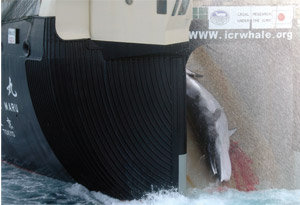
A whale being hauled up the slipway of the Japanese whaling flagship, the Nisshin Maru. Photo by Joshua Gunn
It’s a sight I’ll never forget: a whale being hacked up in front of me, cut into tiny squares, its excess blood and guts discarded. One minute, it was a whole whale; 20 minutes later, nothing but a spinal cord and the harpoon that killed it.
It was February 6, 2009, and I had spent two months in the Antarctic Ocean with Sea Shepherd, the radical conservationist group. Sea Shepherd is notorious for the extreme tactics it uses to stop whaling in the southern oceans each year. Its ship, the M/Y Steve Irwin, had chased and harassed the Japanese whaling fleet for weeks to prevent them from hunting. But on this particular day, the whalers killed in front of us, and at first we could only watch from a distance. But it soon became a confrontation.
The Yushin Maru No. 3, a harpoon ship, attempted to transfer a dead whale to the mother ship, Japan’s whaling flagship, the Nisshin Maru, the floating factory that processes whale meat at sea. The Irwin moved to block that transfer by manoeuvring into the Yushin Maru’s path. Within seconds, the boats collided with a loud crash and screeching noise that rang through our ears. The Irwin tipped 30 degrees on its side—it felt as if the ship was going belly-up. I was on the outside deck of the Irwin, hanging on to a railing watching the water approach from below. The Yushin was pushed down into the water by the force of the impact. I can only imagine the crew must have thought they would have to abandon ship. But 22 seconds later, when the two boats scraped apart, all had survived, with only minor damage to the vessels. It was a collision of two boats—but also a collision of worlds.
The Institute of Cetacean Research in Tokyo, along with many of its supporters, argue that the annual whale hunt by Japan is the country’s national heritage, and that efforts to end Japan’s whaling is colonial Western arrogance. The critics, such as Sea Shepherd, claim that the Japanese government is simply playing a “culture card” to stymie criticism. They believe that conservation—preserving wildlife—outweighs any such cultural differences.
However, are eco-issues, like whaling, really a simple matter of culture versus conservation? Are these two opposing sides? Can they be reconciled? And if they are in opposition, is it right for cultural concerns to trump environmental ones? I take the issue personally. In high school, I lived in Japan for a year on an exchange program. I lived with a Japanese host family, attended a Japanese-speaking high school, and grew to love the culture, country, and my new friends: Japan became a second home for me. But my first home is the environmental movement. My parents, Robert and Bobbi Hunter, were ecoactivists who had fought on the first anti-whaling campaigns against the Soviets in the North Pacific in the 1970s. My father co-founded Greenpeace, which has campaigned against the global whaling industry for decades.
So you can understand why, on one hand, I felt it was important to be part of the environmental battle for the whales. But on the other, I believe cross-cultural understanding and co-operation is vital. The issue is more complex than black and white. Japan claims that its annual whale hunt is for scientific purposes. The “research” hunt is run by the Institute of Cetacean Research, which is heavily subsidized by the government of Japan. The ICR studies whale-stock demography and health. To do this, the Japanese whaling fleet targets around 900 Minke whales annually. In addition, each year a different endangered species of whale is targeted, including humpback and fin whales.
Once the scientific data is collected, the whale meat is then sold for commercial use by Kyodo Senpaku, the same private firm that runs the fleet. Selling whale meat for commercial use after collecting it for scientific use is acceptable under current international whaling laws. Recently, however, the hunt has also been called “cultural” by the ICR, which says that Japan is simply continuing its centuries-old cultural practice of whaling. Sea Shepherd and Greenpeace, among others, dismiss these claims as a smokescreen. If it is in fact commercial and not scientific, that would make the hunt illegal: there has been an international ban on commercial whaling since 1986.
Believing the law is on its side, Sea Shepherd was the lone group to oppose the Japanese whaling hunt in Antarctica this past winter. Sea Shepherd fights the whaling industry everywhere, whether Norwegian, Icelandic, or Japanese. Sea Shepherd’s members don’t buy the cultural basis of the hunt any more than they buy its scientific value. And so the group engages in radical direct action to stop the hunts, such as ramming ships at sea and sinking ships in port, which is why some governments have labelled Sea Shepherd “eco-terrorists.” Its activities have undoubtedly stopped or limited whaling activity around the world.
Some critics, such as Milton Freeman, a specialist in ecology and culture at the University of Alberta, view groups like Sea Shepherd as difficult cases. He worries that their anti-Japanesewhaling line leads to rhetoric that is simply anti-Japanese. Freeman views anti-whaling actions as not just an animal-rights issue, but also a type of cultural bullying. It’s Western ecogroups campaigning against the remaining whaling nations, such as Japan, demanding they cease their hunt and assimilate Western cultural beliefs about whales and conservation.
This is what’s increasingly known in academic circles as “political ecology”—essentially, the politics of nature and the different ways people understand and treat nature. For some, a whale is just another fish in the sea, a resource like any other to be harvested. Others put a different value on a whale, and see a socially complex, highly intelligent sentient being that deserves the chance for a full and healthy life.
Freeman argues that our own Western views on whaling don’t give us the right to attack Japanese beliefs about it: “Seeking to stop a culturally valued activity, in any society,” he says, “is to attack those people’s culture and identity.”
Jun Hoshikawa doesn’t feel attacked. “What is taking place in the Southern Ocean is not part of Japanese culture and traditions,” says Hoshikawa, director of Greenpeace Japan. “There is a difference between coastal whaling in Japan and the industrial hunt in the Southern Ocean. Coastal whaling has taken place for centuries and continues today on a small scale with boats and spears. That can be argued to be part of Japan’s culture and identity … The industrial hunt in the Antarctic was introduced by western countries post-World War II, and is run by the government of Japan today using a six-ship fleet with exploding harpoons and guns, and it kills whales on a mass scale. It was and is purely a commercial industry. I do not call that culture.”
Hoshikawa says 82 percent of people in Japan do not eat whale meat. The profits come mainly from delicacy food restaurants or “public provisions,” where whale meat is provided to high school cafeterias, jails and the military. Mainly, it “goes to people who cannot reject the whale meat,” Hoshikawa says in a phone interview from Tokyo.
In the past, the whale-meat industry regularly produced ¥7 billion annually (US$74 million) in profit. But in recent years, profits have dropped off due to decreasing demand in Japan and unfilled catch quotas because of interference from groups like Sea Shepherd and Greenpeace. In 2007, the industry saw profits of just ¥5 million (US$51,000). The government of Japan has heavily subsidized the ICR’s whale program over the years to allow its work to continue, despite the financial loss. The real reason Japan persists with whaling, says Hoshikawa, is not because it is a profitable industry any longer, but because “the whaling issue has been framed through a lens of nationalism. It has less to do with whales or the industry and more to do with protecting the sovereign right of a country.” With so much negative international attention focused on Japan because of its whaling, the country is being pressured by other nations to stop the whaling project. In the last few years, nationalism has crept onto the scene: although the hunt is commercially unviable, countries like Japan that still run whaling hunts now see it as a political defeat to cave in to international pressure.
This is not an abstract issue for Canada: many of the same dynamics are at play when it comes to Canada’s annual seal hunt. On this issue, we are regarded with much the same contempt by the international community that Japan bears for its whaling.
“Every state is sovereign and can do whatever it wants” says Calestous Juma, former special advisor to the chair of the International Whaling Commission and professor of International Development Studies at Harvard University. “You can’t condemn sovereign states for exercising their rights because they will just go ahead and do it.” The International Whaling Commission is the international body that regulates whaling. Over the years, the IWC has sent letters of protest to Japan against the hunt in the Southern Ocean. In the IWC’s 2007 letter, it wrote that the lethal hunt of whales was unnecessary for Japan’s research, and called upon the government of Japan to suspend the whaling program.
But there are no real consequences for flouting the IWC rules, since as Juma says, there is no separate enforcement body for the treaty. The IWC comprises 84 member states that meet once a year to set quotas and regulations on whaling. But without an enforcement body, the regulations are toothless. Norway for example, works outside of the IWC and engages in commercial whaling despite the moratorium. Japan, in contrast, attempts to work within the framework by using the scientific loophole. This is because Japan has a real interest in doing things legally. “They want to be a good global citizen,” says Juma.
Ironically, the Japan Whaling Association states on its website that the purpose of the Japanese scientific research in whale stocks and health is to gather evidence that will lift the moratorium so that commercial whaling can resume. Dr. Hiroshi Hatanaka, director-general of the Institute for Cetacean Research in Tokyo, says that because the ICR believes whale stocks to be plentiful and healthy, “there is no need or reason to prevent sustainable commercial whaling in the Antarctic under IWC management procedures.”
The international community has reacted, but so far the results have been lacklustre. Panama de-registered the whaling fleet’s cargo vessel late last year, but Japan re-registered it under its own national registration; the Australian and New Zealand governments toughened their stance against Japan’s whaling, threatening to take action legally in international courts. But so far, these diplomatic and legal actions have been unsuccessful or stalled. Australian Prime Minister Kevin Rudd said in June 2008 that Australia and Japan would simply have to agree to disagree.
Over the winter, a small group of IWC countries have been working at negotiating an agreement with Japan that would gradually phase out whaling in the Southern Ocean by reducing the catch by 20 percent per year for five years. In exchange, Japan would get permission to kill an increased but yet-to-be-determined number of whales off Japan’s coasts in the Pacific Ocean.
The package was developed at the request of the American chairman, Bill Hogarth, a Bush administration appointee. It was intended to be a step forward in ending Southern Ocean whaling and break the deadlock with Japan. However, most environmental groups, such as the International Fund for Animal Welfare, believe this was a compromise that would both allow Japan to continue its commercial hunt, and effectively lift the global moratorium on commercial whaling. But Japan refused the deal. Japan’s Agriculture, Forestry and Fisheries minister Shigeru Ishiba said, “We cannot accept any proposal that would allow outside countries to prohibit Japan from continuing its research hunt.”
So the question becomes: is whaling simply a question of sovereignty? In this case, does diplomacy trump ethics, leaving the international community powerless to stop the killing? The Japanese whaling industry has cunningly used the term “culture” as a get-out-of-jail-free card—by framing this as an issue of culture or sovereignty, it aims to make any antiwhaling group look like they are colonialist and discriminatory. But the reality is that the hunt is senseless slaughter in service of fake science, a dead industry, and nationalist posturing. The whales should not bear the punishment for our foolishness.
How far are we willing to go—how much environmental damage are we willing to do—in the name of culture, heritage, national pride? None of these things will be of much use in an environmentally devastated land- and seascape.
More than 30 years ago, in 1977, my parents fought to end whaling in Australia. Their protest, in Albany, Western Australia, led to international attention, that culminated in the end of whaling in Australia. It is now one of the strongest anti-whaling nations in the world.
At the end of the anti-whaling campaign I went on this year with Sea Shepherd, I found myself in Australia and decided to visit Albany. What I found there was a miniature eco-haven: a dozen wind-power generators spinning on the horizon and organic crops in the fields. One of the old harpoon ships of the Australian whaling fleet, Cheynes IV, is now an on-land museum, and boats go out every day filled with tourists for whale-watching. The whale-watching industry has now surpassed the profitability of the whale-killing industry of 30 years ago.
I took a boat ride myself to see the whales. We got to see them up close, close enough that I could touch them. They played together in their pod, diving and chasing, waving their fins out of the water as they breached, tails in the air. It’s another sight I’ll never forget.
]]>