 With this his final column in the print edition of This, MASON WRIGHT begins a regular series profiling independent Canadian record labels for this.org. Here is his first, from our Jan/Feb 2015 issue.
CANADA IS HOME TO DOZENS of small and independent record labels that nurture the development of emerging artists in every part of the country. Often these labels represent the breeding ground for musicians who end up filling the rosters of larger and more established labels both within our borders and abroad. Despite this vital role, the public profile of labels like We Are Busy Bodies and Sonic Records is low. This ongoing series is an attempt to correct that by telling the stories of the indie labels that help musicians realize their potential.
WE ARE BUSY BODIES
Home base: Toronto, Ont.
Notable artists (past and present): Limblifter, Meligrove Band, METZ
The We Are Busy Bodies you see in 2015 is in many ways similar to the label Eric Warner launched 10 years ago. As a concert promoter in Toronto in the early 2000s, Warner became friends with local and touring musicians and wanted to contribute to their success by releasing their records. That hasn’t changed.
“I release records and work with musicians because I am passionate about music and want to be able to champion what I believe in,” says Warner, who also manages bands. That doesn’t necessarily leave the label with a signature sound, however, and Warner reports that the label is run “in an extremely biased manner.”
“We release music that we enjoy and work diligently in sharing it with others, hoping they have a similar reaction as we do,” he adds. “We have released folk, punk, noise music, rock and every other subgenre that could be associated.” Perhaps typically, this includes projects few other labels would consider: LP re-releases of seminal albums that were never available on vinyl (Limblifter’s self-titled 1996 album) and comeback records from local favourites with smaller followings (Meligrove Band’s Bones of Things).
With almost 50 releases under his belt and seven more planned for 2015 (along with the creation of a subsidiary label), Warner expects We Are Busy Bodies to continue to be a learning experience. “There is an element of trial and error as you’re always exploring new avenues to support your releases, sell product and monetize to support the infrastructure,” he says, “but it’s definitely become easier.”
]]>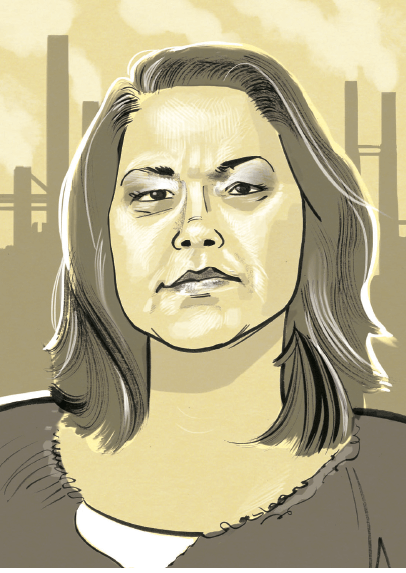
Illustration by Nick Craine
Fearless environmental activist Ada Lockridge leads her First Nation’s charge against oil giant Suncor
ENVIRONMENTAL ACTIVIST AND RABBLE-ROUSER Ada Lockridge is the recipient of many whispers. Through her work trying to stem the petrochemical pollution surrounding her home of Aamjiwnaang First Nation, she has become equal parts private detective and confessor. Whether it’s a plant worker letting her know about an industrial accident or an apology to Aamjiwnaang for bearing the brunt of the area’s pollution, Lockridge is frequently told things in a hushed voice.
Over the past decade, she has found ways to turn those whispers into a sustained campaign of environmental activism. Her history of getting things done has made her a fixture at community meetings and provided her insider access to CEOs and government officials alike. Whenever she meets someone important she likes to jokingly ask, “Are you sure you want to give me your number? Because I will call you.”
Her latest battle is with the Ontario Ministry of the Environment and oil giant Suncor—and it’s one that will take all of her dogged persistence to succeed. In southern Ontario, more than 60 petrochemical facilities are clustered along the St. Clair River south of Sarnia, earning it the nickname Chemical Valley. In the middle of this valley is Aamjiwnaang. The area around Lockridge’s home was one of the first in North America to have its oil reserves exploited. In the 1850s, companies such as Imperial Oil got their start in the new market. The neighbouring town of Sarnia became a hub for the fledgling industry thanks to its proximity to both oil reserves in towns like Petrolia and Oil Springs, and the Great Lakes waterway. With the concentration of facilities came pollution and new health problems for local residents. Lockridge describes the pervasiveness of illness in the community saying, “When someone around here is sick, we ask ‘What kind or cancer do you have? How much time do you have?’”
So when Lockridge and her fellow Aamjiwnaang community members heard in 2010 that the Ministry of the Environment had approved a 25 percent increase in production at Suncor’s desulphurization plant, they decided they’d had enough. It was time to do something. Together with her neighbour Ron Plain and the national non-profit Ecojustice, which mobilizes lawyers and scientists to defend Canadians’ right to a healthy environment, Lockridge decided to launch a legal challenge against Suncor and the ministry.
The case, often dubbed the Chemical Valley Charter Challenge, is part of Ecojustice’s right to a healthy community campaign. If successful, it could see a radical change to the permitting process for industry. Essentially, Ecojustice lawyers argue the ministry broke the law when it green-lighted Suncor’s increased production. The ministry, they add, failed to consider two main factors: the cumulative effect of the industry’s emissions, which they say violates both the “right to life, liberty and security of the person” enshrined in the Canadian Charter of Rights and Freedoms, and also the “right to the equal protection and equal benefit of the law without discrimination.”
The latter largely refers to Lockridge and Plain’s status as First Nations community members. As Kaitlyn Mitchell, an Ecojustice lawyer working on the case, says: “Ron and Ada have particular ties to their community, so it’s certainly not easy to just get up and move.” The ministry, she argues, is not recognizing the First Nations’ connection to the reserve lands—something she, and others, believes constitutes an act of discrimination.
To date the lawyers have submitted over 2,000 pages of supporting evidence (about everything related to environmental health, cumulative pollution, and the vulnerability of people living on reserve), as well as defended against Suncor’s attempt to have the case dismissed. Much of 2014 was spent cross-examining the 19 witnesses sighted.
While the Suncor case could prove monumental, it’s far from Lockridge’s first act of environmental activism. She harkens back to 2002, when Imperial Oil had a major “process-upset” that caused a sand-like catalyst to spew from their emissions stacks. The cloud of industrial pollution was blown south from the plant, across Aamjiwnaang, to the neighbouring town of Corunna. This was the first time Lockridge decided to do something. After the accident and the subsequent struggle to have Imperial Oil include Aamjiwnaang in their cleanup plan, Lockridge decided she could no longer be passive. She dedicated her evenings and weekends to fighting against the constant pollution around her.
In the first few years of her activism, Lockridge learned how to do air sampling using filters on plastic buckets, compiled data for researchers, and worked with biologists, such as Dr. Michael Gilbertson from the International Joint Commission (a Canada/U.S. government initiative that investigates issues related to the countries’ shared waterways). Together, she and Gilbertson re-examined a 1996 Ministry of the Environment study which was completed three years after Suncor had a large on-site accident. The ’96 study showed high levels of mercury in area plant and marine life—a startling discovery that caused Gilbertson to wonder how such things might affect the community’s birth ratio. Similar compounding questions arose as more studies were completed. Eventually, Lockridge began to wonder“My god, what did we start? I think there’s more to it than we realize.”
Although Aamjiwnaang has many forested areas, it’s the countless smoke stacks and flares that dominate the horizon. Among these stacks are warning sirens, which send the alert of an accident, usually resulting in an increased amount of pollution being released. Some of the factories are so close to Lockridge’s house that she hears their sirens and sees workers running to their cars—how can the danger possibly be contained within the company’s chain-link fences? Since 2004 Lockridge has been keeping a detailed calendar charting the “releases” and “upsets”, as the industry euphemistically calls them. In the decade since she started keeping track, she can count only two months without a notation; some months show as many as 15.
Even when the sirens are silent, government-approved emissions from many of the plants contain a host of toxic chemicals, the exact make-up of which is kept from the public (it’s considered a trade secret, and thus protected). Although the individual emissions of each of the 60-plus facilities are within the Ministry of Environment’s parameters, many, like Lockridge, believe the cumulative effect poses a serious problem.
High levels of mercury have been found in the blood, hair, and urine of some Aamjiwnaang members, and a community-led body mapping survey showed asthma levels in adults and children far exceeding that of the surrounding communities. In 2005, prompted by Gilbertson’s questioning on mercury effects, Lockridge co-authored a study of the on-reserve birth ratio. The result? Since the mid-’90s, two girls were born for every boy, helping to explain why there were so many girls’ softball teams in Aamjiwnaang. Many scientists believe that endocrine-disrupting chemicals such as toluene and benzene are the probable cause of the skewed ratio. These chemicals are frequently emitted by the area’s industrial neighbours. But it’s challenging to establish a baseline for air quality testing in the area, says Lockridge.
She once took a sample on what seemed like a clear day—one where there had been no recent sirens—but even that “good day” sample recorded low levels of carcinogens. Frequently, when studies are compiled and presented, little action is taken. Government and industry officials say the results need to be further tested. This frustrates Lockridge. In 2013, when yet another county-wide health study was proposed she asked “Will this be the scientific proof that is needed to say, ‘Yes, it is indeed the chemicals in the industry that are causing the health effects here?’” The representative from Health Canada, she says, responded, “‘No, it’s not.’” She sees the court case as a way to finally force the government into action.
Unfortunately, Suncor and the government have the resources to drag out the case—although Lockridge’s reputation and no-nonsense approach have helped counter the imbalance. She recounts one incident where both have helped. The Ministry of the Environment had been slow to cough-up an important document and when Lockridge found out she simply phoned the ministry and said, “It’s Ada Lockridge calling, I’d like a copy of the report and I’ll be there in 15 minutes. Can you have it ready at the front desk?” Sure enough, it was.
As of December 2014, it seemed likely that the hearing portion of the case wouldn’t start until spring 2015. A ruling could take many months more, and an appeal is likely if the decision is in favour of Lockridge and Plain. The slow pace of the judicial system works to the benefit of Suncor—the company is able to maintain its contentious operations for as long as it takes for a final decision to be heard and enacted. Meanwhile, Lockridge and many others in Aamjiwnaang will continue watching the smoke stacks, charting the releases, sampling air in plastic buckets and demanding their rights. And people will continue whispering tips and apologies to Lockridge.
]]>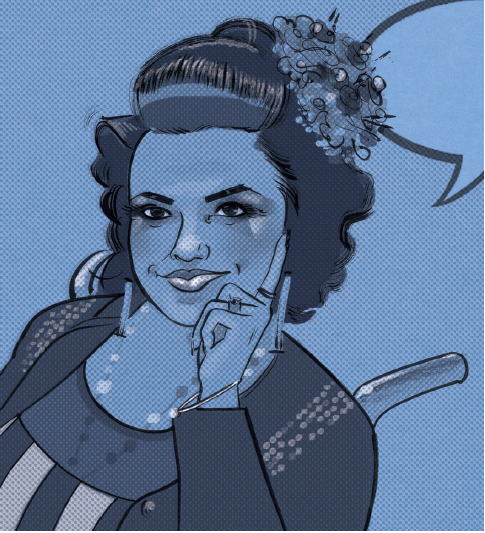 Writer and advocate Jewel Kats gives life to inspiring characters with disabilities
WORDS HAVE CONNECTED THE DOTS of Jewel Kats’ life, keeping her company throughout. She describes writing as a passion that churns from within and comes out by the ink of her pen. An award-winning children’s author and comic strip writer, Kats has penned titles such as Cinderella’s Magical Wheelchair and What Do You Use to Help Your Body? Her goal is to create identifiable and relatable main characters for children living with disabilities. As an advocate, Kats is also the self-titled Original DitzAbled Princess—a reference to her autobiographical comic strip series. “I’ve been affectionately called ‘ditzy’ more than once, twice, thrice,” she says. “I decided to empower this adjective, and stuck ‘abled’ behind it.”
Knowing her close connection with books and reading, I was surprised to learn Kats didn’t understand a word of English in kindergarten. Living in an inter-generational home, she primarily spoke Hindi and Punjabi. Luckily, she says, her love for picture books saved the day. “I would stare and stare at the text and illustrations of picture books until my eyes were ready to pop out,” she says. She was especially enchanted with the illustrations in The Berenstain Bears and Dr. Seuss. “I started piecing English together by recognizing words that I was learning in ESL through the recorded narrative of stories,” she adds, “and began associating words with drawn items—regardless of whatever artistic medium was used.”
As the words accompanying the artwork made more sense, Kats became a bonafide bookworm. By age nine, she was already disappointed with school’s scant book offerings. Itching for a good read to cozy up to on a particularly chilly winter night, Kats convinced her mom to drive her and her younger sister to the bookstore at their local mall in Scarborough, Ont. En route another vehicle crashed into Kats’ passenger door and drove off. “Eventually, someone returned,” she says, “Until this day, we don’t know if it was the same driver or not.”
When the ambulance later arrived, Kats didn’t feel anything wrong—at first. While her mom and sister were largely unharmed, Kats soon realized she couldn’t move her right leg. She was an inpatient at Toronto’s SickKids Hospital for six weeks before being sent home in a body cast. Despite being stuck in bed and having to lay flat on her back, Kats found a familiar escape in reading, particularly Archie Comics. Yet, though the characters of Riverdale would keep her entertained for hours—“I was always drawn to the colourful illustrations and guaranteed punch lines”—she could never fully relate to them. Everyone, she says, was able-bodied and that no longer included her.
As it turned out, many years later, Kats herself would get a chance to fix this. It was like something out of storybook. As an adult Kats had graduated from avid reader to accomplished graphic novelist with the DitzAbled Princess series. While exhibiting her work at Toronto’s Fan Expo in 2013, fate interceded and Kats met one of the Archie Comics’ powers-that-be: Dan Parent, who is easily one of the series’ most prolific writers/artists. “I was pumped beyond belief,” Kats says. “After all, I had a bone to pick with him.” Wheeling up to her once idol gone peer, in her trademark hot pink wheelchair, Kats looked him square in the eye: “Why isn’t there a character with a disability in Riverdale? How is that even possible?”
Parent didn’t have an answer, but he invited Kats to keep in touch, which she did. Like many, Parent was inspired by Kats’ passion and advocacy—so much so that shortly after their meeting a new girl came to Riverdale. Harper Lodge, an advice columnist who uses the pen name Jewel and has a punky fashion style that doesn’t stop at her hot pink wheelchair. The character was on the cover of the comic’s 656th issue, her debut.
This is only one example of Kats acting as inspiration; there are many. At a two-day event at Buffalo, New York’s Museum of disABILITY History, which was held in Kats’ honour, fans of her work told her that she made them feel cool. It took her aback—she’d never even thought a disability could take away from someone’s cool factor. Coming from Kats, this seems genuine. After all, when Kats wanted a character to identify with in Archie Comics, she made it happen, and when she wanted a word search book full of fashion and glamour, she created it. The aspiring fashion designer sees her wheelchair as an opportunity to showcase the highest, sparkle-covered platform shoes, and makes sure all children of all physical abilities can relate with fairy
tales. Her confidence is as contagious as her smile. She is a woman who doesn’t self-impose limits.
“People have found inspiration from my real-life story,” she says. “I’ve personally triumphed over a childhood car accident, sexual abuse in my teens, anorexia, depression and divorce in my adult years. I’ve never let anything or anyone stop me. I refuse to give up.” Kats believes kids pick up on her upbeat vibe and assurance there is always a light at the end of a tunnel, if not a rainbow. “One reader read Cinderella’s Magical Wheelchair so many times that she had to tape the pages together!”
Now living in Etobicoke, Ont., Kats sees all the positive feedback and attention as an illustration to how much her work is needed: “Some call my work innovative, others have called me a pioneer; I beg to differ. People with disabilities have existed since the beginning of time. We were here yesterday. We are here today. We will be here tomorrow. I just happen to be recording stories that need to be told.”
]]>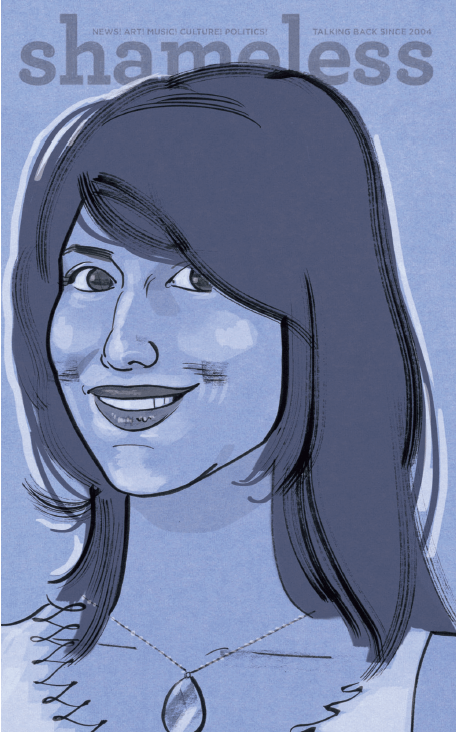
Illustration by Nick Craine
Editor, designer and professor Sheila Sampath is a refreshing voice for intersectional, accessible feminism
IT’S OCTOBER 2014 and I’m sitting on the floor in Sheila Sampath’s Toronto living room, discussing the progress of the newest issue of Shameless, an independent magazine for teen girls and trans youth. Surrounded by communal snacks, the team talks about contributors and deadlines while trying not to disturb Peter Mansbridge the cat, wary of anyone coming too close to his favourite end of the sofa.
Sampath, who leads Shameless as editorial director in addition to running activist design studio The Public, is alternating between tapping out meeting minutes on her MacBook and programing alerts into her iCal. She’s dressed in a fox motif: there’s a fox face on her pullover sweater, which is tucked into high-waisted short shorts, and her legs are wrapped in opaque tights, with her feet capped off with bright, fox-faced socks. Though this high level of sartorial effort for an informal meeting is marvelous, it’s not that strange; those who know Sampath expect colourful fashion choices. But this one has extra panache. “Oh!,” she says with characteristic gentle enthusiasm when asked about her foxy inspiration, “I’m trying it out for my Tumblr, Professor Femme.”
The idea for Professor Femme, whose tagline reads “undermining the academic industrial complex one brightly coloured outfit at a time”, grew from Sampath’s other other job as design instructor at the Ontario College of Art and Design. When she first took the role, her look sometimes caused her to be mistaken for a student or to not be taken seriously by a new class. “I’m brown, I’m a girl, I have bangs and wear goofy socks. I don’t look like other people who work there,” Sampath says. “I had this moment where I thought, ‘Maybe I should buy a blazer?’ But then I thought no, it’s not me. Plus, I think it’s radical to be femme in an academic space.” Women shouldn’t have to look like men to succeed, she thought. And so, starting with her threads, Sampath determined to say something big with small, continuous everyday choices. The micro-revolution, after all, is her specialty.
Sampath remembers clearly the first electrifying moment of microrevolution nearly 15 years ago at the Toronto Rape Crisis Centre (TRCC). During an anti-oppression workshop, the white women and racialized women were separated to compare notes on navigating the day-to-day, based on how they present to the world. It was the first time Sampath had spoken to women of colour in a political way, learning how systemic oppression wasn’t just about a glass ceiling or affirmative action but how its tentacles reach deep into the human psyche. And then something clicked. It was oddly empowering, says Sampath, to learn that the world stamped her with a societal code based not only on what she did but how she looked.
“Growing up, I had such low self-esteem and felt I never measured up,” she says. “But these women helped me realize that my dislike of myself was also because of a system reflected at me by others. It had honestly never occurred to me before.” It became the kernel of an ambition that would fuel Sampath’s working life, leading the conversation of systemic oppression and collaborating with others on how to pull it up from the roots. But though she figured out the kind of work she wanted to do, she had no idea how to do it. She liked counseling at the TRCC but eventually found it emotionally exhausting; providing front line work required the kind of stamina she didn’t have. So how to help? “I like making things,” she says. “And I thought: ‘That’s what I can do.’”
After design school and a cursory trial with the advertising industry, Sampath helped create social justice design studio The Public in 2008. Its work has received sizable recognition (including a recently-awarded Elder Abuse Prevention campaign for Newcomer Women’s Services of Toronto) and Sampath has cemented herself as a social justice ambassador, frequently appearing on conference and radio panels, including a recent spot on CBC’s The Current. But despite the accolades, The Public is most interested in accessible design, especially through popular education and skill share workshops.
“I learned some powerful lessons when I was there,” says Jessica Bartram, former intern at The Public and OCAD student. Instead of working on client work, which Sampath finds “exploitative, really. They’re here to learn, not to be cheap labour,” all paid interns are tasked with two projects. The first is to design a poster with an ubiquitous theme, like Take Back the Night or Idle No More, that’s free to download on The Public website. Users can tailor the type on the poster, download and print, allowing those without design ability the access to promote worthwhile campaigns in their community.
The second task is to create a skill-share design zine, like Intro to Typography or Intro to Colour, also free to download. Bartram says her first zine draft was really formal, academic writing—what she’d been taught. “But Sheila asked me to rethink it,” she adds. “The process taught me how not to be a gatekeeper of my education with highfalutin language but to be generous with my resources by being simple and clear. That’s a pretty powerful lesson, for design and for life.”
Shameless, the entirely volunteer-run teen magazine, recently celebrated its 10-year anniversary. While it’s roller-coasted through a few incarnations of itself, under Sampath’s direction Shameless has evolved into creating feminist work that aims to dig beneath the surface of gender divide and into the intersection of oppressive forces such as race, class, and ability to cast a spotlight on communities largely ignored by mainstream media. Even so, activist-speak has a downside: It can be intimidating and shut out the curious. Some might know that colonialism has been hurtful but aren’t even really sure what colonialism is, for example, says Sampath, and Shameless allows a space for them to learn.
When Julia Horel began work at Shameless as a web editor, she says she was just starting to become political. “Sheila gave me the freedom and support to explore it,” says Horel, who is now the magazine’s publisher. “It can be a scary thing, but she gave me the space to grow my education and voice without any judgment. She taught it’s courageous to say you don’t know something but are willing to learn and she doesn’t shame anyone for not being ‘activist’ enough because she knows she’s still learning, too. If I can now offer any leadership to others in this kind of way, it is 100 percent because of Sheila.”
“Work at The Public and Shameless can be pretty insular,” Sampath tells me as she untwists an Oreo. “You make this thing and then out it goes; it’s hard to measure the effect.” But then, she says, you see dozens of people come to a magazine launch, or thousands leave notes for a poster campaign on Tumblr, as was the case with The Public biphobia awareness campaign, This is Our Community. “Ya, that kind of thing makes me feel good as a person and a maker, sure, but I also realize it means something to people in a way that has nothing to do with me. And then you think maybe these little things that you do are connected to really big things and that’s connected to making little feelings. If everyone’s little feelings exist together it can lead to big, collective feelings. And that can change something.” She peaks up between her Sheepdog bangs, “Want an Oreo?”
]]>
Photo by Benoit Rochon
We know we missed many of the amazing Canadians who out there doing great social justice work in this issue, so we’ve decided to feature new all-stars online at this.org throughout January and February. In our first online-only profile, we introduce you to Courtney Cliff, a 23-year-old activist who is doing amazing social justice work with gay straight alliances in Alberta.
Know an all-star who didn’t make the list, but you’d like to see featured? Tweet us your nominations at @thismagazine or send editor Lauren McKeon an email at [email protected]. We can’t wait to see who you pick so we can be even more inspired! Also stay tuned for more content from the magazine.
****
Waiting outside a meeting room at MacEwan University in Edmonton, Courtney Cliff is only pretending to look at her phone. It’s 2011, and Cliff is in the first year of her sociology degree. She’s seen the rainbow-coloured posters for InQueeries, a student group that welcomes LGBTQ, straight, and allied students, all over campus. Today is the group’s first meeting of the year and though she wants to join, Cliff is too nervous to go inside. At 19, she identifies as queer, but has never been part of a LGBTQ community—growing up in a conservative Alberta town, Cliff’s peers bullied her because they suspected she wasn’t straight. At Cliff’s high school, support groups for LGBTQ students were non-existent. Outside the InQueeries meeting room, she feels like she’s about to jump off a diving board in front of a huge crowd. Twenty minutes pass before Cliff finds her courage and steps inside. “If I don’t do it now,” she thinks, “I probably never will.”
It’s an instant fit. Within a year, Cliff is the president of InQueeries, and is also involved in other activist groups, including the MacEwan Sexual Health Club and the Feminists of MacEwan Club. Now 23, Cliff is fully entrenched in the advocacy world. Still located in Edmonton, Cliff works part-time with as the community liaison worker for the altView Foundation, a charitable organization dedicated to making Strathcona County a better place for LGBTQ citizens. Her job is to work with youth and teachers in the area’s public schools to create Gay Straight Alliances (GSAs)—groups like InQueeries that, as official student clubs, serve as a safe space for LGBTQ students and straight allies. Cliff says she hopes she can do the job forever. She adds that she lives vicariously through the students, who have—positive—opportunities she didn’t at that age. With her work today, she believes she is seeing what her high school experience would have been like if there were a GSA: so much better.
Kiyl Fairall, who co-founded the MacEwan Sexual Health Club in 2013, says that Cliff looks at things from a broad perspective to see who’s missing from important conversations and why. It doesn’t matter what’s happening with Alberta’s political climate, Fairall adds, Cliff doesn’t get discouraged—she keeps fighting. “She continues to show up for and support the kids she works with through her job at altView,” Fairall says. “She tells them that despite pushback, your experiences, stories, and identities are valid.”
Living in Alberta can be challenging for LGBTQ activists and youth. Cliff has faced—and continues to face—obstacles while she fights for equality in the province’s conservative climate. On April 7, 2014, the Liberal party urged the Alberta government to create legislation that would require school boards to develop policies to support students who wanted to form GSAs. The province’s Progressive Conservatives (PC) responded in December by introducing the Act to Amend the Alberta Bill of Rights to Protect our Children, otherwise known as Bill 10. The bill would give Alberta school boards the option to reject students’ requests to create GSAs, although the students would have the “right” to appeal to their school board and then the courts. The bill has created a divide amongst parties, and some PC members resigned in face of the ensuing criticism. The bill has passed its second reading, but is currently on hold.
With the possibility of the bill looming, however, Cliff says she and her students are “resilient” and “fighting” for youths’ rights to have a GSA without barriers. The students are taking action, and a group has started a letter writing campaign to support one another from school to school. Cliff believes that if these kinds of support systems had been there for her in high school, things would be a lot different today. To imagine how different, she only needs to look at the youth she works with and their shifting attitudes toward themselves. It amazes her, especially when she reflects on her own self-perception as a teenager. “It’s cool to see them be so aware of themselves,” Cliff says. “They have found a way through their identities to become activists at such a young age.”
]]>
Illustration by Nick Craine
Dedicated anti-poverty activist and doctor Ryan Meili tackles the root causes of illness and addiction
IN 2010, RYAN MEILI STOOD in the medical clinic where he worked, on the west side of Saskatoon. A girl named Maxine walked in. She was a 20-year-old from the streets who moved as if she were 91. She wanted antibiotics, but really needed a hospital. With a case of full-blown AIDS and a drug addiction, she was getting weaker. Meili remembers the sound of her lungs through his stethoscope, like a rubber boot being pulled from the mud. There was only so much he could do—the damage was done. Maxine’s life had been tragic, full of poverty, dysfunction, and abuse of all sorts. He finally got her to a hospital, where he visited twice a day, but she came and went, often scoring drugs in between.
Meili says stories like Maxine’s are much too common in Canada, and the 39-year-old Saskatchewan-based family doctor is fiercely determined to break the pattern. “What we can do in response as health care providers is really limited,” he says, “because we’re not really able to impact the root cause of illness.” But Meili decided to try anyway and in 2013, he created Upstream, an organization that seeks to address the social determinants of health, such as poverty, nutrition, education, and housing.
In just a few short years, the movement is already making strides: sparking conversations on social media via Facebook, writing blogs and articles for national news outlets, and creating partnerships to deliver awareness on determinants in powerful ways. In 2013, Meili learned that Saskatchewan and B.C. were the only two provinces in Canada without a poverty reduction strategy, so Upstream helped spearhead the recent Poverty Costs campaign, working with the Saskatoon Anti-Poverty Coalition, Saskatoon Food Bank, Saskatoon Health Region and other groups keen to implement a plan.
Through sharing hard facts (the economic cost of poverty in Saskatchewan is $3.8 billion due to increased health and social services), a fierce letter-writing campaign, and asking disadvantaged men and women to share their stories online, Poverty Costs turned out to be a big win, with the Saskatchewan government committing to a poverty reduction strategy in October 2014.
“It’s about taking what we know, getting people aware of it, turning that awareness into real policy change and, ultimately, improving the health of Canadians,” says Meili, who realized he wanted to work with under-served communities when he started practicing medicine. He felt it mattered more to service patients most in need. Then, during his first year of medical school in 2002, he met Dr. William Albritton, professor of pediatrics and then dean of the College of Medicine at the University of Saskatchewan, who further inspired him with the idea of social accountability—that doctors should be mindful of growing social concerns.
The following year, Meili and two friends approached Albritton with the idea to start a student-run clinic in Saskatoon’s inner city. “When he first got started, I told him the problem is not going to be setting up the clinic, because you’re committed and have that ambition,” remembers Albritton. “The success of the clinic will depend upon attracting people who will follow you, who will maintain that same degree of commitment. And he’s tenacious; he’s done a very good job of finding
people with those same world views.”
Eleven years later, Meili is now a supervisor at the Student Wellness Initiative Towards Community Health (SWITCH) clinic that sees about 50-plus clients every shift, three times per week. “Some days are tougher than others. Some days you take a story home, you get touched by people. It’s really hard,” he says. “But it’s even tougher to not be there. It’s tougher to walk away. Once you’re aware that there are these injustices and people who are struggling, you want to be there to help.”
Meili would surprise a lot of people if he ever did walk away. “He’s always had this intense, clear vision of the world that he believes we could have, with no sense of exhaustion in pursuing that,” says Liz James, a longtime friend who met Meili while the two were involved with the student activist network at the University of Saskatchewan. “Things seem possible to Ryan that not everybody believes are possible.”
Take, for instance, the time he was living in Halifax in 1999. He was working at the Big Life Café as a cook and server and heard about an initiative out of the Falls Brook Centre, a local community hub. People were casually tossing around the idea of delivering prosthetic limbs to poor communities in Central America as part of the Limbs to Light campaign. That summer, Meili tore out the seats of an old yellow school bus he rented, strapped himself in and drove from Saskatoon to Halifax, collecting unwanted limbs along the way. Loaded to the roof with arms and legs, he drove down the east coast of the U.S., until he reached Nicaragua. In local villages, victims of landmines had been fashioning scraps of homemade material into limbs. Meili dropped off his stash to the Red Cross and, one month later, headed back home.
Travelling back and forth between run-down areas of Central America, and disadvantaged communities in Saskatchewan, Meili witnessed the same kinds of injustice, gaps between rich and poor. So began the shift from a direct hands-on, people-helping person (which he still is) to thinking more in terms of the system as a whole, rethinking not only about health care, but how we make decisions as a society.
In his early days with the SWITCH clinic, in 2006, Meili was invited to speak at a New Democratic Party (NDP) Convention where he challenged the ruling government to do a better job of balancing resources. “I think from that experience, I realized if I wanted politics to work that way, I needed to get more involved.”
So he did. He ran twice for leadership of the Saskatchewan NDP, first in 2009 when he finished a close second, and then in 2013 when he lost by 44 votes. He’s not sure he’ll run again, but it’s possible. “It would have been an excellent place to bring these ideas forward, but right now, what I’m able to do with Upstream in practice and research is valuable,” he says. “The challenge now is to try and accomplish something dramatic. What we’re really trying to do is apply a new lens to our political decision-making and to do that is pretty ambitious.”
Meili hopes to steer what he calls “an issue that cuts across political lines” and move away from a system that “flounders from crisis to crisis” to one that presses societal concerns—such as the life circumstances of young girls like Maxine.
Maxine never had chances, and her fate isn’t difficult to predict; it’s right there in the first chapter of Meili’s book, A Healthy Society, published prior to his second political run. Meili had been working with a First Nations community in rural Saskatchewan when he got the news. Maxine ran back to the streets she’d known since she was 13 and was hit by a car that shattered her pelvis. Back in the hospital, she contracted pneumonia. She never recovered and died just before her 22nd birthday.
“What often escapes our attention when considering the tragic story of one individual is how intimately it is connected to all of us, to the collective decision-making process that is electoral politics,” says Meili. “It is politics that decides whether young women like Maxine live or die.”
]]>
Illustration by Nick Craine
Documentarian Nayani Thiyagarajah uses curiousity and compassion to confront shadeism in racialized communities
ON A GREY NOVEMBER DAY IN TORONTO, with the sun nowhere in sight and an irritating mix of rain and snow outside, Tamil-Canadian filmmaker and artist Nayani Thiyagarajah is in good spirits—despite being bogged down by a head cold. In between sniffles and blowing her nose, she laughs easily and talks about the sun, its role in her projects, and the communities she loves.
At 26, Thiyagarajah has already done quite a bit for her community. Besides filmmaking and writing, Thiyagarajah is a doula, yoga teacher, dancer, and also currently finishing up the interdisciplinary studies program at York University. If that weren’t enough to keep her busy, she’s also in the post-production phase of her documentary, Shadeism: Digging Deeper.
The feature-length film is a longer version of a short, created in 2011 with some classmates. As the title suggests, the film examines shadeism, a form of discrimination between lighter-skinned and darker-skinned members of the same community. It doesn’t only affect South Asians; it is pervasive within many racialized communities, including African, Caribbean, Latin American, Arabic, and East Asian ones. By 2018, it’s estimated the global skin-lightening industry will be worth U.S. $20-billion—thanks in large part to the maintained racial hierarchy (whiteness is better) in our society.
Shadeism, the short, starts off with a voiceover of Thiyagarajah talking about the sun and how women in South Asian culture are consciously and subconsciously told to hide from it because it darkens their skin—therefore supposedly making them less desirable. The original 20-minute short film struck a nerve among young women of colour. For many, what is often an uncomfortable and hushed conversation around skin tone discrimination, was, for the first time, presented in a frank and open manner as a group of friends in the film shared their experiences.
Racism is something everyone has heard of, says Thiyagarajah, but this idea of colorism or shadeism is not as discussed, especially in immigrant and refugee communities where other things such as putting food on the table or paying rent take priority. “Because we’re still dealing with so much racism, it’s really hard to talk about the internal stuff,” she says. “We don’t have the capacity to focus on the internal dynamics.”
Shadeism is not a new concept. American writer Alice Walker first coined the term colorism in a 1982 essay. Those in racialized or ethnic communities, and particularly women of colour, have long been aware of and oppressed by standards of beauty based on hue. It’s not easy to openly address this sort of discrimination because it requires a nuanced understanding of colonial history, complicated power dynamics, and the ways in which such beliefs are passed down from generation to generation.
The idea for the short came after a conversation Thiyagarajah had with her then three-year-old niece, who felt she wasn’t pretty enough because she was darker-skinned. Thiyagarajah was shocked to discover how race and standards of beauty had already seeped into a child’s mind.
Thiyagarajah was studying journalism at Ryerson University at the time and the short became a final project for her television documentary class. Initially, she says, her journalism instructor and classmates were skeptical about whether shadeism was even an issue, confused over what it was exactly—the program was mostly comprised of white Canadians who had little understanding of shadeism or how it impacted ethnic communities. It was at her and her team’s insistence that it became a short doc.
This was in 2009 and at the time Tamil demonstrations drawing attention to Sri Lanka’s violent 25-year-long civil war were taking place all over Toronto. Thiyagarajah noticed how mainstream media’s coverage painted protestors as supporters of the Tamil Tigers, even though not all of them were. She knew the reasons behind the demonstrations were much more complex than what was reported, and points to this failure to examine or even mention the country’s intricate history preceding the conflict as lazy reporting.
Mainstream media is not exactly known for its diversity or fair coverage and a hasty CNN-style news cycle leaves little room for more nuanced and balanced storytelling—let alone reporting from Tamils themselves. It was the desire to branch beyond the protests and present other stories plaguing her community that empowered Thiyagarajah to look at documentary-style storytelling as a tool for change and resistance work.
Thiyagarajah loves stories. She gushes about spending her childhood visiting a beloved uncle who worked at the HarperCollins’ factory and had an apartment filled with books. “He had like three copies of Goodnight Moon!’” giggles Thiyagarajah. As an adult, she always carries around a book. On the day I speak to her, she has a public library copy of Coolie Woman: The Odyssey of Indenture by Gaiutra Bahadur, a non-fiction read about Bahadur’s great-grandmother who travelled from India to Guiana to work as an indentured laborer, living a borderland life between freedom and slavery. Thiyagarajah, who is interested in history, migration and the South Asian diaspora, wanted to learn more about the experiences of Indo-Caribbean people as told through their own stories and perspectives.
Thiyagarajah is a fast-talker; anecdotes, ideas, book and film recommendations flow out in conversation. She’s constantly consuming media, interested in themes of diasporic resistance, immigration, and journey within a framework of community.
Her parents immigrated to Canada from Sri Lanka in 1985 and she was born and raised in Toronto’s Flemingdon Park, a multicultural neighbourhood in the city’s North York district. Coming from a supportive family instilled a strong sense of community and love, which led Thiyagarajah to become involved in community theatre and youth arts organizations including, ArtReach Toronto and The Remix Project.
“Nayani knows how to make connections between worlds. She occupies many different worlds and is able to connect her story with others’ stories as well, which is an amazing strength,” says friend Amanda Parris, co-founder of Lost Lyrics, an alternative education organization in the city. Thiyagarajah’s empathy enables her to create spaces to help people feel comfortable and open up, which serves her well as a documentarian and interviewer.
Thiyagarajah describes the process of filming Shadeism as a journey of growth, one that was far from a painless experience. Thiyagarajah admits she and her crew had little understanding of the film’s impact when she first posted the short on Vimeo. She says they were surprised to see how quickly it was shared, garnering almost 4,000 views in the first week.
In February 2011, the crew was invited to the Empowering Women of Color Conference at UC Berkley where Shadeism was screened along with a workshop. Thiyagarajah recalls that after the film people were crying. A Latina woman came up to Thiyagarajah but was unable to speak because she was so overwhelmed she was bawling.Thiyagarajah gave the stranger a hug, and at that point realized the heaviness of the film and her obligation and responsibility to her community—especially if she was going to crack open this can of worms.
While attitudes toward skin colour are not easily summarized, there were common threads as women from different backgrounds responded to Shadeism. Comments kept flooding in from all over. While most were supportive, there were also women challenging Thiyagarajah because of her own privileges, growing up lighter-skinned with straighter hair.
As a result, Thiyagarajah felt that Shadeism needed to be turned into a longer documentary featuring a multitude of perspectives. She invited more people, including First Nations women, to share their stories. She has also decided to include supporting elements to the film including a downloadable self-care toolkit, resources and questions to help viewers process the film and their own life experiences. The team also partnered with Lost Lyrics to develop a curriculum with the intention of using Shadeism: Digging Deeper as a teaching tool, complete with a resource package for teachers.
“It’s about [our] community,” says Thiyagarajah, who specifically wanted her friends and family to be in or involved in the feature. “It’s about documenting and remembering other people’s lived experiences. Our stories are more than stereotypes. We have beautiful, rich and difficult and challenging lives that are all part of us.
]]>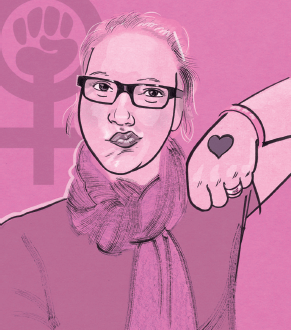
Illustration by Nick Craine
Fierce feminist Julie Lalonde won’t let backlash stop her from fighting for women’s rights
ATTENTION SEEKING FEMINIST. Extraordinary Franco-Ontarian. Award-winning feminist buzzkill. Both good and bad, Julie Lalonde has heard it all—this is how she knows her feminist action is effective. “The resistance we face to our work is real and palpable,” says Lalonde. “To be a lifelong feminist requires an incredible amount of tenacity.”
It’s this kind of drive that helped Lalonde co-create a coalition that pushed for a university-funded campus sexual assault centre at Carleton, a six-year battle that ended successfully in 2007. “Nobody was talking openly about sexual assault on campus then,” she says. “Not like they are today. We were really alone and pushing up against some huge obstacles.” Lalonde has continued to push through those obstacles since: In 2008, she helped get women and gender studies classes into Ontario’s high school curriculum; in 2011 she launched the Hollaback! movement in Canada; and in 2012 she founded the pro-abortion rights group The Radical Handmaids, a satirical street theatre group that raises awareness on how the government polices
women’s reproductive rights.
I’m not surprised when, right away, Lalonde confesses: “I’m juggling a lot right now.” The 29-year-old is also a freelance writer and has a part-time job supporting rural survivors of sexual violence through the Sexual Assault Support Centre of Ottawa. She regularly discusses sexual violence in Ontario schools and talks feminism through Ottawa radio airwaves on CHUO 89.1FM with her show The Third Wave. It’s not always easy, she says, especially considering the current attacks against outspoken feminists, particularly through social media. “I get a lot of backlash, threats and harassment,” says Lalonde. “But I can get up in the morning and keep going because I have a track record of getting the job done.”
Lalonde attributes a lot of this to her time spent at Carleton while earning her masters in Canadian studies and women’s studies. As the first in her family to attend university, she was expected by her family to use the privilege afforded by a post-secondary education to better the world: “My parents busted their humps to be able to put me through school. I am eternally grateful for their sacrifices and definitely feel the weight of the responsibility that comes with it.”
Lalonde grew up listening to the Spice Girls and Alanis Morissette. In high school the Catholic school dress code served as what Lalonde describes as an awakening to how brutally sexist the rules were, forcing girls to have no option, other than skirts—even in a Northern Ontario climate. It was around this age she read and re-read Margaret Atwood’s The Handmaid’s Tale. An ex-nun who, “clearly saw my budding feminism” gave her the dystopian novel. Growing up Catholic, Lalonde
once toyed with the idea of becoming a nun—it was the only career she knew of where she could help better the world. But, “I hated religion and going to church, so quickly realized, being a nun wasn’t it.” Her a-ha! moment arrived during class discussions in her women’s studies classrooms at university.
Today, Lalonde manages the sexual violence prevention campaign, draw-the-line.ca, through which she gives Ontario-wide presentations regarding sexual violence and bystander intervention. Knowing students are not only engaged with the issue of sexual violence but want to know more on how to prevent it, Lalonde hopes this information can be valued in the education system as much as calculus or reading CanLit. In addition to schools, Lalonde also speaks on military bases and even at Parliament Hill.
The activist is passionate about her work and making sure its message is received by the masses, while also making it accessible to everyone. And though she’s faced backlash, her work has also been positively received. In 2013, she was presented with the Governor General’s Award for her work to end sexual violence against women—unaware she was even nominated until after she got a call from her former colleagues at Status of Women to let her know she won. In 2011, she won a Femmy Award, given by peers in the Ottawa Gatineau area, for her work fighting violence against women.
Lalonde isn’t worried about people identifying as feminists. Rather, she encourages people to do feminist work and live by a feminist politic: “bell hooks nailed it when she declared that feminism is for everybody.”
]]>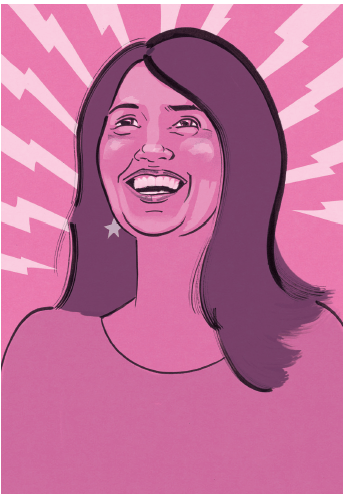
Illustration by Nick Craine
No matter what she does, anti-violence activist Farrah Khan is all about collaboration and women’s empowerment
ON INTERNATIONAL WOMEN’S DAY IN 2008 there was a massive blizzard. Thinking the self-defense workshop she was scheduled to facilitate would be cancelled, Farrah Khan curled up in a blanket, hoping to pass the snowy night with some cartoon watching. The group of South Asian women and children she was supposed to teach, however, were not about to let a ferocious blizzard stop them. They called Khan to let her know the workshop was still on. She trekked to the Toronto-based mosque expecting a small group, but the room was packed. When Khan asked if they wanted their children to leave since she would be talking
about violence against women, one woman just shook her head: “They need to listen to this.”
What was supposed to be a one hour self-defense workshop turned into a three hour extravaganza, with grandmothers practicing how to get out of a wrist hold alongside their granddaughters and everyone shouting their loudest “NO!”
This story is what Khan’s work is all about: women empowering other women. The 35-year-old is currently a violence against women counselor at the Toronto-based Barbra Schlifer Commemorative Clinic and the coordinator of Outburst!, a movement of young Muslim women against gendered violence. But her activism started long before adulthood.
Born in Scarborough, Ont., then moving to Burlington at around age six after her parents divorced, and then finally to Toronto at 19, Khan spent most of her adolescence in a generally homogenous, mostly white environment. Her father is a South Asian Muslim and her mother, a Dutch Christian; still, even with her light skin, Khan stood out.
By Grade 6, she was reading about environmental activism, listening to political hardcore rock music, and reading a book called The Fragile Flag by Jane Langton. It’s about a young girl who marches to Washington for nuclear disarmament. “As a racialized Muslim person coming of age in a Catholic school that was made-up of majority white students,” Khan says, “how could I not notice injustice around me?”
As an outspoken survivor of child sexual abuse, Khan’s activism was a way of coping with and understanding the traumas and violence in her own life. When she was 12, she first told her family and a teacher at school about what was happening, as well as calling the Children’s Aid Society, which she says did nothing. So she decided to take matters into her own hands.
At 16, she began campaigning to raise awareness against sexual violence. Khan says many people assumed the person who had abused her was on the Muslim side of her family—playing into the Islamophobic perceptions of Muslim men. In actuality, it was her Dutch Christian maternal grandfather. At indie rock shows, Khan would take to the stage and speak to crowds of young people, sharing her own story to bring light to the many stories of sexual violence happening to women everywhere.
“From being bullied for having facial hair, called a Paki, to seeing our mosque be attacked or my own personal experiences of violence in the home by my maternal grandfather,” says Khan, “there was never a question that I had to address violence in many of its forms.”
Khan is especially dedicated to addressing violence within the South Asian and Muslim community. As a self-identified Muslim feminist, she seeks to learn from young Muslim women and hear their stories. The common Western narrative is that of the oppressed Muslim woman, unaware of her rights. But Khan shatters that myth. “Many Muslim women are exhausted of being asked ‘How do you reconcile being Muslim and x?’ as if the religion is rigid, static and can be our only social location,” says Khan. “There are many ways to be Muslim as there is to be feminist.”
As a queer Muslim woman, Khan adds, she’s consistently asked how she can be all she is, as if people like her are mythical creatures, like unicorns. That’s obviously not the case, says Khan, adding there are many queer feminist Muslims. She co-facilitates a yoga program for queer and trans Muslim youth, for instance, and has seen how many young people are surprised to see that they’re not alone in how they identify.
Along with her job as a counselor, coordinator of Outburst!, and co-facilitator of a yoga program, Khan also engages in different artistic projects like HEARTBEATS: The Izzat Project, a graphic novel by various South Asian women about persevering through violence. She also co-founded AQSAzine, a series of grassroots zine publications inspired by the disappointing media coverage of the 2007 Aqsa Parvez case.
There is simply no typical day for Farrah Khan. Khan’s job is more of a lifestyle based on her ideologies as an intersectional feminist: from counseling survivors to fighting for a survivor of sexual assault’s right to wear a niqab while testifying in court to creating short films and prose.
Despite all her accomplishments, however, Khan insists she is not a leader of a movement. For her, activism is about being collaborative, working with and learning from one another. Toronto-based artist Vivek Shraya sees that collaborative aspect in Farrah. “What is particularly unique about Farrah is that is she isn’t motivated by celebrity but rather community,” says Shraya. “In the time I have known her, she has been primarily dedicated to a myriad of community projects to ensure that other marginalized voices are heard and other stories are shared.”
I see this in Khan, too. For her, there is no perfect survivor, or perfect activist leader; only groups of women who work together and learn from each other. Later, during our interview, when I ask her what advice she would give young girls of colour, she responds with a smile: “I think it’s what they tell me.”
]]> Come help us celebrate the launch of our first ever Social Justice All-Stars issue!
With this issue, we turn our focus to 30 totally awesome Canadians who are working to make the world a better place. From fighting for feminism, LGBTQ rights, and better mental health services to fighting against racism, discrimination, and harmful stereotypes, these social justice warriors lift our spirits and give us sunshiney hope for the future.
To help kick-off the issue, we’re hosting “This is Not a Ted Talk”. You’ll hear from three of our social justice all-stars: Sheila Sampath, Farrah Khan, and Nayani Thiyagarajah. Each woman will tell you more about their social justice work and, we’re sure, inspire you just like they inspired us!
WHERE: The Supermarket, 268 Augusta Avenue, Toronto, Ont.
WHEN: January 28, 2015. Doors open at 7:30 p.m., “This is Not a Ted Talk” speakers take the stage at 8 p.m.
COST: $5 at the door, which includes a copy of our Jan/Feb 2015 Social Justice All-Stars Issue