Illustration by Paige Jung
We met them first near the hot food. The catering staff were serving a dim sum shrimp dumpling on a bed of rice at the near end of the table. The caterers must have brought hundreds of ramekins to the venue that night, there was an endless stream of them, a new one for each portion.
Her eyes widened with a light of familiarity as she took me in, then gave me a smile. “You’re wearing my outfit!”
I was in a jumpsuit, sleeveless, black, a deep plunge of a neckline, a long string of pearls, black patent open toe pumps. She wore a short black skirt, pleated like a kilt, her legs in black lace stockings, her feet in heavily buckled boots. Her arms, like mine, were bare skinned, but not unadorned—elaborately tattooed. Her hair was stylish in an unkempt, flattering way.
He was in a tailored jacket, slacks a close enough match to suggest a suit, with a dress shirt and blue plaid bow tie, his own nod to the dress code.
He stood by her, encouraging her, enjoying her.
“I’m wearing your outfit?” I responded, puzzled.
“I looked for something exactly like that all day, all over town. You are wearing exactly what I pictured myself in. But I could find nothing. Where did you get that?”
“Eileen Fisher,” I laughed. “Last year’s season.”
“You bought it here?”
“Not here, dear. Your first mistake is to try shopping here.”
The two of us laughed together, discussed the difficulties of getting off the island, eventually parting company after exclaiming over the shrimp, my helpful husband steering me expertly away and back into the crowd.
We didn’t see them again for a while. The room was full, and there was another room besides, with the same food and another bar—a quieter setting, decorated with photos from the 40 years of theatre we were celebrating.
“Remember? We took your dad to see Putnam County Spelling Bee when he was here.”
“Oh, god, and then we got home to find the dog had eaten the chocolate he’d hidden in his suitcase!”
We lingered awhile and then returned to the lobby where things were noisier, gayer, brighter.
We stood at a long, bar-height table, the one nearest the entrance, at the edge of the nucleus of the crowd. Servers and other attendants orbited behind and around us as they found their way with trays, serving food, collecting glassware.
Then we heard it.
“Fuck you, you bitch.”
I turned to look as the two separated. He strode out the door. She circled past me, found an unoccupied length of table a little ways away and took out her phone. She began texting.
I stayed in my place for a few moments, absorbing. It was then that I noticed how young she was. Not yet 30, I would guess.
There I was, nearly 60, a steadfast man at my side, the calm waters of my marriage keeping me buoyant, making my own enjoyment possible. This wasn’t my crowd, either. She bit her lip, then glanced up and around and recomposed her face. I could imagine her heart pounding, her eyes stinging.
No one else had noticed. She was alone and I wished she could know that the room was not staring at her, that if she needed a safe way out, one was at hand. It was the kind of thing I would have wanted at her age. Someone to step up and say, “I’ve noticed you. I’ve chosen your side.”
I moved next to her and when she looked up, I smiled, put my fingertips on her forearm, and asked, “Will you be okay?”
“You heard that?” she asked.
“Yes, we did. But don’t worry. No one else heard.”
“I can’t believe he did that. It’s humiliating.”
I agreed that she was right to be offended. “It was a childish way to speak—and unacceptable.”
“Childish. I know. Can you believe it? He’s in his forties. But what can I do?”
“Do not date children. Of any age. I think you know enough about this man to make a good decision.”
She looked at me. “He’s moved in.”
I held her eye.
She inhaled. Sighed.
“What matters now is only this party, whether you can still enjoy yourself, whether you’ll be safe when you go home.”
She assured me he would not be violent. But he would be hard to get rid of.
“What you do after tonight is up to you. My intent is only to help you stay in this room, if you want, to confirm your right to enjoy yourself and not have someone take this away from you by being vulgar in public.”
She worked for a property manager and had come with tickets the office had purchased. She was texting to see if she could find a friend who might want to come see the show. I looked at her tickets.
“These are some of the best seats in the house. You’re right to want to share them. But if no one can come on such short notice, you will still enjoy the show. It will be fun. Entertaining.”
Her boyfriend approached and I stepped away. Everyone has the right to a little time to apologize.
He didn’t.
I glanced at my husband. We were now some distance from each other, the feuding couple between us. I didn’t look at the couple directly, but I think they felt our fleeting observation. The boyfriend walked out of the theatre.
Moments later, my husband and I and the young woman reassembled. We smiled at the other guests nearby, engaged them in light, brief, cheerful remarks.
Whenever the young woman would start to rail about her boyfriend’s misdeeds, I would let her finish her sentence and then change the subject. I was not there to be her advocate in a bad relationship. I felt she should have no time for him and tried to demonstrate this by having no time for him, or even accounts of him, myself. The path forward lay in choosing a state of mind that excluded him.
The lights dimmed a warning. We were called to the theatre.
I took my seat without optimism and let the entertainment absorb me.
]]>
Art by Valerie Thai
Robin had been ready to start school for a year. On the first day, she was prepared, wearing a blue dress with pink hearts and carrying a giant backpack that tugged at her mother’s heart.
Robin’s parents both came to drop her off. As they left, they waved goodbye to their oldest child and called out: “Ona!” Goodbye in Mohawk. Robin wasn’t starting at just any elementary school. She was starting at a Mohawk language immersion school, or more specifically, the Language Nest program, Totáhne, run by Tsi Tyónnheht Onkwawén:na (TTO), the Language and Cultural Centre in Tyendinaga.
“It was a really good feeling,” Robin’s mom, Alyssa Bardy, says, smiling when she remembers that morning. “To drop her off, and say hello and greet the teachers in Mohawk.”
TTO was established in 2000, by a group of community members concerned with the revitalization of the Mohawk language in Tyendinaga. The name means keeping the words alive. Their services include a Mohawk immersion elementary school and an adult learning program. For the youngest community members, there’s the nursery program, or Language Nest, which includes language learning, culture-based learning, and lots of outdoor play.
Bardy is Upper Cayuga of Six Nations and mixed settler. She belongs to Mohawks of the Bay of Quinte (she’s also my cousin—we’re related through our Dutch-Canadian mothers). She and her husband, Markus, decided to send Robin to the TTO because “it’s kind of a way that we can take back the parts of our culture that were taken away from us,” Bardy says. “On my dad’s side, we have family members who did attend residential school. Specifically we have stories in our family in which, at the residential schools, children were punished physically for speaking the language.”
That’s the fire that motivates her, Bardy says, in terms of putting her daughter into Mohawk language immersion school today. “It’s kind of a way to show honour to those people before us, who had a language, which is a key element to culture, taken away… It’s like an act of reclamation.” It’s particularly special because Robin is the first generation in Bardy’s family that’s been able to immerse herself in it. “To me, there’s nothing more important than being able to take [the language] back,” Bardy says.
Bardy’s watched her daughter thrive in the new school, absorbing words and bringing them home for the rest of the family to learn. Alyssa and Markus are planning to keep her in Mohawk language immersion. But currently, the TTO only offers up to Grade 4. After that, Robin will have to switch to a different school. There’s currently no school near the family that offers Mohawk language immersion from kindergarten to Grade 12. For Robin’s family, and for other Indigenous families reclaiming what’s theirs, this causes a very real concern: if their children have to leave immersion school, will they retain the language they’ve learned up to that point—or lose it?
*
Over the past couple of decades, many Indigenous groups have been pushing hard for language preservation. Grassroots movements have tried to match the demand from parents and communities for schools that offer language programming. There have been tremendous successes, such as the creation of community led, non-profit organizations across Ontario, like TTO. In Six Nations, Kawenní:io/Gawení:yo Private School (KGPS) recently received their high school accreditation—it’s the only school in Canada that offers Cayuga and Mohawk languages from kindergarten to Grade 12. Some communities have found strength in collaboration, like the First Nations with Schools Collective, a group of eight First Nations in Ontario who work together with the aim of achieving “full control of our lifelong-learning education systems, including schools on reserve.”
Data from Statistics Canada shows that for the 2021-2022 school year (the most recent year for which data is available), there were 59,355 students in Indigenous language programs in public elementary and secondary schools in Canada. An additional 8,238 students were in Indigenous language immersion programs. These numbers do not include private schools. However, whether public or private, nearly all of these schools face challenges, including a lack of first-language speakers, space and funding, and curriculum resources.
“If you want to run an immersion school, you have to be ready to take on a number of things,” says Neil Debassige, an education expert from M’Chigeeng First Nation. He joins the Zoom call smiling, with a long beard, baseball cap, and glasses, sitting in a wood-panelled room. He’s spent his career in First Nations education systems, including as a kindergarten student in one of the earliest immersion programs, and later as a teacher and principal at that same school, Lakeview Elementary School. He ran an immersion program there which he describes as “relatively successful.”
When looking at how education systems are developed, and what they need to be successful, Debassige says they really need to answer four key questions:
1.) Are we clear in what our learners need to know and demonstrate in order to meet our sovereign definition of success?
2.) Are we clear in how students are going to demonstrate their learning?
3.) Are we clear in their response when they don’t learn it?
4.) Are we clear in how the community privileges education?
But even when these questions can be answered, Debassige says, immersion schools are a contentious issue in many communities. “It’s not because people don’t think it’s important,” he says, but because “this colonized process of this system that we’re in, it operates on a divide-and-conquer approach. So if communities can be divided in terms of what they think is important in their education system, it’s easier to defeat them.”
Debassige talks about deprivation theory, how people have been conditioned through dependency and the idea that there’s not enough to go around. When grassroots language programs emerge, they might be seen as competition to mainstream schools on reserves. He says those schools, which follow the Ontario curriculum and receive government funding, are severely underfunded, “but at least it’s some first-level funding.”
Starting an immersion school, Debassige says, means taking on the challenge of being underresourced, and fighting for financial support. While schools on reserve (which may offer Indigenous language programming) can receive government funding, immersion schools, similar to private schools, may not be eligible for the same amount. Their funding can come from a variety of sources, including government grants, community fundraising, or other organizations. The TTO, for example, has received funding through the Association of Iroquois and Allied Indians (AIAI), the Mohawks of the Bay of Quinte band council (MBQ), and through the province’s Ontario Trillium Commission.
Yet numerous studies show that students who are exposed to a language in an immersive way will exhibit higher levels of fluency. “If you want to get good at something fast, you need to be immersed,” Debassige says. “That makes perfect sense.” But he says it can be a hard choice for parents to decide to put a child in a grassroots language school, especially a newly founded one. If it’s an immersion school, Debassige says, and parents know that they’re underfunded, they have to consider whether they’re willing to risk the chances of their child not having access to equal sports opportunities, special education, and more.
Debassige says he’d rather describe the schools as bilingual or trilingual. The connotations of bilingual programs and students are more positive. Even so, there’s a level of uncertainty with these programs. “We’re not sure if they’re going to work,” Debassige says.
Today, Debassige runs a couple of tourism businesses, including captaining a chartered boat to take people fishing, renting cottages, and co-hosting a TV show that’s produced on the reserve and airs nationally. These are his passions, but he’s still involved in education work through his own consulting business. They do school evaluations, appraisals of principals, and capacity development. It’s obvious that he cares deeply about language schools, but it’s also obvious that the work comes with a great deal of challenge. I ask what keeps him in it, and he softens a little.
“I have a stake in it,” he says. “I’m a parent. I have two daughters.” One goes to McMaster University, and the other is in Grade 12. “We wanted them to be the kids that were the top Ojibwe language students and the valedictorian of their class, and they were that every year,” he says. Proudly, he tells me that when she graduated, his daughter was the first ever Indigenous valedictorian at her provincial high school. “They were proof that it could be done.”
Debassige says the same is possible for every First Nation kid, if they’re dealt a better hand. “You know, if the system supports that, then I think we can get to fluency and I think—we can do literacy in our language, and be literate in English as well at the end of Grade 8. I honestly think that.”
*
Cyndie Wemigwans is a fluent Nishnaabemwin speaker from Dooganing (South Bay) Wiikwemkoong Unceded Territory. She’s had a varied career: she worked as a chef and as a mechanic before accepting a job as an interpreter at Rainbow District School Board. Recognizing a need for first-language teachers, the board encouraged her to become a certified teacher, and she went through Nipissing University to get her Teacher of Indigenous Language as A Second Language certificate. Now, she’s a teacher at the Wiikwemkoong Board of Education.
Wemigwans teaches her students with Nishnaabemwin immersion, speaking to them about 40 percent in Nishnaabemwin and 60 percent in English at the start of the school year, and shifting toward 80 percent Nishnaabemwin and 20 percent English by the end. She notices a difference between the way she teaches compared to second-language teachers in the school. “I find a lot of teachers are afraid— they’re teaching the curriculum, but they want to infuse the Nishnaabemwin in with the curriculum, but they’re kind of lost on how to go about it.”
Conversely, it can also be tricky for first-language speakers who don’t have teaching experience to teach the language. “For them it’s a little bit difficult, like how to teach the kids, the language itself…It’s hard to find people that have both experience in a school setting and the language.”
In her first year teaching, just before Christmas break, Wemigwans remembers putting her students to the test, asking them to build sentences out of everything they’d learned up to that point. They aced it. Watching them converse in Nishnaabemwin, Wemigwans says, “I had tears coming down. I’ve given them that sentence structure, how to figure out what’s animate, inanimate, the endings… and they understood it. They didn’t have to really think so hard because they understood it.”
Wemigwans says that for her, passing her language on to generations to come is important because “that’s who we are.” She has three kids, including a seven-year-old daughter who is fluent in Nishnaabemwin. “How I explain that to my little one is, when I move on from this world to the next world, if you’re speaking English… I’m not going to understand you,” Wemigwans says. “It’s important that my children speak the language, so that I can still communicate with them.”
Bardy says that the schools play such an important role not only for children, but also for their families. Last January, the Bardys went to a Midwinter Ceremony, a social celebration hosted by Robin’s school to celebrate the beginning of midwinter, an important time of year in the Haudenosaunee calendar. When they got there, Robin and one of her school friends saw each other from across the longhouse. Her friend greeted Robin with her Mohawk name, and the two ran to each other and embraced. The interaction happened completely in Mohawk.
“It was so cool,” Bardy says, “to see that was the first way she was acknowledged, by her Mohawk name, and how Robin responded to that. So inspiring.” Bardy says it’s hard to say at this age how the language might be benefitting her daughter, but “there’s definitely a confidence there.”
“She’s not a shy girl, she’s not afraid to correct us if we say something wrong, or if we say something in English and she feels like it should be said in Mohawk,” Bardy says. “I think it’s instilling a sense of pride in who she is, as maybe a potential language speaker.”
Bardy says the schools play a vital role in reconnecting families to their language and parts of their culture. She worries about Robin losing what she’s learned after immersion school. “We’re going to have to dig deep as a family and do the work to sustain it, and surround ourselves with people who know the languages, and make sure we have everything in place, all the resources that we can possibly have.”
“My biggest fear about that is that we don’t make it a habit of our daily life,” Bardy says, “And it slips away from us.” Though some schools, like Robin’s, currently only offer immersion for younger grades, this could change in the future as First Nations communities, families, parents, and schools continue working to expand. Expansion could include everything from offering more grade levels to expanding their resources and programming. Some parents are just trying to get an immersion school near them.
“We need immersion schools in our communities,” says Tracy Cleland. Cleland is from Wiikwemkoong, Ontario. She’s passionate about the Ojibwe language and was involved in a language nest nearby, Nawewin Gamik, that was started by local elders. Nawewin Gamik ran for about four years, Cleland says, and during that time they had well over 300 attendees, in addition to seven kids and their parents who were there every day. It was forced to close last year due to a lack of funding. Though there are schools that offer a lot of language classes, “it’s not a hundred percent immersion,” Cleland says. “If there was [an Ojibwe school] built in Toronto or something, I literally would move there just to get it. That’s how important I feel it is,” Cleland says. “I’m so close to moving to Wisconsin cause they do have one.” She stresses the importance of dedicated funding for creating immersion schools. “And not just short-term funding—you can’t get things done in a year or six months.”
Part of Debassige’s consulting work with the First Nations with Schools Collective has included developing a new funding formula. They’re trying to negotiate with the federal government to advocate for better access to quality programming. By lobbying for more provincial and federal money, Indigenous language immersion schools could continue doing their work and expand to serve more children. Some schools have also had success at community fundraising, but this can be hard to sustain long term. In the meantime, communities and families are left to find ways to teach their language to the next generations.
*
Testimony from Indigenous communities and a growing body of research speaks to the benefits of learning ancestral languages. Language experts say that maintaining Indigenous languages in early childhood helps to preserve culture and identity. Losing the language impacts an entire community’s well-being.
For Bardy, having her daughter learn Mohawk is about something much bigger. “Aside from knowing the language itself, I want [Robin] to know how the language ties into who she is as a Onkwehón:we,” Bardy says. Onkwehón:we translates to original people. Languages can also be a way to share knowledge systems and to shape people’s worldview and relationships with the land. “One word in Mohawk can be like a sentence in English,” Bardy says. “So I want her to have an appreciation of how descriptive and flowery and beautiful the language is, and how it ties into our place in the natural world and here on earth and as Onkwehón:we and as caretakers of the land.”
Robin is now in her second year in the Totáhne. Last autumn, her younger brother also started at the Language Nest, learning more of the Mohawk language along with his sister. He already had a handful of words when he started, thanks to Robin bringing them home.
Their experience with the immersion school so far has been incredible, Bardy says, and she’s really grateful to have that resource in their community. “Watching your child thrive and flourish in the language, it gives me so much pride,” she says. “When you go outside or you’re looking at a book, and your daughter tells you the name of something in Mohawk, it’s a really special moment.”
“Those bits of culture that were taken away—to me, that reclamation is one of the number one priorities in raising my kids. The schools are an extension of how families and Onkwehón:we can take back what was taken away so many years ago.”
Editor’s note: Robin’s name has been changed to protect her privacy
LEARNING MORE
Want more information about Indigenous language education? Here are some places you can start:
First Nations with Schools Collective
Kingston Indigenous Languages Nest
]]>
Nathan Kanasawe was 23 when they first went viral. Early one September morning in their town of Sudbury, Ontario, they decided to go on a 2 a.m. drive with a friend. While driving, they saw someone testing a Boston Dynamics robot dog.
“I did a U-turn because we’re like, ‘Well, what the fuck was that?’ And then, when we pulled up beside it, we were like, ‘That’s so cool. Can we take a video of it?’” In the video, Kanasawe and their friend could be heard saying “oh my God!” and “I love you!” excitedly to Spot, the black and yellow dog.
“I was really amazed by it. I didn’t have any other thoughts other than, ‘Oh my god, it’s a robot.’ I had no real thoughts about what it meant, politically or socially. I was just like, ‘It’s a robot dog!’”
When they went to bed, the video had gained about 60 retweets. They were woken up the next morning by their notifications going off as the post reached 50,000 retweets. The video later hit 14 million views and had thousands of retweets. Boston Dynamics themselves had to put out a statement. While the video continued trending, people started digging up Kanasawe’s tweets about being a K-pop stan, and posting pictures of their face.
It was 2020 and, though many people shared Kanasawe’s wonder, others began to criticize him for being excited about seeing the robot. “At first people were like, ‘Whoa, that’s really freaky.’ But then, people were like, ‘Have you guys heard about Boston Dynamics opening up a military contract? They’re gonna use the Boston Dynamics dogs as police dogs.’ I was like, ‘That’s fucking awful. But I didn’t know that.’”
Twitter users began commenting things like, “So, you love police dogs,” and calling Kanasawe a “bootlicker.” Some even suggested that they were part of Boston Dynamics’ marketing agency.
Kanasawe, who is Ojibwe, attempted to explain his position by responding to comments on the original tweet. “I was trying to [tell] people…I understood that these things were dangerous to people of colour as well. But it was hard to respond to everybody. I mean, I’m getting hundreds of replies in just a few minutes, over the course of maybe three days. Doing damage control in that type of situation is kind of impossible.”
Kanasawe says they didn’t realize people would become so hostile so quickly. “Because all of the comments on the video were negative, it started leaking into my other posts.” Despite the fact that they tried to maintain separation between their family and social media, Kanasawe’s family became aware of their Twitter account after the video went viral. Kanasawe says they never felt unsafe, but they did feel “exposed” and “embarrassed” as the tweet started to follow them in their everyday life.
“I had no privacy. I don’t think I realized that it was going to affect my internet footprint significantly. Ninety percent of the searches on my full name, that robot dog will just show up,” Kanasawe says. The negative backlash and subsequent pile-on led Kanasawe to delete his tweet, then his entire account. Out of an abundance of caution, he made his new Twitter account and previous Instagram accounts private.
“I really didn’t want it to happen again,” they say. “I felt very out of control of whatever narrative was being placed on that video. I think that because I didn’t have any control over it, a lot of people made assumptions about me and about my friend, too,” Kanasawe explains, noting that they hated it. They ended up wondering: should they continue to be this online?
*
Why are people so comfortable being awful to others on social media?
Faye Mishna, a University of Toronto professor in the faculty of social work, has studied bullying and cyberbullying for decades. She says there are different factors that lead to people choosing to be bullies online. One of the factors is, of course, the perception of anonymity. “If you don’t know me, you don’t see the effect that you have on me,” Mishna says. “Being online can disinhibit because it seems impersonal. You don’t see the impact you have.”
Mishna’s studies focus on how bullying, cyberbullying, and more recently, sexting, affect kids and young people—groups for whom being online has always been part of life. “When we first started, every family had a computer. They didn’t have small devices. [Those] changed everything. It was as large as the Industrial Revolution. Once you have cars and the industrial revolution, you can’t act as though you don’t.”
Statistics from Media Technology Monitor say, “Two in five Canadian kids aged two to 17 own a cell phone and 60 percent have used one in the past month. Usage (87 percent) and ownership (81 percent) are the highest among teens.” If you own a smartphone, chances are you’ve got at least one social media account. The 2018 Canadian Internet Use Survey says social media was regularly used by nine out of 10 Canadians between the ages of 15 to 34.
Since devices make us more connected, there’s more opportunity for young people to experience cyber victimization. According to Elizabeth Englander for the Journal of Pediatrics and Pediatric Medicine, “Increased digital exposure to a potential perpetrator of cyberbullying seems to increase the odds of victimization, in much the same way that greater exposure to a traditional aggressor can increase the odds of becoming an in-person target.” Simply put: the more time you spend online, the higher the possibility of being subject to cruelty on the internet.
The Canadian Internet Registration Authority (CIRA) says in a recent study that most Canadians think social media usage has a “neutral impact on their overall wellbeing.” With that being said, there is a significant increase in the number of people who feel it can be “detrimental.”
“Slightly more Canadians feel social media is harmful (20 percent) to their wellbeing than in 2020, when 16 percent described it as such. Similarly, fewer see it as beneficial,” the study says.
The effect that cyberbullying can have on a young mind is “terrible,” Mishna says. “For young people, it can affect your ability to concentrate, to go to school, to socialize. It can make them depressed; it can make them scared to reach out, it can make them anxious.”
The Health Education & Behavior study by Meaghan C. McHugh, Sandra L. Saperstein, and Robert S. Gold “OMG U #Cyberbully! An Exploration of Public Discourse About Cyberbullying on Twitter” backs up that claim. It said that cyberbullying can lead to anger, low self-esteem, depression, and suicidal ideation.
While there is ample research about cyberbullying of kids and adolescents, the data for the phenomenon among adults is more scant. Statistics Canada discovered in a 2019 study that a quarter of young adults aged 18 to 29 years old experienced cybervictimization in 2018, with receiving unwanted sexually suggestive or explicit messages and aggressive or threatening emails, social media or text messages being among the most common forms.
The numbers also show that queer and Indigenous youth, of which Kanasawe identifies as both, are also at risk for even higher levels of cyberbullying. In fact, 52 percent of youth who don’t identify as male or female reported being victimized online.
The Statistics Canada study continues, “Besides gender, the likelihood of being victimized online was greater among sexually diverse youth (sexual attraction other than the opposite sex) and First Nations youth living off-reserve.” This means young queer and Indigenous people may be less likely to express themselves online, leaving them with fewer outlets to share and connect.
*
The attacks Kanasawe faced changed how they interact with others. Now, they tend to guard their posts, when they decide to make them, by keeping them private and limiting their number of followers. “I didn’t want a lot of people seeing tweets, and if they did, then I would delete them,” they say. “It kind of changed the way that I was on social media.”
On going viral, Mishna says it’s important to know that that kind of response is a possibility. “You can’t really anticipate it except just to know that it could happen. I think we really need to provide support for people [being bullied]. One of the things is, why is it important not to do that, not to join in and shame, because it really does affect someone terribly.”
In an interview with Paper Magazine, then 19-year-old Jazmine Stabler recalled going viral in a cruel meme posted on Twitter. The meme made fun of her facial tumor, which Stabler was born with and had grown to accept. “Why post me? I’m just over here in Alabama living my best life, attending college, minding my own business.” Her comments came after her prom pictures were posted on Twitter with the explicit intent of making fun of the young woman. She took it in stride, but not everyone who unwillingly has content go viral is able to cope with all the negative attention.
In 2019, actress Constance Wu received heavy backlash for a series of tweets criticizing the renewal of the show she starred in, Fresh Off the Boat. After taking a three-year break from social media, Wu said in 2022 that the negative reception she received led her to attempt suicide.
Going viral didn’t affect Kanasawe’s mental health the way it did Wu’s. Things took a weird turn about a year after the video was posted, though. Someone had edited the audio to include the n-word and antisemitic phrases. Kanasawe could do nothing about it, since they previously licenced the video to American pop culture blog Barstool Sports and no longer owned it. This made it impossible to get the video taken down after it went to the wrong side of the internet. Kanasawe was especially hurt that people couldn’t tell the video had been vandalized, and that others were finding the edited video funny.
“My friend and I, we’re not Jewish, and we’re not Black,” they explained. “But if we had been either of those two things, it would have probably taken a mental toll on us to see not only just the video, but the response to that video. To people just laughing and cheering it on. It would have been horrible.”
One of the worst parts of facing this kind of thing is the sense of powerlessness, the lack of agency over whether and how others understand us. “[Cyberbullying] really needs to be dealt with as a community,” Mishna says. She says it’s important that people not just pile negative comments onto viral posts. “One thing that can help is bystanders intervening. A bystander can respond privately to the victimized person just to provide some support. They are incredibly important, and research has shown that when bystanders do jump in and say something, it really makes a difference.”
Nowadays, Kanasawe doesn’t use Twitter that much. They’ve mostly migrated to TikTok, an app with its own host of cyberbullying and negativity. Though, their time on the app is spent trying to help others in the queer community. They run the account More Binders, a mutual-aid program that provides free binders to trans youth. They’ve even gone viral on TikTok, but this time around, it was more positive. “When I had a video go semi-viral [on TikTok], it was for a good purpose. That video was me talking about how I wanted to send trans kids binders for Christmas,” they say. They understand how expensive binders are, and they’re committed to sending the gender-affirming clothing to trans youth who can’t afford it.
“It’s just ironic now because without that video going even semi-viral, I wouldn’t have been able to run More Binders for the last three-ish years.”
It’s not going viral that’s the problem, then; it’s how we behave in groups when we don’t like something. Taking a second to think before commenting can go a long way toward helping ensure those who are already marginalized have a safer life, both online and off.
]]>
Sometime around 2005, in the halcyon days of the internet when it was still treading its path to ubiquity, I peaked. Hunkered down late at night in a small room exclusively dedicated to housing a family desktop computer, I used the free peer-to-peer file-sharing client LimeWire to pirate the less-free peer-to- peer file-sharing client LimeWire Pro. The genius of such a move is one I will never again equal. From there, I sifted through mislabelled songs, copious malware, and recordings of Bill Clinton saying “I did not have sexual relations with that woman” until I found something called digital drugs. The pirated folder contained audio files supposedly engineered to simulate, using specialized sound waves, the sensations of different substances.
Back then, on the precipice of puberty, I knew about drugs the way I know about the concept of enlightenment now. That is, I knew vaguely what sensation I was expecting without any firm idea of when I’d know I was experiencing it. With a smorgasbord of different drugs’ effects at my fingertips, I ran the gauntlet. Beyond the whole medley that appeared in Fear and Loathing in Las Vegas, there were audio sequences said to recreate the feeling of certain experiences: swimming in a frigid lake, déjà vu, having sex with a co-worker on an out- of-town work trip, confessing your love to a best friend, the anticipation floating around a marathon’s starting gun. I was surprised to find that these promises felt accurate: the sounds did take my mind to another place. To some degree, each felt like dreaming for the first time, like being dropped in the middle of an already running narrative and left to gradually fumble around for my place in the proceedings before being suddenly yanked into another thread of another unfolding story only to start all over again.
Of course, I had no idea whether any of it actually was accurate, or if anything was happening at all. As it turns out, that was a more difficult question than it would initially appear. What was being advertised as “digital drugs” were combinations of sound frequencies known as binaural beats, and their legitimacy, efficacy, and potential medical and recreational impacts remain up for debate.
*
Binaural beats were first discovered by Prussian physicist Heinrich Wilhelm Dove in 1839 by striking tuning forks on each side of a student’s head and learning they heard the difference in frequency as a slow, third beat. Dove didn’t pursue the discovery further. It wasn’t until the 1970s, with the work of Dr. Gérald Oster, that binaural beats were taken as anything more than a mild curiosity by the scientific community. In 1973, Scientific American published Oster’s article “Auditory Beats in the Brain,” which outlined the differences between monaural beats and binaural beats. Oster described monaural beats as only requiring one ear to perceive. Binaural beats, on the other hand, he described as “perceived when tones of different frequency are presented separately to each ear,” which requires the use of both ears to localize and selectively filter out certain sounds, such as when eavesdropping on a conversation at a large, noisy party. His observations and insight opened the question of whether binaural beats could be a new, rich vein for cognitive and neurological research.
Later work further clarified the binaural beat effect as something akin to an auditory illusion. In the simplest terms, binaural beats aren’t a sound, per se. More accurately, they’re a perception of sound when two pure tones, played at a different frequency into each ear, create the recognition of an additional modulation of tone within the brain. This third tone is the binaural beat. Despite the technical lack of another tone, the brain registers the difference in frequency between the two tones as a third, distinct tone. For example, when a pure tone is played at an 80 Hz frequency in the left ear and a 90 Hz pure tone is played in the right ear, the brain would perceive a third tone at a frequency of 10 Hz. Most interestingly, the origin of this third tone is perceived by the listener to be from within their own head.
In the 1980s and later, neurological and auditory research began to focus jointly on the reasons our brains create this effect and on whether there are any potential usages, specifically whether it can entrain mood or perception or— perhaps—even act analogously to a drug. The optimistic belief in the ability of binaural beats to synthesize a selected result is based on two strong reasonings. One is that, for most of human history, music and sound have been used to tune into a particular headspace. All of us have a song or two that changes our mood, positively or negatively, simply by hearing it. The second reason for belief in the potential of binaural beats is due to our greater scientific understanding of brain waves with the invention and wider use of magnetic imaging.
Using an electroencephalogram (EEG), a test that reads electrical activity in the brain using electrodes attached to the scalp which looks familiar to anyone who watches horror movies, we can see how brain cells communicate by measuring electric impulses. Our brain cells are always in communication, and the frequency with which they are in communication shows up as wavy lines on an EEG recording. In 2016, researchers in the Department of Computer Science and Information Technology at the Dr. Babasaheb Ambedkar Marathwada University in India used an EEG test to observe and group brain waves. Their research concluded there to be five main frequency bands of brain waves that are believed to correspond to our emotional states.
When we’re asleep, our brain waves are in Delta, low frequency, because there isn’t much to communicate beyond the messages required to keep us alive. During a deeply relaxing scenario, when our minds tend to wander into daydreams, such as being pampered at a spa, our brains are likely in Theta, which operates at a frequency between 4 to 8 Hz and relates to our subconscious mind. A slightly higher frequency, up to around 12 Hz, will likely be registered when someone is passively focused and generally relaxed. Thus, it’s likely this range—Alpha—will correspond to someone who is rewatching The Office for the dozenth time. Basically, it’s being in a general good mood free of the need to meaningfully engage with an external source. The Beta wavelength is typically our normal frequency. It operates between 12-35 Hz and can range from relaxation to anxiety depending on the world around us. The frequency band with the highest Hz, anything above 35, is Gamma, which signals a heightened degree of concentration. This is the wavelength of our brains when we’re focused on a task or situation.
All this is to say that it’s believed by some scientists, and binaural beat connoisseurs, that we can use the brain’s perception of binaural beats to simply recalibrate our current wavelength into whichever frequency band we desire to experience. But the question remains: does it work?
*
Back in 2005, I was an audio addict, digitally dosing myself on LSD, heroin, mescaline, and strange designer drugs only known by some combination of letters and numbers. As far as I knew, the sensations were similar to their physical counterpoints. Digital cannabis made me giggle. I’d have vivid daydreams on audio psychedelics. Binaural beats mimicking cocaine had me impatient and talkative, jittery with a vague sense of violence. Of course, that was the past. And time has a way of softening people, so now I use binaural beats to achieve a flow state of concentration or induce drowsiness for a power nap.
A pilot study conducted by the Oregon Health & Science University and the National College of Natural Medicine on the neuropsychologic, physiologic, and electroencephalographic effects of binaural beat technology on humans found no significant differences between the experimental and control condition in any of the EEG measures. But in that same study, the self-reported measurements of the participants saw an increase in mood and a decrease in overall anxiety. Better put: there was no scientific reason that participants felt an improvement in mood, yet they did.
There must be a motive behind why people are using binaural beats. Anecdotally speaking, I certainly feel calmer when I listen to one of the myriad binaural beats soundscapes that are easily findable online, so isn’t that the same thing as being calmer, even if my brainwaves disagree? After all: I think, therefore I am. That may be the entire point, suggests Dr. Monica Barratt, a senior research fellow at RMIT University in Melbourne, Australia. “There are a lot of activities that affect our nervous system and can produce psychoactive effects, including meditation, chanting, exercising, even doing art,” says Barratt. “Yes, we can consider binaural beats through [this] lens.”
And I’m not alone in using them for this reason. In 2021, Barratt was a researcher with the Global Drug Survey (GDS), an independent research study that aimed to collect data on drug use patterns and trends worldwide. When questioned on the survey, five percent of the over 30,000 respondents said they used binaural beats to experience altered states at least once within the last year.
Dr. Cristina Gil López, a cognitive neuroscience researcher and educator, writes on her website that the beats have become trendy due to our increasing difficulty to focus and be productive in our daily activities. We live in a state of permanent distraction, so we seek new ways to mentally focus and decrease off-putting distractions, like anxiety. Other studies echo the sentiment that exposure to binaural beats can boost cognition by reducing anxiety and the perception of pain, albeit modestly.
So where do we go from here? While large-scale investigations comparing the effects of binaural beats specifically and auditory beats as a whole are still rare, there are some promising case studies for their potential application. One such avenue is the Safe and Sound Protocol (SSP). The SSP is a therapeutic tool that uses specially filtered music designed to stimulate the vagus nerve, which carries signals between the brain and heart. The SSP is intended to induce the body and mind into feeling a sense of safety. There have been successful case studies that show SSP exposure can improve social awareness in children and adults with autism and help to reduce chronic pain in older patients.
Barratt herself underwent the protocol as part of her research. For 30 days, she listened to audio files as part of the SSP and may have discovered the everyday benefits binaural beats could have on many of us. “I felt some positive effects and there [weren’t] any downsides. It could all be placebo in the sense that taking time every day to listen to some special music may be an intervention in itself.”
While writing this piece, I thought about what initially drew me to these files. The truth is I have no idea. There was no larger reason behind accessing them beyond the fact that I could.
It took roughly 135 years from a Prussian physicist striking tuning forks on opposite sides of the room and noticing the effect for another researcher to even give that effect a name. Since then, we’ve seen vast leaps in technology that have allowed scientists to measure, with as much certainty as currently exists, that nothing is happening within the brain that can explain why binaural beats can improve our mood and decrease our anxiety levels. But people who listen to them claim that they do, time and time again. In defiance of the science, they feel that listening to binaural beats can impact their mood.
Maybe in another 135 years we’ll discover that they’re right. Maybe we’ll still only know that the effects are something many people enjoy. Maybe that’s all the reasoning I needed to enjoy binaural beats as much as I did when I was 12.
I know it’s all the reason I need to enjoy them now.
]]>
Photo by IMAGINIMA
“It was just something to do…like getting your hair braided,” says Kayowe Mune, describing the mindset held by many communities about female genital mutilation/cutting (FGM/C).
Mune, now 42, is a content creator based in Toronto and was cut when she was six years old, as part of what’s known as vacation cutting, which often happens during the summer when school is out. Mune was born in Somalia and was living in Saudi Arabia with her parents at the time. While spending the summer at her grandmother’s house back in Somalia, Mune was taken to a hospital to be cut. Since her cousins were already going, her grandmother added Mune to the group, accompanied by her aunt.
“It wasn’t like the village lady…shrouded in scars came with a…razor,” says Mune. She explains that she was taken to a “really nice” hospital, where a lineup of other girls also sat waiting for their turn. While the hospital may have been welcoming, the procedure was done without anesthesia.
“I remember sitting outside waiting for [my] turn, and that part was pretty scary because you can hear them screaming,” Mune says. In the days that followed, all that Mune recalls is feeling dissociated from her body.
A tradition in many African cultures, FGM/C is viewed as a way to protect a girl’s chastity and ensure that she gets a good husband, explains Mune. Older generations often don’t see anything wrong with the practice and it’s frequently equated to male circumcision, which isn’t comparable at all, according to Giselle Portenier, co-chair of the End FGM Canada Network. Portenier, who is also a journalist, learned about the abuse of women’s human rights through her documentary work. She co-founded the End FGM Canada Network after realizing how big and under-reported an issue this is in Canada. Portenier explains that the equivalent of this kind of genital mutilation/cutting performed on males would consist of cutting off the head of their penis.
“There is no comparison,” she says.
*
Female genital mutilation/cutting is classified into four types, per the World Health Organization. Type I, also known as a clitoredectomy, involves the partial or total removal of the visible part of the clitoris and/or the prepuce/ clitoral hood, which is a fold of skin surrounding the clitoris. Type II, also known as an excision, is the partial or total removal of the visible part of the clitoris and the labia minora, the inner folds of the vulva, with or without the removal of the labia majora, the outer folds of the skin of the vulva. Type III, also known as infibulation, involves the narrowing of the vaginal opening through the creation of a covering seal. The seal is formed by cutting and repositioning the labia minora, or labia majora, sometimes through stitching, with or without removal of the clitoral prepuce/clitoral hood and glans. Type IV includes all other harmful procedures to the female genitalia for non-medical purposes, such as pricking, piercing, incising, scraping and cauterizing the genital area.
FGM/C is not something that affects only those in African countries. While there’s no official study detailing the prevalence of FGM/C in Canada, vacation cutting affects survivors living in Western countries, too. It is practiced and/or affects those living in 92 countries across every continent but Antarctica, and this number is only growing as more survivors are discovered.
Often, girls who are born in Canada are taken to their parents’ home country, usually in African nations such as Somalia or Egypt, to be cut and then brought back home to Canada. In other cases, such as Mune’s, girls immigrate to Canada with their families having already experienced FGM/C. This happens despite the fact that female genital mutilation has been identified as a form of aggravated assault in Canada’s Criminal Code since 1997, a move the Department of Justice says was made in keeping with Canada’s commitment to support the 1993 United Nations Declaration on the Elimination of Violence against Women, the United Nations Convention on the Rights of the Child, and the 1995 Platform for Action of the Fourth World Conference on Women. These recognized that violence against women, including FGM/C, violates their human rights and fundamental freedoms.
Still, according to Portenier, there are over 100,000 survivors of FGM/C in Canada and thousands of girls at risk. This figure is based on End FGM Canada’s analysis of immigration from 29 FGM/C practicing countries in the Middle East and Africa as reported in the 2011 Canadian Census. Yet, “there [is little support] for them in Canada, largely because there is a culture of silence and silencing about this issue here,” says Portenier.
The silence is often due to a fear of causing offence around other people’s traditions. In May 2023, a daycare worker alleged that a two-year-old child’s genitals had been mutilated and alerted Quebec’s youth protection services, which reportedly replied that the case was too delicate for the agency to handle. (The child was later examined by a doctor, and the case has since been declared unfounded.) In response to This Magazine, Quebec’s Human Rights Commission refused to comment as this case involved a minor.
Canada is also the only Western country, besides New Zealand, lacking in official statistics on FGM/C, according to a 2020 report by Equality Now, a human rights association dedicated to the welfare of women and girls. “Efforts to get statistics and be [funded] by the Canadian government on statistical analyses have failed on several occasions,” says Portenier. While the government has attempted to calculate estimates, their most recent September 2023 report still states that “the results should not be interpreted as official estimates of FGM/C in Canada.”
Despite the failure of the federal government, last year Alberta was the first and only province to date to pass a bill strengthening existing laws that ban female genital mutilation in the province. The bill states that health professionals who practice or facilitate FGM/C in the province will be removed from practice if convicted. Additionally, those convicted in other jurisdictions will not be permitted to practice in Alberta.
When asked how things can be improved for survivors in Canada and those who are sent for vacation cutting, Women and Gender Equality Canada stated that they strongly condemn FGM/C and under the federal Gender- Based Violence Strategy they “provide funding to various community-based initiatives that address FGM/C nationally” and will “continue to work together with [their] provincial and territorial counterparts as well as with academics and service providers to ensure a multidisciplinary approach so that impacted women and girls have access to culturally safe services.”
While there are federal as well as provincial plans in place to address FGM/C, not a single prosecution has occurred since the 1997 criminalization of FGM/C in Canada. According to Global News, a leaked border services report in 2017 also showed that FGM/C practitioners were entering Canada to carry out the procedure. The lack of prosecutions in Canada come as a shock when in comparison, the U.S., the U.K., France, and Australia have all prosecuted cases of FGM/C.
*
Since FGM/C is generally performed without anesthesia, the first immediate side effect is the intense pain. Bleeding occurs and scar tissue forms over time in most cases of cutting. Depending on the type, menstruating and urinating can be difficult and cause pain, as can childbirth and intercourse. Female sexual pleasure is hardly taken into consideration, but this is also compromised.
Depression, PTSD, and anxiety are just a few of the psychological effects of FGM/C. Others include not being able to do things a child normally does, recalls Mune. “When you’re cut, they don’t want you to learn how to ride a bike because you can open up your stitches.” Sports were out of the question for girls, but Mune was able to rebel when she moved to Toronto and signed up for her school’s athletics program.
While immigrating to Canada helped Mune escape some of the cultural restrictions imposed on girls, she and many other survivors faced, and continue to face, a whole other set of challenges here.
“I would say white Canadian doctors are not educated, and a lot of them don’t care, especially the males,” says Mune, speaking about her experience with the Canadian health-care system. Mune has found compassionate care with doctors who are primarily women of colour, but other challenges persist. With staff shortages, difficulty in getting appointments, and medical professionals’ generally busy schedules, awareness and empathy have been hard to come by for Mune.
Over time Mune has gotten better at advocating for herself, but she wishes there was a way for doctors and gynecologists to know that they are seeing a survivor of FGM before they enter the examination room. “I think… it should be highlighted, like every [appointment] that this person is a survivor of genital mutilation…before [the healthcare provider] sees [the patient],” says Mune.
Organizations like End FGM Canada are working to create more awareness around the practice in Canada. Initiatives include educational modules designed for health-care professionals and child-protection workers. A special module for teachers is set to release in November 2023. They also created “Miss Klitty,” a campaign that promotes education about the clitoris. In the vast majority of cases of FGM/C, the clitoris is harmed. This is often due to the belief held by many practicing cultures that the clitoris is evil, explains Portenier. Thus, “Miss Klitty” was created as a way to demystify the clitoris and get people talking.
One option for those who have experienced FGM/C is reconstructive surgery. Dr. Angela Deane, an obstetrician/gynecologist at North York General Hospital and the University of Toronto, focuses on clitoral reconstruction. Deane sees up to five patients per month for consultations regarding potential treatments. She explains that in some types of cutting the clitoral glans is removed, which is the very visible tip on the vulva.
“What we can do is release more clitoral tissue from beneath all that and bring that forward to the outside. And having that new clitoral tissue on the outside is like a creation of a new gland,” says Deane. This new gland can then offer more sensation. Surgery can also include removal of a cyst or scar tissue, as well as defibulation. Depending on the impacts of FGM/C, an individualized care plan is recommended which can be non-surgical and include medications or therapy to address pain or scar tissue. Often, recommendations also include seeking mental health support, sex therapy, and physiotherapy.
Mune says one step forward is to make therapy or counselling free of cost for survivors. “It used to be hard for me… when I was younger to afford [therapy]… and I knew I needed it,” she says.
Mune also emphasizes the importance of education and a present father in a young girl’s life. Her parents were unaware of her being cut and they never would have supported it had they known. Even today, she knows Somalian families where daughters with present fathers have never heard of FGM/C, while other families send their daughters to be cut without the father’s knowledge. That’s not to say the women and other men of the families are deliberately trying to hurt their daughters, Mune underlines. “They’re not monsters…they’re doing this out of love…It’s just an old, very ancient procedure that needs to go away, and it just won’t go away.”
Anecdotal statements from Mune, other survivors and wider diaspora communities suggest that FGM/C is still a problem and while global efforts from the United Nations have been helpful, change has been slow due to its secretive nature. What sets Canada apart from other Western countries is the lack of statistics on FGM/C and its implications here.
In order to prevent vacation cutting in Canada, a first step would be to fund a project on obtaining proper statistics. Efforts at all levels of government also need to be placed on genuinely communicating with members of communities and working together to eradicate this practice from Canada rather than being afraid of offending people.
Providing coverage for reconstructive surgery under provincial health policies would also help. In Ontario, for example, coverage varies depending on a person’s needs, and clitoral reconstruction is not fully funded. Finally, law enforcement and the legal system also need to work on prosecuting cases of FGM/C, as done by most other Western countries. Canada’s culture of silence can no longer afford to continue to perpetuate this abuse.
]]>Our News Editor is responsible for overseeing the magazine’s front-of-book This & That section. This Magazine publishes six print issues a year, with each issue featuring 4 to 6 news stories, including 1 profile (600 words) and 3 to 5 stories that fall under our various news slugs (300-600 words each). The News Editor edits each of these stories, working alongside the editor to incorporate their feedback as well. We cover topics including, but not limited to: health, education, labour, harm reduction, housing, poverty, urban issues, rural issues, elections, new bills/laws/studies/reports, racial justice, feminism, Indigenous rights, and 2SLGBTQ+ issues. We work with a mix of experienced and emerging writers, with an emphasis on bringing in new and diverse voices. We strive for regional diversity within the section, i.e. covering stories from various urban and rural locations across the country, as well as national stories. The section takes a progressive lens to Canadian news topics and highlights social justice issues and stories left out of the mainstream national media (we’ll sometimes cover stories that have received press in local, community, or campus media).
Ideal candidates have some combination of editing experience, news writing experience, connections to emerging Canadian journalists, interest in various topics on the news spectrum, and a love of independent publishing.
This position pays a small per-issue stipend. This is a remote position that can be done from anywhere in Canada. Candidates must be Canadian residents.
This Magazine encourages applications from individuals from marginalized groups currently underrepresented in Canadian media. We’re looking for early career editors with a good understanding of This’s mandate and what makes a This story and angle.
Please email your resume and cover letter by Friday, May 26, 2023 with the subject line “News Editor application” to: [email protected]
]]>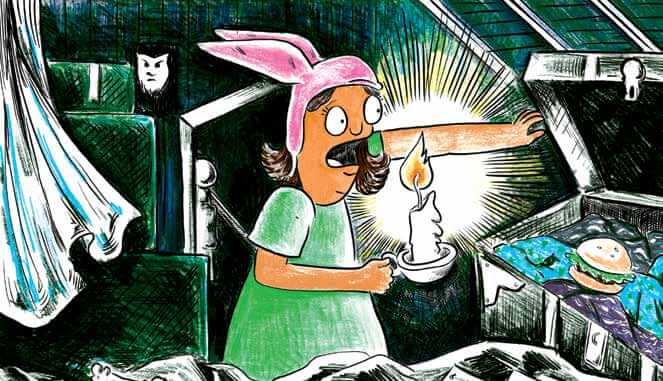 Illustration by Paterson Hodgson
At nine years old I was an under-the-covers reader. Even on nights when my parents were distracted by their cassette tapes and homemade wine, I wouldn’t risk turning on my bedside lamp after 8:30 p.m. Maybe my parents knew I was deep into the world of Nancy Drew or Encyclopedia Brown under those blankets, a flashlight illuminating the clues and cliffhangers on the pages.
Now, almost four decades later, I’m once again reading Nancy Drew books at 8:30 p.m. every night, only in my 10- and eight-year-old sons’ room. We join Nancy as she investigates mysterious bungalows or stolen clocks, and my youngest son makes wild guesses about what the criminals are up to. Both boys are often still debating plot possibilities after I turn out the light. I don’t think they read under the covers after I leave, but I wouldn’t mind if they did.
The popular culture of my kids’ generation is phenomenally different from the pop culture I grew up with. There is more of it, for one thing: an abundance of TV channels and streaming services, music apps that let them listen to what they want when they want, and many more book series tailored to their age group. Yet the appeal of a child detective is untouchable.
So much media for children in the tween and teen years features kids doing adult things with little adult interference. Teen-detective stories are appealing at this developmental stage because they provide examples of how a person can remain a child, while accessing the bravery associated with adulthood. Because growing up is scary.
In the most recent Nancy Drew novel I read aloud, Nancy gets knocked out then spends several chapters trapped in the gross basement of a bungalow in the middle of nowhere. For me, this is terrifying. For my kids? Well, they take it in stride. Their faith in Nancy is unshakeable. Nancy is brave, and smart—she can handle anything.
The day after we read this section of the novel, my eldest son is starting at a new summer camp. He is excited, but clearly nervous, bouncing around the kitchen, checking his outfit in the mirror, speculating on every detail of how the day might go. He is in no physical danger, but freaking out about this adventure into something brand new. Watching him go through these emotions gives me some insight into why children around his age are so attracted to stories where they see kids confronting the unknown and emerging triumphant.
And in those older mystery novels, that’s where it ends. The mystery is solved, the teen detective wins. Then everyone goes back to their sock hops—until the next mystery crosses their path. But there’s something missing from those older detective books: how do the characters feel as they go through these intense experiences? Did Encyclopedia Brown ever contemplate whether he could live up to the expectations placed on him by his father? Did Nancy Drew ever ponder her own mortality after being hit on the head repeatedly by the bad guys? Did the Hardy Boys ever wonder if their close sibling relationship would survive into adulthood? We don’t know.
These stories were written in an era where children were not expected to examine their inner lives, even as they navigated the complex emotional path to adulthood. It is something that the books published before the 1960s rarely touched upon, but I’m starting to see it in more contemporary stories. Weirdly, the place I’ve seen this navigation of a child’s inner life chronicled with the most depth and heart recently was in The Bob’s Burgers Movie.
It’s a bit of a left turn, I know, going from the classic Nancy Drew novel to an animated musical comedy about a family running a burger restaurant in a fictional town on the east coast of the U.S. And I certainly wasn’t expecting a tween detective story to shape the narrative of the full-length Bob’s Burgers movie, when I took my own family to the movie theatre for opening night.
For those unfamiliar with the series, Bob’s Burgers chronicles the ups and downs of the Belchers: parents Bob and Linda and their three children, 13-year-old Tina, 11-year-old Gene, and nine-year-old Louise. They scrape by on the profits from their underrated burger restaurant, and each episode draws viewers into their flawed but heartwarming family life.
In the full-length film, Louise is positioned as a central character as she unravels clues related to a murder mystery that many of the characters are attempting to solve. It is Louise who finds the skeleton that prompts the discovery of the murder in the first place, and in the space of a few minutes her character goes from confident and sarcastic to reeling in terror. This, combined with being teased in the school yard for her attachment to a bunny-eared hat she has worn since early childhood, sends Louise into a spiral of self-doubt. Contemplating life without her beloved hat leads her to conclude the only way she can prove that she is brave and not—horror of horrors—“a baby,” will be to solve the murder mystery. The adventures that ensue and the eventual conversations Louise has with her family allow her to gain a stronger sense of self.
This is not a coming-of-age story. Louise doesn’t get through these trials by making a clear transition into adulthood. Rather, it is a story showing the tiny steps children approaching adolescence must take to understand themselves a little better. Louise is working to solve a real, messy, grown-up mystery, while also grappling with the fear of removing her signature childhood hat, after so many years of clinging to it for security and a sense of self. The murder is ultimately solved, but the important story is really Louise’s emotional growth. In a scene near the end of the film, we watch as Louise backflips off of a horizontal bar in the school playground, and her bunny ears fall to the ground. The viewer never sees the character without her hat, but the movie shows her calmly retrieving it and placing it back on her head. The hat has become a choice rather than a desperate emotional crutch.
As the mother of a 10-year-old, I see struggles like these play out every day with my own child. I’m conscious of the trend of encouraging children to acknowledge and name their feelings, a trend that was very much not present when I was growing up in the 1980s. Recently, my son woke up on a school day and immediately declared he was sick. This had been happening a lot since the pandemic, and I was suspecting it was more emotional than physical. When I was a child, there was no such thing as a permissible “mental health day.” If I didn’t want to go to school, too bad. Faking sick was the only way to get out of it, and I could see my own kids using that age-old technique. But all it took was a quick discussion about how it’s okay to be overwhelmed and a little freaked out about whatever lies in store beyond the safety of our family home, to shift the narrative. I’m glad this shift to naming and discussing feelings as a tool for handling life’s challenges is making it into the beloved child-detective genre too, in its modern incarnations.
When my family went to see The Bob’s Burgers movie, it was Louise’s story that stood out for us, providing an unexpectedly emotional and nuanced look at the character. Viewers of the TV show have almost never seen Louise without her hat, and over multiple seasons, the hat has rarely been acknowledged or mentioned. It’s just a part of Louise, a character many viewers have grown to love.
Watching her grapple with a personal change that seems small but is actually huge for a child, all while trying to solve a murder, connects the audience to Louise more than I ever felt connected to the unemotional teen detectives of the past. And last summer, whenever we were driving somewhere for a family trip, my kids would play the movie soundtrack. Listening to them sing Louise’s words in the song “Sunny Side Up Summer” always got me: “Each and every day/ I just think I’m pretty great/ yep that’s right/ no big deal/ I’m not hiding what I feel.”
Louise may not have the clean-cut poise of Nancy Drew or the methodical detachment of Encyclopedia Brown, but in The Bob’s Burgers Movie she’s the messy, modern kid detective we all deserve.
]]>Our News Editor is responsible for overseeing the magazine’s front-of-book This & That section. This Magazine publishes six print issues a year, with each issue featuring 6 news stories, including 1 profile (600 words) and 5 stories that fall under our various news slugs (300-400 words each). The News Editor edits four of these stories per issue (the Editor edits the remaining 2.) We cover topics including, but not limited to: health, education, labour, harm reduction, housing, poverty, urban issues, rural issues, elections, new bills/laws/studies/reports, race and racism, feminism, Indigenous rights, and LGBTQ2S+ issues. We work with a mix of experienced and emerging writers, with an emphasis on bringing in new and diverse voices. We strive for regional diversity within the section, i.e. covering stories from various urban and rural locations across the country, as well as national stories. The section takes a progressive lens to Canadian news topics and highlights social justice issues and stories left out of the mainstream national media (we’ll sometimes cover stories that have received press in local, community, or campus media).
Ideal candidates have some combination of editing experience, news writing experience, connections to emerging Canadian journalists, interest in various topics on the news spectrum, and a love of independent publishing.
This position pays a small per-issue stipend. This is a remote position that can be done from anywhere in Canada. Candidates must be Canadian residents.
This Magazine encourages applications by individuals from marginalized groups currently underrepresented in Canadian media. We’re looking for early career editors with a good understanding of This’s mandate and what makes a This story and angle.
Please email your resume and cover letter by Friday, June 17, 2022 with the subject line “News Editor application” to: [email protected]
]]>Do you love CanLit? Are you always on the lookout for diverse and emerging authors? Are you a huge supporter of small presses and independent publishing? If so, we want you! This Magazine is looking for a Reviews Editor!
Our reviews editor is responsible for overseeing the reviews portion of the magazine’s Arts & Ideas section. This Magazine publishes six print issues a year, with each issue featuring one feature review (200 words), 5 regular reviews (100 words/each), and one book excerpt (350 words). We review work published by small presses with an emphasis on new and emerging writers. We review novels, short story collections, poetry, non-fiction, essay collections, graphic novels, plays, and memoir. We strive for regional diversity, i.e. showcasing writers and presses from various urban and rural locations across the country. We prioritize books from marginalized writers and work about political and social justice themes. The intent of the reviews section is to promote new Canadian and Indigenous small press books.
Ideal candidates have some combination of editing experience, reviewing experience, a familiarity with emerging and established Canadian authors, interest in various forms of Canadian writing, and a love of small print media.
This position pays a small per-issue stipend. This is a remote position that can be done from anywhere in Canada. Candidates must be Canadian residents.
This Magazine encourages applications by individuals from marginalized groups currently underrepresented in Canadian media. We’re looking for early career editors looking to break into the industry.
Please email your resume and cover letter by Thursday April 14, 2022 with the subject line “Reviews Editor application” to Tara-Michelle: [email protected]
]]>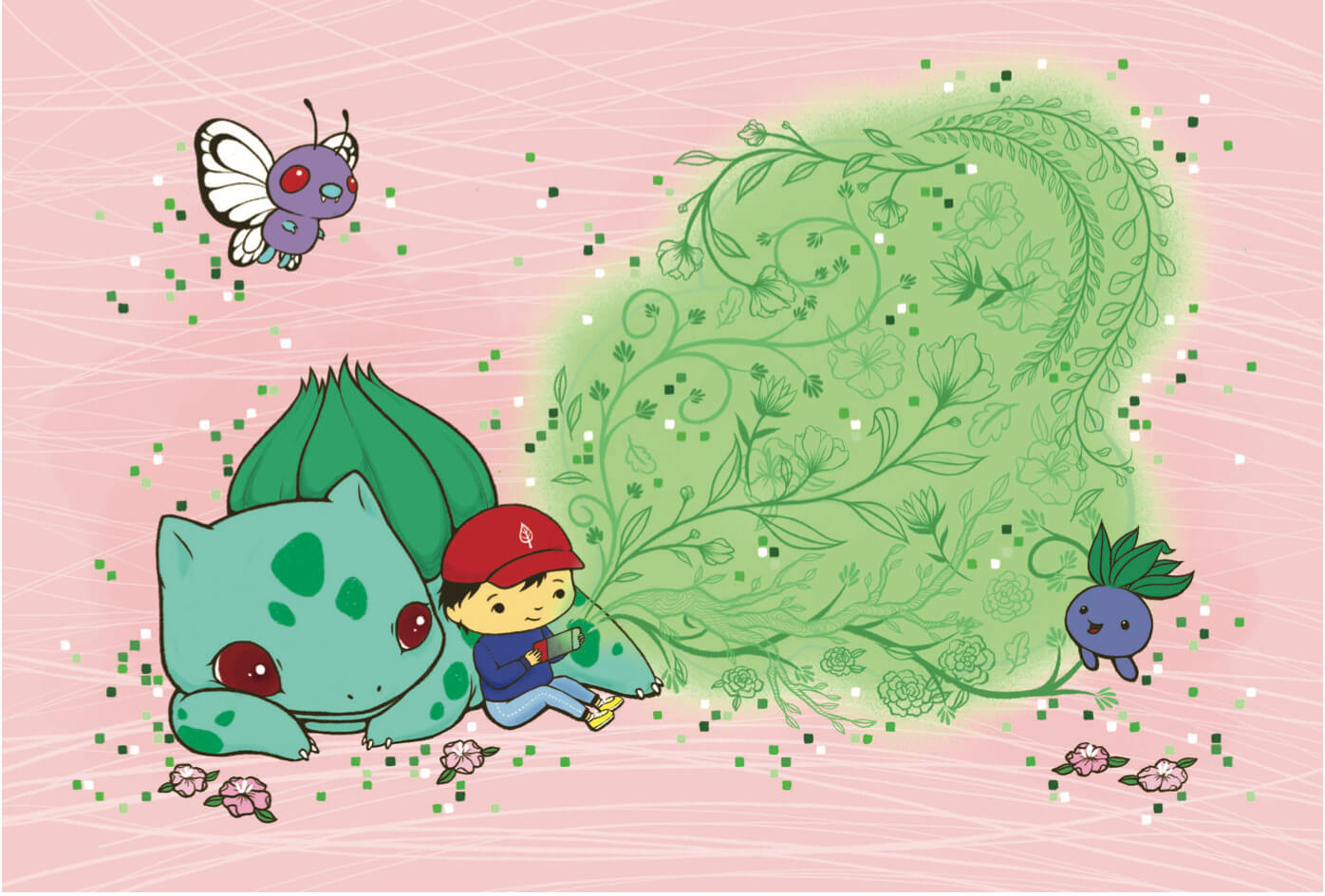
Illustration by Flavia Chan
Dear city planners,
I was 10 years old when I picked up Pokémon for the first time. I remember unwrapping it Christmas morning and rushing to immediately grab my Nintendo DS to play it, immersing myself in this world where creatures and humans not only coexist but work together to build a brighter future. A world where cities are built around landscapes, renewable energy, and pedestrians. Throughout the game I would walk, bike, and ride trains to (as their tagline goes) “catch ‘em all” and beat the game.
While I’m not proposing you start to let 10-year-old kids run around and explore as they please, there is something to be learned from the world of Pokémon. With the climate crisis worsening and major cities becoming inaccessible to pedestrians, we should be looking at the Pokémon video games—most notably the 2019 games for the Nintendo Switch, Pokémon Sword and Pokémon Shield—as inspiration for future city planning.
As an adult, I revisited the Pokémon games and could not help notice how much these games encapsulate the visions we have for our cities. These in-game cities are built entirely for walking and biking, not a single car to be seen. Additionally, these cities are built with the natural landscape in mind. I sat there in awe, just like I had 13 years ago, of the way nature and people interacted. Both living in harmony, benefiting from each other.
Satoshi Tajiri, the creator of the Pokémon games, had this exact same vision for the franchise. As a child living in the still rural landscape of Machida, Tokyo, he was an avid bug collector, which inspired his childhood nickname, “Dr. Bug.” But as he grew older, more of the places he explored turned into highways and apartment buildings. When he first imagined Pokémon, he wanted kids to experience the same awe and wonder he did exploring as a child in the wilderness. But how will children be able to experience that when we are building our cities without taking into consideration the nature and people that live around them?
City planners, it may sound obvious, but you need to start building cities for people. According to a survey by Nature Conservatory Canada, nine out of 10 Canadians are happier in nature, but 74 percent of those surveyed said it’s easier to just stay indoors. This can be attributed to the destruction of natural landscapes to make way for more urban development, which is the same thing Tajiri experienced during his childhood.
It’s time for you to look at the world of Pokémon and take a page out of Tajiri’s book. He has given us the perfect example with the video game world that he has created. People are meant to explore and coexist with nature, not destroy it to build skyscrapers. If we continue down this same path of urbanization, soon 10-year-old children will only be able to experience the wonder of exploration through a screen. By incorporating eco-friendly infrastructure introduced in Pokémon into our city planning, children, both present and future, will be able to experience the thrill of exploring in person.
Yours in exploration,
Marco Ovies
]]>